Showing posts with label menstruation. Show all posts

Wednesday, February 13, 2019

The profane and the sacred

More than a month ago, I wrote to the author of this piece--in the context of the controversy over women entering the temple at Sabarimalai.  The god at Sabarimalai apparently cannot deal with "unclean" women--the menstruating kind.  So, the god banned all females between 10 and 50 from coming to his home.

In my email to the author, I used quite a bit of material from my blog, especially this post of mine.  I suppose there are many topics for which I can easily copy/paste from my blog.  But then that has always been one of the reasons for my blogging.

I then forwarded my email to a few women in the extended family.  I am sure a man talking about menstruation is not the easiest topic for women in the old country!

Men ought to talk more about this topic.  Talk as in to understand, to learn, and to empathize with those whose lives get complicated--unnecessarily--only because they are women who menstruate.

Three years ago, in a post in which I argued that taxing feminine hygiene products is asinine, I embedded a Ted talk by a man, Arunachalam Muruganantham.  He did all that and more--he went about designing a machine that would help women make inexpensive sanitary napkins.

The story of this "Pad man" has been told in popular culture.  How his entrepreneurship has helped out girls is the subject of a documentary that has been nominated for an Oscar.
For [the director] Zehtabchi, the most revealing moment of the project was when she went unannounced into a coed classroom in Kathikhera and asked the teacher to have the students define a period. The teacher called on a teen-age girl and asked her to stand. For two and a half excruciating minutes, the girl writhed, unable to answer. “We discovered that, yes, there was a lesson in the textbook about menstruation and the female body, but that the teacher had actually skipped the lesson because she was uncomfortable,” Zehtabchi said.
For a land of talkers who are highly argumentative even when in agreement, people in the old country avoid all the important topics altogether.  Like menstruation.  I hope they will talk more openly, honestly, and with science and evidence.  If they do, then they will also start treating women like how they ought to be treated as equals, and not as second-rate humans.

But then I live in a country where the current president, when he was a candidate, was upset with the questioning from a female journalist and decided that her questions were because "There was blood coming out of her eyes, blood coming out of her wherever."  Some day, the sooner the better, men will realize their mistaken ways.  Until then, we need many more Arunachalam Murugananthams.

Sunday, April 01, 2018

Those bloody women!

I grew up in an India that seems so much like a different planet altogether.  In that old India, I grew up with women--young and middle-aged alike--practically disappearing for three days from the main areas of the home.  In grandmas' homes, they were cast away to the farthest end, far away from the street entrance.  As a kid, I got to see them only if I was tasked with taking food for them.

In the industrial town where we lived as a nuclear family, mother was exiled upstairs.  She used the bathroom there, slept there, and never came down for three days.  Even worse, not only was she not in the kitchen cooking those tasty foods, a neighbor woman brought us food or came over and cooked.  Sometimes, father cooked dinner--the only couple of dishes that he knew how to make.

The mystery deepened when my sister too started this routine.  What the hell was going on?

One day, like many times before, I was given a grocery list that I was supposed to take to the store.  As I always did, I scanned the list.  An item there was new: "Sanitary napkins."

Curious I have forever been.  I asked my mother what that was.  Even before mother could reply, my sister jumped in with "shut up!"

Later on, of course, the biology textbook and fellow students helped solve the puzzle.  I then understood why there was a raggedy piece of cloth in the upstairs bathroom that we kids were told to avoid--it served as reusable sanitary napkins.

It was a different world back then.  I have no idea why people refer to the past as "the good old days."  There could not have been anything good in women being treated as outcasts for three days a month, leave alone their second-class treatment the rest of the time!

Despite the changes that have happened, I doubt that there is open and educational talk about periods.  Not only with girls and women, but also with boys and men.  Instead, it is increasingly about the products that can be sold to "help" girls and women.  I am not confident by any means that the old cultural stigma about menstruation, and females, has gone away.
The outsize attention paid to products reduces menstruation to a hygiene issue when it should be much more. The monthly shedding of the uterine lining is part of a cycle that lasts, on average, for 40 years. It is a vital marker of health and a pivotal developmental milestone for half the world’s population.
Menarche [the first menstrual period] should be a prime opportunity to begin a girl’s lifelong authentic engagement with her body. Instead, we hand her a pad and teach her to put it up her sleeve when she goes to the bathroom.
It is a strange world!

America too, where mothers socialized "their daughters to keep tidy and discreet"!
Even now, American girls are socialized to see menstruation, and more generally, their bodies, as problems to be solved through use of the “right” products. Today, we are exporting this view around the world.
Yep!
Challenging the social stigma and disgust directed at the female body must be our main mission — in the developing world and everywhere else.
Amen, sister!

Monday, July 10, 2017

10LADs and women

It was about a year ago.  The hot summer days.  The Republican nominee for the presidency said that the news anchor at Faux News "had blood coming out of her wherever."

That was merely an addition to lots of other words and phrases he had used to describe women: Fat. Pig. Dog. Slob. Disgusting animal ...

Ah yes, the good times they were.  And they kept on coming.  And it keeps on coming, well past his advice on pussy-grabbing, thanks to 63 million Americans.

With him as the president, I have no right to comment on the state of affairs anywhere else in the world.  Those who live in glass houses ... and I am stark naked in my glass house :(

At least in the years past we pretended to worry about morals.  We Americans could claim the moral high ground as an aspiration.  But, the day to day reality now makes utter hypocrisy out of any moral finger-pointing.

The fact that we now occupy a stinking swamp having come down from the high ground does not mean, however, the world's problems have gone away though.

Consider, for instance, the death of an 18-year old girl in Nepal.  Even by itself, that death is a tragedy.  And then to think about other young women like here, only because they menstruate--you know, the "blood coming out of her wherever"--makes it terribly, terribly tragic.  All because of "a tradition known as chhaupadi that sequesters menstruating women from their families.":
The Supreme Court of Nepal ordered an end to chhaupadi, which is linked to Hinduism, in 2005. But it is still practiced in many of Nepal’s isolated villages, particularly in the west. A bill is pending in Parliament to formally criminalize the practice. Many people in rural villages believe that menstruating women are impure and can bring bad luck on a household. Under the chhaupadi tradition, the women are kept from taking part in normal family activities and social gatherings or from entering houses, kitchens and temples....
The practice has its dangers: Women must often brave winter cold or summer heat in rude huts where they are vulnerable to human and animal intruders.
Vulnerable to animals like snakes that bit that 18-year old woman who died a day after that unfortunate event.

All because of "blood coming out of her wherever."

Visualize this.  A kid might write to the President complaining about anything--from homework to stress to world peace to whatever.  From anywhere on the planet, for that matter.  (An uncle of mine wanted to name his home "White House."  So, he wrote a letter to President Eisenhower requesting his ok  And he received a formal reply stating that the President had no problems with that.)

Now, think about a Nepali girl who wants to tell the American President about this chhaupadi issue. ... you can fill in the rest!

Don't ever think that I am exaggerating such an aspect of the Presidency.  That's what the 10LADs in the subject refers to:
At the beginning of his first term, President Obama said he wanted to read his mail. He said he would like to see 10 letters a day. After that, the 10LADs, as they came to be called, were put in a purple folder and added to the back of the briefing book he took with him to the residence on the second floor of the White House each night.
Caption at the source:
In the Obama White House’s hard-mail room, each intern and staff member read and categorized 300 letters a day.
The reporter asked Obama "how he might advise Donald Trump on what to do with the mail if he were to become president."  Obama's response:
He laughed. “You know what, this is a great habit. But um, it, uh,” he said about the idea of a President Trump reading constituent mail. “I think it worked for me because it wasn’t something I did for anyone else — I did it because it ... sustained me. So maybe it will sustain others in the future.
“O.K.?”
No letter from a Nepali girl about "blood coming out of her wherever," will ever be read by this president.

Maybe those girls will write to the real leader of the free world, who personally knows well about "blood coming out of her wherever."


Monday, February 15, 2016

God hates menstruating women?

This recent post was about the pathological relationship that some have with women, and most of that pathology having to deal with religion.  Another post from three weeks ago was on a public policy issue relating to women--taxing tampons.  Put them together as a Venn diagram of sorts and you can see the possibility of religious institutions having practices that restrict menstruating women, right?

I have been trying to understand this issue for a long time.  It is a strange world that I had to understand as a young boy when my mother could not attend a wedding in the family.  She traveled with us all the way and then had to exclude herself from mixing with people.  It was the introduction to women's issues that were never talked about but were always there.  If not for the biology class that described the ovary, Fallopian tubes, and the uterus, and why bleeding happens, the whole thing would have been a bloody mystery to me.  (Yes, the horrible pun intended; hehehe!)  It is darn stupid to exclude girls and women from regular life just because they menstruate.

Now consider a temple setting.  A Hindu temple, like any place of religious worship, is not a place for reason.  It is about faith, and like all religious faiths, well, it is irrational.  In such a faith context, bleeding women are typically not allowed to go anywhere near the pooja (worship) room at homes and, of course, the temples too.

I have no quarrels over how people want to practice their faiths.  It is up to the believers to think about how awful their faith-based everyday life can be, like with banning menstruating believing women from the zone.

So, if some of the faithful think it is not kosher to ban the menstruating women from temples, what options do they have to correct the injustice as they perceive it?

In India, that's what apparently led a few to approach the court--in the context of the Sabarimala temple ban on females between 10 and 50 years of age.  Why the court, you might wonder.  Because,  unlike here in the US, India's temples have government oversight.
The ban was enforced under Rule 3 (b) of the Kerala Hindu Places of Public Worship (Authorisation of Entry) Rules, 1965 (women at such time during which they are not by custom and usage allowed to enter a place of public worship).
So, if the government oversees the functioning of temples, then, of course, the judicial arm of the government has a say in whether menstruating women should be barred from entering temples.
A Special Bench led by Justice Dipak Misra, which is hearing the Sabarimala temple entry issue, will consider the intervention application. The students want the apex court to address and decide on whether modern society should continue to bear with “menstrual discrimination” when the Indian Constitution mandates right to equality and health of women to achieve gender justice.
As you read this, perhaps you think, "wait a second, this is bizarre."  But, bizarre is in the eye of the faithful.  Barring menstruating women from temples is not bizarre to many believers (including women), just as wrapping up women in burqas is not bizarre to another group of the faithful.  Many churches in old Europe do not allow female tourists in skirts or without a scarf over their heads--bizarre faith-based practice.  What is bizarre to one is apparently holy to another!

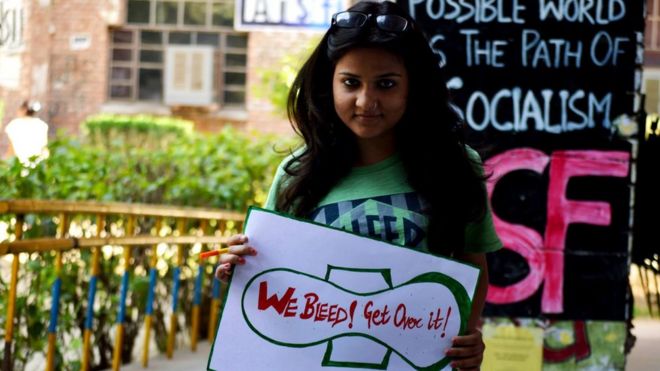
Why only the Sabarimala temple?  The "Happy to Bleed" campaign began after this:
"A time will come when people will ask if all women should be disallowed from entering the temple throughout the year," Prayar Gopalakrishnan, who recently took charge of the hilltop temple dedicated to Lord Ayyappa, told reporters earlier this month.
"These days there are machines that can scan bodies and check for weapons. There will be a day when a machine is invented to scan if it is the 'right time' for a woman to enter the temple. When that machine is invented, we will talk about letting women inside," he added. 
Ah yes, surely science and technology can deliver such a gadget--there are plenty of smart Indians, women too, who can work on it ;)

Back to the high court in India:
At a preliminary hearing on Friday, Justice Misra had asked whether the Vedas, Upanishads and scriptures discriminate between men and women. “Is spirituality solely within the domain of men? Are you saying that women are incapable of attaining spirituality within the domain of religion? Can you deprive a mother?” Justice Misra had asked.
Now, it doesn't take a rocket scientist to, therefore, conjecture that women cannot be priests at temples, right?  That controversy will be for another day! All this atheist can do is observe such happenings and comment on this mad, mad, mad religious world ;)

Source