Showing posts with label FYS. Show all posts

Saturday, November 30, 2019

World Wide Fiction

Though I am not certain about this, the first fictional pieces that I read in the English language were the Enid Blyton series.  Unlike the stories in Tamil, in which I could understand the references, I was often lost in the particulars in the Blyton works.  Especially the foods the kids in those stories ate.  What were ham and bacon all about.?  These appeared all the time in the Enid Blyton books--the kids ate them with eggs before they went about their adventures.

What were ham and bacon?

We figured it was from pigs.  But, what then was the difference between ham and bacon.  There is a limit to imagining foods of a different culture, particularly in those primitive days before the internet, before the television, and when telephones were rare.  So, I figured out a solution to the puzzle: bacon and ham had to be something like idli and dosai, which are from the same ingredients but look and taste different from each other.

The power of imagination that fiction provides; they help us understand the world, and somehow make order of the chaos that is outside.

With the Indian fiction, especially like in RK Narayan's Swami and Friends, there was no need to imagine the foods they ate.  Because I ate the same kind of foods. Like Swami, I too hoped to have a good cricket game every single day.  Swami's grandmother reminded me a lot of my own grandmothers.  I could absolutely relate to this fictional kid in a fictional town.  The pains and pleasures of his were mine as well. His Malgudi was my Neyveli, plus Sengottai, plus Pattamadai.

The inability to understand an alien culture did not stop me, however, from reading a whole lot of fiction by British and American authors. And, of course, the Russian authors too.

Now, did I for a moment ever pause to think that the British authors were speaking for all the British, or that the American authors were portraying all Americans?  Of course not.  But, I could imagine the situations in which the Artful Dodger was trapped in a world of child criminals in a Dickensian world.  And could empathize with him and Oliver Twist.  I could feel for Anna Karenina.  The people and the settings that Somerset Maugham described were not difficult to understand.

I don't merely read fiction that is written by "my people" and set in "my contexts."  Zadie Smith writes about all these and a lot more:
I felt I was Jane Eyre and Celie and Mr. Biswas and David Copperfield. Our autobiographical coordinates rarely matched. I’d never had a friend die of consumption or been raped by my father or lived in Trinidad or the Deep South or the nineteenth century. But I’d been sad and lost, sometimes desperate, often confused. It was on the basis of such flimsy emotional clues that I found myself feeling with these imaginary strangers: feeling with them, for them, alongside them and through them, extrapolating from my own emotions, which, though strikingly minor when compared to the high dramas of fiction, still bore some relation to them, as all human feelings do.
It was never a one-to-one matching between me and the characters.  But, the human condition bore plenty of similarities.  Similarities to what I felt and experienced, or to what I observed around me.

As one whose imaginations are highly circumscribed, I have always believed that "some people will tell our story better than others."  I want them to help me understand the world in all its complexity.
[A] book can try to modify your behavior, but it has no way of knowing for sure that it has. In front of a book you are still free. Between reader and book, there is only the continual risk of wrongness, word by word, sentence by sentence. The Internet does not get to decide. Nor does the writer. Only the reader decides. So decide.
We can try to understand this wide world through stories.  Go ahead.

Monday, July 22, 2019

Trend lines, headlines, and politics

One of the two brand new courses that I will teach in the coming academic year will be about how much the world has changed--for the better--and yet the news headlines will have us believe otherwise.  (Instead of working on the syllabus, here I am "wasting" away my time!)

Consider one of the many awesome things that we have accomplished--thanks to every government in the world advancing literacy and spending money on education, children from any background can now attend school. (Sadly, there are countries where girls are not educated.)


What a fantastic cause for celebration!.  It is phenomenal an achievement that of all the humans who are 15 years or older, only about 13% is illiterate..  We humans deserve credit for making such a world happen.

However, to look at that kind of progress and to merely engage in self-congratulations is, well, not what I do.  To begin with, that is not my job--I am a critic, by choice and by profession.

But, the change for the better does not mean that we can rest easy; after all, there are a gazillion ways in which we ought to work towards improving the state of the world, for humans and non-humans alike.  In this context, if we were to merely engage in rah-rah about literacy even for the disadvantaged, we begin to overlook the serious troubles there.

Does one imagine, for instance, that a government school in rural Uttar Pradesh is anywhere near the quality of the school that I (and the commenter) went to?  Why are the kids in rural Uttar Pradesh condemned to those godawful schools where teachers might not even come to class, leave alone being horrible teachers in the classroom, while kids in Neyveli get much better education?  Not the kids' fault that they were accidentally born to their parents who live in a certain area, right?

Now, think about how education is merely one out of the gazillion ways in which the accidental birth makes a huge difference in one's life.

Most of us in the political left-of-center always worry ourselves to death that such inequality that arises for no fault ought to be addressed via public policies.  Even while celebrating the fantastic reductions in extreme and absolute poverty, we worry about the uneven competition that exists only because of the accident of birth.

My go-to-expert on these topics, Branko Milanovic, has written in plenty about these issues.  One of his recent empirical analysis showed how "the entire world’s economy is lifted by the open exchange of goods, but this growth is unevenly distributed. The “global upper middle class” — that is, working class individuals in wealthy nations — take it on the chin as less skilled jobs move to poorer nations. Meanwhile, the global middle class and the very wealthy benefit tremendously."

Some of us--yes, I have conveniently inserted myself into an excellent company!--have argued for years that this calls for a new social contract in which we can appropriately compensate the people and communities who lose in this global win.  I yell about this at other places too ;)

"The sensible solution for a wealthy nation is to open its borders to as much trade as possible, but to tax the beneficiaries of free trade to lift up those who lose out."  It is so obvious.  But, apparently obvious only to a few of us who have no political power to make this happen :(


Source


Sunday, March 24, 2019

Learn to embrace uncertainty

In graduate school, it seemed like the faculty expected me to go the quantitative route, because of my background in electrical engineering. Statistical modeling and, more importantly, GIS, which was in its infancy back then.

I couldn't care about those data-based inquiries.

Because, I was convinced that the human condition that I was interested in learning and thinking about was beyond mere data.  Further, I even made fun of how the data were used in the publish-or-perish academic culture: Faculty and students were more often than not playing with data and seeing if anything would come out of it, instead of thinking through the issues and then using the data.

As with everything else, I chose the losing route.

Graduate students who specialized in data-based research techniques and GIS moved on to good jobs in academia and outside.  I struggled to find a job!

I did continue to criticize the publish-or-perish culture that encouraged fooling around with data and statistical software, which was getting to be more and more sophisticated.  All these were before "big data."

I now feel vindicated.  Phew!

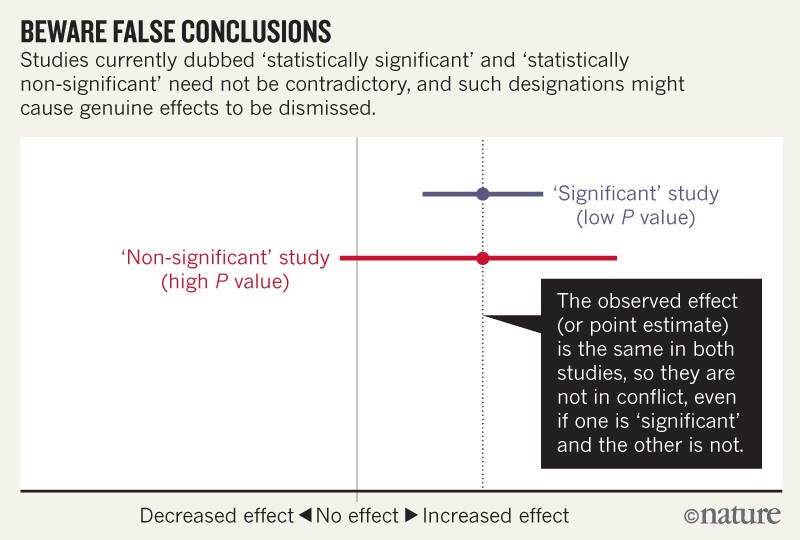
Pissed off scientists have risen up in their opposition to the abuse of statistical significance:

Source

The authors--"more than 800 signatories"--want researchers to quit categorizing:
The trouble is human and cognitive more than it is statistical: bucketing results into ‘statistically significant’ and ‘statistically non-significant’ makes people think that the items assigned in that way are categorically different ...
On top of this, the rigid focus on statistical significance encourages researchers to choose data and methods that yield statistical significance for some desired (or simply publishable) result, or that yield statistical non-significance for an undesired result, such as potential side effects of drugs — thereby invalidating conclusions.
Note how they phrased it? "encourages researchers to choose data and methods that yield statistical significance for some desired (or simply publishable) result" is exactly what I did not find appealing back in graduate school!

More from the authors:
The objection we hear most against retiring statistical significance is that it is needed to make yes-or-no decisions. But for the choices often required in regulatory, policy and business environments, decisions based on the costs, benefits and likelihoods of all potential consequences always beat those made based solely on statistical significance.
Exactly!

And even more important is this point from the authors on what will happen if we got rid of our focus on statistical significance:
Decisions to interpret or to publish results will not be based on statistical thresholds. People will spend less time with statistical software, and more time thinking.
More time thinking.  What a concept!

Thursday, October 18, 2018

Progress Report

If everything goes well, I will have to shed my General Malaise persona, and step into the the role of Mary Poppins next year, when I engage with college freshman students about how awesome the world is! ;)

I am forced to play the optimist in the classroom because I worry that all through the k-12 years, and in college classes too, it is more likely than not that students are presented only with the negative stories.  Like how population growth is a problem. Or about the polar bear. Or about the wars.  And how the country of Africa is messed up. How corporations have ruined lives. ... the list is endless.

I tell ya, if I were a college freshman, after listening to such stuff over and over and over, I will simply drop out and move to Montana and live in a cabin waiting for the end of the world as we know it.

My General Malaise personality is with a clear understanding that the world now is a much, much better place than the ones that the people who preceded us experienced.  Smartphones, internet, abundance of food, all the entertainment that people want, long lives, eye glasses, varieties of food, ... why do we so conveniently forget that the world in which we live is a fabulous place?

I suppose whether it is in the news media or in college education, only bad news is sexy.  Nobody wants to talk about the number of planes took off and landed.  It is one crazy way we humans operate.

Consider, for instance, the following graphic of the progress in India since the time I was born:


In case the chart is not clear:
Life expectancy at birth: An increase of 56 percent
Infant survival: Increase of 76 percent
Personal income: Increase by 457 percent
Food supply: 23 percent increase

Notice a zero growth in democracy level.  Because the country was democratic even when I was born.  Only for two years was the country under a strong leader with individual rights suspended--the kind of a political system that the modi-toadies would love to re-create now!

BTW, income and food supply are all per capita numbers.

The following chart shows the improvement in life in the US, since my birth in the old country:


So, why do I complain?  Simple.  I want even better conditions and I want them to come about faster.  My complaints are not because I think this is a crappy world that is inferior to some good old days. 

Further, it is not just about me and my welfare.  For me, the neighborhood does not stop with my yard.  As I look around, I recognize that we humans are also fully capable of screwing things up. Exhibit 1: Syria. Exhibit 2: Yemen. Exhibit 3: .... you get my point that we humans can intentionally make things worse.

We do all that even when we are fully aware that we have come a long way!

Tuesday, October 16, 2018

Trend lines, not headlines

First, read the following:
If you had to choose a moment in time to be born, any time in human history, and you didn't know ahead of time what nationality you were or what gender or what your economic status might be, what time would you choose? Paleolithic? Neolithic? Ancient Greece or Rome? Medieval times? Elizabethan England? Colonial America? The 1950s?
Think about it.

Think again.

Remember, that in this thought experiment "you didn't know ahead of time what nationality you were or what gender or what your economic status might be."

Yes?

So, which moment in time would you choose to live?

My answer is no different from the one the questioner himself provided: I would choose today.

What if I were one of the struggling plebes and did not inherit millions from his father?
 “We are fortunate to be living in the most peaceful, most prosperous, most progressive era in human history,” he opined, adding that “it's been decades since the last war between major powers. More people live in democracies. We're wealthier and healthier and better educated, with a global economy that has lifted up more than a billion people from extreme poverty.”
I agree with him.  This is the best of times all over the world.  It is phenomenal.  

I have proposed to teach a freshman seminar course in which I want students to verify for themselves how much we are all better off today compared to decades and centuries past.  The title of the course that I have proposed, which is the title of this post also, is from one of the talks that Bill Clinton gave years ago, Clinton suggested that people should understand the trend lines and not simply be glued to the headlines.

So, if all is well, then "why the doom and gloom heaped on us by politicians and pundits"?

Micheal Shermer, from whose column in the Scientific American I excerpted those quotes, gives a few explanations.  To me those explanations are rather immaterial.  I am amazed at how much we can't seem to think about the big story of the phenomenal success on various fronts that we humans have achieved over the past two hundred years.  Our inability to situate an unfortunate event against a an appropriate measure over time blows my mind.

BTW, the questioner who posed that thought experiment with which I began this post?  Another former President. Thanks, Obama!