Showing posts with label aid. Show all posts

Tuesday, February 14, 2017

More on that damn foreign aid

Remember this post on how the foreign aid that the US gives is sinking it deeper and deeper into the gazillion dollar debt?

Go ahead, take a minute to read that and come back.

You ready for me?
The United Kingdom’s largest-circulation Sunday newspaper recently launched a petition calling for an end to ring-fenced aid spending (worth 0.7% of national income). Prior to his election victory, US President Donald Trump railed against “sending foreign aid to countries that hate us,” reflecting a widespread belief that aid needs to be cut. The United States allocates less than 1% of the federal budget to aid, but the average American believes this figure to be thirty-one-times higher.
Yes, welcome to the brave new world of alternative facts and all-about-me-who-cares-about-the-rest.

The other day, in class, students were clearly appalled at the fact that a billion people in this world do not even have access to electricity.  Mere access.  Without access, there is no question of consumption of electricity.  Students were at a loss understanding why developed countries were not helping out.  I didn't tell them though at the miserly amount we give as foreign aid; why completely discourage those young students, right?

Ah yes, let those poor people eat cakes in the dark!

But,enough with the doom and gloom.  (Flynn resigning, and the FBI continuing to investigate him, has boosted my morale!)

Let us look at something positive then:
The Bill & Melinda Gates Foundation spends more each year on development aid than most rich governments do.
Re-read that sentence.  Go ahead.  And be impressed.

Against the backdrop of the pathological presidency of Trump's, which wants to reduce funding for organizations that educate girls and women about family planning, I want to highlight the following from the Gates Foundation:
For the first time in history, more than 300 million women in developing countries are using modern methods of contraception. It took decades to reach 200 million women. It has taken only another 13 years to reach 300 million—and the impact in saving lives is fantastic.
Why is this a big deal?
When women in developing countries space their births by at least three years, their babies are almost twice as likely to reach their first birthday. Over time, the ability of women to use contraceptives and space their pregnancies will become one of the largest contributors in cutting childhood deaths.
If only the asshole president and his asshole minions will listen to Bill Gates, Melinda Gates, and Warren Buffett!  There is a lot more to life than to be obsessed with fertilized eggs!
Contraceptives are also one of the greatest antipoverty innovations in history. When women are able to time and space their pregnancies, they are more likely to advance their education and earn an income—and they’re more likely to have healthy children.
Join me in yelling a yuge "fuck you" to trump and his minions, and an even bigly and yuger yell to say "thank you" to Bill Gates, Melinda Gates, and Warren Buffett.

Sunday, April 24, 2011

So, is this a good time to rethink American foreign aid? You bet it is!

For the correct reasons, and not the wrong ones.

We don't want to reduce foreign aid because of the isolationist and Tea-Party nutcases.  Nor because of any stupid idea that this and cuts to NPR will somehow wipe away the trillions of debt.

It is time we re-configured the foreign aid because almost always we have been spending money on the wrong people.  I really like the points Ken Adelman makes:
Four of the largest U.S. foreign-aid recipients today -- Egypt, Israel, Pakistan, and Afghanistan -- all take contrary positions on issues of critical importance to the White House. South Vietnam once got gobs -- gobs upon gobs -- of U.S. foreign aid. That didn't help much. Likewise with Egypt, Iran, Pakistan, Zaire (now the "Democratic" Republic of the Congo), and other "friendly" (read: graciously willing to take U.S. money) countries.
The conclusion seems clear: The relationship between "the United States' ability to positively influence events abroad," as Nye puts it, and the amount of U.S. foreign aid a country receives is unclear at best. For decades now, the United States has been the No. 1 foreign-aid donor -- it has given the most money to poor countries -- so it can't move up any on that scale. But this hasn't translated in making America the most popular or most influential country around the world. Quite the contrary.
Even the all-time No. 1 recipient of U.S. aid, Israel, rebuffs Washington constantly, on momentous issues of peace. Moreover, Israeli polls show the lowest approval for the U.S. president of nearly anywhere in the world.
Most of what Adelman writes is not new, of course.  His is a response to this piece by Joseph Nye.  Adelman has lots of examples, of which I liked this the best:
Let's recall: The State Department agreed to the Mubarak government's request for its approval before any U.S. democracy programs for Egypt got launched. To put it simply, the soft-power agency consented that anti-dictator programs appropriated by the U.S. Congress first get approved by that dictator.
Awful how we were all cuddly with dictators and showered them with gifts.  That certainly didn't buy us popularity with the people, did it?  Adelman concludes:
I've come to believe that liberals focus primarily on intentions, while conservatives focus more on results. No doubt the soft-power goals of the State Department and USAID on diplomacy, foreign aid, exchange programs, and the like seem wonderful. They're peaceful, caring, intercultural, and so on. They signal the right intentions.
The hard-power association with Pentagon budgets, weapons, and soldiers seems quite contrary. They signal the wrong intentions. But looking at the actual results of soft power versus hard power may yield results that make today's fashionable thinking seem soft, if not altogether squishy.
Nope, I don't want to increase spending on the hard-power--we have way too much already, and one only needs the graphic on the right to be reminded that both in absolute and relative terms we are over-emphasizing the defense budget.  And, if we go by outcomes, well, being stuck in Iraq and Afghanistan for this long tells us that in these days of asymmetric warfare the inexpensive IEDs seem to give our gazillion dollar hard power one hell of a competition, do they not?

What we really need to cut is the size of the defense budget.  But, unfortunately, there are not enough people with the cojones to go after that one.  In fact, it seems like there is always an overwhelming majority that is ready to increase the defense allocation.

Sunday, March 27, 2011

Why not eradicate malaria, instead of bombing the shit out of people?

In my introductory classes, I almost always show them this TED talk that Bjorn Lomborg gave a couple of years ago.  Lomborg, who is probably a banned word in the academic hallway where my office is given that I am surrounded by self-proclaimed Socialists and Marxists, makes a neat and simple point:
If we had say, 50 billion dollars over the next four years to spend to do good in this world, where should we spend it?
Apparently America's answer is that we would rather spend it on bombing a country.  I mean, think about the cost of the recent wars and what they actually deliver in terms of returns.  Joseph Stiglitz, who initially estimated the cost of Iraq War at $3 trillion--yes, 3,000 billion dollars--had to revise it upwards:
two years on, it has become clear to us that our estimate did not capture what may have been the conflict's most sobering expenses: those in the category of "might have beens," or what economists call opportunity costs. For instance, many have wondered aloud whether, absent the Iraq invasion, we would still be stuck in Afghanistan. And this is not the only "what if" worth contemplating. We might also ask: If not for the war in Iraq, would oil prices have risen so rapidly? Would the federal debt be so high? Would the economic crisis have been so severe?
The answer to all four of these questions is probably no. The central lesson of economics is that resources -- including both money and attention -- are scarce. What was devoted to one theater, Iraq, was not available elsewhere.
And now, we are on to yet another war of choice--in Libya.  It is not cheap.  Mark Thoma summarized it in one single sentence; a sentence heard around the blogosphere:
We have enough money to pay for military action in Libya, but not for job creation?
The Economist's correspondents are engaged in a debate on this very issue of guns and butter.  Exhibit one:
If our foreign policy aims to prevent suffering and death with finite resources, it makes sense to ask whether this war makes sense on those grounds. I grasp the tiresome point that the choice on the table was not a choice between taking out Libya's air defences and buying bed nets. The choice was between taking out Libya's air defences or not. But the question nagging some of us is why this was the choice on the table. Why did this come up as a matter requiring urgent attention and immediate decision? Why is it that the choice to express our humanitarian benevolence through the use of missiles and jets gets on the table—to the top of the agenda, even—again and again, but the choice to express it less truculently so rarely does? If our humanitarian values really set the agenda, how likely is it that the prospect of urgent military intervention would come up so often?
It's important that we take the logic of humanitarian justification seriously, but it's true that talk of bed nets tries to do this in a somewhat confused and confusing way. What we really need is intelligent insight into the death and suffering intervention in Libya can be expected to prevent relative to other feasible options. That no one seems even to try to do this in a serious or systematic way—that it seems almost surprising when someone notes the existence of options "between sitting on our hands and launching something close to all-out war"—suggests that objective humanitarian success isn't actually the guiding light of Operation Odyssey Dawn.
Exhibit two is an argument with this colleague, explaining why we Americans and our government prefers the bombing approach than the malaria tent approach:
it simply isn't true that we aren't faced with calls for peaceful humanitarian interventions as often as we are faced with calls for military ones. We are faced with calls for peaceful humanitarian interventions all the time. People are asking for more money for USAID. People are asking for more money for UN peacekeepers. People are asking for more money for the United States Institute for Peace. They're asking for more money for the Global Fund to Fight AIDS, Tuberculosis and Malaria. If you want America, collectively, to be doing more of this sort of thing and less of the bombing sort of thing, then what you need to do is to argue that those sorts of activities are central missions of the United States government, because the most powerful political forces in America over the past couple of decades have been arguing that they aren't, and that's why we're not doing more of them.
In other words, yet again the argument is that we the people are to be blamed--we haven't emphasized enough to our warmongering politicians that we would prefer our tax dollars to spent otherwise. 

Well, as we go about bombing the shit out of countries, we need to keep this in mind:
If the experience of the last ten years has taught us anything, it should be this: We can bomb our enemies into the Stone Age, but we cannot bomb them into the 21st century

Wednesday, February 09, 2011

If this doesn't tick you off ....

... then, I don't know what will
That is American realpolitik for you!  Thank Henry Kissinger for making it such a permanent feature of how the US deals with the rest of the world.
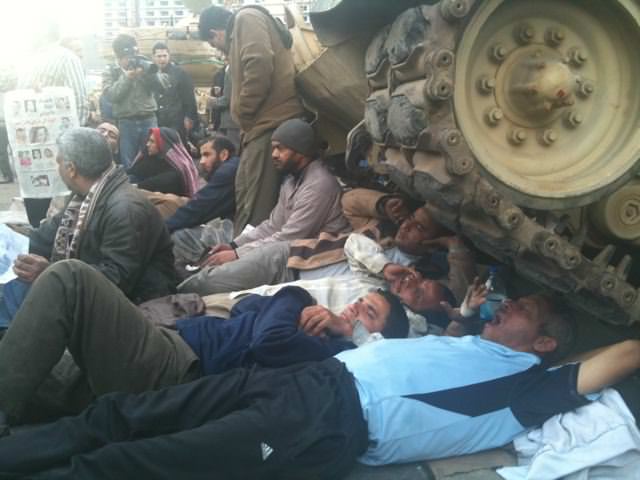
So, with the revolution on television, Twitter, and everywhere, has the US changed its policies?  Ahem:
And yet, with Egyptian protestors literally sleeping under the treads of tanks, the flow of U.S. military aid to the regime shows no signs of letting up. Earlier in the crisis there were signs that Congress would oppose the administration's requests for continued aid, but no longer, as the Los Angeles Times reports:
Sen. John McCain (R-Ariz.) had earlier said "all options are on the table," including aid cuts. But in an interview Tuesday, he said that now "is just not the right time to threaten that."
McCain said he was concerned that a reduction in aid might affect Egypt's willingness to cooperate with Israel.
Sen. Patrick J. Leahy (D-Vt.), chairman of the Senate subcommittee that oversees foreign aid, declared last week that he would not vote for aid to Egypt, adding that he knew no lawmaker who would.
This week, however, Leahy appeared to soften his position, saying through a spokesman that he would oppose any new aid "until the situation is resolved."
White House officials said earlier in the crisis that they would review the aid if the Mubarak government didn't move promptly toward political reform. But within a few days, officials clarified that they weren't considering cuts to aid.

Thursday, January 13, 2011

Don't simply give foreign aid. Give Micronutrients

Bjorn Lomborg writes:
Billions of dollars are given and spent on aid and development by individuals and companies each year. Despite this generosity, we simply do not allocate enough resources to solve all of the world's biggest problems. In a world fraught with competing claims on human solidarity, we have a moral obligation to direct additional resources to where they can achieve the most good. And that is as true of our own small-scale charitable donations as it is of governments' or philanthropists' aid budgets.
So, where will be the largest return on investment?
Micronutrient deficiency is known as "hidden hunger." This is a fitting description, because it is one of the global challenges that we hear relatively little about in the developed world. It draws scant media attention or celebrity firepower, which are often crucial to attracting charitable donations to a cause.

Friday, August 20, 2010

The apathy towards Pakistan and its floods

Quite a few days ago, as the crisis started unfolding, I noted Pakistan's' president Zardari being apathetic about the catastrophic floods in his country.  So, if the country's president could have behaved thus, why should we be surprised that the floods have barely made a dent on the world's consciousness/conscience!

First, the latest numbers.  Even in that earlier post, I argued that the numbers of people affected will quickly grow to a very large number.  Current estimates are that at least 20 million people have been messed up by these floods of unimagined magnitudes.

Yet, a question remains: why has this not hit emotional resonance across the planet, especially in the affluent world?

My cynical mind says it is in the timing.  Mid-August pretty much the entire European world,a even the broke Greeks, tunes out and head to beaches and villas and rivieras.  Watching BBC or CNN while on vacation, even if one did, will not jolt one into caring.  And Australia is in the middle of an intensely close election.  I would guess that in India it is difficult to evoke sympathy for Pakistan even under ordinary circumstances, and recently tensions have been quite high.  This means we are left with China and the USA.  China couldn't care for anything on this planet unless it stands to benefit, which means that we should be surprised if anything like a huge aid comes from China.

Despite labeling this as cynicism, I find it difficult to walk away from these reasons.  Others have been thinking about this as well, it seems.

Over at Foreign Policy, Mosharaff Zaidi writes:
Between our fear of terrorism, nervousness about a Muslim country with a nuclear weapon, and global discomfort with an intelligence service that seems to do whatever it wants (rather than what we want it to do), Pakistan makes the world, and Americans in particular, extremely uncomfortable. In a 2008 Gallup poll of Americans, only Afghanistan, Iraq, the Palestinian Authority, North Korea, and Iran were less popular than Pakistan.
The net result of Pakistan's own sins, and a global media that is gaga over India, is that Pakistan is always the bad guy. You'd be hard pressed to find a news story anywhere that celebrates the country's incredible scenery, diversity, food, unique brand of Islam, evolving and exciting musical tradition, or even its arresting array of sporting talent, though all those things are present in abundance.

From the venerable Brookings Institution comes this:
The relatively limited media coverage of the Pakistani floods is puzzling. Our analysis of major global English-language print and broadcast media shows that Pakistan’s floods have been covered far less than other major disasters. Ten days after the flooding began there were approximately 320 broadcast news stories and 730 print news stories covering the Pakistan flood disaster with the number of stories in print media rising to almost 1,800 by day 20. In virtually every other major disaster, including the Indian Ocean tsunami, Hurricane Katrina and the recent Pakistan and Haiti earthquakes, coverage was well over 3,000 stories in both print and broadcast media respectively by day 10 and by day 20.
The slow-onset nature of the disaster may be one reason for the limited attention. Earthquakes, tsunamis and hurricanes are one-time calamitous events, making it easy to capture the public’s attention, especially if real life mimics Hollywood movie scenarios. At the beginning of the Pakistan floods, rivers rapidly overflowed destroying everything in their wake. However, water levels are currently rising more slowly. Water is steadily enveloping more and more of Pakistan’s countryside every day. ...
The negligible media attention in the English-language press is certainly a factor in the limited support for flood victims from private individuals, foundations and corporations, especially in the U.S.
AidWatch presents another angle:
one third of the variation in how much TV attention a disaster gets is explained by how popular the affected country is with US tourists. Sadly for the flood survivors, Pakistan is nowhere on the list of top destinations for US travelers in Asia and the outlook’s not great: the World Economic Forum ranked Pakistan 113 out of 133 countries in its latest Travel and Tourism Competitiveness Report.
In addition to all these observations, the Economist notes:
Some donors still have bad memories of an earlier disaster, in 2005, when an earthquake struck the Pakistan-run bit of Kashmir, killing nearly 80,000 people. Foreign governments and charities promised some $6 billion in aid, to be spent by Pakistani officials and by local and foreign NGOs. Some, inevitably, was wasted or stolen. More troublingly, some local charities, such as Jamaat-ud-Dawa, which had links to extremists, ended up claiming credit for the relief work. And that is before taking into account the credible worries that Pakistan’s spies support elements of the Taliban in Afghanistan and have done too little to rein in Islamist terror directed at India.
The magazine argues, and I concur here, that:
In Pakistan the greatest need will be in the coming weeks and months, as flood waters recede, homes and roads need to be rebuilt and fields have to be replanted. That gives donors time to find effective ways to co-ordinate their help—ways that, where possible, should bypass Mr Zardari’s loose-fingered friends. Already there are signs of progress. Some $3 billion has been offered by the World Bank and the Asian Development Bank, the UN has set up a fund and donations from governments are starting to flow. America, a provider of much military and other aid to Pakistan, is lending helicopters and providing other help, hoping to show ordinary Pakistanis that it is not the hostile bully many of them believe it to be.
India, Pakistan’s traditional foe, could also turn disaster into opportunity. Some have described the current floods as the worst battering Pakistan has taken since the man-made disaster of partition from India in 1947. India itself has suffered recent floods and has offered some help (Pakistan is unsure whether to accept). Delivering it could show that India genuinely wants its troubled neighbour to recover and to prosper. A little money now could go a long way.
Zaidi puts it much better:
The fact that people in other countries don't like Pakistan very much doesn't change the humanity of those affected by the floods or their suffering. It is right and proper to take a critical view of Pakistani politicians, of their myopia and greed. It is understandable to be worried about the far-reaching capabilities of the Pakistani intelligence community and reports that they continue to support the Taliban in Afghanistan. It is even excusable that some indulge in the fantasy that a few hundred al Qaeda and Taliban terrorists are capable of taking over a country guarded by more than 750,000 men and women of the Pakistani military, and the 180 million folks that pay their salaries.
But are the farmers of Pashtun Ghari, of Muzzafararh and Dera Ghazi Khan, of Shikarpur and Sukkur, really obligated to allay these fears before they can get help in replacing their lost livelihoods? Twenty million people are now struggling to find a dry place to sleep, a morsel of food to eat, a sip of clean water to drink -- and the questions we are asking have to do with politics and international security. The problem is not in Pakistan. It is where those questions are coming from.
Pakistan has suffered from desperately poor moral leadership, but punishing the helpless and homeless millions of the 2010 floods is the worst possible way to express our rejection of the Pakistani elite and their duplicity and corruption. The poor, hungry, and homeless are not an ISI conspiracy to bilk you of your cash. They are a test of your humanity. Do not follow in the footsteps of the Pakistani elite by failing them. That would be immoral and inhumane. This is a time to ask only one question. And that question is: "How can I help?"
Finally, if one needed yet another before/after photo of this catastrophe, here is one from NASA:
Before (August 2009)
And, after:

Tuesday, August 10, 2010

Christian charity feeds non-gay African famine victims

When I was in Tanzania, which now seems like eons ago, one of the hot news items in the papers there was from neighboring Uganda, whose government, with valuable assistance from American evangelicals, had passed one of the most virulently anti-gay legislation in the world.  There I was comfortably seated inside the newly constructed Doubletree and having coffee in the morning admiring the scenery when I almost spilled that bloody strong coffee when I read about the death penalty for gays!  If it was that shocking to a straight guy, I could only imagine how absolutely threatened gays felt in Uganda ...

Well, that was then ... and the following is now (from, ahem, America's Finest News Source) about a Colorado-based Christian charity that raises money to feed non-gay famine victims in Sub-Saharan Africa

Christian Charity Raising Money To Feed Non-Gay Famine Victims
Note how this charity "does not discriminate"--helped non-Muslims in Indonesia :)

Friday, July 30, 2010

Ethics in giving to the poor in Africa, and elsewhere ...

Two interesting reads on the same day, from two different perspectives, and both adding to the increasingly loud arguments on why financial aid to the poor, especially in Africa, might be more harm than good--at least in the way we have been doing it.
First, from an NGO field worker/volunteer, Andrew Morgan (ht to you-know-who-you-are for the link):
“I was shocked when I saw my family not digging,” my Ugandan friend Joseph said. “It was the start of the rainy season. ‘What are you doing?’ I asked them when I saw them sitting at my mother’s hut. I asked, ‘Why aren’t you preparing your fields?"
He stared out at the black ribbon of asphalt ahead of us, a narrow road that connects Gulu to the nation’s capital, Kampala. We had a few more hours to go before reaching home, and with a busted radio in the car, words were our only comfort. I waited for him to continue as he dug through the memory.
“You know, they had just returned from life in the camp. For ten years plus they were receiving food from the World Food Program. One of them said to me, 'We are not foolish. We decided not to farm. We are still waiting to meet the right NGO that will help us with food.’ Tssssssk! Can you imagine?”
Yet, despite such ground-level experiences, Morgan writes:
Sure, my money could end up reinforcing negative stereotypes on the ground. And some of it might even be used to line the pockets of a local government official somewhere. But despite this, I made the donation because I still have faith in giving. I am still convinced of its potential, its ability to catalyze opportunity.
I keep this faith even though I don’t take charity at face value anymore; I’m more critical now, and this, I think, is a good thing.
I suppose at an individual level this might be ok.  We make lots of decisions in life that are faith-based.  How much ever those decisions might come across as "irrational," well, those are the individual's decisions.

Now, add up all these individuals, and we get an entire country.  When the country has to decide whether or not it should allocate some of the common money to such causes, then it cannot act merely on faith, can it?  In democratic societies, most resource allocation decisions have to go be justified, and we hope that notorious wastes like the Bridge to Nowhere are in the minority.

Collective resource allocation requires, and rightfully so, evidence-based decisions not faith-based.  Then it is the Dambisa Moyo kind of people that appeal to me, who point out that aid in its old format is a colossal waste..  To add to that growing list is the "Dutch journalist Linda Polman, who draws on decades of experience of reporting from wartorn disaster zones" whose book War Games has been reviewed in Spiked. 
The question Polman wants to raise – and the one she urges aid workers, journalists reporting on aid operations and the governments and individuals who donate money and resources to ask – is if Doing Something is always that good when attempts to do right can go so wrong. War Games suggests that international non-governmental organisations (INGOs) have exacerbated tensions, poured money into the coffers of war lords and rebels, prolonged conflicts and contributed to entrenching an image of the ‘Third World’, particularly Africa, as a basket case for the wealthy nations.
Later, even while bursting a few bubbles in the book, the reviewer writes:
Aid is indeed Big Business today. Since the end of the Cold War, the number of INGOs has mushroomed. In the 1980s, around 40 were active in Cambodian refugee camps set up by the Thai border. Today, by contrast, the ICRC estimates that each major disaster attracts around 1,000 national and international aid organisations. In 2004, some 2,000 organisations descended on Afghanistan.
It is the somewhat luxurious job of journalists to raise tough questions without having to provide any solutions. But considering how willingly journalists generally go along with accounts of war and famine provided by INGOs, and how much they have abandoned their job of investigating, questioning and interrogating the complexities of conflicts, then we should welcome the publication of Polman’s book, or at least parts of it, as an example of when Doing Something is very worthwhile.
I can already imagine the shocked expressions of most of my students when I respond with all these and more ammo to their remarks in favor of more aid.

Thursday, April 02, 2009

Foreign Aid: to give or not to give?

A few weeks ago I blogged about the Q/A with Dambisa Moyo, which was in the NY Times magazine. In that interview Moyo had a neat argument:
Think about it this way — China has 1.3 billion people, only 300 million of whom live like us, if you will, with Western living standards. There are a billion Chinese who are living in substandard conditions. Do you know anybody who feels sorry for China? Nobody.
Forty years ago, China was poorer than many African countries. Yes, they have money today, but where did that money come from? They built that, they worked very hard to create a situation where they are not dependent on aid.
Here is Dambisa Moyo jousting with Stephen Colbert:

The Colbert ReportMon - Thurs 11:30pm / 10:30c
Dambisa Moyo
comedycentral.com
Colbert Report Full EpisodesPolitical HumorNASA Name Contest

Sunday, February 22, 2009

Is foreign aid screwing up African countries?

The NY Times Magazine has a short Q/A with Dambisa Moyo, whose comments are highly critical of aid to African countries, and the role of celebrities. It is a short one, and worth every minute of your time to read it. An excerpt here, where she compares African countries with China:
Think about it this way — China has 1.3 billion people, only 300 million of whom live like us, if you will, with Western living standards. There are a billion Chinese who are living in substandard conditions. Do you know anybody who feels sorry for China? Nobody.
Forty years ago, China was poorer than many African countries. Yes, they have money today, but where did that money come from? They built that, they worked very hard to create a situation where they are not dependent on aid.
Of course, there are lots of studies that are also critical of foreign aid. Including studies from the World Bank itself! Here is one:

Since the early 1980s, virtually every African country has received large amounts of aid aimed at stimulating policy reform. The results have varied enormously. Ghana and Uganda were successful reformers that grew rapidly and reduced poverty. Cote d'Ivoire and Ethiopia have shown significant reform in recent years, but it remains to be seen if this is sustained. In other countries policies changed little or even got worse. The paper synthesizes the findings from ten case studies that investigate whether, when, and how foreign aid has affected economic policy in Africa.

The main findings from the case studies are that:

  • Policy formation is primarily driven by domestic political economy. Most major reforms have been preceded by economic and political crises.
  • Large amounts of aid to countries with bad policy sustain those poor policies.
  • In general donors have not discriminated effectively among different countries and different phases of the reform process. Donors tend to provide the same package of assistance everywhere and at all times.
  • Aid played a significant and positive role in the two sustained reformers (Ghana, Uganda). It helped with ideas in the initial phase. Financial assistance grew as policy improved and increased the benefits of reform, helping sustain political support.
  • The composition of aid is important. In the pre-reform period, technical assistance and policy dialogue are most supportive of reform. During periods of rapid reform, policy dialogue is important, as is finance. This is the phase in which conditional loans tend to be useful and effective. At a later stage of reform, conditionality is less useful, while finance remains important.
  • In summary, aid in some cases has been effective in supporting policy reform, and by building on the lessons from these case studies assistance could be more systematically effective in this way.