Back when our ancestors were hunting and gathering, men did not have to worry about their women asking them the now cliched joke, "do I look fat in this?" And men then could easily see their own penises because they did not have over-sized waists that blocked everything down.
Now, we don't have to worry about hunting and gathering. We worry about fat though. A lot. Abundance has become a problem. A huge problem. Even in the continent that has long been a poster-child for poverty and starvation!
In
Africa, the world’s poorest continent, malnutrition is stubbornly
widespread and millions of people are desperately hungry, with famine
conditions looming in some war-torn countries.
But
in many places, growing economies have led to growing waistlines.
Obesity rates in sub-Saharan Africa are shooting up faster than in just
about anywhere else in the world, causing a public health crisis that is
catching Africa, and the world, by surprise.
Obesity is a not merely a public health issue, it now comes across as a pandemic!
The causes are the same:
Many
Africans are eating more junk food, much of it imported. They are also
getting much less exercise, as millions of people abandon a more active
farming life to crowd into cities, where they tend to be more sedentary.
More affordable cars and a wave of motorbike imports also mean that
fewer Africans walk to work.
The older I get, the more I am pissed off that a whole bunch of smart and talented people spend their lives creating problems for humans. "Food scientists" create newer and unhealthy junk foods. MBAs devise devilish marketing strategies to trap especially the young and the poor. And more. Can't these talented devils use their brain power do something meaningful for humans, instead of being the glorified drug-dealers in lab coats and suits that they are, all in the name of "making money"?
They
killed Tony the Tiger. They did away with Cheetos’ Chester Cheetah.
They banned Kinder Surprise, the chocolate eggs with a hidden toy.
The
Chilean government, facing skyrocketing rates of obesity, is waging war
on unhealthy foods with a phalanx of marketing restrictions, mandatory
packaging redesigns and labeling rules aimed at transforming the eating
habits of 18 million people.
Nutrition
experts say the measures are the world’s most ambitious attempt to
remake a country’s food culture, and could be a model for how to turn
the tide on a global obesity epidemic that researchers say contributes
to four million premature deaths a year.
The modern (junk) food industry goes after kids with all kinds of marketing gimmicks. They are powerful child abusers, against whom most parents are simply powerless. I agree with the Chilean politician, Guido Girardi, who "publicly assailed big food companies as “21st century pedophiles.” Pedophiles in suits!
Blixen is best known for Out of Africa, her account of living in Kenya, and one of her stories, Babette's Feast, both of which have been adapted into highly acclaimed, Academy Award-winning motion pictures. Prior to the release of the first film, she was noted for her Seven Gothic Tales, for which she is also known in Denmark.
Boy don't I feel like a fool! She is the one from Out of Africa? The one that I was talking about the other day because my daughter was just at Masai Mara?
I then did a Google search for "Karen Blixen Kenya" and, wait, there are coffee plantations and a gazillion other things with her name? And all this is the famed Masai Mara part of Kenya?
"Isak" was appropriate: Blixen's emergence as a writer was indeed late
and unexpected. She had returned to Denmark in 1931, stony broke – her
marriage was finished; her African coffee farm had failed; her romantic
lover, big-game hunter Denys Finch Hatton, had died in a plane crash.
Although she had written much earlier – her first stories were published
when she was barely 20 – she'd chosen marriage and Africa over writing;
but that life was now finished. At 46, she must have been feeling both
desolate and desperate; but also, evidently, boiling with creative
energy.
It is amazing how every day is a revelation of how little I know. I am amazed that they let me teach! In a university!
The agenda for tomorrow's class includes, for want of a better phrase, a show-and-tell by a student, T, who recently spent three weeks in Kenya.
While I haven't been to Kenya--I went to Tanzania three years ago--I did get to know about Kenya in two different ways, even when I was way young. The first was through the travelogue series that Manian authored in Ananda Vikatan (ஆனந்த விகடன்.) The other was through my classmate, Belliappa.
Belli and his brother had a wonderful opportunity during Belli's middle school years, thanks to his father's assignment in Kenya for two years. The few evenings and nights that our town cooled down enough for us to wear sweaters, Belli and his brother often showed up wearing their (green?) corduroy jackets, which they brought back from Africa!
The brothers wrote about their experiences in the school magazine--back in 1977. Yes, that long ago. They concluded with the following lines:
We have traveled--physically and mentally--a long way from those school days. I met Belli last year, during my sabbatical hundred days in India. Unlike me, he is so easily recognizable from the images we carry from thirty years ago.
In one of those travels over the years since high school graduation, I spent three weeks in Tanzania, in December 2009. The following is a column I wrote in that context:
Register Guard, Dec 27, 2009
DAR ES SALAAM, Tanzania — When students asked me about my winter break
plans, my favorite reply was a simple one-liner: “I am going home.”
Their typical response was something along the lines of, “Oh, how long
will you be in India?” That is all the opening I needed to engage them
in a discussion of how Africa is the “home” for all humans. The “roots”
of Alex Haley’s Kunta Kinte are connected to our own collective
narrative as well.
Tanzania offers a compelling argument for why it is home to humans —
going back to hominids, who were human-like precursors to our kind. The
evidence, in this case, includes the well-preserved footprints of
hominids in northern Tanzania, estimated to be 3.75 million years old.
Further, with coffee having originated in Ethiopia, the stretch of
Africa that includes Tanzania, Kenya and Ethiopia is an important
ancestral home to this avid coffee drinking human.
Tanzania is merely one country in the African continent, and at almost a
million square kilometers, Tanzania has about four times the area of
Oregon. Yes, four times — that is how large the country is. Dar es
Salaam, the capital city, and its neighboring region has a population
roughly equal to that of the entire state of Oregon. One can, therefore,
easily imagine the challenge at the very early stages of planning the
trip — how to choose the parts of Tanzania to visit over the three weeks I
will spend here. Of course, I am here to focus on a research question,
but more on this later.
As I continued to work on my going-home travel plans, I brought in
Africa and Tanzania as examples at the appropriate moments in my
classroom during the recently concluded fall term. For instance, during a
discussion on global climate change, I used maps to point out that the
electricity consumption in New York City alone was equal to the
consumption in all of sub- Saharan Africa, with the exception of South
Africa. Yes, it caught the students’ attention.
Students’ response has been the same over the years: They are excited to
learn about the continent of Africa when provided with the chance, and
utterly disappointed if there is nothing presented despite their genuine
interest in learning more. I remember one African-American student in
particular who was visibly disappointed that there was nothing about
Africa in the schedule of social science classes.
Even if the rest of us are not like that student, who was innately
driven to understand Africa, the post-Sept. 11 world in which we live
requires us to give Africa the attention it deserves. I hope that we
have not forgotten the significant pre-Sept. 11 incidents in Africa.
First, in 1998, came the near- simultaneous bombings at the U.S.
embassies in Dar es Salaam and Nairobi, Kenya, the work of al-Qaeda.
Responding to these incidents, President Bill Clinton ordered missile
strikes on precise locations in Sudan in an attempt to neutralize Osama
bin Laden. Ten years later, al-Qaeda sympathizers have yet another safe
haven in Somalia. Its capital, Mogadishu, has earned notoriety as the
world’s most dangerous place.
From an economic perspective, Tanzania and most of Africa seem to be
falling behind the rest of the world. Globalization, which columnist
Thomas Friedman popularly refers to as the world getting flatter, has
delivered a double whammy to Africa. On the one hand, the trend of
globalization has further pushed the heavily populated nations of China
and India closer to the United States and Europe. On the other hand,
most African countries rarely register a blip in our academic and
journalistic radars. The economic playing field does not seem to have
been leveled for Tanzania and most of the rest of Africa.
Yet we continue to marginalize Africa, even though doing so serves
neither our academic interests nor the geopolitical interests that
govern our realpolitik. I suppose the election of Barack Obama as
president has given us a wonderful opportunity: Instead of arguing over
where he was born, why not channel all that energy into understanding
Africa?
What is special about this photo of two elderly African women? They are at a martial arts class. for defending themselves, as this photo essay at Foreign Policy explains:
Two elderly women wait for their martial arts class to begin in a slum in Nairobi, Kenya, in January. By some counts, one in five adult rape victims in Kenya is older than 60 -- one survivor is 105. Intercourse with the elderly is believed by many would-be attackers to bring good luck, purify one's sins, and even cure AIDS. Starting in 2007, a program called I'm Worth Defending has empowered women to fight back by teaching self-defense classes in Nairobi slums.
I followed up on one of those hyperlinks where it reads:
The Nairobi Women's Hospital, home to the country's largest gender violence recovery centre, treats about 230 cases of sexual violence every month - the oldest survivor was 105 years old.
"When it comes to rape, I am my only defender," said Veronica Njeri, 65, another member of the class. "Here in the slums, people act like there is no law."
Yet another piece of evidence that we live in one screwed up world. Though, I suppose it was not any better in the past--perhaps even worse!
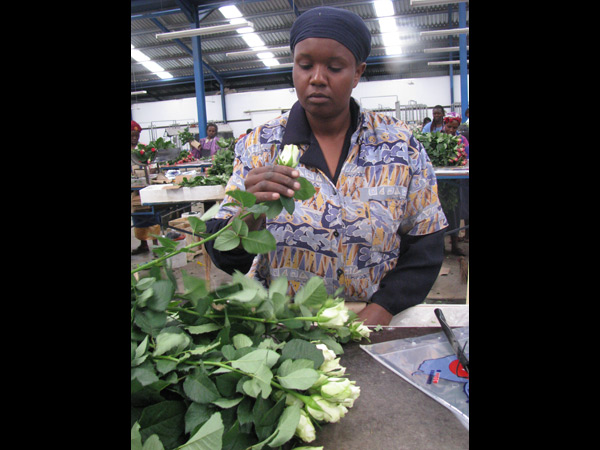
The caption for this photo reads:
"A Maridadi employee takes a moment to appreciate the flowers."
It is from an essay in Slate about Kenya's growing flower exports.
While blogging about the economics of flowers is not new here, this photo is new--the Kenyan employee appreciating and admiring the flower.
Sweet!
DAR ES SALAAM, Tanzania — When students asked me about my winter break plans, my favorite reply was a simple one-liner: “I am going home.”
Their typical response was something along the lines of, “Oh, how long will you be in India?” That is all the opening I needed to engage them in a discussion of how Africa is the “home” for all humans. The “roots” of Alex Haley’s Kunta Kinte are connected to our own collective narrative as well.
Tanzania offers a compelling argument for why it is home to humans — going back to hominids, who were human-like precursors to our kind. The evidence, in this case, includes the well-preserved footprints of hominids in northern Tanzania, estimated to be 3.75 million years old.
Further, with coffee having originated in Ethiopia, the stretch of Africa that includes Tanzania, Kenya and Ethiopia is an important ancestral home to this avid coffee drinking human.
Tanzania is merely one country in the African continent, and at almost a million square kilometers, Tanzania has about four times the area of Oregon. Yes, four times — that is how large the country is. Dar es Salaam, the capital city, and its neighboring region has a population roughly equal to that of the entire state of Oregon. One can, therefore, easily imagine the challenge at the very early stages of planning the trip — how choose the parts of Tanzania to visit over the three weeks I will spend here. Of course, I am here to focus on a research question, but more on this later.
As I continued to work on my going-home travel plans, I brought in Africa and Tanzania as examples at the appropriate moments in my classroom during the recently concluded fall term. For instance, during a discussion on global climate change, I used maps to point out that the electricity consumption in New York City alone was equal to the consumption in all of sub- Saharan Africa, with the exception of South Africa. Yes, it caught the students’ attention.
Students’ response has been the same over the years: They are excited to learn about the continent of Africa when provided with the chance, and utterly disappointed if there is nothing presented despite their genuine interest in learning more. I remember one African-American student in particular who was visibly disappointed that there was nothing about Africa in the schedule of social science classes.
Even if the rest of us are not like that student, who was innately driven to understand Africa, the post-Sept. 11 world in which we live requires us to give Africa the attention it deserves. I hope that we have not forgotten the significant pre-Sept. 11 incidents in Africa. First, in 1998, came the near- simultaneous bombings at the U.S. embassies in Dar es Salaam and Nairobi, Kenya, the work of al-Qaeda. Responding to these incidents, President Bill Clinton ordered missile strikes on precise locations in Sudan in an attempt to neutralize Osama bin Laden. Ten years later, al-Qaeda sympathizers have yet another safe haven in Somalia. Its capital, Mogadishu, has earned notoriety as the world’s most dangerous place.
From an economic perspective, Tanzania and most of Africa seem to be falling behind the rest of the world. Globalization, which columnist Thomas Friedman popularly refers to as the world getting flatter, has delivered a double whammy to Africa. On the one hand, the trend of globalization has further pushed the heavily populated nations of China and India closer to the United States and Europe. On the other hand, most African countries rarely register a blip in our academic and journalistic radars. The economic playing field does not seem to have been leveled for Tanzania and most of the rest of Africa.
Yet we continue to marginalize Africa, even though doing so serves neither our academic interests nor the geopolitical interests that govern our realpolitik. I suppose the election of Barack Obama as president has given us a wonderful opportunity: Instead of arguing over where he was born, why not channel all that energy into understanding Africa?
I think back in India we still have a couple of stamps in our collection that refer to the Kenya-Uganda-Tanzania alliance that later collapsed. Now, the alliance is regrouping, with Rwanda and Burundi also in the mix. Good for them, I say. You--the reader--ought to be happy too. (editor: what makes you think that this blog actually has readers? Well, the site traffic data?)
The note accompanying the photo at the source reads: Leaders of the Eastern African Community sign the common market treaty
Of course, this will not be a common market when I am there in Tanzania in, oh my freaking life, two weeks!!!
It was interesting to read in that news item the following quote:
"From 36 million people in the Kenyan market we are moving to 126 million. The impact is going to be great," said Vimal Shah, the chief of a giant Kenyan beverages and food manufacturer.
"We cannot remain an island anymore. The key now is to become competitive."
Vimal Shah! How much ever I am familiar with the idea that there are people of Indian origin scattered all over the planet, it continues to amaze me that it is such a global group. When I was young--a long time ago--a new kid (Belliappa) who joined our school had spent a couple of years in Kenya because his dad was working there. That might have been the first time I came face-to-face with what was otherwise merely news reports. I wonder what that guy is up to now ....
From Neyveli to America to Tanzania ..... I would not have imagined such a life journey .... awesome!
Lysistrata convinces the women of Greece to withhold sexual privileges from their husbands as a means of forcing the men to negotiate a peace, a strategy however that inflames the battle between the sexes. The play is notable for its exposé of sexual relations in a male-dominated society and for its use of both double entendre and explicit obscenities.
Apparently one Kenyan is mighty upset with the women who took the Lysistrata route and withheld sexual relations; Jimi Izrael writes:
The strike is over, but homeboy is suing for damages. Really? Like what -- chafin'? Feenin'? What? If men called a lawyer every time a woman used sex to manipulate them, the courts would be clogged up for centuries. I think that Kenyan brother needs to get to know himself a little better --- if you catch my meaning --- and call it a wrap.