Showing posts with label NASA. Show all posts

Monday, October 05, 2015

Never Again Scientific Activities. I.e., NASA!

About two years ago, I blogged here that India was wasting a whole lot of resources on an expedition to Mars when it had plenty of problems, especially the daily realities of open defecation and urban waste management.  And then a year later I celebrated India's success with the Mars expedition, and was delighted with the number of female scientists in the project.

It is not that I am a flip-flopper who is happy to ride along with success.  If it were up to me, I would any day push India towards spending money on the fundamentals like addressing defecation and the atrocious government schools.  The Mars expedition success does not change the reality on the ground.

The United States, on the other hand, has been doing everything possible to dismantle its valued, respected, and universally admired NASA, thanks to Congress crying that there is no money to fund NASA.  Seriously?  My old country and the adopted country are both messed up with their priorities in their own ways!  The richest country that the planet has ever known has no money for NASA?  We waste trillions of dollars on fighting wars for reasons that did not even exist, but no change to spare for NASA.
In the 1960s, NASA’s budget was nearly five percent of our federal budget. The U.S. space program gave us solar panels and MRI scans and inspired two generations of citizens to become fascinated by science and engineering, which is arguably the driving force behind our technological superiority among nations. Today, NASA scrapes by, still doing remarkable things with rovers and probes, on less than half of one percent of the federal budget. How can we help more Americans understand the value NASA has for our advancement?
From five percent of the budget to less than half of one percent?  Shocking.  Disgusting.

Even more shocking to when it is put like this:
NASA's flat budget won't pay for a Mars mission. At the moment NASA can't even get an astronaut to the International Space Station without buying a seat on a Russian rocket.
Seriously?  WTF!
In recent years, the agency has had to build its strategies around flat budgets. "Budget is mission-critical" is a catch phrase at headquarters. NASA retired the space shuttle program in 2011 not because the hardware was old or dysfunctional, but to free up several billion dollars a year to build new rockets and capsules that could go beyond Low Earth Orbit.
Why spend the money, you ask?  Here is Neil deGrasse Tyson:
There’s a lot to do in space.  I want to learn more about the greenhouse effect on Venus, about whether there was life on Mars, about the environment in which Earth and the Sun is immersed, the behavior of the Sun.  We still can’t predict the day-to-day behavior of the Sun.  We have something called space weather now, which monitors particles that stream off from the Sun.  That’s a whole frontier, didn’t exist a few decades ago.  We knew about it but we couldn’t measure it, couldn’t do anything about it.  So I see NASA as our… the extension of our senses into space.  ‘Cause Earth is not an island, Earth is a participant in our cosmic environment.  And the more you think… I only have to look down, the more doom you are because of the environment in which we’re embedded.  You look down, all the asteroids coming behind you and you miss it. 
But, all that cannot happen when we want to cut NASA's budget further down from the less than half of one percent of the federal budget.
What a mess. The majority of Americans love NASA, and it’s incredible that NASA can do such amazing feats like send probes to Pluto and Saturn and protoplanets like Vesta and Ceres at all, let alone given the Keystone Kops feel of the Congresspeople pulling the purse strings. My only hope now is that these folks in Congress get replaced in the 2016 elections.
It’s hard to look to the stars when the people funding you have their heads jammed into pork barrels.

What a mess!

Wednesday, May 06, 2015

I’m not a scientist ... But, I'm not an idiot either!

In the introductory class that I am teaching this term, I reminded them--yet again--about the importance of general education.  In order to further drive home the point, I pulled up this interactive quiz on scientific literacy.

The awesome advantage of teaching in these times when I can project learning materials like that quiz straight from the web and have the entire class participate in it.  I tell ya, a classroom is not for nonstop lecturing, and I feel sorry for all those students held captive in rooms where the instructors love listening to themselves!

"Oh my god!" exclaimed a student at one of the questions (#7) that had drawn a miserable correct-response rate in the survey of Americans.  It was a question where answers based off religious explanations sharply diverge from the scientific explanations.

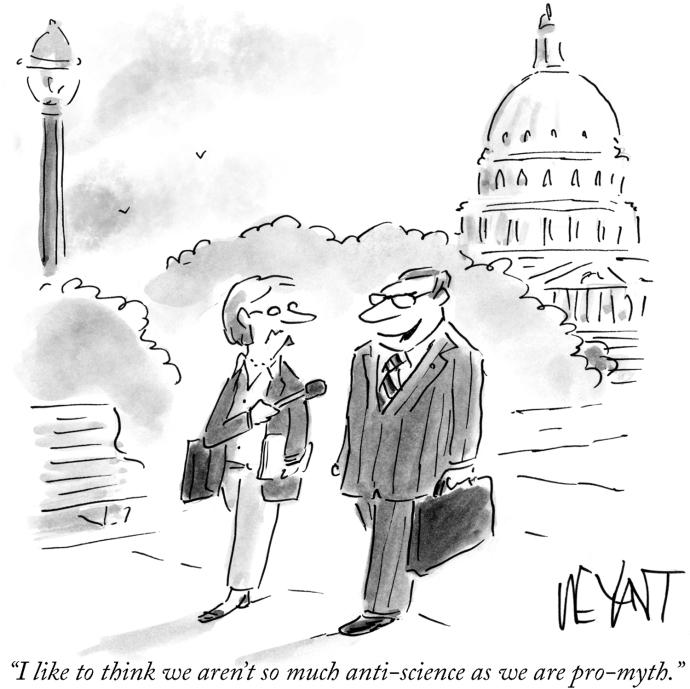
The US is becoming one heck of a crazy country with its anti-science attitude, which finds a home in only one of the two major parties: the Geriatrics Only Party.  The GOP's "leaders" are getting more and more insane with every passing day.

Source

The Pulitzer-winning science writer at the New Yorker, Elizabeth Kolbert, writes:
Last week, the House Science, Space, and Technology Committee, headed by Texas Republican Lamar Smith, approved a bill that would slash at least three hundred million dollars from NASA’s earth-science budget. ... Defunding NASA’s earth-science program takes willed ignorance one giant leap further. It means that not only will climate studies be ignored; some potentially useful data won’t even be collected. ...
The vote on the NASA bill came just a week after the same House committee approved major funding cuts to the National Science Foundation’s geosciences program, as well as cuts to Department of Energy programs that support research into new energy sources. As Michael Hiltzik, a columnist for the Los Angeles Times, noted, the committee is “living down to our worst expectations.”
Yep, this is the country that once sent astronauts to the moon. And now it is the same country that wants to make sure that there will be less money for scientific research, especially on one of the most urgent issues of the day that the entire world is worried about.

Kolbert writes:
Cutting NASA and the N.S.F.’s climate-science budgets isn’t going to alter the basic realities of climate change. No one needs an advanced degree to understand this. Indeed, the idea that ignoring a problem isn’t going to make it go away is one that kids should grasp by the time they’re six or seven. But ignoring a problem does often make it more difficult to solve. And that, you have to assume, in a perverse way, is the goal here. What we don’t know, we can’t act on.
 To use Yakov Smirnoff's line from a different context, "America, what a country!"

Thursday, August 09, 2012

What are we really watching when we watch the Olympics?

That's what Louis Menand asks, when he writes:
If someone described to you an ancient civilization in which, every four years, at great expense, citizens convened to watch a carefully selected group perform a series of meticulously preset routines, and in which the watching was thought of not as a duty but as a hugely anticipated and unambiguously pleasurable experience, you would guess that, socially, this ritual was doing a lot of work. You would assume that it was instilling, or reinforcing, or rebooting attitudes and beliefs that this hypothetical civilization regarded—maybe correctly, maybe just superstitiously—as vital to its functioning. You would say that the spectacle had a content. Do these Summer Games have a content? What are we really watching when we watch the Olympics?
It is one heck of an interesting question.  What are we watching, and why are watching?
The modern Olympics are a model example of what the historians Eric Hobsbawm and Terence Ranger have called invented traditions—ritualized official or quasi-official events, often presented as revivals of ancient practices or in other ways designed to imply continuity with the distant past.
Well, why would we want to invent such traditions anyway?  Why these rituals every four years?
Modern societies are still obsessed with these secular rituals, in part because almost all of them have become successfully commercialized. Maybe they offer an illusion of permanence and continuity in a world characterized mainly by mobility, change, and uncertainty. No matter what happens to us next year, there will be a Super Bowl. Or maybe they feed our tribal instincts, stimulate the irrational basis of loyalty to our community or our country. Even the most cosmopolitan American viewer of the Olympics has a hard time not rooting for the American. If you watch, you don’t just want to see how it comes out. You care who wins.
And, despite the virtuous talk about the honor of competing and the comity of sport—and the talk is virtuous, and fine as far as it goes—winning really is what the spectacle is all about.
Hmmm .... Menand seems to be voicing that ultimate bottom-line often quoted here in the US: Winning isn't everything; it's the only thing.

To me, what was way more interesting than anything else in the essay was the lack-of-sports-enthusiasm that Menand describes in his family when he was growing up because of "an aversion to the belief" that
the ability to run faster or throw farther than other people is a contribution to the common good, and that we ought to honor the athlete in the same way that we honor the artist and the statesman.
Now, if only Menand would pursue that thought in another essay of his.  
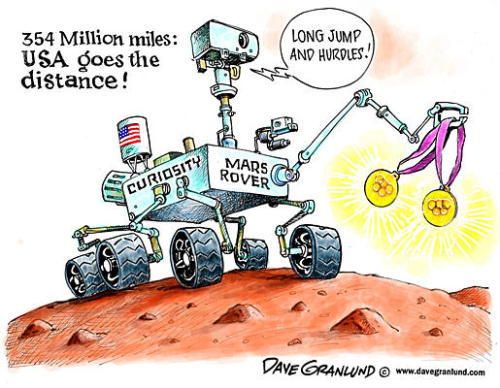
Here is one real-world situation that reflects that thought: NASA successfully landed Curiosity on a planet about 150 million miles away.  And it took more than eight months to travel from here.
Immediately after learning about the successful landing, did President Obama congratulate NASA and its engineers?  After all, this President has annually made a big deal of his picks in the NCAA basketball tournament.  With NASA, well, not to my knowledge. Perhaps he did after a couple of days? 
Did Candidate Romney immediately congratulate NASA and its engineers? Not to my knowledge.  Perhaps he did after a couple of days?

Will the winning Super Bowl team be invited to pose with the President at the White House? You betcha!  Because, "the ability to run faster or throw farther than other people is a contribution to the common good" more than, for instance, the NASA engineers' contribution to the common good?  And then we wonder why kids in America don't feel inclined to work on their math and science skills? Oh well!
 

Friday, August 03, 2012

Seven Minutes of Terror: D-Day approaches

NASA's coverage of Curiosity's descent through the Martian atmosphere on to its surface will begin at 8:30 p.m.(Pacific Time) Sunday night and go until 1:00 a.m. Monday morning. 

a

Sunday, August 08, 2010

Mary Roach goes to Mars!

Well, ... of course, she did not go to the planet; it is her new book--the title is Packing for Mars!

With an unflinching eye for repellent details, she launches readers into the thick of spaceflight’s grossest engineering challenges: disposing of human waste, controlling body odor without washing, and containing nausea — or, if containment fails, surviving a spacewalk with a helmet full of perilously acidic ­upchuck.
In other words, everything gross, or absolutely intriguing, about space travel that you (at least I) wanted to know :)
Roach persuades a Russian astronaut to explain ground control’s reason for nixing his request for a blowup sex doll: “We would need to put it in your schedule for the day.” And a bone-loss-study participant, forced to lie in bed for three months to simulate the effect of weightlessness on his skeleton, divulges where and how study participants conduct their auto­erotic lives.
A blowup sex doll up in the space station?  Hilarious!

Sunday, April 04, 2010

How much would you pay for the universe?

Earlier this morning, NPR had a segment on the final remaining space shuttle rides.  I recalled how my high school friend, Srikumar, and I were excited to hear about a space shuttle program--yes, we were back in India, in a small town.  It sounded absolutely beyond my imagination that there would be this spacecraft to take astronauts back and forth.  All the more wild it was given that I hadn't seen the inside of an airplane up until then--actually, it was quite a few more years after all this that I actually stepped into an airplane.

Over the last few years, the US has not been able to figure out what its space policy ought to be.  It was bizarre when in the middle of two wars, one day, President Bush jumped up and said that we are going to Mars.  That sounded so hollow.  And now President Obama's comments are far from encouraging when it comes to NASA and space exploration.

I suppose we need a Carl "billions and billions" Sagan to get us all pumped up .... Neil deGrasse Tyson does his part ...

Wednesday, September 30, 2009

USA! USA! ..... India?

Here is Jon Stewart getting upset with Aasif Mandvi who reports that India discovered water on the moon, while America's USGS and NASA provided the tech support :-)

The Daily Show With Jon Stewart
Mon - Thurs 11p / 10c
Deep Space Naan
www.thedailyshow.com

Daily Show
Full Episodes

Political Humor
Ron Paul Interview