Of course, there are plenty of places on the planet where electricity is still a novelty. And in tremendous short supply. India is one of those. Are we surprised then that this country of more than 1.2 billion people with huge economic aspirations wants to produce a lot more electricity than it currently does? And, given that coal is the most inexpensive way to get those electrons flowing, it ought not to surprise us that India, like China, is rapidly expanding on coal-fired power plants.
From the comforts of climate-controlled rooms here in the West, we are ready to point fingers at India and China for accelerating carbon emissions, which have immense implications for all the nearly seven billion that we are now, and the other flora and fauna as well. It is simply bizarre that the advanced countries don't seem to appreciate the tremendous shortage in electricity, which is vital for modern economic activities.
The World Bank has essentially shorted its fuse in this context (ht).
The World Bank is planning to restrict the money it gives to coal-fired power stations, bowing to pressure from green campaigners to radically revise its funding rules.WTF, right?
As Spiked notes, such a decision is the equivalent of keeping the poor in the dark, and contradictory to the Bank's mission to eradicate poverty!
where does this new policy leave China and India? Based on International Monetary Fund GDP figures, adjusted to allow for the lower costs of many items in poorer countries, China is the second-largest economy in the world and India is the fourth-largest. Yet both countries have massive, and overwhelmingly poor, populations. China is only in 90th place in terms of GDP per head, and India is 137th. So are these amongst the ‘poorest’ countries that will still get World Bank aid or not? Even these rising economic powerhouses are in desperate need of development.All those greenies who talk a boatload of crap about the simpler and "fuller" lives that the poor lead, well, I think they ought to relocate to places like the Tanzanian village I visited and live there for the rest of their lives. Yes, I am bloody pissed!
But far from fretting about this shocking poverty, Western greens don’t seem very keen on the developed world having reliable electricity at all.
India's minister for the environment, Jairam Ramesh, whose decisions I have blogged about a few times in the past, continues to defy the West and the greenies on this, even while recognizing the importance of protecting the environment. I say, good for him, and the country too. The latest:
Union Minister of State for Environment and Forests Jairam Ramesh on Saturday asserted that India would not succumb to international pressure on any legally binding commitments to reduce carbon emission.Not only that:
Speaking at the National Conference and Annual Session of the Confederation of Indian Industry (CII) here, Mr. Ramesh said the government would act only in the national interest on the issue.
“I can assure you we are not taking on any legally binding commitments under international duress."
Yielding to intense pressure from the coal ministry and end user ministries of power and steel, the environment ministry has agreed to consider approval of all proposed mining projects that obtained stage I forest clearance before 2010, and also offered to free up more forest land from no go areas for mining.I am sure those whose blood runs green will be outraged. But then they are aghast that even the screwed up World Bank plan doesn't go far enough because it spends too much on these conventional energy sources. Hey, the Bank spends that because of the severe shortfall"
The World Bank's record on funding fossil fuels has long been a target of green campaigners. Last year, for instance, the World Bank was attacked for its controversial decision to grant nearly $4bn (£2.5bn) to the South African company Eskom to build what would be one of the world's largest coal-fired power stations.The Bank knows all too well the reality on the ground:
The bank spent £3.4bn – one-quarter of all its spending on energy projects – on coal-fired power in developing countries in the year to June 2010. That was 40 times more than the sum spent five years previously.
In 2009, a World Bank blog post by Justin Lin, the organisation’s chief economist, explained why support for coal was essential. ‘The answer is that there is an urgent need for energy in the poor countries that we serve and indeed in my home country, China… Because coal is often cheap and abundant, and the need for electricity is so great, coal plants are going to be built with or without our support. Without our support, it is the cheaper, dirtier type of coal plants that will proliferate.’But, when it comes to poor people, it is awful that the directly or indirectly their ideological opposition translates to the same Republican Party bottom-line of "screw the poor!" And they oppose it even if the electricity generation will not be from fossil fuels:
when the Ethiopian government announced plans for a major new hydro-electric scheme - in a country where 70 per cent of people have no access to electricity - greens have demanded that international organisations like the World Bank and the European Investment Bank should refuse to support it (see They don’t give a dam about development, by Nathalie Rothschild).I can forever keep punctuating my comments here with WTF!
Visualize in your mind the following "famous NASA image that is often called a "satellite photo of earth at night" when you listen to the greenies harshly critique the energy consumption in India and China as the most urgent climate change problem, and point out to them that the problem originates in the rich countries.
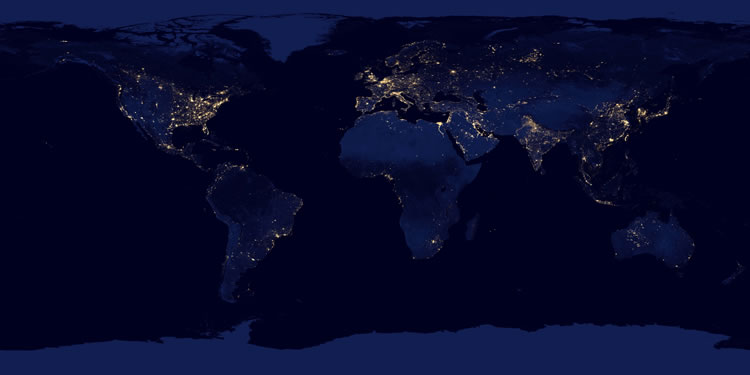
Ideally, the advanced countries, and the US in particular, would adopt energy policies that can then speed up the transition to feasible and inexpensive alternatives to coal. Because, climate change is for real, and carbon is one heck of an accelerator of this process. But then here in the US we area lot more concerned about Jersey Shore and Charlie Sheen and Obama's birth certificate and .... Yes, WTF! yet again :(