Showing posts with label torture. Show all posts

Friday, January 27, 2012

The Inquisition ignited the modern police state

One of the best habits I got into a very long time ago was to read Lingua Franca.  The magazine began about the time I was growing up as a graduate student.  It was something like an inside-baseball version of intellectual discussions.  From Lingua Franca, which didn't last long, I transitioned to a life of a daily dose of aldaily.com.

Today, aldaily.com serves me this essay about how all our awful waterboarding and torture and censorship and everything else have their origins in the Inquisition.  But then,
[Why] did the Inquisition come into being when it did? Intolerance, hatred and suspicion of one group by another had always existed. Throughout history, these realities had led to persecution and violence. But the ability to sustain a persecution – to give it staying power by giving it an institutional life – did not appear until the Middle Ages. Until then, the tools to stoke and manage those embers of hatred did not exist. Once the tools do exist, inquisitions become a fact of life. They are not confined to religion; they are political as well. The targets can be large or small. An inquisition impulse can quietly take root in the very systems of government and civil society that order our lives.
Yeah, why, and how?
The tools are these: there needs to be a system of law, and the means to administer it with a certain amount of uniformity. Techniques must be developed for conducting interrogations and extracting information. Procedures must exist for record-keeping, and for retrieving information after records have been compiled and stored. An administrative mechanism – a bureaucracy – is required, along with a cadre of trained people to staff it. There must be an ability to send messages across significant distances, and also an ability to restrict the communications of others – in a word, censorship.
The Inquisition was built on all of these capabilities. The new universities brought order to canon law, defining heresy with precision and therefore defining who was “inside” and who was “outside”. The Church bureaucracy became professional; papal chanceries turned out perhaps 300 letters in 1200 and 50,000 a century later. Inquisitors learned how to organise their documents and make them searchable; a person’s testimony to one tribunal could be known to another tribunal decades later. Interrogation manuals, like the famous Practica written by Bernard Gui, were drawn up to instruct inquisitors on how to question the accused – the tricks to use, the psychology to employ. The resemblance to the modern manuals for military personnel and intelligence operatives is hard to miss. As a supplement to interrogation, torture became systematic – subject to rules, perhaps, but rules that proved elastic, as they always do.
What an institutional support, eh that took intolerance to awful depths! 

Every once in a while, I ask students in my classes about the Spanish Inquisition.  Simple questions like if they know what it was about.  The approximate time when it happened.  And then I share with them the Mel Brooks version of the history of the world in which he presents the Inquisition :)

Tuesday, November 15, 2011

Waterboarding IS torture. Deal with it!

I have nothing to say to this part of the press conference other than, "Thank you, Mr. President"
Q    Thank you, Mr. President.  Last night at the Republican debate, some of the hopefuls -- they hope to get your job -- they defended the practice of waterboarding, which is a practice that you banned in 2009.  Herman Cain said, “I don’t see that as torture.”  Michelle Bachmann said that it’s “very effective.”  So I’m wondering if you think that they’re uninformed, out of touch, or irresponsible?

PRESIDENT OBAMA:  That’s a multiple-choice question, isn’t it?  (Laughter.)  Let me just say this:  They’re wrong.  Waterboarding is torture.  It’s contrary to America’s traditions. It’s contrary to our ideals.  That’s not who we are.  That’s not how we operate.  We don’t need it in order to prosecute the war on terrorism.  And we did the right thing by ending that practice.
If we want to lead around the world, part of our leadership is setting a good example.  And anybody who has actually read about and understands the practice of waterboarding would say that that is torture.  And that's not something we do -- period.

Friday, June 10, 2011

The brutality in Syria and a 15-year old :(

This news video blocks out the image because it is apparently too gruesome...

The results of a 15-year old boy who was tortured by the Syrian regime because he participated in anti-government protests ...

Whatever leads one to torture another is beyond my wildest possible imagination, and that too a 15-year old?  Cutting the genitals off? :( :(

Monday, May 02, 2011

bin Laden is dead. It is the day after. Now what?

As I went to bed last night, I realized that I had to redo the mental script I had for my classes--some of the students might want to discuss the bin Laden-related events, while some might not care.  Then the question of whether I had a pedagogical responsibility to treat this as a learning opportunity as well.  If a learning opportunity, then what were the lessons to focus on?  How would I then go about discussing those lessons?

Teaching, as I see it, is nothing but editorial decisions everyday.  We select and present materials to students. We interpret the data in the manner in which we prefer--even when we try our best to be impartial, and leave our ideological preferences at home.

As I was driving to work, I figured out a game plan.  My formal teaching/learning moment would be to highlight the importance of understanding of geography.  That we understand that location matters, and the location-related relationships matter.  So, I would use maps of the Indian Subcontinent to tell a story of sorts. But tell a story in a way that draws questions.

However, I wanted to do that as a wrap-up after inviting comments from the students.  But then how would I broach the subject?  I figured I didn't have to worry about this--I was confident that at least a couple of students would jump on this topic even before I got to the computer in the classroom.

It turned out exactly that way. "T" loudly remarked that he wanted to discuss the current events and not our regularly scheduled topics.  "What happened, man?" I asked him with a smile.  "T" said "about last night, and Osama."  And thus we discussed the events. For 45 minutes. Including recalling where we were on that fateful 9/11. "T" asked whether it was ok to publicly celebrate--apparently a few had expressed displeasure at the celebrations.  "Go ahead and celebrate" I told him. "Bin Laden has killed tens of thousands, including thousands of Muslims" I added.

At the end, I reminded the class that all politics aside, we owe a thanks to the military.  I asked those who had served to stand so that we could thank them. One stood. We clapped. And then I asked all those with friends and families who have served in the military to stand. With the exception of a couple of students, the entire class stood up.

And, with that we took a break, and then I did my spiel on geography, location, and relationships. At the end of it all, we had only 20 minutes out of the 110-minute session to talk about resources, which was the topic for the day.

As the students were exiting, "T" paused for a second and said, "thanks for allowing us to talk about this for more than half the class time."  

I wonder whether the students know that I hate violence. I hate wars. I have never touched a gun in my life. Not even a bullet. I hope that I will never, ever, touch any of those killing machines.  A friend, "P," when I told him about these views a few years ago, thought it was a noble to goal to set for oneself--to not ever go anywhere near those weapons of destruction. He should know--he is a Vietnam veteran!

But, does it matter whether or not students know what my personal preferences are?  I tell you, teaching is immensely tougher than what it seems from the outside.

I am glad though that Osama bin Laden is gone. Capturing him, then trying him in a regular court--not one of those Guantanamo circus cages--would have been my preferred option. While I hate the death penalty, I recognize that it is legal in this country.  Bin Laden would have been sentenced to death after the due process.


So, it is now the day after. It is not as if we now revert to the halcyon days of September 10, 2001.  There is simply no there there. But, there are a few things I hope Obama, the Democrats, and the Republicans will start thinking about. Such as the ones that Dahlia Lithwick writes about:
About all we can say with certainty is this: We tortured. We live in a world in which we must contend with information obtained by torture. We now need to decide whether we want to continue to live that way. Writers from ideological backgrounds as diverse as Matt Yglesias and Ross Douthat argue that it is time to return to the paradigm abandoned after 9/11. Let's put the 9/11 attacks and the existential threat it created behind us. With Bin Laden's death, let's simply agree that the objectives of the Bush administration's massive anti-terror campaign have finally been achieved, and that the time for extra-legal, extra-judicial government programs—from torture, to illegal surveillance, to indefinite detention, to secret trials, to nontrials, to the prison camp at Guantanamo Bay—has now passed. There will be no better marker for the end of this era. There will be no better time to inform the world that our flirtation with a system of shadow-laws was merely situational and that the situation now is over. ...

The "war on terror" language was always metaphorical, I realize, but it unloosed a very real Pandora's box of injustice on a nation that prides itself on its notions of fairness. That makes the highly symbolic death of Bin Laden an apt time—perhaps the last apt time—to ask whether this state of affairs is to be temporary or permanent. If President Obama truly believes, as he said last night, that justice has finally been done, he should use this opportunity to restore the central role of the rule of law in achieving justice in the future.
And, can we please start complete withdrawal of the military from Afghanistan? And not get all too entangled in Libya?  And reduce defense spending so that we can provide better social safety nets?


As the month draws to a close, I will have yet another learning opportunity--"Memorial Day."  But, I don't do any talking in class for that--like in the years past, all I have to do is update my slides of images of Oregon's soldiers who have been killed in Iraq and Afghanistan. A very quiet automated slide-show for ten minutes. That always leaves me drained, emotionally and physically.

Wednesday, February 09, 2011

If this doesn't tick you off ....

... then, I don't know what will
That is American realpolitik for you!  Thank Henry Kissinger for making it such a permanent feature of how the US deals with the rest of the world.
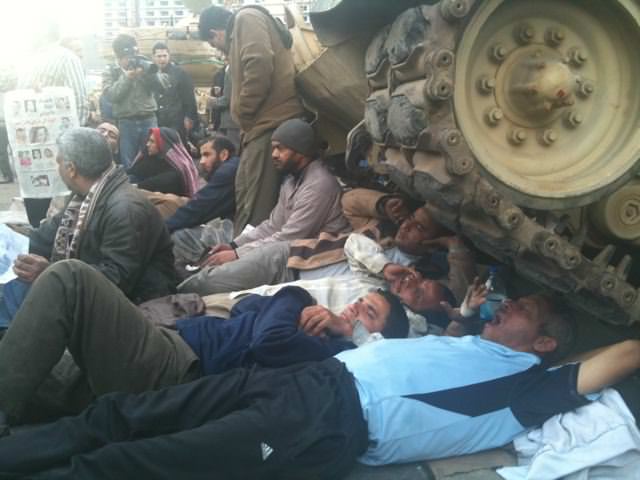
So, with the revolution on television, Twitter, and everywhere, has the US changed its policies?  Ahem:
And yet, with Egyptian protestors literally sleeping under the treads of tanks, the flow of U.S. military aid to the regime shows no signs of letting up. Earlier in the crisis there were signs that Congress would oppose the administration's requests for continued aid, but no longer, as the Los Angeles Times reports:
Sen. John McCain (R-Ariz.) had earlier said "all options are on the table," including aid cuts. But in an interview Tuesday, he said that now "is just not the right time to threaten that."
McCain said he was concerned that a reduction in aid might affect Egypt's willingness to cooperate with Israel.
Sen. Patrick J. Leahy (D-Vt.), chairman of the Senate subcommittee that oversees foreign aid, declared last week that he would not vote for aid to Egypt, adding that he knew no lawmaker who would.
This week, however, Leahy appeared to soften his position, saying through a spokesman that he would oppose any new aid "until the situation is resolved."
White House officials said earlier in the crisis that they would review the aid if the Mubarak government didn't move promptly toward political reform. But within a few days, officials clarified that they weren't considering cuts to aid.

Sunday, February 06, 2011

Bush cancels trip to Switzerland--afraid of arrest warrant

So, the macho former president, George Bush, gets wimpy about the protests that were planned by human rights groups, and cancels his trip to the fabled neutral territory of Switzerland.  Well, it was more than the threat of protests--a fear that he might be served with an arrest warrant for war crimes.  After all, in his memoirs, Bush admits to having authorized waterboarding, among other things. "Damn right!"  A confession statement right there!
Since the arrest of the late Chilean dictator Augusto Pinochet in London in 1998, international leaders can no longer be confident of immunity.
Adds the Guardian:
"Bush enjoys no immunity from prosecution. As head of state he authorised and condoned acts of torture, and the law is clear – where a person has been responsible for torture, all states have an obligation under international law to open an investigation and prosecute." He added: "Bush will be pursued wherever he goes as a war criminal and torturer."
Legal proceedings under way in Spain accuse White House legal advisers, known as the Bush Six, of criminal wrongdoing for advising that the techniques were legal.
"Nobody – from those who administered the practices to those at the top of the chain of command – is under a shield of absolute immunity for the practices of secret detention, extraordinary rendition and torture," said Martin Scheinin, UN special rapporteur on human rights and professor of public international law at the European University Institute. "Legally this case is quite clear. Bush does not enjoy immunity as a former head of state, and he has command responsibility for the decisions that were taken."
It is not merely Switzerland that Bush has to avoid.  Recall the Mayor of London's note of warning in the rather conservative British paper, The Telegraph?
It is not yet clear whether George W Bush is planning to cross the Atlantic to flog us his memoirs, but if I were his PR people I would urge caution. As book tours go, this one would be an absolute corker. It is not just that every European capital would be brought to a standstill, as book-signings turned into anti-war riots. The real trouble — from the Bush point of view — is that he might never see Texas again.
One moment he might be holding forth to a great perspiring tent at Hay-on-Wye. The next moment, click, some embarrassed member of the Welsh constabulary could walk on stage, place some handcuffs on the former leader of the Free World, and take him away to be charged. Of course, we are told this scenario is unlikely. Dubya is the former leader of a friendly power, with whom this country is determined to have good relations. But that is what torture-authorising Augusto Pinochet thought. And unlike Pinochet, Mr Bush is making no bones about what he has done.
Unless the 43rd president of the United States has been grievously misrepresented, he has admitted to authorising and sponsoring the use of torture. Asked whether he approved of “waterboarding” in three specific cases, he told his interviewer that “damn right” he did, and that this practice had saved lives in America and Britain. It is hard to overstate the enormity of this admission.
So, it is for real.  Bush, and his fellow travelers, have to rethink their travel plans to many countries; Amnesty International says:
Anywhere in the world that he travels, President Bush could face investigation and potential prosecution for his responsibility for torture and other crimes in international law, particularly in any of the 147 countries that are party to the UN convention against torture.

Thursday, November 11, 2010

Damn Right! we are all waterboarders now

Dahlia Lithwick's piece, commenting on President Bush's candid admission that he okayed waterboarding, is a depressing read.  She points out why some of us are troubled by this:
The persistent failure to hold anyone accountable at any level for years of state-sanctioned abuse speaks louder than their words. It has taken this issue from a legal question to a matter of personal taste. What we choose to define as torture is now just another policy disagreement, like extending the Bush tax cuts or picking a caterer. This is precisely the kind of sliding-scale ethical guesswork the rule of law should preclude.
Lithwick articulates well the point that we fail to grasp: Waterboarding is not a policy option like tax cuts.  She writes:
Indeed, as Andrew Cohen notes, when the men ordering the destruction of those tapes are celebrated as "heroes," who's to say otherwise? Check, please.
All these mean then that we are all waterboarders:
All this was done in the name of moving us forward, turning down the temperature, painting over the rot that had overtaken the rule of law. Yet having denied any kind of reckoning for every actor up and down the chain of command, we are now farther along the road toward normalizing and accepting torture than we were back in November 2005, when President Bush could announce unequivocally (if falsely) that "The United States of America does not torture. And that's important for people around the world to understand." If people around the world didn't understand what we were doing then, they surely do now. And if Americans didn't accept what we were doing then, evidently they do now. Doing nothing about torture is, at this point, pretty much the same as voting for it. We are all water-boarders now.

Saturday, September 25, 2010

Forty years of op-ed at the NY Times

I grew up with opinions (op-eds) as the norm in newspapers.  But, it wasn't always so.  The NY Times is celebrating 40 years of op-eds:
On Sept. 21, 1970, readers who turned to the last inside page of The Times's main section found something new. The obituaries that normally appeared in that space had been moved, replaced by something called Op-Ed. The vision of John Oakes, the editorial page editor, and Harrison Salisbury, the eminent foreign correspondent, Op-Ed was meant to open the paper to outside voices. It was to be a venue for writers with no institutional affiliation with the paper, people from all walks of life whose views and perspectives would often be at odds with the opinions expressed on the editorial page across the way. (Hence, Op-Ed - Opposite Editorial.)
The multimedia the paper has put together for this occasion is pretty good.  The following is one of those--more here.
For Op-Ed's 40th anniversary, Ali Soufan, a F.B.I. supervisory special agent from 1997 to 2005, recounted the events that triggered his Op-Ed in April 2009.

In the op-ed, Soufan wrote:
It is surprising, as the eighth anniversary of 9/11 approaches, that none of Al Qaeda’s top leadership is in our custody. One damaging consequence of the harsh interrogation program was that the expert interrogators whose skills were deemed unnecessary to the new methods were forced out.
Mr. Mohammed knew the location of most, if not all, of the members of Al Qaeda’s leadership council, and possibly of every covert cell around the world. One can only imagine who else we could have captured, or what attacks we might have disrupted, if Mr. Mohammed had been questioned by the experts who knew the most about him.
A lack of knowledge perhaps explains why so many false claims have been made about the program’s alleged successes.
 It is a new administration, but I am not sure how much things have changed.  Here is an exhibit on the continuation of some of those practices:
President Barack Obama's administration has invoked the state secret privilege to avoid a lawsuit on behalf of Yemeni-American cleric Anwar al-Awlaki, whose father charges the US government of targeting him for assassination.
Nasser al-Awlaki last month asked two civil rights groups to sue the White House and the Central Intelligence Agency for placing his son on a list of people targeted for killing.
The younger Awlaki is considered a dangerous terrorist by the US government and is currently believed to be hiding in Yemen.
The American Civil Liberties Union (ACLU) and the Center for Constitutional Rights (CCR) filed the court action seeking to force the US government to say how it decides to target US citizens for murder far from any armed conflict without due process.
Am waiting for that "change" ....

Sunday, September 19, 2010

On the death of two American soldiers

It had been a while since I checked in with Tom Ricks' blog, The Best Defense, and I did on this last Sunday of the summer.

Bad idea.
Truly depressing and distressing stories about two soldiers.

The first one was about a Marine, Tom Bagosy, who committed suicide on May 10th.
Bagosy joined the Marine Corps in 2004 and married Katie in 2005. They have two children.
He was deployed to Iraq in 2006 and promoted to sergeant in 2007. He joined Marine Corps Force Special Operations Command in October 2008 and was deployed to Afghanistan. During his tours he earned several medals including two Combat Action Ribbons and a Marine Corps Good Conduct Medal, according to information from MarSOC.
But, he was far from healthy inside--severe PTSD ... how tragic ... and a system that couldn't help him despite his wife's pleas:
“I spoke to his psychiatrist and when that didn’t seem to help — at this point I felt the same as Tom that no one was listening to him or cared enough to help — I wrote a letter asking for a new doctor,” she said. The referral didn’t go through until a week after Bagosy died. ...

“I talked to his psychologist and I said that he was suicidal and tried to overdose the day before and had a gun and needed in-patient,” Katie Bagosy said.

When Bagosy discovered his doctors wanted to admit him to the hospital, he bolted from his Substance Abuse Rehabilitation Program and headed for the parking lot. Staff tried to stop him and even asked other Marine patients to grab him, but Bagosy got away, according to witnesses and his wife.

“As Tom drove away he called me and said something about pulling a gun on someone and then said, ‘I love you and I don’t think I’m ever going to see you again,’” Katie Bagosy said, adding her husband was crying hysterically. He then hung up on her.

While being pursued by two provost marshals, Bagosy stopped on McHugh Boulevard and shot himself in the head.
Sgt. Tom Bagosy was 25 years old when he died.

In another post, Ricks linked to this story about "the US Soldier Who Committed Suicide After She Refused to Take Part in Torture"
Spc. Alyssa Peterson was one of the first female soldiers who died in Iraq. Her death under these circumstances should have drawn wide attention. It's not exactly the Tillman case, but a cover-up, naturally, followed. ...
Peterson, a devout Mormon—her mother, Bobbi, claims she always stuck up for "the underdog"—had graduated from Flagstaff High School and earned a psychology degree from Northern Arizona University on a military scholarship. She was trained in interrogation techniques at Fort Huachuca in Arizona, and was sent to the Middle East in 2003, reportedly going in place of another soldier who did not wish to go.
On September 15, 2003, Peterson shot herself with the service rifle because she did not want to participate in the torture practices.
The official probe of her death would later note that earlier she had been "reprimanded" for showing "empathy" for the prisoners. One of the most moving parts of the report, in fact, is this: "She said that she did not know how to be two people; she…could not be one person in the cage and another outside the wire."
The article includes a note from her brother, and this slide-show narrated by her mother; I doubt if one can watch and listen without getting emotional.

Spc. Alyssa Peterson was 27 when she died.

Saturday, September 11, 2010

President Barack O'Bush and state secrets

The following two quotes are substantive follow-up, wouldn't you agree, to the earlier post that increasingly there is very little difference between Bush's policies and Obama's?
"It can fairly be said that the Bush administration made torture the law of the land and the Obama administration is making impunity for torture the law of the land," said Ben Wizner, the American Civil Liberties Union (ACLU) attorney who represented the plaintiffs in the case. ...
"You've got state secrets, targeted killings, indefinite detention, renditions, the opposition to extending the right of habeas corpus to prisoners at Bagram [in Afghanistan]," Mr. Hayden said, listing the continuities. "And although it is slightly different, Obama has been as aggressive as President Bush in defending prerogatives about who he has to inform in Congress for executive covert action."
Yes, as Reason titled this, it is "torture today, torture tomorrow, torture forever"

What a refreshing change it has been at the White House! :(

Friday, May 21, 2010

Quote of the day, and more about the UK democratic experiment

We will be strong in the defence of freedom.  The Government believes the British state has become too authoritarian, and that over the past decade it has abused fundamental human rights and historic civil liberties
That is the preamble to the "civil liberties" section of the platform that the Tory/Liberal Democrat coalition government. (ht
Simply awesome.  After the triangulating Tony Blair and the rather dull Gordon Brown, and their bizarre fetish to faithfully follow the Bush/Cheney approach to infringing on civil liberties, wow, what a refreshing set of sentences.  It simply gets better; here is a sampling:
  • We will introduce a Freedom Bill.
  • We will scrap the ID card scheme, the National Identity register and the ContactPoint database, and halt the next generation of biometric passports.
  • We will outlaw the finger-printing of children at school without parental permission.
  • We will extend the scope of the Freedom of Information Act to provide greater transparency.
Hey, can we get that government here, too?  Andrew Sullivan points out that the new "coalition" government is going exactly where President Obama with his huge majority wimped out:
A judge will investigate claims that British intelligence agencies were complicit in the torture of terror suspects, William Hague, the foreign secretary, said tonight. ...
Hague's statement redeems a pledge that both he and his then Liberal Democrat opposite number, Ed Davey, made in opposition. Hague told the BBC: "We have said again in the coalition agreement that we want a judge-led inquiry. So will there be an inquiry of some form? Yes, both parties in the coalition said they wanted that. Now what we're working on is what form that should take."
The coalition agreement published today by the government does not explicitly call for a judicial inquiry; it simply states: "We will never condone the use of torture."
Glenn Greenwald, too, points out this contrast:
[Just] contrast all of this to what is taking place in the United States under Democratic Party rule.  We get -- from the current Government -- presidential assassination programs, detention with no charges, senseless demands for further reductions of core rights when arrested, ongoing secret prisons filled with abuse, military commissions, warrantless surveillance of emails, and presidential secrecy claims to block courts from reviewing claims of government crimes.  The Democratic-led Congress takes still new steps to block the closing of Guantanamo.  Democratic leaders push for biometric, national ID cards.  The most minimal surveillance safeguards are ignored.  Even the miniscule limits on eavesdropping powers are transgressedAnd from just this week:  "Millions of Americans arrested for but not convicted of crimes will likely have their DNA forcibly extracted and added to a national database, according to a bill approved by the U.S. House of Representatives on Tuesday" (h/t Dan Gillmor). Can anyone even imagine for one second Barack Obama standing up and saying:  "My administration believes that the American state has become too authoritarian"?
It will be neat if a news person can get Dick Cheney's reaction to the coalition government's platform.  BTW, where is that war criminal man?  He has not been snarking in the news lately ...

Monday, March 29, 2010

Obama on torture: look back, or merely go forward?

A near-complete copy/paste of a Glenn Greenwald post--to excerpt would be gross injustice to his observations:
President Obama gave an interview earlier this week to an Indonesian television station in lieu of the scheduled trip to that country which was canceled due to the health care vote.  In 2008, Indonesia empowered a national commission to investigate human rights abuses committed by its own government under the U.S.-backed Suharto regime "in an attempt to finally bring the perpetrators to justice," and Obama was asked in this interview:  "Is your administration satisfied with the resolution of the past human rights abuses in Indonesia?"  He replied:
We have to acknowledge that those past human rights abuses existed.  We can't go forward without looking backwards . . . .
When asked last year about whether the United States should use similar tribunals to investigate its own human rights abuses, as well his view of other countries' efforts (such as Spain) to investigate those abuses, Obama said:
I'm a strong believer that it's important to look forward and not backwards, and to remind ourselves that we do have very real security threats out there.
That "Look-Forward/Not-Backward" formulation is one which Obama and his top aides have frequently repeated to argue against any investigations in the U.S.  Why, as Obama sermonized, must Indonesians first look backward before being able to move forward, whereas exactly the opposite is true of Americans?  If a leader is going to demand that other countries adhere to the very "principles" which he insists on violating himself, it's probably best not to use antithetical clichés when issuing decrees, for the sake of appearances if nothing else.
The New Yorker's Jane Mayer -- in the last paragraph of her new article documenting the multiple lies told by former Bush speechwriter and current Washington Post columnist Marc Thiessen in his pro-torture book -- offered the best summary yet as to why Obama's "Look Forward/Not Backward" mentality is so destructive:
The publication of "Courting Disaster" suggests that Obama’s avowed determination "to look forward, not back" has laid the recent past open to partisan reinterpretation.  By holding no one accountable for past abuse, and by convening no commission on what did and didn’t protect the country, President Obama has left the telling of this dark chapter in American history to those who most want to whitewash it.
Nothing enables the glorification of crimes, and nothing ensures their future re-occurrence, more than shielding the criminals from all accountability.  It's nice that Barack Obama is willing to dispense that lecture to other countries, but it's not so nice that he does exactly the opposite in his own.

Friday, February 19, 2010

The latest on torture by the CIA

Following the launch of a Justice Department criminal probe into the CIA's alleged abuse of detainees, the intelligence agency was forced last week to complete months of previously scheduled torture over the course of one frenzied weekend. "We were already way behind on false executions as it was," said CIA director Leon Panetta, who was overseeing the consolidation of several human pyramids into one large one so that relentless tauntings and other dehumanizing practices could be accomplished more efficiently. "Only three of the car batteries have any juice left, and these poor dogs are almost too tired to strike. If we weren't keeping these guys awake 24-7, there's no way we'd be able to wrap this up by Sunday." Panetta said that if the CIA didn't finish in time, he will order a covert operative to assassinate Russian president Dmitry Medvedev to take some of the pressure off.
Source? The Onion. Which means, well, you know what it means :)

Sunday, September 20, 2009

One doesn't fight in the hope of winning

That is the quote that Gary Wills, professor emeritus at Northwestern, uses to conclude his essay in the NY Review of Books.
It is a depressing thought, no?, to think that most of the time we fight the good fight not in the hope of winning it? So, what is the context in which Professor Wills writes this? At how much the change in the White House has not translated to significant directional changes that would indicate a move towards restoring the ideals of the constitution. The entire essay, which is not at all lengthy, is a great read. Excerpt:
A president is greatly pressured to keep all the empire's secrets. He feels he must avoid embarrassing the hordes of agents, military personnel, and diplomatic instruments whose loyalty he must command. Keeping up morale in this vast, shady enterprise is something impressed on him by all manner of commitments. He becomes the prisoner of his own power. .... He is a self-entangling giant.

.... in the nuclear era, the Constitution has become quaint and obsolete. Few people even consider anymore Madison's lapidary pronouncement, "In republican government the legislative authority necessarily predominates." Instead, we are all, as citizens, asked to salute our commander in chief. Any president, wanting leverage to accomplish his goals, must find it hard to give up the aura of war chief, the mystery and majesty that have accrued to him with control of the Bomb, the awesome proximity to the Football, to the Button.

But, we fight, not in the hope of winning because, as Professor Wills puts it:
Nonetheless, some of us entertain a fondness for the quaint old Constitution.
Yes. We do.

Thursday, September 03, 2009

"Hottest" law school dean against torture

Asha Rangappa writes in Slate that:
whatever we conclude about the effectiveness of torture on terrorism suspects abroad, we will never use it to elicit information from people within the United States. That leaves trust and cooperation as our most promising means of getting intelligence domestically, and maintaining our good-guy image is vital to that effort. Any intelligence obtained through torture has to be balanced against the diminished capacity of the FBI to effectively exploit its intelligence base here at home. We should remember that when we calculate what kind of interrogation is a net gain or loss for our national security.
So, where does the "hottest" adjective come from, you ask? Details here:
There are certain honors that most lawyers aspire to such as clerking for the Supreme Court, or being selected for it. And there are others that descend unwished for, like a boon sent by the gods to the wrong supplicant. One of these is winning the annual contest for hottest law school dean. In 2006, this “honor” went to Yale Law School Assistant Dean Asha Rangappa who the sponsoring web page called “as hot as a fire in a crowded theater.
Now, the last name "Rangappa" almost certainly points to her roots to Coorg, which has a sobriquet of the "Scotland of India." The last name then might mean Kodagu origins?

One of my classmates back in high school was "Belliappa" whose father was "Medappa" ..... wonder whatever happened to him ....

Tuesday, May 19, 2009

Jesse Ventura on waterboarding and torture

Neither the Republicans nor the Democrats will forcefully acknowledge what Ventura says. Thanks, Mr. Ventura.


via: The Daily Dish

Sunday, May 17, 2009

Torture, and government transparency

I really, really, hope that not only will there be a "truth" commission to clear up everything related to torture, but that it will also help clean up DC, at least for a couple of years, just like when the Watergate inquiry lead to a little bit of housecleaning before the vultures returned.
In today's NY Times, Frank Rich writes that we need to do this, and now:
the new administration doesn’t want to revisit this history any more than it wants to dwell on torture. Once the inspector general’s report on the military analysts was rescinded, the Obama Pentagon declared the matter closed. The White House seems to be taking its cues from the Reagan-Bush 41 speechwriter Peggy Noonan. “Sometimes I think just keep walking,” she said on ABC’s “This Week” as the torture memos surfaced. “Some of life has to be mysterious.” Imagine if she’d been at Nuremberg!

The administration can’t “just keep walking” because it is losing control of the story. The Beltway punditocracy keeps repeating the cliché that only the A.C.L.U. and the president’s “left-wing base” want accountability, but that’s not the case. Americans know that the Iraq war is not over. A key revelation in last month’s Senate Armed Services Committee report on detainees — that torture was used to try to coerce prisoners into “confirming” a bogus Al Qaeda-Saddam Hussein link to sell that war — is finally attracting attention. The more we learn piecemeal of this history, the more bipartisan and voluble the call for full transparency has become.

And I do mean bipartisan. Both Dick Cheney, hoping to prove that torture “worked,” and Nancy Pelosi, fending off accusations of hypocrisy on torture, have now asked for classified C.I.A. documents to be made public. When a duo this unlikely, however inadvertently, is on the same side of an issue, the wave is rising too fast for any White House to control. Court cases, including appeals by the “bad apples” made scapegoats for Abu Ghraib, will yank more secrets into the daylight and enlist more anxious past and present officials into the Cheney-Pelosi demands for disclosure.

It will soon be every man for himself. “Did President Bush know everything you knew?” Bob Schieffer asked Cheney on “Face the Nation” last Sunday. The former vice president’s uncharacteristically stumbling and qualified answer — “I certainly, yeah, have every reason to believe he knew...” — suggests that the Bush White House’s once-united front is starting to crack under pressure.

I’m not a fan of Washington’s blue-ribbon commissions, where political compromises can trump the truth. But the 9/11 investigation did illuminate how, a month after Bush received an intelligence brief titled “Bin Laden Determined to Strike in U.S.,” 3,000 Americans were slaughtered on his and Cheney’s watch. If the Obama administration really wants to move on from the dark Bush era, it will need a new commission, backed up by serious law enforcement, to shed light on where every body is buried.

Friday, May 15, 2009

Torture. DADT. Gay. Obama. Wimp.

So, in an earlier post I wondered how the Daily Show would respond to Obama flip-flopping on the torture photos. Well, Jon Stewart did great. An awesome job. But, highly depressing to realize that this is politics here in the good ol' USA.

The Daily Show With Jon StewartM - Th 11p / 10c
Moral Kombat
thedailyshow.com
Daily Show
Full Episodes
Economic CrisisPolitical Humor

More on torture. Transparency?

I thought it was ridiculous to suggest that the photos will stir up anti-American and anti-troop sentiments. Because, there is going on already for that, and as much as the torture photos might, it is also equally possible that a few others might be impressed with the way America handles incorrect, unethical, and illegal actions.
Greenwald articulates it much better than I can:

We're currently occupying two Muslim countries. We're killing civilians regularly (as usual) -- with airplanes and unmanned sky robots. We're imprisoning tens of thousands of Muslims with no trial, for years. Our government continues to insist that it has the power to abduct people -- virtually all Muslim -- ship them to Bagram, put them in cages, and keep them there indefinitely with no charges of any kind. We're denying our torture victims any ability to obtain justice for what was done to them by insisting that the way we tortured them is a "state secret" and that we need to "look to the future." We provide Israel with the arms and money used to do things like devastate Gaza. Independent of whether any or all of these policies are justifiable, the extent to which those actions "inflame anti-American sentiment" is impossible to overstate.

And now, the very same people who are doing all of that are claiming that they must suppress evidence of our government's abuse of detainees because to allow the evidence to be seen would "inflame anti-American sentiment." It's not hard to believe that releasing the photos would do so to some extent -- people generally consider it a bad thing to torture and brutally abuse helpless detainees -- but compared to everything else we're doing, the notion that releasing or concealing these photos would make an appreciable difference in terms of how we're perceived in the Muslim world is laughable on its face.