Showing posts with label social security. Show all posts

Wednesday, July 25, 2012

The economy hits youth worst as they lose the generational war

The Wall Street Journal provides an interesting commentary on how the persistently high unemployment and underemployment among the youth compares with the stagflation the baby-boomers experienced.  In 1982, unemployment rate for the youth was a high 17%.  But,
the situation quickly improved. By the end of 1983, the unemployment rate for 18-24 year-olds had dropped below 14%, and it didn’t get back above that mark until the latest recession. This time around, joblessness among young people remains over 15% three years after the recovery began. ...
Many of today’s 20-somethings, therefore, are stuck on the sidelines for what should be — and what was for their parents — their most important years for wage growth and career development. The effects are likely to be long-lasting. A study by Yale economist Lisa Kahn found that “the labor market consequences of graduating from college in a bad economy are large, negative and persistent.”
From my reading of the situation, it is not getting better, and does not seem like it will get better any time soon.  It is awful!

On top of everything else, most of these youth are also graduating with debts from their years at colleges and universities, which then seems more and more the case that we are looking at a horrible prospect of, what Matt Yglesias referred to as, the indentured servant generation :(

Yet, we refuse to talk about one of the significant ways in which the youth are losing because the game is rigged against them: the enormous diversion of precious resources to the much older generations.
Social Security and Medicare were created in a very different America as a response to very different circumstances. The old-age entitlements were designed to alleviate problems related to an economy still in transition from rural agriculture to urban manufacturing and post-industrial services. Private pensions and retirement savings were relative rarities, and the communitarian dream of multiple generations living under the same roof—invoked as an ideal by some of the very people, such as Joe Biden and Hillary Clinton, who champion old-age entitlements as a means of “independence” for seniors—was a routine necessity.
That’s no longer the case in a country where most retirees are wealthier than the younger people paying for their benefits. According to 2010 data (the latest available) from the Bureau of Labor Statistic’s Consumer Expenditure Data, the typical American 65 or older had a pretax income of about $41,000 and annual expenses of about $37,000, including $4,800 for all medical care costs they bear under the current regime (insurance, prescription drugs, doctor’s visits, etc.). Those who can pay for their needs out of their own pockets should do so
Perhaps only James Bond can help; can he?


Tuesday, February 15, 2011

"Spend, spend, spend" say the Democans

Call them not Democrats or Republicans at Congress. Instead, refer to them as Democans.
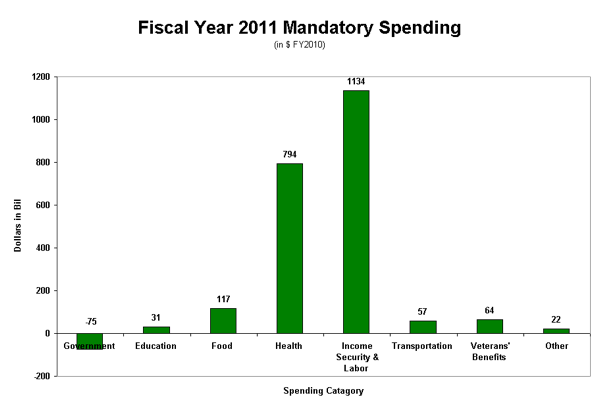
When they talk about the budget without talking about the real big expenditures, I say that is a wonderful example of bipartisanship.
Neither one wants to talk about the mandatory spending, but that is where the real money is! (source for the graph, via)
So, what is in this mandatory spending that takes up nearly 60 percent of the budget?
If only the joke weren't on us voters!
And, of course, even within the Discretionary Spending, way too much agreement on the need to spend a gazillion billion on defense :(

I like how Ezra Klein sums up the situation:
Well, the business of the American government is insurance. Literally. If you look at how the federal government spends our money, it’s an insurance conglomerate protected by a large, standing army.

Wednesday, May 05, 2010

OMG! Federal budget in 2020

This is from the Congressional Budget Office (CBO)

(A much simpler graphic than the one on PIIGS, and infinitely simpler than that nasty military Powerpoint slide!)

ht

Monday, March 01, 2010

Chart of the day: why we have fiscal problems

So, after retirement, at the official retirement age, and on an average, one can look forward to almost two additional decades of life here in the US.

This is when social security benefits kick in, along with Medicare, ...

You make the call :)

Wednesday, October 28, 2009

Quote of the day

“If the long-term issue is entitlement reform, ... the fact that the political system cannot say no to $250 checks to elderly people is a bad sign.”
From David Leonhardt's piece in the NY Times.  The quote itself is from Joel Slemrod, a University of Michigan economist.

Friday, June 12, 2009

More on debts and deficits ....

A follow-up to seeing nothing but red ...
The Economist notes that:
New figures from economists at the IMF suggest that the public debt of the ten leading rich countries will rise from 78% of GDP in 2007 to 114% by 2014. These governments will then owe around $50,000 for every one of their citizens (see article)
Say what?
So, what does the Economist say that we ought to do?

All told the outlook is bleak. In a few countries, the financial crisis has badly damaged the public finances. Elsewhere it has accelerated a chronic age-related deterioration. Everywhere the short-term fiscal pain is much smaller than the long-term mess that lies ahead. Unless belts are tightened by several notches, real interest rates are sure to rise, as will the risk premiums on many governments’ debt. Economic growth will suffer and sovereign-debt crises will become more likely.

Somehow, governments have to avoid such a catastrophe without killing the recovery by tightening policy too soon. Japan made that mistake when concerns about its growing public debt led its government to increase the consumption tax in 1997, which helped to send the economy back into recession. Yet doing nothing could have much the same effect, because investors’ fears about fiscal sustainability will push up bond yields, which also could stifle the recovery.

The best way out is to tackle the costs of ageing head-on by, for instance, raising retirement ages further. That would brighten the medium-term fiscal outlook without damaging demand now. Broadly, spending cuts should be preferred to tax increases. And rather than raise tax rates, governments would do better to improve their tax codes, broadening the base and eliminating distortive loopholes (such as preferential treatment of housing). Other priorities will vary from one country to the next. But after today’s borrowing binge, doing nothing is no longer an option.

That bottom line is what I like the best: "doing nothing is no longer an option." But, rushing to do something could also make things worse. Hmmm, what do they say about a rock and a hard place?

Wednesday, March 18, 2009

Quote of the day!

Going after Jim Cramer is like trying to fix your marriage by getting new drapes.
That was Megan McArdle.

I suppose we want a punching bag, and we have made available a few of them. Meanwhile, the war in Afghanistan and Pakistan is systematically escalated; social security crisis gets ignored; the youth and the children get stiffed with bills that they are not really responsible for .....

Oh well!

Monday, January 19, 2009

Spending our way into economic prosperity?

An excerpt from a FT opinion piece by David Walker, who was the head of the Government Accountability Office from 1998 to 2008.  I especially like his point on stimulus as a down payment on the future.

In fairness, we cannot assign all the blame to Mr Bush. Congress bears some responsibility, as do the American people. After all, in our constitutional republic it is “We the People” who are ultimately account able for what happens in Washington.

....

Any stimulus proposal should be timely, targeted and temporary. It should be large enough to make a difference, but not too large, and be properly structured in order to minimise waste. It should be designed to stimulate job growth and make targeted infrastructure and other investments to make America more competitive.

While some stimulus is called for, we cannot spend our way into economic prosperity, especially when all new spending is debt-financed. It was troubling to see one prominent incoming senior economic official refer to the Obama administration’s planned stimulus proposal as a “down payment” on the future. How can something be a down payment when there is no equity involved? This is an example of how words used in Washington do not always fit Webster’s definitions.

The president and Congress must put a process in place that will enable elected officials to reimpose tough statutory budget controls and reform our nation’s Social Security, Medicare, healthcare and tax systems. All these require significant reforms that Washington has delayed for too long. We also need a baseline review of all main spending and tax choices to re prioritise them to reflect 21st-century realities. 

Wednesday, July 23, 2008

How old is enough?

In two previous posts, I wondered about old age: will medical advancement make death optional, and whether politics is becoming the tyranny of the old. And then the impact of pensions and benefits pretty much bankrupting GM, and perhaps public agencies real soon.

Additional links on this "old" topic:
a. Should old faculty retire when they are eligible for retirement so that the younger ones waiting for a (tenure-track) job can get one?
b. At what age--80+,90+, 100+--do advanced medical treatments for the old become wasteful expenditures?

As a society, we have no choice but to deal with these difficult questions. Uncomfortable questions, no doubt. But, .....