Showing posts with label UN. Show all posts

Sunday, January 29, 2017

We are the world, dammit!

When I was young, like some of my schoolmates, I too actively supported the United Nations.  I still have a certificate for having participated in the UNO Day activities.

The older I got, the more I was concerned that the UN was not achieving any damn thing.  Yes, a few agencies were doing phenomenal work--the FAO, WHO, UNICEF, for instance.  But, think about the UN and we immediately only think about the Security Council and the General Assembly.  The votes and vetoes, where the permanent members play nothing but cold, calculated, political games.

Hence, unlike the young me, the older me has always been highly critical and cynical about all things UN.  But, I understand that for all of us around the world to work together, we have no choice but to deal with various kinds of chaotic, inefficient, and bureaucratic ways.  And given the larger goal of world peace and humanitarian work, well, it is worth it.

Towards this larger goal, I expect my country to also contribute a lot.  After all, with the wealth and power comes great responsibility.  I would any day spend more money to achieve peace and prosperity through such inefficient institutional structures than by bombing countries back to the stone age!

But, we have a new sheriff in the wild west.  The sheriff's deputy to the UN is a brown-skinned woman whose parents immigrated to this country.  From my old country.  But, she has completely whitewashed herself.  From converting to Christianity to parroting the lines of the white nationalist party, aka the GOP:
“You’re going to see a change in the way we do business,” Ms. Haley said. “Our goal with the administration is to show value at the U.N., and the way we’ll show value is to show our strength, show our voice, have the backs of our allies and make sure our allies have our back as well.”
“For those who don’t have our back,” she added, “we’re taking names; we will make points to respond to that accordingly.”
Think about this: "we’re taking names."  To make such a threat to the members of the UN when presenting her credentials and introducing herself?  Not the language of a diplomat who will want to work towards world peace!
The administration’s antipathy toward the United Nations has been sharpened since a Security Council resolution last month condemning Israeli settlements. Mr. Trump and Ms. Haley have criticized the Obama administration’s decision not to veto the resolution. And several Republican senators have supported legislation threatening to defund the United Nations unless the Security Council reverses the terms of the resolution, which Council diplomats say would be politically unworkable.
The GOP pivots on one main issue on the domestic scene, and one main issue on international affairs.  Within the country, whatever be the internal disagreements on issues, it is all about the egg that has been fertilized by semen. When they lift their eyes from this zygote, it is about the "holy land" of Israel.  The concern about the zygote does not mean worrying about the life of the child that is born--to heck with the living is the typical GOP response.  Similarly, the maniacal focus on Israel is less about the tortured history of the Jewish people, and more about the day of reckoning that the GOP faithful want to prepare for.

So, domestic politics gets reduced to the zygote.  And the UN gets reduced to Israel.  Everything else be damned!  Like the situation in Syria; remember this image?


Oh yeah, I forgot that we took care of that Syrian situation with an indefinite ban!


Saturday, September 24, 2016

May Peace Be With You

I have sent this across to the editor

The United Nations marks October 2nd as the “International Day of Non-Violence” for a very good reason--it is the birthday of Mohandas Karamchand Gandhi, popularly known as Mahatma Gandhi.

Gandhi, who was born in 1869, led the independence movement that, in 1947, resulted in the creation of two new countries of India and Pakistan and, with that the end of the British Raj as well. The struggle for freedom, in which Gandhi passionately urged his followers to observe non-violence even against the colonizer’s brutal force, inspired many others, including Martin Luther King, Jr.

Life is full of tragic ironies--Gandhi and King, the champions of peace and nonviolence, fell to bullets that were aimed at them. Unlike Gandhi, who was assassinated in 1948, King had not lived long enough to live in the promised land of freedom.

Albert Einstein summed it up best for all of us when he wrote about Gandhi that “generations to come, it may well be, will scarce believe that such a man as this one ever in flesh and blood walked upon this Earth.” On Gandhi’s birthday, it certainly will help us all to be reminded of, as the UN puts it, the human desire for "a culture of peace, tolerance, understanding and non-violence."

In the contemporary United States, any talk in the public space about peace and nonviolence is rare anymore. Politicians of all stripes want to prove how much they are tougher than the other, out of a fear of being labeled a wimp otherwise. This has been especially the case since the fateful events on September 11, 2001. At the national level, the “tough” ones smell blood when an opponent does not talk war. At this rate, even those running for the office of a local dog catcher will have to prove their toughness.

Of course, violence is more than merely about engaging in war. The political rhetoric over the past year seems to have been anything but peaceful and nonviolent. A new day begins with attacks on yet another person or group of people, based on whatever cultural trait is deemed to be the “wrong” one for the moment. So much so that even I, as insignificant as one can be in the political landscape, have been a target for those who are seemingly at ease with offensive words and rhetoric!

While words, unlike sticks and stones, do not break bones, the violence conveyed through words causes plenty of harm. In the noise and confusion of the violent rhetoric that surrounds us in the real and cyber worlds, we seem to have lost a fundamental understanding of what it means to be human,. One of Gandhi’s favorite prayers says it all about being human--it is to “feel the pain of others, help those who are in misery.” However, and unfortunately, the overall rhetoric and practice these days is far from that interpretation of humanity.

When it comes to the terrible humanitarian crises, like the situation in Aleppo, in Syria, it is depressingly shocking how quickly we closed ourselves from the “pain of others” and how easily we refuse to “help those who are in misery.” We have refused to budge even when the screens all around us flashed the images of Aylan Kurdi--the toddler who was dead, face down, on a beach--or the five-year old Omran Daqneesh, whose dust and blood covered face looked dazed and confused.

Meanwhile, all around the world, the number of people displaced from their homes continues to increase. The United Nations estimates that by the end of 2015, the number of people who have been forcibly displaced from their homes numbered 65.3 million. The UN High Commissioner for Refugees, Filippo Grandi, noted that “at sea, a frightening number of refugees and migrants are dying each year; on land, people fleeing war are finding their way blocked by closed borders. Closing borders does not solve the problem.”

As I write this column, peace and nonviolence seem to be evaporating even in Gandhi’s old lands of India and Pakistan. Tension between the two countries is at such high levels that international media and commentators wonder, and worry, whether the neighbors are getting ready for yet another war. As often is the case with these sibling countries, this time too the fight is over Kashmir, but with plenty of nuclear bombs on both sides of the border.

We shall certainly overcome, in the long run. In the meanwhile, on the “International Day of Non-Violence,” like the stereotypical beauty pageant contestant, I too will wish for world peace.

Wednesday, September 26, 2012

The best responses to Obama's UN speech

This excerpt:
Mr Obama quoted Mahatma Gandhi: "Intolerance is itself a form of violence and an obstacle to the growth of a true democratic spirit." The correct move here was to couch the American defence of the right to blasphemy in the words of a hero of the non-aligned movement whom even the Egyptians might have to applaud, lest they piss off the Indians. Nobody can be against Gandhi! So it's a safe applause line, for anybody except a funky postmodern anti-anti-colonialist like Dinesh D'Souza
Re-read that.  Does anybody come across as the good and principled guy?  Well, other than Gandhi; because, "nobody can be against Gandhi."

The Economist, which is where that excerpt is from, used to serve beauties like this, but it is becoming rare these days.


Sunday, December 04, 2011

The Durban Debacle. Or, Durban Disaster. Or, ...

You pick your choice of alliteration. Jagdish Bhagwati calls it Deadlock in Durban.
First, the United States under Obama's ineffective leadership has drifted yet further into a "What's in it for me?" attitude on key issues requiring international action. In place of what the economist Charles Kindleberger once called an "altruistic hegemon", the US that the world now faces is what I call a "selfish hegemon".

The second problem is that the sheer weight of the US in international affairs, though diminished nowadays, has nonetheless led to a corruption of the principles that should underpin a new climate-change treaty to succeed the Kyoto Protocol.
Ah, the US!  The "selfish hegemon" indeed!  
That is where the $100bn Global Climate Change Fund, promised at the Cancun COP-16 conference, comes in. Unfortunately, even environmental icons such as Al Gore in the US are so heavily invested in new green technology that their self-interest is tied up in this fund being spent on developing privately owned new technologies that are protected by patents.

The new "Green Revolution" seeds that the Nobel laureate agronomist Norman Borlaug developed with public money were freely available to all users anywhere. The technology developed by the money spent from the Global Climate Change Fund also should be equally available to all, including India and China, which would then enable them to agree to more emissions cuts.

Indeed, even the contributions to the fund should have reflected the past damage by the developed countries over the course of a century of carbon emissions - an obligation based on the well-established tort principle that the US has accepted for domestic pollution. But here, too, the US has rejected the idea outright.
I can't see the next elections making the US any more cooperative with the rest of the world.  Even if re-elected, we are looking at a lame-duck Obama with a divided Congress.  And with continued sluggishness in the economy, discussions on the global environment will not an agenda item even for the most insignificant subcommittee!

Naturally, the US position has not earned new friends:
The letter, signed by 16 different organisations and sent to the US Secretary of State, said that while President Barack Obama pledged in November 2008 to "engage vigorously in these negotiations, and help lead the world toward a new era of global co-operation on climate change," he had failed to deliver on that pledge.
Instead, the letter claimed, America is fast becoming seen as a "major obstacle" to progress.
Signatories included Greenpeace USA, the Natural Resources Defence Council, Oxfam America, the Union of Concerned Scientists and the World Wildlife Fund.
Shortly after it was made public, the European Union delegation at the summit criticised the US for "overlooking the facts" on the risk of climate change and suggested it was not doing enough at home to live up to its promises to cut carbon emissions.
Meanwhile, the ex-UN climate chief describes the talks as "rudderless:"
Yvo de Boer said he left his job as the U.N.'s top climate official in frustration 18 months ago, believing the process of negotiating a meaningful climate agreement was failing. His opinion hasn't changed.
"I still have the same view of the process that led me to leave the process," he told The Associated Press Sunday. "I'm still deeply concerned about where it's going, or rather where it's not going, about the lack of progress."
Ron Bailey calls it "Delusional in Durban"
The likelihood of draft proposals that require deep greenhouse gas emissions cuts by rich countries being adopted here in Durban is exactly nil.
 Dummies in Durban, eh!  

Wednesday, March 30, 2011

The UN Resolution is not a support for the Turd Sandwich, er, Libya War

Somehow, all the discussions on the Libya War having an international authorization completely and conveniently skips a critical piece of information: Out of the fifteen members, ten voted in favor and the remaining five abstained.

Breaking this down in a couple of different ways:
  • Of the five permanent members (US, UK, France, Russia, China) two abstained: Russia and China
  • Of the ten non-permanent members, India, Brazil, and Germany abstained.
  • I.e., the ones who did not commit themselves to this Resolution are: Brazil, Russia, India, China, and Germany.  Put those bold letters together, and you get BRIC.
    • BRIC is the group that is now driving the global economy, and Germany is Europe's and the Euro's economic giant.  This means that the Libya War does not have the support of the major economic forces of the day.
    • BRIC + Germany is turning out to be one powerful alliance.
  • The combined population of these five countries is nearly three billion, out of the 6.9 billion in the world.  
    • Germany is the smallest among the five abstaining members, but has the 14th largest population among all the countries.
  • Among the "yea" voters are the following countries that supported the US, France, and the UK: Portugal, Bosnia-Herzegovina, Gabon, South Africa, Nigeria, Lebanon, and Colombia.  South Africa is the only influential economy here.  Add up the population of all these countries and ... well, it is obvious, isn't it?
After the bombing began, the Indian government officially stated its regret over the war.
India views with grave concern the continuing violence, strife and deteriorating humanitarian situation in Libya. It regrets the air strikes that are taking place. The measures adopted should mitigate and not exacerbate an already difficult situation for the people of the country
It is not that I am presenting any sour-grapes argument similar to how in the US we complain about a state like Wyoming having the same weight at the Senate that a mighty California has.  I agree that we work with the established systems that we have.  But, while broadcasting the UN Resolution as the measure of international support for this unconstitutional war, we are conveniently ignoring the fact that the global economic and populous powers are not behind this war.

Well, come to think of it, I am not sure if I can refer to this as "war," given the various euphemisms that the administration prefers instead.  I do like the "turd sandwich" term :(

First up, Jon Stewart
The Daily Show With Jon StewartMon - Thurs 11p / 10c
America at Not-War - Obama Defends Military Action in Libya
www.thedailyshow.com
Daily Show Full EpisodesPolitical Humor & Satire BlogThe Daily Show on Facebook


And now, Colbert:
The Colbert ReportMon - Thurs 11:30pm / 10:30c
Turd Sandwich in Libya
www.colbertnation.com
Colbert Report Full EpisodesPolitical Humor & Satire BlogVideo Archive

Thursday, January 20, 2011

Facebook votes to disband UN

In 2040 ... according to this scenario of life in megacities, visualized by Forum for the Future (ht)
The emphasis here is on individual neighborhoods rather than cities, lessening transportation issues since people don't have to travel as far. Robotic cars have completely taken over from mass transit.

Megacities on the move - Communi-city from Forum for the Future on Vimeo.

Thursday, September 23, 2010

Quote of the day on global poverty

[Schools] have a better record of fighting terrorism than missiles do and that wobbly governments can be buttressed not just with helicopter gunships but also with school lunch programs (at 25 cents per kid per day).

International security is where the money is, but fighting poverty is where the success is.
That is from Nicholas Kristof's column in the NY Times today, in the context of the UN's Millennium Development Goals.  The last few columns from Kristof have been of a flavor that is markedly different from many of previous ones.  I like this version of Kristof much better--and way less depressing!

Sometimes, I wonder if the UN is being slowly replaced by other efforts--the politics, and the bureaucracy, at the UN means that things can happen only very slowly, if they happen. Thus, now, the Bill and Melinda Gates Foundation appears to be a better catalyst for global health issues than the WHO.  The Clinton Global Initiative seems to deliver a lot on various fronts ...

Wednesday, April 21, 2010

Cellphones and toilets--the Indian story

No, it is not about how people accidentally drop their cellphones in the toilet, then take them out and use them--after cleaning it, of course ... (hey, yes, I know at least one person who reads this blog who has done that; you know who you are!!!)
But, is about
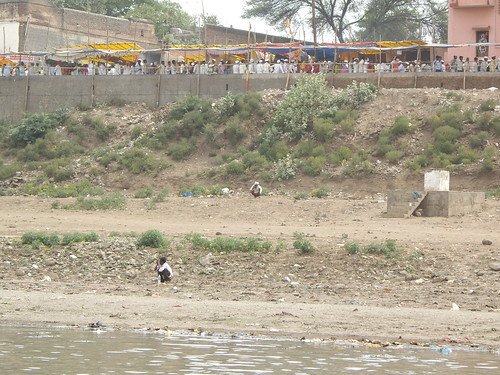
More people in India, the world’s second most crowded country, have access to a mobile telephone than to a toilet, according to a set of recommendations released today by United Nations University (UNU) on how to cut the number of people with inadequate sanitation. ...
India has some 545 million cell phones, enough to serve about 45 per cent of the population, but only about 366 million people or 31 per cent of the population had access to improved sanitation in 2008.
The issue of lack of sanitation in India is not new to this blog.  I have also written at least one op-ed about this.  I hope this situation will change for the better real soon ...
(photo: from flickr)

Wednesday, August 27, 2008

Pakistan: situation normal all f*ed up!

In addition to my previous blogs on Pakistan, here are more developments that can easily make Georgia or even bin Laden the least of our worries!

There are reports that the US ambassador to the UN, Zalmay Khalilzad, will resign as early as October. Why is this news? Because Khalilzad had taken it upon himself to advise Pakistan's Zardari--Benazir's widower--during all that confusion over Musharraf's impeachment and the successor to Musharraf. Turns out that he was working with Bhutto even back in 2006. Condi Rice's people are furious with Khalilzad. Naturally. In most parts of the world, locals do not appreciate any perception of foreign interference in their politics--more so when it happens at a critical state that Pakistan finds itself in. To top things, there have always been speculations that Khalilzad has plans to contend for Afghanistan's presidency--because Hamid Karzai has been so ineffective. In case you are wondering, well, Khalilzad is a naturalized American who was born in Afghanistan.

And, internally, Zardari is the leading candidate for Pakistan's presidency. But all is not well there. In addition to Sharif withdrawing from the government, the Financial Times reports that Zardari is not well--that the guy has severe psychiatric problems. He apparently "was diagnosed with a range of serious illnesses including dementia, major depressive disorder and post-traumatic stress disorder in a series of medical reports spanning more than two years." Great, make a mentally unwell guy in-charge of the nukes. Dr. Strangelove could not have devised a better plan! Of course, according to Zardari's people, he is fit as a fiddle.

Meanwhile, militants have stepped up their activities in Pakistan. The expansion of "SNAFU" is the approriate descriptor for where Pakistan is today.

Friday, July 04, 2008

India's scavengers: horrible practice

From the BBC: Official statistics in India say that there are still around 340,000 scavengers working in villages and small towns.
The UN aims to reduce by half the number of people without basic sanitation by 2015.
But in India alone they face a huge task.
It's estimated that around 700 million Indians to do not have access to safe and hygienic toilets.
Experts say that scavenging in India is most prevalent in the states of Uttar Pradesh, Rajasthan, Madhya Pradesh and Gujarat.