Saturday, February 07, 2015

We are the good guys, right? But,wait, who are they?

Sometimes, I wish I had some kind of a tribal affiliation.  A passionate affiliation where there is a distinct us versus them.
Even as simple as rooting for "my team" versus the "other team" that I want to lose.
Or, my political party to win the elections versus the other that I want gone.
Or, if only I was passionate about my single issue!

Maybe I should rename the blog title to "A rebel without a cause."

When I was younger, I had such affiliations.  The cricket team.  The commies.  Even the Trojans!  Now, it has been years without tribal affiliations and, thus, forever I am in a party of one.  There is no "us" and "we."  Because, unlike with the rules of tribal behaviors, I don't have to prevent myself from expressing a dissenting thought.  And when that is expressed, well, I become branded as one of "them."

The older I get, the more suspicious I am of being in a herd.  I can now see a lot more than mere humor in Groucho Marx's response, "I don't want to belong to any club that will accept me as a member."  Membership comes with more than privileges, yes, but it also seems to intentionally breed a us-versus-them.

This essay, which often has material at levels that are simply way above my paygrade, begins with a verse by Rudyard Kipling.  A verse that I am able to understand, appreciate, and agree with too:
All good people agree,
And all good people say,
All nice people, like Us, are We
And everyone else is They:
But if you cross over the sea,
Instead of over the way,
You may end by (think of it!) looking on We
As only a sort of They!
How do writers like Kipling manage to string together a few words that then get across some awesome stuff?  I wish I were like "them" ;)

Friday, February 06, 2015

Does grammar matter at work? Depends!

"They don't told us where it's at" she said.

Grammar depends on the context.

If a teacher had said that, well, you know you never ever want to be in that educational setting.  The ungrammatical sentence didn't come from a teacher.  In fact, not from a student either.  If it had been a student, I would have suffered that obsessive compulsion to correct that person.

It was at a retail establishment.  A place that is not for the white-gloved.

I am happy that there are such places where people have jobs.  Not all of us have the capabilities or the interest to be investment bankers or teachers or politicians.  To quote from Caddyshack, the world needs ditch-diggers too.

But, even those jobs are evaporating.

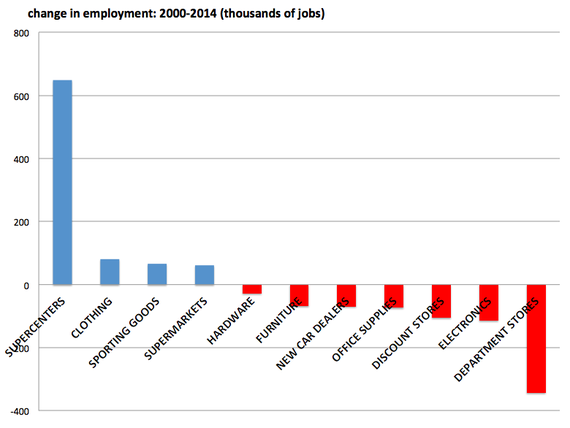
source

There's something happening here.
You don't need a long explication to see what's going on here. Walmart brought ruthless efficiency to the business of selling stuff in stores, and Amazon brought more ruthless efficiency to the business of selling stuff anywhere, so that today, to be a retail salesperson or cashier—still the two most common jobs in America—is to compete with the convenience of a laptop and a couch (or, even worse, a smartphone search filling a spare moment of boredom). As Radio Shack's story shows, when companies go to war against price and convenience, they tend to lose—first go the jobs, then goes the company. ... There is little reason to think that the most important employment engine of the 20th century will continue to pump through the 21st. The future will be cheap, and it will be convenient, but much of it will lose the personal touch of, well, people.
Even as those jobs are evaporating, the chances are that the ones that remain don't pay well.
Though unemployment has finally dipped below six per cent, real wages for most have barely budged since 2007. Indeed, the whole century so far has been tough: wages haven’t grown much since 2000.
Sometimes, I wonder how people make the proverbial ends meet.  And every time I have such encounters, I can't but think it is crazy for the well-heeled like me to ask for raises and for more benefits.

But, of course, those in my earnings bracket aren't comparing themselves to that ungrammatical retail person but to the investment bankers and CEOs.
corporate America, if not the rest of the economy, has done just fine over the past five years. It’s that all the rewards went into profits and executive salaries, rather than wages.
I don't care about my raise.  But, I am pretty darn certain that executives can easily forego a few dollars in order to ensure that the ungrammatical retail person gets to go home with a few more dollars.  Is it possible?  Yes, at least in one company, apparently:
Aetna’s C.E.O., Mark Bertolini, announced that the company’s lowest-paid workers would get a substantial raise—from twelve to sixteen dollars an hour, in some cases—as well as improved medical coverage. Bertolini didn’t stop there. He said that it was not “fair” for employees of a Fortune 50 company to be struggling to make ends meet. He explicitly linked the decision to the broader debate about inequality, mentioning that he had given copies of Thomas Piketty’s “Capital in the Twenty-first Century” to all his top executives. “Companies are not just money-making machines,” he told me last week. “For the good of the social order, these are the kinds of investments we should be willing to make.”
The lowest paid get raises and executives got copies of Piketty's book.  How fascinating!

Sometimes, an extra effort is needed to make sure that a rising tide will lift not only the yachts but also the rafts and the catamarans--wherever they are floating "at."

Source

Thursday, February 05, 2015

Would you let this idiot teach in a university?

Remember the following line from yesterday?
All sorrows can be borne if you put them in a story or tell a story about them
The essay noted that it was from "the writer Isak Dinesen."

That's it. The essayist simply assumes that blokes like me would recognize the name Isak Dinesen.

So, of course, I had to Google; what other option did I have!


Do you see why I thought I made a mistake?  I search for Isak Dinsen, and the first in the list is Karen Blixen.  Pseudonym.

The plot was getting thicker.
Blixen is best known for Out of Africa, her account of living in Kenya, and one of her stories, Babette's Feast, both of which have been adapted into highly acclaimed, Academy Award-winning motion pictures. Prior to the release of the first film, she was noted for her Seven Gothic Tales, for which she is also known in Denmark.
Boy don't I feel like a fool!  She is the one from Out of Africa?  The one that I was talking about the other day because my daughter was just at Masai Mara?

I then did a Google search for "Karen Blixen Kenya" and, wait, there are coffee plantations and a gazillion other things with her name?  And all this is the famed Masai Mara part of Kenya?

And, my, what a colorful and rich life she had!
"Isak" was appropriate: Blixen's emergence as a writer was indeed late and unexpected. She had returned to Denmark in 1931, stony broke – her marriage was finished; her African coffee farm had failed; her romantic lover, big-game hunter Denys Finch Hatton, had died in a plane crash. Although she had written much earlier – her first stories were published when she was barely 20 – she'd chosen marriage and Africa over writing; but that life was now finished. At 46, she must have been feeling both desolate and desperate; but also, evidently, boiling with creative energy.
It is amazing how every day is a revelation of how little I know.  I am amazed that they let me teach!  In a university!