Showing posts sorted by date for query economics. Sort by relevance Show all posts

Saturday, October 22, 2022

Identity Politics

The UK will soon get its third Prime Minister in a matter of three months.  Fifth one in six years.

After the Brexit vote, when Leave beat Remain by 52 to 48, I commented:

A referendum that was heard around the world. This will certainly have enormous repercussions throughout the world, for years to come. An event perhaps as important as the Berlin Wall coming down ... Real life is always infinitely more unpredictable than we can ever imagine.

I was cheering for Brexit, but for a reason that I have been warning about for years.  A reason that is common to both Brexit and tRump and trumpism here in the US: The loss of the importance of geographic and national identities in a rapidly globalizing economy.

Back in 2014, which now feels like eons ago, I was cheering for Scotland to quit the "united" kingdom.  Yes, of course, I want even the remnants of the old empire to crumble to dust.  That will be poetic justice. And I will continue to laugh at jokes like this one: A demon took a monkey to wife – the result by the Grace of God was the English.

But that was not why I cheered Scotland on.  I wrote then:

I am all in support of an independent Scotland for a very simple reason.  We are so much wrapped up with the idea of globalization that we forget we are humans and we like, we love, identities.  Identities especially when there is a long and rich history of the peoples.  Economics--being materially well off--does matter to us, yes.  But, we seem to overlook that we do not live on bread alone.  There is a lot more than mere material satisfaction that makes us human.  Identity--religious, ethnic, linguistic, ... and often these are also intertwined.

That was in 2014.

The post did not go well with one commenter, and I piled on:

My point was that economics aside, people have plenty of other values that cannot (and should not) be monetized. If they value that, and if they want to express that by wanting to go "Scot free" then more power to them. I assume they know what they want and what they are getting into. 

I would point to my old country as an example of a very high price being paid in order to maintain an artificial entity called India. There was no "India" in history and is a creation of the British. Up until the British Raj, those lands had different cultures, traditions, languages, religions, ... One of the worst decisions that the strong man Patel did was to force those who did not want to join the union by even employing the military.

I built on this as the Brexit vote neared in 2016:

The challenge, as I see it, is to figure out how to understand each other and engage in constructive cross-cultural relationships even while holding on to the identities and without making those identities as a metric for hierarchical comparisons.  The solution is not to erase the identities but to understand that we can create a much better future even as we tightly embrace whatever identity that we want to hold on to.

But, this was a challenge that the left-of-center did not take up.  The right-of-center wholeheartedly embraced it because they found a divisive issue on which they could stir up the emotions.

Going further back, to 2011, I quoted one of my favorite political economic thinkers, Joseph Stiglitz, who wrote:

Of all the costs imposed on our society by the top 1 percent, perhaps the greatest is this: the erosion of our sense of identity, in which fair play, equality of opportunity, and a sense of community are so important.

Way back, in 2006, I authored a newspaper commentary, in which I wrote:

We have been so wrapped up with our fascination with globalization that maybe we assumed that ours is a homogenous world. On the contrary, we have different languages, religions, beliefs, histories. And sometimes, people want explicit recognition of those differences.

So, yes, I have been talking and writing about this forever.

No new prime minister will be able to immediately provide a sense of identity and a sense of community.  Inflation and the cost of heating as winter descends will further agitate Britons of every political stripe.  Should Vlad the Aggressor decide to go nuclear in his failing war against Ukraine, the UK will be torn apart by domestic and foreign agendas.

Meanwhile, here in the US, the far right wants to clearly establish an American identity as nothing but white, Christian, and heterosexual, exactly as Jesus and the Constitution intended!  The old country is bulldozing its way to defining India as Hindu.  In China, you can be whatever you want to be as long as you do not talk about being a Muslim or a Uighur or protest for freedom.

Where do we go from here?

Moral clarity makes it simple: First, vote out the wannabe fascists wherever you have the right to vote! 

And then, compel the political leaders to articulate an inclusive vision that allows for distinct identities within national identities even as we work together as a global humanity.  In the old country, we were fed a line in the civics curriculum: Unity in diversity.  Here in the US, some of us cherish e pluribus unum as the real and only motto.

Otherwise, I need to remind you of this: "We have met the enemy and he is us."

Wednesday, September 28, 2022

Consumers don't know the Texas Two-Step

We use "Band-Aid" even in contexts that are not about a cut and bleeding.  Like, when we criticize public policies as nothing but a Band-Aid on the problem.  It is so much a part of our social vocabulary that we forget that Band-Aid is like Xerox--a very specific product that is trademarked.

Band-Aid was invented and made popular by a huge multinational company, Johnson & Johnson.  It is one of the few companies that constitute the Dow Jones Industrial Average, aka the Dow.  Its product range is vast.  How vast?


There's a lot more to what J&J produces--those are merely familiar examples.

Notice the "But" at the end of that excerpt?  There's always a "but" that tells us, as Paul Harvey used to say, the rest of the story.  In the case of Johnson and Johnson, the "but" that is the crux of this New Yorker essay is this: "But what few of those consumers grasped until a series of baby-powder cases began to go to trial was that, for decades, the company had known that its powders could contain asbestos, among the world’s deadliest carcinogens."

One cannot put a Band-Aid over such a problem in which a product has a known carcinogen.  A problem that J&J has known for years.

The company has known all along, but consumers have been aware of it only for a few years.  This is "information asymmetry," which is one of the concepts that I understood in graduate school.  In market economics, we refer to the warning caveat emptor--buyer beware.  But, what if the buyer simply has no clue about carcinogens that a powerful multinational company has known all along?

We consumers are screwed.  That's the simple bottom-line.

Think about the fact that J&J has known for years about the carcinogen in the baby-powder it manufactured and marketed.  It couldn't care about the health effects on consumers.  And when consumers finally linked their ovarian cancers and other health issues to the product, of course J&J did not accept responsibility and discontinue the manufacture and sales of the deadly product.  Instead, the company employed an army of lawyers to fight back.

Here's the most godawful way in which J&J fought back "legally": Johnson & Johnson filed for bankruptcy.

Actually, J&J did not go bankrupt.  After all, it won't be part of the Dow then, right?  This is where the Texas Two-Step comes in.  I had no idea (meta information-asymmetry!) about this “the greatest innovation in the history of bankruptcy” until I read the essay:

The company that did so was called LTL Management L.L.C. LTL, which stands for Legacy Talc Litigation, was created in Texas on October 11, 2021, and merged on the following day with—let’s call it Old J. & J. That same day, LTL Management was converted to a limited-liability company based in North Carolina, and two days after that, on October 14th, it filed for Chapter 11 protection in the U.S. Bankruptcy Court in Charlotte.
The L.L.C. that Johnson & Johnson created never had an office or any employees of its own in Texas or North Carolina. It never manufactured or sold talcum powder; for that matter, it never really conducted any business at all before going belly up. Still, in between its formation in one business-friendly jurisdiction and its bankruptcy in another, the new company took on all of Old J. & J.’s talc liabilities. It was suddenly responsible for some forty thousand talc cases, while a new company, also called Johnson & Johnson Consumer Inc., emerged with all of Old J. & J.’s assets—those tens of billions of dollars—and none of its talc liabilities, leaving it free to carry on with its operations.
The bankruptcy route taken by Johnson & Johnson, formally called a divisional merger, is better known as the Texas two-step.

This bankruptcy shell-game is being challenged in higher courts.  But,

[Many] companies are exploring strategic bankruptcy as a cheaper, faster way out of mass torts. 3M recently tried to move tens of thousands of lawsuits filed by veterans over its allegedly defective Combat Arms Earplugs into bankruptcy after three years of litigating the cases in an M.D.L. Bayer could decide that bankruptcy court is a better way out of the long-tail liability it faces from its product Roundup, which contains glyphosate, a chemical that plaintiffs claim has been linked to non-Hodgkin’s lymphoma.

I do not understand how the executives in-charge of such decisions go to sleep at night fully knowing that they sell products that kill.  And there are lawyers in plenty who not only defend these bastards but also come up with more novel legal schemes.  May all of them be tortured to the maximum when they go to hell that their religions warn them about.

Johnson & Johnson’s most recent quarterly report shows twenty-four billion dollars in sales, and, in the eleven months since it filed for bankruptcy, an average of one woman a day has died waiting to find out if her case against the company would ever be heard.

As an individual consumer, what can I possibly do?  Here's a listing of some of the J&J products that I use: Tylenol, Imodium, Neosporin, Motrin, Zyrtec, Listerine.  I suppose I could buy the generic versions of these, or buy competitors' products. But, I am aware that there are no saints among the multinational corporations that sell us everything from paper towels to automobiles.

I have only one option: Elect people who will go after these bastards.
Your vote, too, has consequences.

(Readers in India need to note that J&J continues to sell talc-based baby powder in India, despite discontinuing in the US and Canada.)

Saturday, May 28, 2022

Life in the slow lane

A two-day weekend was not the norm when I was a kid.  At least, that's how I remember my childhood.  Sunday was a day off from school.  And only the second Saturday of every month was a holiday.

What did we do those Sundays and that lucky Saturday every month?

We helped my father dust and clean our home.  In my tweens, that dusting operation is how I found out that I have intense allergies to cobweb dust.  The reaction was so intense once that I had to be taken to the hospital for an intravenous shot.  My father and sister sneezed and carried on!

Some Sundays we had luxurious oil treatment.  We rubbed the warmed up oil all over and let the skin soak it all up for maybe a half an hour, some of which was spent under the sun sitting on the washing stone in the backyard.  We read a magazine or a book while letting the oil do its job.  And after washing up, we sat down for amma's special Sunday meal.

I am sure that my sister listened to the radio in the afternoon, as she did in the evening and night too.  Amma read her magazines.  Appa wrote letters to the extended family.  My brother and I would start playing chess and end up fighting, or we would play badminton and end up fighting, or fight just because.  It was not unusual for friends to drop in for a visit in the evening.

That was the weekend.

It is a contrast to the life that most of us lead now.  We think that puttering at home is not enough of an activity for the weekend.  "What are your plans for the weekend" is a typical question at the grocery talk small talk and among colleagues and friends.


Simply because we want more.  We want to consume more.  We want to shop for things, even if we don't need them.  We want to eat out even when we know it will be unhealthy for our health and the pocketbook.  We need to keep up with the Joneses.  We know “we must stop shopping, and yet we can’t stop shopping.”

Aswath Damodaran, a professor of finance at the Stern School of Business at New York University, grew up in Chennai, India, in the 1960s and predicts that in the wake of a drastic contraction in consumption, cities would most likely resemble the Chennai of his childhood: “There were no toy stores. Three restaurants for a city of millions. One bookstore, because who needs books?”

Damodaran, from my old country, is being true to his business school thinking and warns that without all of us spending our money, we won't have restaurants round the corner and kids won't have toys.  And that is a problem because ...?  Incidentally, we had all the toys that we needed.  And most of them were made of wood and not plastic, which threatens our lives.

We have granted money and economics way too much importance in life and in our collective decision making.  Even this atheist worries that we worship the market.  I will be happier if the faithful were sincere in their faith; after all, every old religion advises people not to be obsessed with money.  The world has enough and more to help out those who don't.  But, of course, there are lots of privileged people who oppose helping out fellow humans.

I don't imagine that we will change our ways of thinking.  I am sure that even now kids have a hard time imagining the kind of childhood that I had.  In a few years, there won't even be people with firsthand experiences of such lives.  

So ... what are your plans for the weekend? ;)

Tuesday, May 10, 2022

Unearthing the future

The evidence of lignite mining in Neyveli was visible to us if we stepped outside our compound.  From the gate, towards the far end of the road, we could see a small brown sandy hill, which was the overburden from the mines. Years later, the mining area expanded.

What if the lignite hadn't been mined?

The answer to that question is pretty simply that without the mines, there wouldn't have been a thermal power station.  The electricity generated at Neyveli was (and is the case today too?) critical for the state's economic activities.

Mining permanently transforms the terrain and the entire ecosystem.  But, without the essential mining like at Neyveli, there is no economic progress either.

Such a tension between nature and economics is played out all over the world.  As students learn in ECON 101, there's no free lunch.  Something gotta give.

We face those tradeoffs when it comes to "green" energy options too.  In the race to power the world without fossil fuels, we have come to realize the importance of a lightweight: Lithium.

The International Energy Agency named lithium as the mineral for which there was the fastest growing demand as the world transitions from oil and gas to a green energy grid. If the world is to meet the global climate targets set as part of the Paris Agreement, at least 40 times as much lithium will be needed by 2040 compared with today.

We need lithium.  We need lots of it.  We need it now.

Lithium has to be mined.  And, mining has problems.  The problem has reached my neighborhood, to so speak.  There is plenty of lithium in a vast area near the Oregon-Nevada border, in the McDermitt Caldera.


In addition to the impacts on the environment, the mining activity will happen on ancestral lands of Native American tribes.  It will be a vast open-pit mining operation, similar to lignite mining in Neyveli.

The 18,000-acre Thacker Pass mine would reach into ancestral lands of the Fort McDermitt Paiute and Shoshone Tribes, the Burns Paiute Tribe, Reno Sparks Indian Colony and the Shoshone-Paiute Tribes of Duck Valley Indian Reservation.

Several of the tribes, along with environmental groups and others, say the mine would wreck their land, resources and culture, depleting or poisoning water supplies, destroying sacred sites, degrading wildlife habitat and leaving behind hazardous waste.

“They will never ever be able to repair this area. It will never look the same. It will never be reclaimed. It has irreparable harm,” [Daranda] Hinkey said. “What we see here is destruction of the lands, contamination of the water and complete cultural genocide to the Indigenous people here.”

To recap, on the one hand, we have a rapidly growing demand for lithium, which is needed for the transition away from fossil fuels that is screwing up the global climate.  On the other hand, ... Estimates are that about 79% of lithium that can be mined in the US are within 35 miles of Native American reservations. 

So, how would you resolve this tension?

Meanwhile, lithium is not the only metal that we will need in plenty in order to go forward into a renewable energy future.  Recall this issue about cobalt, which is one hell of an expensive item in the lithium-ion battery?

The root problem will be obvious to anybody who thinks through all these.  The root problem is our consumption.  We want nice homes, climate controlled indoors, good food, great entertainment, fabulous clothes, travel to see the world, and more.  Of course, I am no exception; I want them all!  But, this collective consumption, for which there is no seeming end, means that we cannot ever get away from the difficult tradeoffs that we need to make.  Remember, there's no free lunch!

How would you unearth the future?

Monday, April 25, 2022

The other guy

Jerry Seinfeld had a bit about the "Three Tenors" in his hit show, playing on the notion that people could name Pavarotti and Domingo, but couldn't name the third of the trio, who then became "the other guy."  It is perhaps the story of people who don't get no respect!

Growing up, we knew the names of India's Nobel laureates.  Three at that time: Rabindranath Tagore, C.V. Raman, and the other guy.

That other guy was Har Gobind Khorana. 

It is not that we didn't know his name.  We did.  It is just that while Tagore and Raman lived and died in India, Khorana lived abroad.  Further, he was technically born in Pakistan.  Even worse, Khorana gave up his Indian citizenship in favor of living in America, which did not appeal to some of us kids who were quite jingoistic after the Indo-Pak war of 1971.

My father's friend, RV, visiting from America a few years after the war challenged my ideas of what it meant to be Indian.  I remember asking him if he knew the American national anthem.  After all, those were the days before the internet and we relied on books or people for information.  A good sport that RV was, he sang the first couple of lines.

Here I am now blogging this as an American, which has been my nationality for more than two decades.  It is now a different world in which people from India are spread far and wide across the world.  The Indian diaspora is the largest in the world.  There are no crocodile tears over the alleged brain drain.  As I like to joke, my exit was no brain drain.  With my move from India to the US, I simultaneously increased the IQ levels in both countries ;)

So much have the conditions changed over the decades that an American with an Indian parent is now the Vice President of the US is celebrated in India as one of theirs--a contrast to how Khorana was treated decades ago.

This year marks the centenary of Khorana's birth.  But then we aren't sure of that: "The exact date of his birth is not known, because Khorana was born in poverty in a British Indian class that rarely recorded such dates."

What a tragedy that they did not teach us kids Khorana's life story as a shining example of one who was born dirt poor and yet became a Nobel laureate!  How awful that a bizarre and twisted notion of nationalism prevented us from understanding his accomplishment.  As an older man, I have grown to become highly suspicious, to put it mildly, of people and politicians being very nationalistic.  Need I remind you about trump and modi in my adopted and birth lands?

In 1949, Khorana returned to India after earning a PhD in chemistry, "but his promised government job never materialized because the newly independent country was bankrupt."  India's loss was perhaps for the betterment of humanity; Khorana would not have been able to conduct the research that he was able to do in the better funded and equipped labs in Canada and the US.

"In spite of his acknowledged success and prominence, racism marred Khorana’s life through much of his career."  Seriously, why did they not teach us about Khorana's life in order to inspire us kids?

Though the rate of change has been slower than what I prefer, I am nonetheless glad that conditions have changed for the better.  There have been two other India-born Nobel science prize recipients since Khorana--Chandrasekhar and  Ramakrishnan.  (No, economics, for which Sen received a Nobel, is not a science!)  They were not given the silent treatment that was directed at Khorana, but were warmly and enthusiastically celebrated.

Some time soon, I hope, that a person whose work and life was only in India wins a Nobel Prize in the sciences.  If and when that happens, I won't be surprised if that person is a woman.

Tuesday, December 07, 2021

A Faustian Bargain

In the township where I grew up, a fertilizer factory was a part of the project in which mining lignite and generating electricity from it was the star.  This fertilizer factory was the first in the southern part of India to manufacture urea. 

Despite the fact that urea was in great demand, the plant managed to run into losses, the economics of it was perhaps beyond the imaginations of paper-pushing bureaucrats!

A reminder that urea is a concentrated nitrogen fertilizer.  For a rapidly growing population, there is only so much nitrogen that soil can naturally offer, which is why we have relied a great deal on urea.

How important is this synthetic fertilizer? 

As I blogged here a few years ago, "Half of us wouldn’t be alive today if not for synthetic nitrogen. ... Another mind-blowing way to think about it: On average, half of the nitrogen in your body was synthetically fixed."

Of course, practically everything that we do is a Faustian Bargain.  We pay a big price for our reliance on urea.

What would happen if we suddenly stopped relying on this synthesized nitrogen?

We are experiencing it now, not because the world decided to get away from urea but because prices have rocketed up thanks to a "a freakish confluence" of factors.  The high prices and shortages have choked quite a few economic activities, including farming.

But, isn't avoiding fertilizers and going organic a positive development?

Conceptually, yes.  But in a world of 8 billion people, it is doubtful that we can feed everybody without synthesized nitrogen in particular.  And this is what Sri Lanka is finding out the hard way after the government's campaign toward organic farming:

[Farmers] and agriculture experts blame the policy for a sharp drop in crop yields and spiraling prices that are worsening the country’s growing economic woes and leading to fears of food shortages. 

Prices for some foodstuffs, like rice, have risen by nearly one-third compared with a year ago, according to Sri Lanka’s central bank. The prices of vegetables like tomatoes and carrots have risen to five times their year-ago levels.

Why did prices rise so much?

[Three-quarters] of Sri Lanka’s farmers relied heavily on chemical fertilizers, while just about 10 percent cultivated without them. Almost all major crops grown in the country depend on the chemicals. For crops crucial to the economy like rice, rubber and tea, the dependence reaches 90 percent or more.

One does not need to be an agronomist to understand why a sudden withdrawal from synthetic fertilizers would result in such shortages and price hikes.

Now Sri Lanka’s government, run by members of the Rajapaksa family, is rushing to avert a crisis. Late last month, Sri Lanka’s plantation minister, Ramesh Pathirana, confirmed a partial reversal of the policy, telling the country’s Parliament that the government would be importing fertilizer necessary for tea, rubber and coconut, which make up the nation’s major agricultural exports.

And in the old country that has been hit by shortages and inflation?  I assume that there are many more tragic stories like this one:

Danpal Yadav, 44, a rice grower in the central state of Madhya Pradesh, was already reeling under debt because of low crop yields last season. After coming home empty-handed from visits to government fertilizer distribution centers, he grew anguished and talked about suicide, his family said. 

Time was running out for Mr. Yadav to nourish his fields. On Oct. 28, after sleeping outside a fertilizer center for three days and getting nothing, he returned home and bolted the door. 

His brother Vivek later found him unconscious. He had consumed poison. Doctors declared him dead at a hospital. 

“He was desperately trying to find fertilizer,” Vivek Yadav said. “This is the story of every farmer during this season.”

Thursday, February 04, 2021

Subdue the earth? No!

In graduate school, a classmate remarked that his Jewish family would watch out for Jewish names in the news, whether it was good or bad.  I told him that I found doing something similar--watching out for Indian names.  And, if it was a Tamil name, then it was even more exciting.

Of course, sometimes the names pop up in unfortunate circumstances (like here or here.)  But, and thankfully, those are rare.

The cherry on top of awesome news was undoubtedly getting a dosai connoisseur as the Vice President ;)

It is human, after all, to applaud "our people."  An applause that does not have any baggage of superiority of inferiority.

It was that same graduate school excitement that I felt when I read the name of the lead author of a UK government report on the economics of biodiversity: Sir Partha Dasgupta.

My man!

All I read was the Headline Messages.  I love it.

The report notes this: "The Review develops the economics of biodiversity on the understanding that we – and our economies – are ‘embedded’ within Nature, not external to it."

We are embedded within Nature, not external to it.

The fact that we even need to be reminded about this fundamental aspect of life!

Back in graduate school, one of the discussions was the framework that the Judeo-Christian religions offered in contrast to many others around the world.  In the Judeo-Christian approach, god made man in his image and likeness. Then:

And God blessed them, and God said unto them, Be fruitful, and multiply, and replenish the earth, and subdue it: and have dominion over the fish of the sea, and over the fowl of the air, and over every living thing that moveth upon the earth.

In the Judeo-Christian framework, god rules over man, who rules over nature.

That relationship is very different from what the faith in the old country told me.  Whether it was Native Americans or people in India or elsewhere, nature was worshiped.  There wasn't a sense of everything on earth as humans to take any which way it pleased them.

Sir Partha Dasgupta reminds us that we are embedded in Nature.  We don't rule over it.  We are so much intertwined with nature that "Dasgupta said assigning absolute monetary values to nature would be meaningless because life would simply cease to exist if it was destroyed."

Dasgupta's report notes:

[Relying] on institutions alone to curb our excesses will not be enough. The discipline to draw on Nature sustainably must, ultimately, be provided by us as individuals. But societal change – particularly growing urbanisation – has meant that many people have grown distant from Nature. Interventions to enable people to understand and connect with Nature would not only improve our health and well-being, but also help empower citizens to make informed choices and demand the change that is needed

Read the 10-pager.  Spread the word.  Be good to Nature.

Saturday, October 17, 2020

Want to talk about Sully Prudhomme?

Six years ago, I argued in my talk that academe that has been taken over by hyperspecialization, because of which we have failed to contribute to big and contemporary questions for which the public is eagerly looking for answers.

Hyperspecialization has its place, no doubt, even though it leads researchers to inventions and discoveries that are fraught with ethical concerns.  But, that level of hyperspecialization is required in the natural sciences, and not in the social sciences and the humanities.

I could re-run that argument practically every time the "Nobel" Prize in economics is announced.  But, who cares about what I think; let's hear from a real expert--Branko Milanovic.

I have blogged a lot quoting Milanovic.  A consummate scholar, with a phenomenal level of expertise in income and wealth inequality.   A decade ago, Milanovic crunched a whole lot of data and gave us this simple and clear bottom-line: "an astounding 60 percent of a person’s income is determined merely by where she was born (and an additional 20 percent is dictated by how rich her parents were)"

Isn't that a perfect example of big and contemporary issues that the public wants to understand?  Especially here in America where we are told that you, too, can pull yourself up by your bootstraps and become a wealthy individual, we need such a reality check.  You can certainly hang on to your bootstraps, but it will certainly help to be aware it is rigged game in which 80 percent is pre-determined.

Milanovic had a few thoughts after the economics "Nobel" was announced.  He writes (well, tweeted):

when we ignore this biggest issue of all, we are --as indeed we seem to be-- in the world of Nobel in literature. At the time when Tolstoy, Joyce and Proust were publishing, the Nobel prize went to… Sully Prudhomme. Yes, Sully Prudhomme (check it out).

Sully Prudhomme?  I have never even heard this name before. So, yes, I checked it out.  Strange!

In a threaded series of tweets, Milanovic writes:

The point I want to make is this: Economics is a social science. Its aim is to make us understand the world and make people’s lives (materially) richer. The work that should be singled out is the work that does that—in a big way.

Yep.

Tuesday, August 11, 2020

Dosais for breakfast in the People's House in 2021

I am absolutely delighted that Kamala Harris is Joe Biden's running mate.

A year ago, as the Democratic wannabes were positioning themselves, and when it seemed like Haris was a formidable front runner, The New Yorker profiled this daughter of immigrants--Jamaican father and Indian (Tamil) mother.


Harris' mother was from Chennai.
Harris’s mother, Shyamala Gopalan, the Brahman daughter of a diplomat from Chennai, graduated from the University of Delhi at nineteen, and, avoiding an arranged marriage, went to Berkeley to study nutrition and endocrinology. There, she met another graduate student, Donald Harris, from Jamaica, who was pursuing a Ph.D. in economics. The student civil-rights movement, centered on the Berkeley campus, gave the two young immigrants a shared context. “They both identified as people of color and people who were oppressed by a white-male-dominated world,” Meena Harris, Kamala’s niece, told me. “Their fields were science and economics—there were not many Indian women or black men.” They were married while still in graduate school, and Kamala was born in 1964; another daughter, Maya, came two years after that.
A wonderful immigrant story.  Only in America can a brown-skinned woman come to study advanced science, marry another brown-skinned immigrant doing advanced studies in economics, and have a daughter who grows up to be the attorney general of the biggest state, and then its senator, and now a VP candidate.  This itself gives me so much hope for the country that I adopted as mine.

It is awesome that she embraced the Black identity of hers right from when she was young, which is why she chose to study at Howard.
In her late teens, Harris fell in with a group of friends who were bound for historically black colleges. “We all went to private school, we all were educated, we all were very much parented, but we knew kids that weren’t,” Derreck Johnson, a restaurateur in Oakland, told me. He attended the same Catholic school as Maya, before going to Fisk University, and remains close to the family. “The idea of the struggle was embedded in us from our mothers, who told their stories,” he said. Kamala went to Howard and returned to San Francisco for law school. By then, Maya, who had given birth to Meena at seventeen, was in college, so Kamala and her mother often took Meena for overnights and weekends. The matriarchy was intact.
Kamala is not a Tamil word though.  As is the case with most Brahmin names, it is from the Sanskrit, and it means lotus.

This lively, warm, and absolutely human video of Kamala Harris and Mindy Kaling (also with Tamil roots) will remind you of the kind of empathetic and joyful leadership that we used to take for granted.  It is time to make America great again ... and this time with dosai ;)


Thursday, May 07, 2020

Nobody should be left behind

After a few years of blogging, I deleted all the posts in one stroke.  All gone. 

A few months later, I re-started the blog in 2008. 

In one of the earliest posts in this re-invented blog space, on September 19, 2008, I wrote about one of my commentaries that was published in The Register Guard on August 27, 2007.

In that commentary in 2007, I wrote:
Of course, university education is not merely about economic productivity. It is also to develop a culture of learning and an appreciation of various aspects of life. Personally, I am immensely thankful for the opportunity that I have to pursue learning as my vocation. But at a huge cost to the youth, are we incorrectly advocating that college education is the only avenue for individuals to be economically productive?
I recall that my opinion did not go well with some in higher education.  Of course it won't when, as Upton Sinclair phased it, "It is difficult to get a man to understand something when his salary depends upon his not understanding it."

For years, even in my California days, I have been arguing for higher education and career/technical education (CTE.)  I have been appalled at how much we have been systematically marginalizing CTE, even taking a condescending attitude towards it, and pushing college for all. 

And, oh, meanwhile Reagan's politics have taken a firm hold on the public and college has been severely under-funded by taxpayers, which makes those from lower-income backgrounds take on huge debts to go to college.

The result has been a shitstorm.

Angus Deaton, a recent recipient of the economics prize in Nobel's memory, and his colleague and wife, Anne Case, looked into the opioid crisis deaths and their study resulted in the much talked about Deaths of Despair.  They find that the undergraduate degree is one hell of a marker of tragedies.
[The] extraordinary thing for us was just how much power that bachelor’s cutoff had—in morbidity and mortality, marriage, out of wedlock childbearing, and churchgoing—everything you could think of.  We have a real problem in this country. We valorize this bachelor’s degree in a ridiculous way that’s not pinned to anything that people can actually do. It’s this one goal which leaves behind the two thirds of the people in this country who are not going to get it.
One would think that democratic politics, which depend on votes, would seize the opportunity to address the two-thirds, right?

Wrong!  Here is Deaton:
But the politics of not having a bachelor’s are really bad too. The Democrats largely decided to abandon the working class and build a coalition of educated elites and minorities (including working-class minorities), and the Republicans basically followed business and religious organizations.
tRump spoke to the whites in this two-thirds and won a couple of key states by thin margins.  It appears that they are yet to wake up to the reality that he merely wanted their votes and that he has been screwing them even more than what real Republicans used to do.

Deaton has more to say about college and occupations:
I do think it would be better if everybody who’s capable of and wants to get a college degree could get a college degree, and the high cost of state universities is working against that.... Nothing I want to say would want to detract from that, but our education system, which is geared from kindergarten to send people to college, only graduates a third of its students from college. It is a disgrace, because the other two thirds are in this vulnerable group. ... I think we’ve got to change our educational system so that it offers multiple things. You’ve got to find other things for people to do, and a much greater multiplicity of valorization of occupations.
Warren Buffett, whom I have quoted a lot in this blog, also had a lot to say about how we--as a society--are not taking care of everybody.  In responding to a question at the virtual shareholder meeting, Buffett emphasized that “Nobody should be left behind."
Buffett, who’s been a cheerleader for America, added that the wealthiest country in the world should “try to create a society that under normal conditions with more than $60,000 of GDP per capita, that anybody that worked 40 hours a week can have a decent life without a second job and with a couple of kids.”
Unfortunately, nothing has changed much in higher education in all these years since my column was published in 2007.

Maybe we have reached a point where we will be compelled to initiate reforms that should have begun more than two decades ago!  But, radical transformations will have tragic consequences for many.  Only time will tell!

Friday, March 20, 2020

If only we had more empathy

Not only is the COVID-19 a public health crisis, it is one awful economic crisis too.  This is the kind of a situation when people need the safety net.  But, here in the US, we have been systematically tearing apart the safety net ever since Reagan assumed the presidency.  My fellow citizens are finding out that the safety net has plenty of holes.  As if this is not horrible enough, Reagan's "heirs" want to tear up the safety net even more :(

I have blogged a lot about the safety net, and called for a new social contract.  The following is a post from October 2016, in which I worried that we don't have a good safety net because there is little empathy for the other.
*********************

First, read the following excerpt:
It is impossible to imagine Bill Gates’s wealth without Bill Gates’s ingenuity and effort. But it is far easier to imagine Bill Gates’s wealth being produced by someone other than Bill Gates within the institutions of modern American economic society than it is to imagine Bill Gates generating Bill Gates’s wealth in a different time and place – in France in the 1700s, or in the Central African Republic today – in which society was or is less tolerant of entrepreneurial capitalism and the accumulation of personal billions, and where the community of engineers that gave rise to and became America’s tech sector is absent. Indeed, at some point in Microsoft’s history it was Microsoft the information-processing organism that was more critical to Bill Gates’s wealth accumulation than Bill Gates himself. People, essentially, do not create their own fortunes. They inherit them, come to them through the occupation of some state-protected niche, or, if they are very brilliant and very lucky, through infusing a particular group of men and women with the germ of an idea, which, in time and with just the right environment, allows that group to evolve into an organism suited to the creation of economic value, a very large chunk of which the founder can then capture for himself.
That paragraph can easily be used as some kind of an ideological  Rorschach test.  Upon reading that, one can get pissed off and defend Gates's gazillions, or one might applaud in agreement that Gates has been unfairly hogging it all, or ... whatever.

To me, what makes that paragraph standout is this: The author, Ryan Avent, is senior editor and economics columnist at The Economist.  You might remember him from one of my earlier posts?  One of the many reasons why I have been a long-time reader of the Economist is this: It is not an ideological outfit.  It is not like the Nation or the Wall Street Journal.  There is a sensibility that reflects a much broader understanding, which Avent also displays in his essay.

In the essay from which I had excerpted that paragraph, Avent makes an argument that will certainly make one sit up:
The wealth of humans is societal. But the distribution of that wealth doesn’t rest on markets or on social perceptions of who deserves what but on the ability of the powerful to use their power to retain whatever of the value society generates that they can.
His follow-up sentence?  "That is not a radical statement."

After quoting Adam Smith and the wonderful advantages of trade and specialization, Avent writes:
Secure in the knowledge that societal growth would not reduce redistribution (and could indeed increase the value available for redistribution by increasing global output) the incentive to draw the borders of society tightly would be curtailed. The challenge, of course, is to create the broad social interest in an encompassing redistribution. How to do that?
Isn't that the challenge that I have been struggling with all my adult life!  How do we create the broad social interest in redistribution that is needed along with the open borders, trade, and specialization?  How do we develop a social contract that will include redistribution, which the ideologues from the right hate, while also allowing for free trade that the ideologues from the left hate?

Avent writes that Adam Smith the philosopher wrote about that too.  "The force of human empathy can be made to serve either openness or societal mercantilism."  Here again the problem is that we are far more empathetic to people like us, but not towards people completely unlike us.  We conveniently forget that deep down we are all humans, but only view each other through nationalistic or religious or ethnic, or whatever divisive lens we want to use.
There is a better answer available: that to be ‘like us’ is to be human. That to be human is to earn the right to share in the wealth generated by the productive social institutions that have evolved and the knowledge that has been generated, to which someone born in a slum in Dhaka is every bit the rightful heir as someone born to great wealth in Palo Alto or Belgravia. ...
Rich societies can find ways to justify their great wealth relative to others: their members can tell themselves stories about the great things they did that others could not have done that made them wealthy beyond imagination. Alternatively, they could recognize the wild contingency of their wealth, cultivate human empathy, and do what they can to extend the wealth of humans to everyone.
If only we had more empathy.  If only we spent at least as much time thinking about what it means to be human as we spend on entertaining ourselves.  If only ...

Friday, February 28, 2020

Stocks permanently high!

The President of these United States is worried.  About how the market conditions will affect his re-election.  It is always only about him--the people be damned!

People are realizing that Covid19 could affect the interconnected global economy in a number of different ways that won't do any good.  And investors are trying to get out of the market grabbing the dollar bills as they rush to the exits.

The emperor has no economic clothes after all!  The liar-in-chief stands bare naked!

The following is a copy/paste of my post from June 2018:
***********************

The Queen of the United Kingdom and the other Commonwealth realms famously asked a bunch of eminent academics at the London School of Economics why nobody noticed the Great Recession before it arrived.

A simple question that all of us regular people have.  Of course, all the economists do was hem and haw and look the other way.  After all, as the joke goes, economists have correctly predicted 7 of the past 4 recessions!

Predicting the next recession is not easy.  It is impossible.  But, hey, I am not an economist; so, it is not like my reputation is on the line or anything ;)  But, I wonder if we are getting closer and closer to the next one.

Four years after the Queen asked that question, she got an answer:
Sujit Kapadia from the Bank's financial services committee gave the Queen three reasons why the crisis happened - one of which was that it was rare event which made it difficult to predict.
He added: "People thought markets were efficient, people thought regulation wasn't necessary. Because the economy was stable there was this growing complacency,"
"Thirdly, people didn't realise just how interconnected the system had become."
The Queen replied: "I suppose, in money terms, it is very difficult to foresee. But people had got a bit lax. Have they?"
The system is even more interconnected compared to a decade ago.  We have in power at the Oval Office, in the Senate, and in the House, maniacs who believe that regulation is unnecessary.  And, we the people have become a tad too complacent. They don't add up well, do they?
Rapid technological advances are propelling the U.S. economy into a new paradigm, unemployment is the lowest in decades, corporate debt is rising, inflation is dormant and the expansion is one of the longest on record, even if growth isn’t that hot.
Much of that growth is being driven by consumer spending fueled not by rising income, but by borrowing more and running down savings, which have slumped to historically low levels.
Sound like the U.S. economy today? Yes, it does. It’s also the U.S. economy of July 2000
Yep, American consumers are at it again. Spending the money that we don't have, confident that the boom times will continue forever.

So, for how long can consumers can carry on spending, while saving practically nothing at all?
“The toxic mix of rising interest rates, falling savings, low or falling incomes and high levels of corporate debt is a train crash waiting to happen,” said Ann Pettifor, director at Policy Research in Macroeconomics in London. 
Any other perspectives?
The historically low household savings rate has caught the eye of Bernstein, which is now at least partially reconsidering its positive economic outlook for 2018.
 "A big financial shock — which is a plausible scenario for 2018 — not only would damage the consumption forecast but could end the expansion itself," Philipp Carlsson-Szlezak, an economist at Bernstein, wrote in a client note. "For 2018 it remains a core cyclical recession scenario in our coverage."
Always keep in mind that the day before the stock market crash of 1929, an eminent economist of the day, Irving Fisher, made the worst prediction ever:

Source

Sunday, January 19, 2020

Actions and reactions

My first semester in graduate school was also my urban economics professor's first at the university.  I think "urban economics" was the name of the course.  One of the readings that he--a recent transplant from Canada--had for us was about Monterey Park.

Most of the natives were familiar with the place but a couple of us foreigners and out-of-staters had no idea where Monterey Park was.  This essay was all about how the city's population had dramatically changed--seemingly overnight--so much so that even the signage in front of commercial establishments were appearing in Chinese.  And the local whites were upset.

I, as a foreigner, couldn't understand what the big deal was.  Why were the whites so upset?  Yes, there was a time in America's history when the immigrant Chinese were ill-treated.  But, wasn't that history?

Thus, in fall 1987, as a foreign student in Los Angeles, I was introduced to a rapidly changing America, starting with a community that was only a few miles east of the university where I was engaged in intellectual discussions.

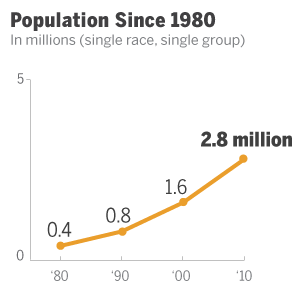
What I didn't know then was this: It had been just about two decades since the US had gotten rid of its racist immigration laws.  In 1965, LBJ and the Democrats passed a sweeping immigration reform that followed the Civil Rights Act.  A new immigration regime allowed non-whites to come to the country.  The initial trickles quickly became a stream and then a wave of non-whites.  Monterey Park had become Chinese majority, with a Chinese-American mayor to boot.  And quite a few white folk were angry.

I didn't know then that I was in the relatively early part of the gushing stream of immigrants from India.

Source

I was in an international setting--on campus and in the city. A bubble that normalized my status.  From my first day, I didn't know anything other than believing all these were the norm!

Almost 30 years after the LBJ-led immigration reform, in 1994, the reactionaries struck.  An anti-immigrant hateful rhetoric clinched a second-term for a Republican governor in California!

But, immigrants continued to move to California.  Silicon technology was altering the economic landscape at warped speeds, and the population from India kept up with this pace.  The stream from India became a huge wave.

All thanks to the reform that was passed by Congress and signed into law by LBJ on October 3, 1965.

But, LBJ had no idea that his immigration reform would lead to the browning of America.

Source
Fifty years later, in June 2015, the reaction to LBJ opening the immigration gates to non-whites came in the form of tRump.

The hateful rhetoric that helped a Republican win the governor's office in 1994 was also the reason why the party lost California.  It is now a state where Republicans are an endangered species, who mostly yell and scream from its inland valleys.  I cannot imagine the hateful rhetoric that has made a success out of tRump and the Republicans having a lasting effect beyond another election cycle.

Better days are ahead.

Tuesday, October 15, 2019

Why the poor, too, focus on the here and now

The news reported the names of the recipients of the grand prize in economics.  I immediately recognized two of the three joint recipients: Esther Duflo and Abhijit Banerjee.

The first thing that I did after reaching my office was to pull up their book that I had purchased years ago.  I remember reading it from cover to cover, and then even using it in a class. 

A couple of sticky notes were still there, and I opened one of those pages:


I immensely appreciated that book primarily because they were doing such on-the-ground work, instead of the highfalutin theorizing that drove me far away from development economics.  Over the years, I have watched quite a few interviews with the couple--who were not a couple when their research collaboration began.

I was sure that I have blogged about Duflo and Banerjee, and I have.  It seems like I bought the book after I read that essay.  The following is a copy/paste of my blog-post from May 17, 2011:
***************************************************
The essay by Abhijit Banerjee and Esther Duflo has lots of observations that might challenge conventional wisdom.  Like this one, for instance:
If there is any chance that by eating a bit more the poor could start doing meaningful work and get out of the poverty trap zone, then they should eat as much as possible. Yet most people living on less than a dollar a day do not seem to act as if they are starving. If they were, surely they would put every available penny into buying more calories. But they do not. In an 18-country data set we assembled on the lives of the poor, food represents 36 to 79 percent of consumption among the rural extremely poor, and 53 to 74 percent among their urban counterparts. 
So, where else do they spend? On other basic necessities?  Not so, they add:
The poor seem to have many choices, and they don't choose to spend as much as they can on food. Equally remarkable is that even the money that people do spend on food is not spent to maximize the intake of calories or micronutrients. Studies have shown that when very poor people get a chance to spend a little bit more on food, they don't put everything into getting more calories. Instead, they buy better-tasting, more expensive calories....
All told, many poor people might eat fewer calories than we -- or the FAO -- think is appropriate. But this does not seem to be because they have no other choice; rather, they are not hungry enough to seize every opportunity to eat more. So perhaps there aren't a billion "hungry" people in the world after all....
We often see the world of the poor as a land of missed opportunities and wonder why they don't invest in what would really make their lives better. But the poor may well be more skeptical about supposed opportunities and the possibility of any radical change in their lives. They often behave as if they think that any change that is significant enough to be worth sacrificing for will simply take too long. This could explain why they focus on the here and now, on living their lives as pleasantly as possible and celebrating when occasion demands it.
Life is complicated, as much as it is beautiful.
************************************

How awesome that their work has been recognized at this level!


Monday, October 14, 2019

General Malaise takes a break

Rarely does a day seem to pass without a politician or an opinion‐maker commenting about the dim prospects for the younger generation to lead a life that won’t be as bright as their parents’. Such a perspective is only partially correct, at best.

The future‐being‐bleak commentary is in the context of employment and earnings. That is, indeed, not off the mark. 

Thanks to competition that is now global, merely being born an American is neither necessary nor sufficient in order to lead a materially rich life, which is a shocking contrast to the old dominant narrative of a home with white picket fences being possible only, and anywhere, in America.

However, this dim view of the future is only partially correct. 

Not because of a proposition that the US will continue to be the most dominant economy—whether or not it will be is immaterial. But, we need to keep in mind that this paranoia over the future is merely about the economic aspects. 

Life is a lot more than merely economics. When we talk about the life that the youth have today—and will face in the future—and contrast that with the life in the decades past, we are conveniently overlooking many important non‐economic issues that will tell a completely different story.

Consider, for instance, the rights that people have now and compare that with those in the fabled Eisenhower era.  MAGA overlooks how life back then was typically difficult for anyone who was not born with a privileged skin tone and into a privileged religious category. 

In contrast, the country is now, for the most part, “free at last, free at last.” We have had a non‐White as the President, who was even re‐elected to that post.  General Motors, whose CEO proclaimed in the Eisenhower days that what is good for GM is good for the country, has a female CEO—Mary Barra--who is now playing hardball with the union. There are plenty of female business leaders now compared to the generations past. 

One can think of many, many more examples that are phenomenal evidence for how much freer we are as a people and, therefore, how much more possible “life, liberty, and the pursuit of happiness” is. Is this not a much better country that the youth are inheriting, which they can—and will—make it even better?

Sure, there is a great deal of economic activity going on in China—our economic competitor that apparently makes us tremble with fear—but a mere reminder of the smog in many of the cities there will send you gasping for air. 

One could list plenty of examples here to further the idea that the youth are inheriting a world that is in a good shape compared to centuries past. Should this not be a cause for celebration, instead of simply moaning about a perceived loss of global economic domination?

I wish we would look at the future through a comprehensive framework. We need to recognize and understand how awesome the present is and then focus our efforts on how to make the future even more awesome.

In my profession, I focus on the economic aspects and make sure that students gain an understanding of the rapidly changing economic global landscape. However, even in those classes, I often remind students that there is more to life than a pursuit of material happiness. Even the students who sleep through my monotonous monologues get the message that economics is merely one part of life, whose importance is dictated only by the values we ascribe to it.

My point is this—despite all our shortcomings, we have somehow managed to create a world that the younger generations will certainly improve upon. 

The future does look challenging, no doubt, when it comes to jobs and economic competition. And immensely more challenging when one thinks about how tRump and his 63 million are preventing us from doing the right things for a sustainable economy and environment.

But, imagine trying to put a dollar value on the fact that people are immensely freer than ever before, or that we don’t choke when we breathe in the air, or that we don’t die from drinking the water--despite all the attempts by a powerful few!

Sunday, June 02, 2019

The inglorious anti-intellectualism

Consider this:
[Folks] can make a lot more potentially with skilled manufacturing or the trades than they might with an art history degree
If you are nodding in agreement, then chances are that you are a tRump supporter thinking that your Dear Leader said this.  I am  also surprised you are here at this blog!

On the other hand, if you feel outraged by that statement, and are ready to fire off yet another Facebook post on how stupid tRump is, well, chances are that you were so maniacally supportive of Bernie Sanders that you still don't understand how you were a part of the reasons why tRump and not Hillary Clinton is the President.

tRump didn't say that about art history.  He cannot be bothered about it.  Right now, he is more concerned about how nasty Meghan Markle is!

It was Obama who dissed art history.

Beating up on liberal education is awesome bipartisanship!  Soon after Obama's remark, the editor of Inside Higher Ed even provided a chart on such bipartisan statements!

But, yes, Obama is no tRump.  He immediately realized his error and then even sent a handwritten apology.

However, the bipartisan beating up of liberal education continues.
Little defense of liberal education for an enlightened citizenry has been heard from any prominent political leader — even Democrats such as Barack Obama, whose education, two books written before his presidency and speeches were more steeped in liberal arts than any president in memory, but who as president caved in to lobbies for STEM education and school privatizers.
Take Mayor Pete, for instance.  With his awesome resume and accomplishments, he is a perfect example of what liberal education can do.  At Harvard, he majored in history and literature.  Kamala Harris majored in political science and economics.  Do I expect them to go rah-rah about the importance and value of liberal education? Nope.  Because it will be a vote-losing "elite" talk, in contrast to the lessons from the Coriolanus story--his life became a mess because he thought he was too good to seek approval from the masses.

So, everybody gangs up to beat up on liberal education. It is not good for democracy, and not good for progress.  It is already getting to be late for any course correction; RMS Titanic meets a white floating thing :(

Saturday, May 25, 2019

Take me to your leader!

More than a month ago, in my talk at the annual meeting of my peers, I suggested that even as we promote the educational framework within which we situate diversity and empathy, we need to recognize that identities help people deal with the fundamental existential angst.  We need to acknowledge that, and respect it, without any condescending attitude.

I have been saying this for years.  I gained this understanding thanks to the number of students I have interacted with over the years who are very different from me.

Which is why in this post almost exactly three years ago, as Brexit was unfolding, and as candidate tRump promised a Brexit-plus here in the US, I wrote:
It is a "deeper emotional issue" about whatever it is that provides value to people.  In the brief time that we get to live on this beautiful planet, we handle our existential crisis in so many different ways.  We try to answer the question of "who am I?" through many affiliations and ideas,  When people search for meaning, there are different institutions that provide them with comfort.  ...
The political identity also plays an important role. While I personally and intellectually recognize that the political identity is a freakish accident--being born in a country--it is very much like the accident of being born in a family that practices a particular religion, speaks a particular language, eats particular foods, listens to particular music, ... All these accidents together help with understanding our own place in the cosmos.We err when we conclude that those institutions that give us various identities are irrelevant.  It is a huge mistake to force people into behaving as one.
Andrew Sullivan apparently made a similar point more recently:
For Sullivan, cohesion comes from transcendental symbols and stories—i.e. religion, nationhood. Liberalism’s public square has “an empty center” that must be filled. “The fact that liberals do not have a language to speak about nationhood or borders or countries … has led to the far-right gaining power,” Sullivan said
Exactly!

Even prior to that, back in September 2014, I wrote in the context of the Scotland referendum to break free:
We are so much wrapped up with the idea of globalization that we forget we are humans and we like, we love, identities.  Identities especially when there is a long and rich history of the peoples.  Economics--being materially well off--does matter to us, yes.  But, we seem to overlook that we do not live on bread alone.  There is a lot more than mere material satisfaction that makes us human.  Identity--religious, ethnic, linguistic, ... and often these are also intertwined.
The challenge is to let people hold on to whatever identity makes sense to them, even as we develop a greater understanding.  And this is no different a bottom-line from what I have been ranting about forever:
The challenge, as I see it, is to figure out how to understand each other and engage in constructive cross-cultural relationships even while holding on to the identities and without making those identities as a metric for hierarchical comparisons.  The solution is not to erase the identities but to understand that we can create a much better future even as we tightly embrace whatever identity that we want to hold on to.
I reinforced this in the discussions:
I am ok with whatever identity that people want to have. But, what I am not ok with is using that identity in order to promote their supremacy and to systematically keep the "other" out. What I imagine is, I would argue, far more challenging than is to have an EU or an India. In India or EU, the diversity is accommodated under a big tent, but--and especially in India--the bigness of the tent allows for people of similar identities to stick to their own kind.
It is not the size of the geography that should matter--think about the tiny countries in the western part of Africa, for instance. The challenge is whether people are informed, educated, and human enough to think beyond their respective boundaries and identities.  
All these require leadership of a certain kind.  But, instead of sorting these issues out, we are tragically rushing into discussing "electability."  Oh well, we will certainly get the leaders that we deserve!

Tuesday, April 23, 2019

Blogging, public intellectuals, and faculty

Of course I am talking about myself; this is my blog!

A few years ago a student exclaimed in class that he was reading my blog and realized that he need not ever come to my classes; instead he could get everything that I might have to say in the class right from the blog itself.

Whenever students discover this, I tell them that my blog serves multiple purposes for me, of which one is that this blog serves as my own notes that I can refer to if/when needed.  And, of course, it also serves the curiosities of anybody who is interested in the content here.

Over the years, I have wondered why faculty do not operate in such modes, within and outside the classroom.  And why faculty do not go to classes and treat students as members of the public with whom they have to intellectually interact. 

Tyler Cowen, who is one heck of a prolific, accomplished, polymath of a professor across the continent, and whom I have cited many times here, says:
What’s a university and what is not? Those distinctions are crumbling. If we’re not a university, maybe no one else will be either. There’s a lot of content on the web. A lot of it’s free. That will be increasingly important. I think it’s already the case on a given day. More people read economics blogs than are taking "Principles of Economics" classes in the United States, so why aren’t the blogs already a kind of university? They’ve sort of won that competitive battle in some way.
The people who read the blogs want to read them. A lot of people in "Principles" class, they’re not paying attention, they don’t want to learn, they feel they have to, so blogs are in some ways doing a better job of educating.
While Cowen uses the example of economics, the same can be said about any subject.  People want to know about any number of topics but somehow we have convinced ourselves that the old buildings with ivies crawling on them is the only way to meet that desire to know.  In fact, it increasingly works the other way around--those who come to the universities are some of those who are least interested in learning and are in college only to pick up a diploma.

Cowen has moved beyond blogging itself--to a "university" that offers a whole bunch of videos.  The interviewer signs off with this:
Maybe the biggest impact of upstarts like Marginal Revolution University will be that traditional colleges will feel more like, well, like blogging. Maybe the line between the formality of college education and the informal materials found online throughout one’s life will blur, and maybe those distinctions will just matter less and less. Authority may sound less like a lecture from a podium and more like a Facebook post.
But, are the faculty, who are busily writing books that nobody ever reads, thinking about such important questions as "What’s a university and what is not?"

Source

You read until here?  Check this out.