Showing posts with label Coriolanus. Show all posts

Wednesday, August 19, 2015

What would Coriolanus eat at the Iowa State Fair? Caprese Salad On-a-Stick?

The ultimate reality show has begun: Who wants to be America's next president?  It is one heck of a freak show in the early stages, until it comes down to something like a semi-final.  This being the dog days of summer, the reality show was recently hosted at the Iowa State Fair.
The internationally-acclaimed Iowa State Fair is the single largest event in the state of Iowa and one of the oldest and largest agricultural and industrial expositions in the country. Annually attracting more than a million people from all over the world, the Iowa State Fair in Des Moines is Iowa’s great celebration, a salute to the state’s best in agriculture, industry, entertainment and achievement.
And well known for the political reality show where the presidential wannabes show up in their summer, casual, regular-person, attires.  It is like how beauty pageants have swimsuit competitions ;)

It is all a part of the pretense that the regular Joe and Jane matter to those patricians.  They need to put on a jolly good show that they defer to us, the plebians.  And they want to make sure that they don't make the mistake that Coriolanus did:
Coriolanus is a patrician warrior who serves Rome with unequalled military prowess and bravery, but he is devilishly proud and utterly disdainful of the lower orders. He even blames them for smelling: which brings to mind a German saying, ‘It smells of poor people here,’ and George Orwell’s observation that to accuse people of smelling is the most hurtful insult that you can direct at them.
Unfortunately, after his great victory at Corioli (hence his honorific title), Coriolanus stands for the office of Consul, one of the most important political offices in Rome. To be elected he needs the approbation of the plebeians: and, rather as in a general election in a western democracy, to obtain it he has to abase himself before them for a short time.
He has difficulty in doing even this because he is so haughty; for although the plebeians know full well he has fought many battles and been wounded many times, they want him to expose his scars to them in person. This, of course, is much beneath his dignity, but Coriolanus manages to come to some kind of accommodation with the plebeians, until their own representatives, the tribunes, inflame them against him by telling outright lies about him. They do this because they see it as a way to increase their own power, to which Coriolanus is an obstacle. They succeed in having Coriolanus exiled from Rome. 
Shakespeare does a masterful job, as he always does.  Oh, incidentally, the story does not end with the exile--watch the play; it is phenomenal.

One of ways that the patricians, er, the presidential wannabes abase themselves before us plebes is by going to the Iowa State Fair and eating crap, er, food that they would normally run away from.  Not merely eating but making sure that the photos and the videos are transmitted all around, even to the plebes in other countries who cannot vote here anyway!  Apparently most of them chose to eat pork chops on a stick:
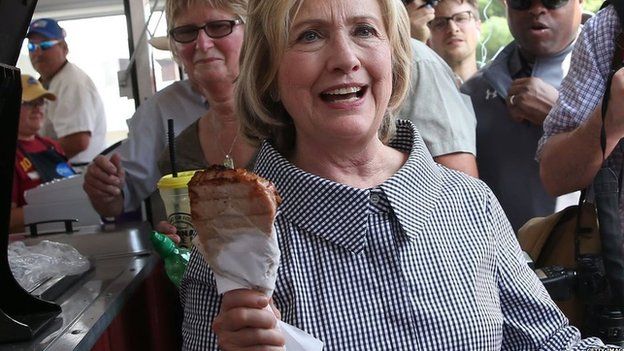
Source

There are, count 'em, 75 foods that one could eat while holding them on sticks!  Seventy-five!  I could not imagine how they get to serve fried butter on a stick; so, I checked it out on YouTube and I am grossed out already ;)

I suppose a modern day haughty Coriolanus would not care about the regular folk who eat all things fatty and rich in cholesterol.  He would not be a wimp like that other patrician who wisely walked away from his arugula comment.  Instead, Coriolanus would arrogantly order a Caprese Salad On-a-Stick and tell the people to go to hell, or even deliver that awful Dick Cheney line! ;)

A final note: are you also wondering how they make a Caprese on a stick?

Tuesday, August 16, 2011

Ron Paul is no Coriolanus. And, no media coverage even when he gets votes!

The presidential primary season has begun, and I am yet again reminded of Shakespeare's Coriolanus.

Coriolanus was one of the plays that I watched at Ashland, with freshmen--during my years as the Director of the Honors Program.  I had no clue about the play. My colleague, the theatre faculty, said that it was an absolutely perfect play to watch and think about, given the war and election season at that time--seems like it is always war and elections, eh! :(

As always, the folks at Ashland did a great job. (When the play ended, I was thankful that they did not adapt it to any other time period, as they occasionally do with Shakespearean plays.) Once again, Shakespeare punched the lights out of me--how did that guy manage to do all that fantastic stuff? And such profound dramas!

Even as the play was progressing, it was difficult not to compare it with contemporary American social and political events.  Politicians pretending to be one of the commoners so that they can get their approval--which Coriolanus resisted doing not because he was idealistic, but because he thought he was too good to seek approval from the masses.

Contemporary politicians know all too well that if they behaved like how Coriolanus did, well, they wouldn't get elected even as a dog catcher.  So, they put on different roles.  Last time around, it was Obama droppin' the "g" or not mentioning arugula after one mishap, in order to relate to the commoners. Similarly, the hilarious attempts by McCain to relate to Joe the Plumbers, and the "betcha" folksy Palin .... well, Shakespeare portrays these so well in Coriolanus.

Here is a neat essay on Coriolanus, from the New English Review (once again, thanks to AL Daily). The author notes that:
Has political life really changed very much since Shakespeare’s day, at least as portrayed in Coriolanus? If anything, it seems to have regressed towards it, having perhaps (but only perhaps) have moved away from it for an interlude of a century or two.

Demagogues and war heroes we have with us still, while discernable principles seem very few and far between. The crowds are still demanding that the candidates display their war wounds: when Mrs Clinton ‘mis-spoke’ she was trying to demonstrate that she, too, knew what it was to be under fire. The desire and willingness to present others in the worst possible light, as a sufficient argument in itself, is still with us.

Unfortunately, demagogues and demagoguery are alive and well.

Except with one guy--Ron Paul.

Paul doesn't seem to care about saying things that people might prefer to hear so that they will, in turn, approve of his candidacy.  Though I don't agree with a few of what Paul says, I find it absolutely refreshing that he mostly says what he means, and means what he says.  And he behaves that way not out of contempt for the public either.

But, the guy gets practically no media coverage.  Why so? (ht)

Mostly because the mainstream media and the Republican establishment wish he would just go away.
One reason the bipartisan establishment finds Paul so obnoxious is how much the past four years have proven him correct -- on the housing bubble, on the economy, on our foreign misadventures, and on our national debt.

The Daily Show also correctly points out this systematic exclusion of Ran Paul--doesn't it remind us of how Ralph Nader used to complain that the two parties and the media have rigged the system?


Tuesday, October 19, 2010

I wish I could vote for "none of the above"

Couple of years ago I watched the fantastic thespians at Ashland enacting Shakespeare's Coriolanus.  I had no idea of the story and, therefore, found the play that much more engaging.  Coriolanus is an arrogant Patrician, and does not heed to the advice that he has to pretend that he can relate to the plebes--which is how the other patricians behave.  As I was watching the play, all I could think of was our own arrogant politicians (editor: aren't politicians by definition arrogant?) who pretend that they are one of the "middle class" common folk.  And we are supposed to play along as well.  I would rather that politicians revealed their inner Coriolanus and went around boasting why they are the elite while the rest of us are suckers.

Last August, George Packer's depressing essay was yet another layer of revelation regarding how our elected officials work to promote themselves and ensure their re-elections--and not to advance the country's agenda.  If that didn't depress us enough, the same magazine, the New Yorker, now has a fine essay on how any meaningful action on an energy policy died in the Senate.
No diagnosis of the failure of Obama to tackle climate change would be complete without taking into account public opinion. In January, the Pew Research Center asked Americans to rank the importance of twenty-one issues. Climate change came in last. After winning the fight over health care, another issue for which polling showed lukewarm support, Obama moved on to the safer issue of financial regulatory reform.
In September, I asked Al Gore why he thought climate legislation had failed. He cited several reasons, including Republican partisanship, which had prevented moderates from becoming part of the coalition in favor of the bill. The Great Recession made the effort even more difficult, he added. “The forces wedded to the old patterns still have enough influence that they were able to use the fear of the economic downturn as a way of slowing the progress toward this big transition that we have to make.”
A third explanation pinpointed how Kerry, Graham, and Lieberman approached the issue. “The influence of special interests is now at an extremely unhealthy level,” Gore said. “And it’s to the point where it’s virtually impossible for participants in the current political system to enact any significant change without first seeking and gaining permission from the largest commercial interests who are most affected by the proposed change.”
Kerry, Graham, and Lieberman were not alone in their belief that transforming the economy required coöperation, rather than confrontation, with industry. American Presidents who have attempted large-scale economic transformation have always had their efforts tempered—and sometimes neutered—by powerful economic interests. Obama knew that, too, and his Administration had led the effort to find workable compromises in the case of the bank bailouts, health-care legislation, and Wall Street reform. But on climate change Obama grew timid and gave up, leaving the dysfunctional Senate to figure out the issue on its own.
I know what the solution is: stop reading the likes of the New Yorker!  if I didn't read them, I would not know how awful every one of these politicians are, right?  I truly wish for that blissful ignorance.

Oh well ...

The good news?  Coriolanus is soon coming to a movie theater near you.  Has some heavy-hitting actors: Ralph Fiennes, Vanessa Redgrave, Gerard Butler (ok, not a great actor!!!) ...


Saturday, November 15, 2008

Coriolanus, politics, and democracy

The presidential primary season was just about in its peak last May, when I went to Ashland to watch three plays with freshmen in the Honors Program. One of the plays was Coriolanus, by Shakespeare. I had no clue about the play. My colleague, the theatre faculty, said that it was an absolutely perfect play to watch and think about, given the war and election season.

The folks at Ashland did a great job. (When the play ended, I was thankful that they did not adapt it to any other time period, as they occasionally do with Shakespearean plays.) Once again, Shakespeare punched the lights out of me--how did that guy manage to do all that fantastic stuff? And such profound dramas!

Even as the play was progressing, it was difficult not to compare it with contemporary American social and political events. Later on in the summer, politics unfolded the way Shakespeare wrote about--four hundred years ago, and about events that occurred more than 2000 years ago! Obama droppin' the "g" or not mentioning arugula after one mishap, all in order to relate to the commoners. Later on the hilarious attempts by McCain to relate to Joe the Plumbers, and the "betcha" folksy Palin .... well, Shakespeare portrays these so well in Coriolanus.

Here is a neat essay on Coriolanus, from the New English Review (once again, thanks to AL Daily). The author notes that:
Has political life really changed very much since Shakespeare’s day, at least as portrayed in Coriolanus? If anything, it seems to have regressed towards it, having perhaps (but only perhaps) have moved away from it for an interlude of a century or two.

Demagogues and war heroes we have with us still, while discernable principles seem very few and far between. The crowds are still demanding that the candidates display their war wounds: when Mrs Clinton ‘mis-spoke’ she was trying to demonstrate that she, too, knew what it was to be under fire. The desire and willingness to present others in the worst possible light, as a sufficient argument in itself, is still with us.