Showing posts with label wikileaks. Show all posts

Thursday, June 14, 2012

Going after Obama's Kill List leakers makes case for WikiLeaks

Finally, Jon Stewart has something to say about the emperor's President's Kill List. 

Now, before you click play and laugh away, here is more for you about those darned drones; let us see if you will laugh now!

Senator Rand Paul is introducing a bill to protect us--yes, you and me living in America--from those darned drones:
Like other tools used to collect information in law enforcement, in order to use drones a warrant needs to be issued. Americans going about their everyday lives should not be treated like criminals or terrorists and have their rights infringed upon by military tactics
WTF, right?  We have reached a situation where the Constitution and the Bill of Rights apparently aren't enough, and we need additional legislation to protect us and our rights from our own government. 

Meanwhile, Obama's don't-take-prisoners-to-Guantanamo-but-kill-them approach via drones is, as one can easily predict, triggering (yes, awful pun!) the growth of anti-American sentiments in those countries where drones are extensively used:
The New York Times has an extraordinary Op-Ed this morning by Ibrahim Mothana, a 23-year-old democracy activist and Al Qaeda opponent in Yemen. The headline is “How Drones Help Al Qaeda,” and it explains in compelling detail how the principal U.S. tactic ostensibly devoted to fighting Al Qaeda in his country — repeated drone attacks — is having exactly the opposite effect.
At the end of his post, Greenwald also refers to the Jon Stewart clip on the Kill List.  But, wait, there is more for you.  As Stewart point out, those pompous Congressional folks are upset--not at the fact that the President has his finger on a Kill List, but about the fact this was leaked.  How dare they leak it!

You see why the likes of Julian Assange are important for democracy?  If in a supposedly democratic US there can be so much of a secrecy about government programs, and when there is bipartisanship against leaks, one can imagine how incredibly opaque things might be in many other countries around the world. 

Speaking of Assange, he lost his legal battle against extradition. 

Ok, here is the Daily Show segment; watch and weep!

Thursday, March 17, 2011

WikiLeaks: the aftershocks now in India

Here in the US, where yesterday's news becomes staler than the stalest in a context of the 24x7 news cycle, and when Japan and the Middle East have overwhelmed us, and rightly so, it is not any surprise that WikiLeaks barely registers a blip anymore on our radars.  Thus, there is pretty much no ripples from the news of the unusual and cruel treatment of the alleged leaker, Bradley Manning, and the recent resignation of the State Department spokesman, P.J. Crowley, over this matter.

But, the effect of WikiLeaks is now being felt big time all the way across in India.

The Hindu has a special on the Indian connections to WikiLeaks, and India Today lists "eight bombs" of which the #1 is:
Wikibomb 1: Congress bought MPs for 2008 trust vote.
US cable suggests MPs from Ajit Singh's RLD were paid Rs. 10 crore each by the Congress during the 2008 trust vote.
To the common man (aam aadmi) in India, politicians being bribed isn't exactly news.  It is a given that it is a rare exception when a politician is considered "clean."  What is new then?  Phenomenal evidence, from information leaked by outsiders who have no personal investment in the outcomes.  The Hindu reports:
In a cable, dated July 17, 2008, sent to the State Department (162458: secret), accessed by The Hindu through WikiLeaks, U.S. Charge d'Affaires Steven White wrote about a visit the Embassy's Political Counselor paid to Satish Sharma, who is described as “a Congress Party MP in the Rajya Sabha ... and a close associate of former Prime Minister Rajiv Gandhi considered to be a very close family friend of Sonia Gandhi.”
Mr. Sharma told the U.S. diplomat that he and others in the party were working hard to ensure the government won the confidence vote on July 22. After describing the approaches the Congress leader said had been made to the Bharatiya Janata Party and the Akali Dal, Mr. White drops a bombshell of a revelation:
“Sharma's political aide Nachiketa Kapur mentioned to an Embassy staff member in an aside on July 16 that Ajit Singh's RLD had been paid Rupees 10 crore (about $2.5 million) for each of their four MPs to support the government. Kapur mentioned that money was not an issue at all, but the crucial thing was to ensure that those who took the money would vote for the government.”
Lest this should be construed by the visiting diplomats as an empty boast, Mr. Sharma's aide put his money where his mouth was: “Kapur showed the Embassy employee two chests containing cash and said that around Rupees 50-60 crore (about $25 million) was lying around the house for use as pay-offs.”
Well, the ruling government won the crucial confidence vote, and the coalition (UPA) continues in power even now.  As one can imagine, the opposition parties are trying their best to seize the opportunity, in the grand traditions of carpe diem.  Again, The Hindu:
The Opposition sought to mount pressure on the government outside Parliament too. At separate press conferences, both the National Democratic Alliance and the Left parties said that Indian democracy had been “maligned” and demanded the immediate resignation of the government.
Not that the politicians from the opposing camp are saints!  But, all these make for interesting political theatre, while the common man is screwed by the corrupt politicians, rising food prices, ....

So, even otherwise, how does India compare with other countries when it comes to corruption?  According to Transparency International, India ranks at # 87 out of the 178 countries analyzed.  Guess who else shares that same ranking?  Albania, Jamaica, Liberia.  Excellent company, eh!

Friday, February 18, 2011

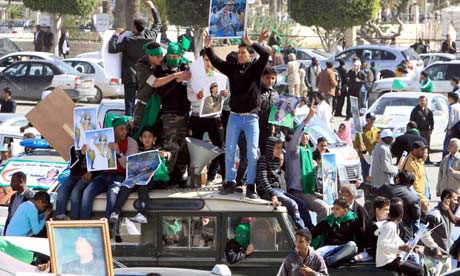
No Ukrainian nurse can help Libya's Gaddafi. Cheering the protesters

So, it appears that the Arab youth are mad as hell. 

And, Libya's Gaddafi is now at the receiving end of the  raging emotions that have been bottled up for 41 long years.  Yes, it was in 1969, almost 42 years ago, this maniac took over the country! 

But, Gaddafi will clearly not go away without putting up a fight, and he has quickly resorted to dirty tricks:

The mainstay of the unrest is in regional towns and cities, where many people live in poverty.
Foreign journalists operate under restrictions in Libya, so it has been impossible to independently verify much of the information coming out of the country.
But the BBC has confirmed that several websites - including Facebook and al-Jazeera Arabic - have been blocked.
And the airport in Benghazi, the country's second largest city, has been closed, amid reports that protesters have taken it over.
Residents in Benghazi told the BBC that electricity has been cut off, and tanks are posted outside the court building.
Benghazi protesters have told international media they have learnt from Tunisia and Egypt, and are determined to depose Col Gaddafi.
Media outlets loyal to Col Gaddafi had earlier conceded that security forces had killed 14 protesters in Benghazi on Thursday, though other accounts put the death toll much higher.
 The news channel that US cable corporations refuse to carry, Al Jazeera, also has a similar report:

Marchers mourning dead protesters in Libya's second-largest city have reportedly come under fire from security forces, as protests in the oil-exporting North African nation entered their fifth day.
Mohamed el-Berqawy, an engineer in Benghazi, told Al Jazeera that the city was the scene of a "massacre," and that four demonstrators had been killed on Friday.
"Where is the United Nations ... where is (US president Barack) Obama, where is the rest of the world, people are dying on the streets," he said. "We are ready to die for our country."
I hope my intro class students are tuned in--one of the two short stories that I have assigned for their final projects is Hisham Matar's "Naima."  Matar writes in the Guardian:
I appeal to Colonel Gaddafi and his security forces: for the sake of the mothers, for the sake of those who died, for the sake of Libya, please don't shoot and torture your people.
I blogged before that Matar knows well about this dictator and his cronies ...

So, why the Ukrainian nurse in the heading you ask?  Thank WikiLeaks for that

Sunday, December 05, 2010

Wikileaks TMZ :)

The opener was quite imaginative.  The Hillary Clinton piece was way too funny

Tuesday, November 30, 2010

The latest edition of WikiLeaks: voyeurism by an anarchist

I am far from impressed with what has been reported from the latest WikiLeaks dump.  "Pentagon Papers" this aint.  I am all the more convinced now that Assange and WikiLeaks are, at best, hacker anarchists.  There is nothing particularly bad at being an anarchist.  But, pretending that this is all in the public interest and nothing but, and the world's papers going along with that song is, well, like the warm piss on oneself on a cold day!

I like what Spiked has:

This idea that the publication of private conversations and communications is in the public interest – whether it’s done by tabloids or by sanctimonious candidates for the next Pulitzer Prize – is a self-serving attempt to present voyeurism as an important public duty. It is not unlike the claims made by reality TV producers, who frequently argue that their tawdry offerings ‘raise awareness’ and serve the ‘public interest’.
How is the public interest served by the purposeless leaking of information? Since when has it been obligatory for institutions to expose their private deliberations to everyone on the internet? Has the public learnt something important from all this? Has some wrong been put right by the mass dumping of communiqués on to the world wide web? Or is this really a case of the narrow interests of the news organisations involved getting confused with the interests of the public?

Wednesday, September 01, 2010

When the Chinese state collapses

So far at least, Deng Xiaoping's approach to open up the economy without political liberalization seems to be working, and much better (?) than Mikhail Gorbachev's perestroika and glasnost.

The latter quickly triggered the demise not only of the feared USSR but the entire Eastern European Communist bloc.

China, meanwhile, is going strong, and a pretty good economic speed.

Like many, I thought that the protest movements in 1989 would fundamentally restructure China's internal political arrangement.  But, Deng and Li simply wiped out the protesters. 

There is still a part in me that hopes that the Communist government would collapse. Soon.  But, there are no signs of such an apocalypse.

At least, that is what I thought until I read this blog post over at the New York Review of Books.  Pretty darn exciting:
On July 21 in Beijing, four days before WikiLeaks published its documents, Chinese President Hu Jintao convened a high-level meeting to discuss ways to prevent leaks from the archives of the Communist Party of China. 
How fantastic it would be if slowly various secrets begin to leak out ... It has the potential for not only the downfall of the Communist government, but even for a completely new global order.

So, what are the kind of secrets that we might want to know about first?  Apparently there is a list of seven party secrets that have a priority over others:
  1. The famine during the Great Leap Forward in 1959-62. Somewhere between 20 and 50 million people died because of bad policy, not “bad weather.” What exactly happened? What policies caused the famine and what policies suppressed information on it? How much grain was in state granaries while people starved? Is it true that Mao sold grain to the Soviet Union during those years in order to buy nuclear weapons?
  2. The death of Mao’s military commander General Lin Biao in 1971. The official version of events, which to this day exists only in bare outline, strains credulity: Mao’s “closet comrade in arms” suddenly plotted a coup, failed in it, tried to flee to the Soviet Union, and was shot down in his plane. What really happened? Why? Why shouldn’t we know more?
  3. Mao’s will and personal lockbox. Mao’s wife Jiang Qing said at her trial (as part of the “Gang of Four”) that Mao had a written will that mentioned her. Did he? What did it say? Mao also apparently kept his own lockbox of “most core secrets” that, in his later years, not even Jiang Qing could see. Mao’s mistress Zhang Yufeng kept the key until September 21, 1976, twelve days after Mao’s death, when Hua Guofeng, Mao’s anointed successor, is said to have taken it from her. What’s in the box?
  4. The Beijing Massacre of 1989. The basic story is fairly well known from The Tiananmen Papers, Zhao Ziyang’s memoirs, and Li Peng’s diary. But the records of some key meetings still are classified, and responsibility for the massacre remains an extremely sensitive question in Chinese politics.
  5. The brutal suppression of the Falun Gong after 1999. Falun Gong claims there are concentration camps for their members and that internal organs of executed believers are surgically removed and sold. True? Untrue? What do the records say?
  6. Beijing’s huge but secret “stability maintenance” budget. The Shanghai Academy of Social Sciences reports that Chinese government spending on domestic “stability maintenance”—the monitoring, intimidation, roughing-up, and illegal detention of petitioners, aggrieved workers, religious believers, professors, bloggers, twitterers, and other sources of “trouble”—now exceeds what the government spends in any category except the military. What are the details of this budget?
  7. Bank accounts of Communist Party officials. Corruption and graft are widely viewed to be problems at every level of Chinese government, but exactly how much money have officials squirreled away? How much have they sent abroad?
 I can't wait ... here is to wishing that it will happen soon. Real soon.

Wednesday, August 11, 2010

More on the hi-tech anarchist: WikiLeaks

In the movie Conspiracy Theory, the Mel Gibson character is being hounded and abused by the state because it turns out that one of his crazy conspiracy theories is not crazy at all, but true.  I suppose my branding of WikiLeaks as nothing but a hi-tech anarchist, and no way a journalist, is similarly one of those darts that actually hit the target and close to the center.  How about the following excerpt:

Amnesty International, Campaign for Innocent Victims in Conflict, George Soros’s Open Society Institute, the Afghanistan Independent Human Rights Commission, and the International Crisis Group signed the letter (delivered via email), citing concerns that Afghan informants named in the document dump will face the brutal retribution of the Taliban. Assange responded by asking Amnesty International to “provide staff to help redact the names of Afghan civilians,” a pointless exercise now that the documents already exist online, unredacted.
Amnesty expressed interest in assisting, though warned that they are constrained by limited resources, and suggested a conference call to discuss the issue further. Assange responded, via email, with a threat: “I'm very busy and have no time to deal with people who prefer to do nothing but cover their asses. If Amnesty does nothing I shall issue a press release highlighting its refusal." On his Twitter feed, Assange told his followers to not “be fooled on the ‘human rights groups’”—scare quotes are in the original—because they are “US led.”
When Amnesty International is upset with him, well, that ain't good news for a supposedly war-ending, peace-mongering, truth-seeking Assange.  Anarchists are far more destructive than otherwise.  Which is why even though I am usually sympathetic to their goals, I usually follow them only from a safe distance.  Anarchists don't do constructive engagement.  WikiLeaks is nothing but the latest version of a Molotov cocktail.

Monday, August 02, 2010

The hi-tech anarchist: WikiLeaks

Julian Assange now identifies himselfas the editor of WikiLeaks.  Which then has set off a whole range of discussions on whether what Assange does is journalism at all.

And then there are those who have already branded Assange a threat to national security and that he ought to be arrested. Who would have imagined that Time would have a piece with the title, "Should the US kidnap WikiLeaks' founder, Julian Assange?"

So, from my home-office in Eugene, Oregon, I have a different take on all these--Assange and WikiLeaks are the latest version of anarchism and anarchists who have always challenged the state and status quo.

It used to be that the meetings of the World Trade Organization or the G-8 or the IMF were the venues that provided anarchists with an outlet for their political and cultural dissent.  Most governments treated them as a nuisance, and every once in a while would make their police reaction so strong that anarchists ended up getting a lot more publicity and sympathy than would otherwise have been the case.

So, to all these rebels without a cause, al Qaeda and the Anglo-American "war on terror" have provided an ideal outlet for their passions, and with quite a focus as well.  This entire format of information-anarchy also works well for them--no need to gather in public places, and no visible confrontation with the establishment.  Given that the wars have affected the entire world now, and given the outright horrors of, say, waterboarding or Guantanamo or ... I can easily imagine that while those of us who are pacifists (or wimpy?) simply blog or write op-eds or grumble to our local Congress member, the young and radical anarchists have WikiLeaks.

To a large extent, this is a sign of the times--the information and technology world in which we live.  If our government can, from the comforts of military bases in Nevada, fly unmanned planes that kill people all the way across the world in Pakistan, then, hey, is it any surprise that these radical dissenters have their own remote operations?
WikiLeaks, I suspect, is only the beginning of all kinds of cyber-activities yet to come. 

Monday, July 26, 2010

The massive leak through WikiLeaks

In case the FBI is snooping around even here, I want to clarify to them that my post last week was purely an accident :)

Tuesday, July 20, 2010

An interview with WikiLeaks founder, Assange

I wish it were a better interviewer ... but, that does not take away the need to understand government (and corporate?) secrecy ...


Here is an excerpt from a lengthy piece in the New Yorker:
As it now functions, the Web site is primarily hosted on a Swedish Internet service provider called PRQ.se, which was created to withstand both legal pressure and cyber attacks, and which fiercely preserves the anonymity of its clients. Submissions are routed first through PRQ, then to a WikiLeaks server in Belgium, and then on to “another country that has some beneficial laws,” Assange told me, where they are removed at “end-point machines” and stored elsewhere. These machines are maintained by exceptionally secretive engineers, the high priesthood of WikiLeaks. One of them, who would speak only by encrypted chat, told me that Assange and the other public members of WikiLeaks “do not have access to certain parts of the system as a measure to protect them and us.” The entire pipeline, along with the submissions moving through it, is encrypted, and the traffic is kept anonymous by means of a modified version of the Tor network, which sends Internet traffic through “virtual tunnels” that are extremely private. Moreover, at any given time WikiLeaks computers are feeding hundreds of thousands of fake submissions through these tunnels, obscuring the real documents. Assange told me that there are still vulnerabilities, but “this is vastly more secure than any banking network.”