Showing posts with label ukraine. Show all posts

Friday, September 02, 2016

Strangers in Our Midst

Any time I come across a news item about the Roma, I am immediately reminded of my old high school friend, Srikumar.  I am always impressed with how he has dedicated himself to the cause of bringing together the Roma and the Czechs.  Yes, the Czechs, because that is where Kumar lives.  His life journey is a fascinating turn of events, as I noted here.  (A few months after I blogged that, Kumar's father--who died a few months ago--wrote to me appreciating that post.)

Unfortunately, when the Roma are in the news, it is often because they are being driven out of somewhere.  This time, it is in Ukraine:
Several dozen people in a Roma community in southern Ukraine were forced to flee their homes after a mob tore through their neighborhood over the weekend, breaking windows, tearing down fences and even setting a house on fire while the heavily outnumbered police stood by and watched.
What happened?  What was the cause?  A false claim that a 9-year old girl (not Roma) was raped and killed by a Roma male.  That this claim was untrue did not matter to the mob.  But, even if the rapist/killer was Roma, why the wholesale attack on the rest of them, right?
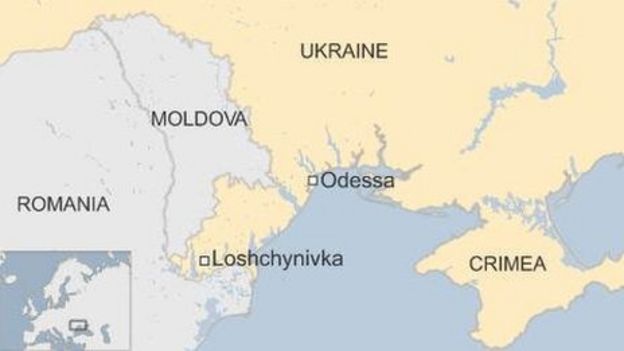
After the girl’s death, hundreds of residents demanded that the Roma be expelled, and on Sunday they gained the backing of the district council. Even Mikheil Saakashvili, the governor of the region of Odessa, which includes Loshchynivka, and a former president of Georgia, offered tacit support in a video message posted on Facebook, denouncing the village’s “antisocial elements.”
Even Saakashvili.  How awful. The guy should know better than this!

Source

The US Holocaust Memorial Museum condemns the unfortunate development:
The United States Holocaust Memorial Museum strongly condemns these outrageous acts. It urges the government of Ukraine and local authorities to provide protections for the Roma and other threatened minorities, and to develop educational and community programs that will help build respect for cultural diversity.
“Between 1933 and 1945, Roma and Sinti suffered greatly as victims of the Nazis and their allies.  Ultimately, between 220,000 and 500,000 died in the genocide of the Roma and Sinti peoples,” said Museum Director Sara J. Bloomfield.  “Sadly, the recent pogrom in Loshchynivka, Ukraine, is but one of many acts of violence and forced evictions visited upon the Roma in Europe since 1945.” 
Maybe my old friend will soon have something about this on his Facebook page.

All over the world, there seems to be a sudden uptick in xenophobia.  This major party presidential candidate is not helping here, but is making things worse. I suppose simply getting along is not that easy for us humans!


Thursday, November 27, 2014

'Tis Thanksgiving. Remembering the year that was ...

As we sit down for the Thanksgiving meal with friends and family, perhaps all of us can be thankful for one thing—the year with strange and unexpected developments is coming to an end.

Who would have thought that this country would ever end up panic stricken about Ebola? So panicky we became that the photograph of a nurse biking in a small town in Maine caused quite a few, who were thousands of miles from the Pine Tree State, to worry that they, too, caught the dreaded virus infection. We became so involved with the panic over nothing that we even forgot the thousands in West Africa who continue to suffer from the illness.

Ebola came in time for us to worry about the state of the world just when the Israel-Gaza conflict ended. Of course, the end of the bombing campaigns does not mean that peace has descended upon that troubled geography. Not far away, a ruthlessly barbaric outfit that grew out of the ashes of Al Qaeda in Iraq (AQI) has quickly become a force to reckon with. And the number of name changes this outfit has had in a matter of few months—Islamic State of Iraq and the Levant (ISIL), Islamic State of Iraq and Syria (ISIS), Islamic State (IS)—has made the casual observer feel like there are multiple versions similar to the number of Agent Smiths in “The Matrix” movie series.

The big European story is, of course, about how Russia swallowed up the Crimean Peninsula. One day Crimea was a part of Ukraine, and the next day it became a Russian territory. Russia is not done with gobbling up Ukraine’s land, with more military incursions expected.

The perils of Pakistan continue, with the same old formula of a weak and ineffective government that is constantly trying to keep the powerful military away. The story of its life ever since its birth in 1947! Meanwhile, suicide bombers continue to strike, with a recent one near the border with India killing nearly sixty and injuring another estimated hundred. Terrorists have warned that the next incident will be in India.

If you are like me, every once in a while you wonder whatever happened to the more than 300 girls who were kidnapped in Nigeria. Remember all that Facebook and Twitter activism to “bring back our girls”? But then that was such a long time ago and Ebola has completely taken over our panic-stricken collective consciousness.

The global economy continues to be in a state of flux. Economists keep warning about the Euro area on the verge of a recession and, perhaps, deflation as well. An economic contraction while prices keep falling is one awful combination, which will surely be worrisome to the millions of unemployed youth, especially in the southern countries of Spain, Italy, and Greece.

While we in the US might feel sheltered from such an listing—however incomplete it is—of less than pleasant developments around the planet, the Ebola virus was a nasty reminder that we live in an interconnected world and that what happens in a remote part of West Africa will not necessarily stay in West Africa. The military conflicts around the world will force the US to act—a burden that comes with being the sole global superpower. Economic slowdown in Europe will affect us, given the highly interdependent economic web that links us to countries that we might not even be able to identify on a world map.

An old idea that is often mentioned, especially in academia, is that “war is God's way of teaching Americans geography.” We need to update that for the contemporary contexts. Now, any crisis is apparently how we Americans learn geography. Thus, thanks to Boko Haram, we were forced to look up Nigeria on a map. With Ebola in the news, there is a good chance that a few Americans were suddenly thrust with narratives about the historical connection between Liberia and slavery in the US. But then, if history provides any guidance, we perhaps passed on all the chances to learn geography.

Whether or not we learnt anything, not unlike my students, we are thankful that the tumultuous and eventful year is coming to an end. But, of course, just because the calendar year is ending, all those problems won’t simply go away. It will be a long while before the public health professionals declare an end to the current Ebola outbreak. The geopolitical tensions in the Levant, Ukraine, and Pakistan, will continue irrespective of the month and the year. Above all, there is really no respite from one certain scary development—when the calendar flips to 2015, the campaigning for the November 2016 elections will begin!
Sunday, September 14, 2014

Don't know much about geography. Don't know much about, well, everything.

The Onion made fun of bloggers like me:
So, of course, here I am returning to my blog after a break of, gasp, two days!

BTW, if there is nobody to read a blogger's post, then does the blog post make that philosophical noise in the forest? ;)

Anyway, two months ago, I remarked on how much even the attention-paying few realize that yesterday's news becomes quickly forgotten:
We live in a world in which yesterday's news is not merely yesterday's news but feels like something that might have happened back in the Jurassic Age! 
Apparently, I was not the only one to think along those lines, though it does almost always feel that way in my world.  In today's paper, I read this commentary, where the author writes that "even dedicated news junkies are bound to tune things out" because of the sheer volume of events:
A look back at this year shows just how fickle the public’s attention can be. Several stories have peaked in the news, but no two have commanded the same peaks of attention at the same time.
Google Trends tracks how often people search for keywords — including those related to major events — all over the world. Back in March, the conflict in Ukraine grabbed the world’s attention, but it was largely forgotten when Malaysia Airlines Flight 370 disappeared.
It wasn’t that the action in Ukraine or its global importance diminished, as we would see later in the year. Audiences and news organizations simply switched head space and resources to the other story.
Two stories could not claim the same peak of attention at the same time.
Then, in July, the fighting in Gaza ramped up along with its audience. But just as it was heading for a Google Trends peak as high as those of Ukraine and MH370, something else happened: the downing of another Malaysia Airlines jet in Ukraine. With two big stories developing simultaneously — the plane was shot down on the same day Israel launched its ground invasion of Gaza — neither managed the heights of attention of Ukraine and MH370 earlier in the year.
Within weeks, however, attention shifted again. An outbreak of ebola in West Africa wiped almost everything else off the map. In August, there was another change. Ebola dropped well off its peak, as the crisis in Ferguson, Mo., began to capture eyes from around the world.
Then, as the Islamic State has advanced farther across Syria and Iraq and has committed horrific crimes, it has pulled readers and viewers away from ebola and other stories. Of course, none of this has any impact on whether the deaths from ebola are mounting (they are) or concern from public health officials is growing (it is).
Forget the "average" person.  What about the experts?  No, I am not referring to Thomas Friedman.  And, no, by experts I am not pointing to where John McCain drools.  I am referring to real experts like, well, me.  Hahaha!  Ok, seriously, what do the experts think?  Here is Dan Drezner, who has now started moonlighting at the Washington Post, opining that nobody knows anything:
Let me be blunt:  I didn’t expect a lot of this to go down in this fashion. After all, I’ve been relatively upbeat about global economic governance, and I was hopeful that as the developed economies recovered, so would their ability to tamp down geopolitical tensions.  Oops.
It has been one awful year. Just when it seemed like we were all settling into more peaceful and friendly ways, kaboom!

Drezner ends it with an important piece of advice:
when the world seems like an uncertain place and you’re looking for some guru to help explain what the world will look like in 2015, please remember:  Nobody. Knows. Anything.
If that is the case, then is it even worth following the news?

YES, DAMMIT!  Don't ever take your eyes off the world news.  Otherwise, the McCains and the Friedmans of the world will screw us even more than they have.

Ok, I exaggerated.  Ignore the world news.  Ignore the Onion.  READ THIS BLOG! ;)


Thursday, February 20, 2014

Maidan. A word. Many countries. Many memories.

Back when I was a kid--in the old prehistoric days when even having a phone, a landline that is, was rare, the மைதானம்  (maidan) was my source of entertainment in more ways than one.  The odd cricket games that I have played there were fun because I was part of a group, and the memories were not because I made any significant contribution with the ball, or the bat, or on the field--after all, I sucked then, and suck now, in sports.  But, hey, our fond memories are not always because we were the star attraction, are they!

The maidan near our home was even more entertaining for me because of the political rallies that were held there. With no television or video games or any of the modern ways in which we amuse ourselves, and with my natural attraction to the political theater, I had more than my fill of the dramatic entertainment from the maidan. I chuckle even now as I recall the local politicians issuing threats to Reagan, who had become the president towards the final months of my existence in that small town. The American MGR, as they referred to him sometimes.

If I had been asked about the word "maidan"--then, or even until a few weeks ago--I would have replied that it is an Indian usage for an open space, like a playground or a meeting space. And you would have laughed at my ignorance and would have pointed out that it might be a word that is used in India, but it has its origins elsewhere.  So, I will save you the trouble and admit to be being an ignoramus.  And also tell you how I found this out.  I tell ya, every day is a revelation of what a remarkable idiot I am!

A few weeks ago, as the situation in Ukraine started worsening, our local newspaper featured an op-ed by one with extensive Ukrainian connections. A friend followed that up with an email that included plenty of photographs as well.  In all these, I noticed the word  "Maidan" being used for what was always referred to in the news as Independence Square.

The usage of maidan in Ukraine intrigued me.  As with anything, from the silly to the profound, Google came to my rescue.  And Wikipedia informed me that "in most cases derived from the Arabic term for "square."

So, a word derived from the Arabic was the one we had been using even in my part of the old country, and the word was also being used in Ukraine.  How awesome is that!  Kiev's Independence Square is Maidan Nezalezhnosti:
Since the start of Ukraine's independence movement in 1990, the square has been the traditional place for political rallies, including for large-scale radical protest campaigns: the 1989 student "Revolution on Granite", the 2001 "Ukraine without Kuchma", the 2004 Orange Revolution, and the ongoing Euromaidan.[2] Besides, the Maidan is a traditional point for several non-political events such as the city's Christmas Tree and the various festivities annually held on the Ukraine Independence Day and Kiev City Day.
I wish that news reports didn't use the translated name of Independence Square and instead reported about the events at Maidan Nezalezhnosti.  

Ukraine flashed on my radar back in those prehistoric days in the old country when I, like many in my cohort, read The Odessa File.  (The idiot I have always been, I first thought it was all about the Nazis in Ukraine!)  Years later, my friend went to study in the Soviet Union, and I have a vague memory of one his letters, which were always lengthy, describing his visit to the Black Sea one summer and noting that the Ukrainian girls were pretty. (No, he is not married to an Ukrainian; his wife is Czech!)

A couple of years ago, when a friend brought over a visiting Ukrainian to have dinner at my place, I showed her the gift that my friend gave me when I was in the final stages of the undergraduate program.  She confirmed that it was, indeed, Ukrainian. 


Another good friend from my graduate school days, who died a few years ago, was married to an Ukrainian--he was from Iran. A few years ago, I had a student with parents who were from the old USSR, and one parent was an Ukrainian. Another student not only had Ukrainian roots, but her great-granndparents had even spent a few years in Hyderabad--yes, in India--as they fled one of the many chaotic upheavals in Ukraine.

Back when I was playing in the maidan near home, I would never have imagined so many connections with a country that I have never visited. Yet, here I am. And trying to keep up with the developments in Ukraine because, well, it is kind of personal and not merely intellectual an interest.

We will wish for peace in the maidan in Kiev and throughout Ukraine.  

Tuesday, May 22, 2012

Philosophy professors will do it ... topless?

South of the border, geographically and not anatomically speaking, there is one heck of a war going on--the drug war.  One candidate for the Mexican Congress, a 34-year old philosophy professor, decided to shake the voters into action in a rather innovative manner (ht):
[Natalia] Juarez decided to appear topless on a billboard surrounded by half-a-dozen supporters of her party, the PRD (Party of the Democratic Revolution). The billboard shows the seven women, including Juarez, naked from the waist up and covering sensitive areas with their right hands while they raise their left fists.
The candidate says it's her way of giving voters in Mexico a wake-up call.
"Society is lethargic. We don't seem to be aware of our role. We need to get energized. We need to tell people, 'Hey, wake up because if you don't, sharks are going to eat you up. Wake up, you citizen and politician," Juarez said.
A caption above the women on the billboard reads: "I dare you to build a new project for a nation with no prejudices."
Of course, women baring themselves to protest is not new.  It seems to happen quite regularly in Ukraine.  In the past, such attempts may have worked--when intentional nudity or even semi-nudity in the public would have been extremely rare.  But, the shock value is immensely low, I would think, in these contemporary times of "whatever."

In Nigeria, women threaten to do that as a shaming strategy ... 

Wednesday, May 18, 2011

Running Scared. From Waterloo? Not me :)

The Eurovision winner from Azerbaijan:


A favorite of mine from a previous Eurovision contest:


The most famous Eurovision winner among all ...

Friday, February 18, 2011

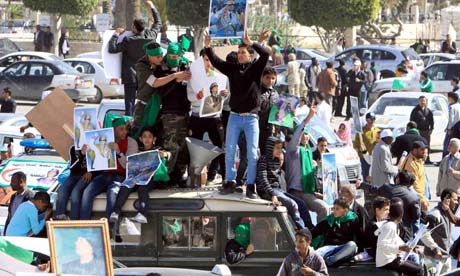
No Ukrainian nurse can help Libya's Gaddafi. Cheering the protesters

So, it appears that the Arab youth are mad as hell. 

And, Libya's Gaddafi is now at the receiving end of the  raging emotions that have been bottled up for 41 long years.  Yes, it was in 1969, almost 42 years ago, this maniac took over the country

But, Gaddafi will clearly not go away without putting up a fight, and he has quickly resorted to dirty tricks:

The mainstay of the unrest is in regional towns and cities, where many people live in poverty.
Foreign journalists operate under restrictions in Libya, so it has been impossible to independently verify much of the information coming out of the country.
But the BBC has confirmed that several websites - including Facebook and al-Jazeera Arabic - have been blocked.
And the airport in Benghazi, the country's second largest city, has been closed, amid reports that protesters have taken it over.
Residents in Benghazi told the BBC that electricity has been cut off, and tanks are posted outside the court building.
Benghazi protesters have told international media they have learnt from Tunisia and Egypt, and are determined to depose Col Gaddafi.
Media outlets loyal to Col Gaddafi had earlier conceded that security forces had killed 14 protesters in Benghazi on Thursday, though other accounts put the death toll much higher.
 The news channel that US cable corporations refuse to carry, Al Jazeera, also has a similar report:

Marchers mourning dead protesters in Libya's second-largest city have reportedly come under fire from security forces, as protests in the oil-exporting North African nation entered their fifth day.
Mohamed el-Berqawy, an engineer in Benghazi, told Al Jazeera that the city was the scene of a "massacre," and that four demonstrators had been killed on Friday.
"Where is the United Nations ... where is (US president Barack) Obama, where is the rest of the world, people are dying on the streets," he said. "We are ready to die for our country."
I hope my intro class students are tuned in--one of the two short stories that I have assigned for their final projects is Hisham Matar's "Naima."  Matar writes in the Guardian:
I appeal to Colonel Gaddafi and his security forces: for the sake of the mothers, for the sake of those who died, for the sake of Libya, please don't shoot and torture your people.
I blogged before that Matar knows well about this dictator and his cronies ...

So, why the Ukrainian nurse in the heading you ask?  Thank WikiLeaks for that

Thursday, February 10, 2011

Will Egypt's protesters learn from Ukraine? No, we never learn :(

After revolutionary euphoria fades and normality returns, democratic revolutions can be betrayed and reversed.
Thus writes Ukraine's former prime minister, Yulia Tymoshenko, while commenting on what lessons the Ukrainian "Orange" Revolution can teach the protesters in Egypt.  Of course, we need to keep in mind that Tymoshenko has an axe or two to grind in this context.  Nonetheless, some of the points she makes, including that quote, are valid.

Despite Mubarak refusing to quit, it seems increasingly the case that his days as Egypt's president are not going to be too many.  The question then is about the day after.  Which is why Cassandra's Tymoshenko's observations matter.

Oh well ... Last weekend I had invited for dinner a visiting Ukrainian environmental attorney and her host.  So, all the more the reason for Tymoshenko's opinion to trigger the following video

Tuesday, February 01, 2011

Wednesday, March 03, 2010

Wild Dances ... well, Ukrainian

I used Ruslana's 2004 EuroVision song for the warm-up in my intro class today :)  It certainly is high energy, eh!  I wonder if this song ever worked its way into the presidential elections there ....?