Showing posts with label GM. Show all posts

Monday, August 26, 2013

Can GM food feed the planet? Yes, it can. Will it? Depends!

In response to a question at a recent guest-lecture, I commented that rising affluence is the cause of what we often refer to as "problems."  With affluence, we humans tend to increase consumption of different types, including food.  Affluence means that we are no longer limited to surviving on cassava and bananas.  We begin to want more nutrition and variety. Vegetarians want to increase protein and fat and sugar intake. Carnivores with money are tempted to eat more animal food..

Of course, the world is not full of affluent population--we cannot afford to be misled by the exceptional affluence here in the US that has made food so inexpensive:
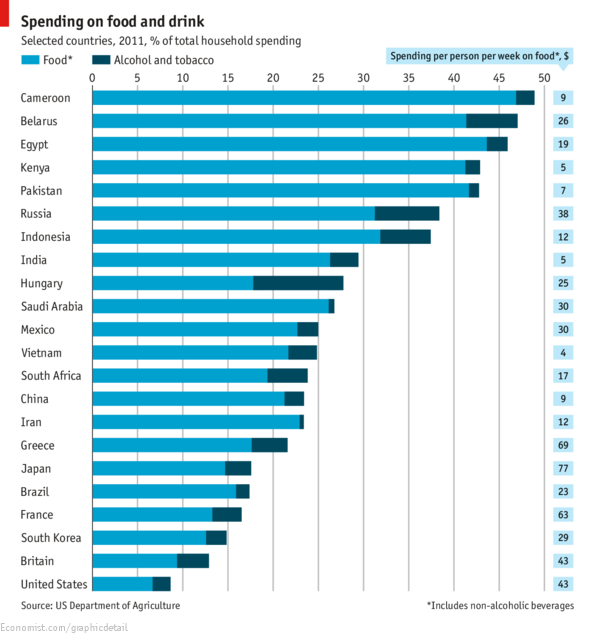
Image source

Against such a background, we are also certain that the global population will increase by at least another two billion people, if not even more.  The higher numbers, along with the projected increase in affluence, means one undeniable aspect of life--we will need to produce more food.

Producing more food begins with increasing agricultural yields.  Not merely because of the growth of the vegetarian population--that will be a much slower growth compared to the demand for animal protein. All those animals have to be fed.

Hence my worries over the sustained opposition to GM food.  The Scientific American has a "food issue" in which there is this lengthy piece on GM crops:
[Despite] overwhelming evidence that GM crops are safe to eat, the debate over their use continues to rage, and in some parts of the world, it is growing ever louder. Skeptics would argue that this contentiousness is a good thing—that we cannot be too cautious when tinkering with the genetic basis of the world's food supply. To researchers such as Goldberg, however, the persistence of fears about GM foods is nothing short of exasperating. “In spite of hundreds of millions of genetic experiments involving every type of organism on earth,” he says, “and people eating billions of meals without a problem, we've gone back to being ignorant.”
So who is right: advocates of GM or critics? When we look carefully at the evidence for both sides and weigh the risks and benefits, we find a surprisingly clear path out of this dilemma.
This is a battle that has been going on for decades now.  We might even find a peaceful solution to the Israel-Palestine issue before we sort out the GM crop disagreements.  So, where do we go from here?
There is a middle ground in this debate. Many moderate voices call for continuing the distribution of GM foods while maintaining or even stepping up safety testing on new GM crops. They advocate keeping a close eye on the health and environmental impact of existing ones. But they do not single out GM crops for special scrutiny, the Center for Science in the Public Interest's Jaffe notes: all crops could use more testing. “We should be doing a better job with food oversight altogether,” he says.
I doubt we will reach any middle ground on this, given the deep trenches that have been dug.

Meanwhile, the race is on to label foods, which this Scientific American editorial notes is "a bad idea":
We have been tinkering with our food's DNA since the dawn of agriculture. By selectively breeding plants and animals with the most desirable traits, our predecessors transformed organisms' genomes, turning a scraggly grass into plump-kerneled corn, for example. For the past 20 years Americans have been eating plants in which scientists have used modern tools to insert a gene here or tweak a gene there, helping the crops tolerate drought and resist herbicides. Around 70 percent of processed foods in the U.S. contain genetically modified ingredients.
Instead of providing people with useful information, mandatory GMO labels would only intensify the misconception that so-called Frankenfoods endanger people's health [see “The Truth about Genetically Modified Food”].
But, isn't sticking a label on the food better for consumer choice?  Consumers can then buy whatever they want to buy?  Not really:
 Many people argue for GMO labels in the name of increased consumer choice. On the contrary, such labels have limited people's options. In 1997, a time of growing opposition to GMOs in Europe, the E.U. began to require them. By 1999, to avoid labels that might drive customers away, most major European retailers had removed genetically modified ingredients from products bearing their brand. Major food producers such as NestlĂ© followed suit. Today it is virtually impossible to find GMOs in European supermarkets.
Americans who oppose genetically modified foods would celebrate a similar exclusion. Everyone else would pay a price. Because conventional crops often require more water and pesticides than GMOs do, the former are usually more expensive. Consequently, we would all have to pay a premium on non-GMO foods—and for a questionable return.
So, to recap: where will all the additional food crop production come from to feed the growing population that will also be more affluent?

Saturday, April 24, 2010

GM repaid taxpayers? Not even close :(

Shikha Dalmia dissects the news story, and General Government Motors' claim, that GM has paid the government back.  (Dalmia is also from India.  And, no, I don't know her; India is a land of a billion-plus people!!!)
First, what was the news item?  In his weekly address, the President talked about this:
Fresh off the news that General Motors had paid back its taxpayer-backed loans five years ahead of schedule, Obama said the decision to help the companies as proven to be less costly than the alternative.
The CEO of GM wrote an op-ed in the WSJ, and the title of that was: The GM Bailout: Paid Back in Full

So, what does Dalmia say about this?
when Mr. Whitacre says GM has paid back the bailout money in full, he means not the entire $49.5 billion--the loan and the equity. In fact, he avoids all mention of that figure in his column. He means only the $6.7 billion loan amount.
The rest is not cash but taxpayer our equity in the corporation--yes, lest we forget, we are the majority owners over at GM.
But, Dalmia says that is not all; it gets worse:
the company has applied to the Department of Energy for $10 billion in low (5%) interest loan to retool its plants to meet the government's tougher new CAFÉ (Corporate Average Fuel Economy) standards. However, giving GM more taxpayer money on top of the existing bailout would have been a political disaster for the Obama administration and a PR debacle for the company. Paying back the small bailout loan makes the new--and bigger--DOE loan much more feasible.
In short, GM is using government money to pay back government money to get more government money. And at a 2% lower interest rate at that. This is a nifty scheme to refinance GM's government debt--not pay it back!
GM boasts that, because it is doing so well, it is paying the $6.7 billion five years ahead of schedule since it was not due until 2015. So will there be an accelerated payback of the rest of the $49.6 billion investment? No. That goal has been pushed back, as it turns out.
Hmmm .... hire a couple of accountants and executives who can juggle numbers .... wait a minute; wasn't that Enron's approach as well? Ahem ....

Friday, February 26, 2010

The eggplant war in India

An eggplant war is going on in India, with immense implications for agriculture.

Familiarity with “eggplant parmigiana” might tempt us to think that the crop originated in Italy.  However, it is India that is the geographic home for this vegetable, where it has been cultivated for hundreds of years. 

However, it is not referred to as eggplant in its native habitat—the name there is “brinjal” in the English language.  In the Tamil language that I grew up speaking at home, this vegetable is called “kaththarikai.”   

When we were young, my siblings never cared for the brinjal dishes, which meant that I could eat that much more of my mother’s tasty preparations.  However, mom rarely cooks this anymore because dad has suddenly become allergic to this vegetable after almost 80 years of enjoying it in various forms!  A small helping of brinjal immediately translates to rashes that then take at least a fortnight to go away.

It is a bizarre coincidence that dad’s eggplant allergy started about the same time that India started debating whether or not to allow the cultivation of genetically modified (GM) brinjal.  Of course, this correlation has no causation at all.  But, I suspect that it is all the more the reason for dad to write off brinjal for the rest of his life. 

The goals of genetic modification to this native vegetable are straightforward.  Bt-Brinjal, as the GM variety is known, is a trans-genic brinjal that was developed by the global leader in this field, Monsanto, through its subsidiary.  The idea is that introducing the soil bacterium Bacillus Thuringiensis (Bt) into the genetic structure will make the plant more pest-resistant because the insects that attack the plant will, in turn, fall victim to the Bt toxin.  This approach will, theoretically, increase yields and reduce the need for synthetic pesticides.    

The opposition to this Bt-brinjal is along the same lines of concerns over any GM crop.  Do we know enough about how it might affect human health?  Will the GM crop drive out the native strains?

For now, the federal government has imposed a moratorium, and the statement issued by the Environment Minister, Jairam Ramesh, reflects the concerns of those who oppose Bt-brinjal.  The minister, whose graduate studies in science and public policy were at MIT and Carnegie Mellon University, declared that the moratorium will be in place “till such time independent scientific studies establish, to the satisfaction of both the public and professionals, the safety of the product from the point of view of its long-term impact on human health and environment, including the rich genetic wealth existing in brinjal in our country.”

However, this Bt-brinjal war represents a much larger issue.  Demand for fruits and vegetables will increase in this largely vegetarian country of more than a billion people not merely because of the large population but because of the growing affluence. 

In meat-eating lower-income countries undergoing economic growth and development, studies show that increasing affluence triggers growth in the demand for meat.  In China, for instance, thanks to the rapid economic growth, per capita meat consumption more than doubled in a short period between 1985 and 2000, according the estimates from the Food and Agriculture Organization.     

In the case of India, the affordability of the growing middle class will quickly translate into greater demand for vegetables and fruits, even more than the growth in meat consumption.  But, conventional agricultural practices will not be able to satisfy this affluence-driven consumption.  At the same time, there is a limit to which fertilizers and other modern agricultural practices can increase yields.  Further, people in India—and in the rest of world, including here in the US—are also a tad worried about dependence on chemicals in the food chain. 

So, to a large extent, this war over Bt-brinjal is more than about the brinjal productivity itself.  This is also setting the stage for decisions that will have to be made regarding a whole range of crops that are viable candidates for genetic modification as a route for increasing productivity. 

Well, I know at least one person who is relieved to be on the sidelines of this Bt-brinjal war—my father, who has stopped eating kaththarikai!

Thursday, February 25, 2010

Size matters: small is beautiful?

To paraphrase Dick Cheney, Hummer is in its last throes :)  I suppose this is better than how Government General Motors told Saturn another of Cheney's statements--*&%$ yourself!

In the context of Hummer's inevitable death, Tunku Varadarajan writes:
Americans aren’t shy or subtle, and bigness gets the point of one’s prosperity across to one’s neighbors without artifice or nuance. Big McMansions and cars telegraph “I’m rich and successful” to those not schooled in the snobberies and subtleties of class, to those who lack hypocrisy. Big American breasts are a perfect (if occasionally gaudy) metaphor for the country’s bounty. 
I wish he had clarified whether those breasts were of women or men :)
Anyway, Varadarajan has a neat observation:
the demise of the Hummer looks like more than the end of an automotive brand. It looks like the start of an age when we need to measure ourselves afresh—and maybe start to resize America.
I am not sure whether a downsizing will really appeal to mainstream America.  I wrote about this at Planetizen--though, it was before this Great Recession.

I am, therefore, all the more reminded of Schumacher's Small is Beautiful.  Yes, it takes me back to my first year of grad school, which was when I read that book.  It had enormous appeal, but not only was it a tad touchy-feely, it was pretty much a retelling of Buddhist philosophy in political economic language.  But, I have always had a soft spot for the small is beautiful approach to life--again, in a way I wrote about this at Planetizen.

Wednesday, January 27, 2010

So, Toyota is the new GM?

Remember Government Motors General Motors?  It was bumped into second position by the mighty Toyota?  I suppose one cannot be king for long:
Toyota’s “reputation for long-term quality is finished,” said Maryann Keller, senior adviser at Casesa Shapiro Group LLC in New York, a strategic adviser to auto industry. “People aren’t going to buy Toyotas, period. It doesn’t matter which model. What’s happened is sufficient to keep people out of the stores,” she said in an interview yesterday.
The carmaker said late yesterday it’s expanding a record 4.26 million-vehicle recall announced in November to include 1.09 million additional U.S. autos, to fix accelerator pedals at risk of being trapped by floor mats. Losing its reputation for quality would undercut Toyota’s decades-long campaign to promote reliability and safety that helped it become No. 2 in U.S. sales.

So, if our logic for pouring money into GM and Chrysler because they are American companies that needed to be propped up, will we then extend that sympathy to Toyota too? Just asking :)

Tuesday, January 05, 2010

Ford and Toyota sell .... Chrysler and GM?

Turns out that Government Motors General Motors, is still struggling .... while Ford, which did not get any bailout money, is doing fine, says the WSJ:

Ford Motor Co. posted a 33% rise in December U.S. light-vehicle sales, ending a stellar year for the auto maker compared with its rivals. Ford recorded its first full-year market-share gain since 1995.
Meanwhile, Chrysler Group LLC posted a 3.7% decline compared with a year earlier and said its full-year sales were the worst the auto maker had seen in 47 years.
The largest U.S. auto maker—General Motors Co.—posted a 5.7% decline, but said its process to sell down Pontiac and Saturn inventory was ahead of schedule and reported a 2.2% increase for the four brands GM will keep after its streamlining.
Toyota Motor Corp. of Japan said its U.S. sales rose 32% to 187,860 vehicles last month.
The results underscore how the auto makers have responded to the recession that began officially in December 2007 and led to the bankruptcy filings of Chrysler and GM.
More cash for clunkers?

Sunday, November 22, 2009

Meanwhile at Government Motors, er, at GM ...

You know what attracted me to this op-ed in the NY Times?  The leader "Portland, Ore."  To think that a NY Times op-ed on GM would be authored from somebody here in Oregon .... I was trapped :-)

It was a bad, bad idea for the government to run this automobile sinkhole company.  Anyway, we are where we are.  This op-ed argues that:
Maintaining a majority stake in a struggling G.M. as the 2012 election approaches will only increase the liability. If G.M. has to use taxpayer money to bail out Opel and Daewoo, its Korean division (which lost billions on currency speculation, no less), the issue of bailout money being sent abroad will undoubtedly be a campaign issue.
G.M.’s global interests are far too diverse for it to serve its taxpayer owners faithfully, and it can’t afford to subjugate its business prerogatives to the political needs of its major shareholder in the White House. So, unless Americans develop a sudden obsession with G.M.’s $40,000 Volt electric car just in time for an I.P.O., taxpayers will be stuck with tens of billions of dollars in losses.
I wonder if the logic is why worry about tens of billions of dollars in debt, when we are piled high in gazillions of dollars of debt.


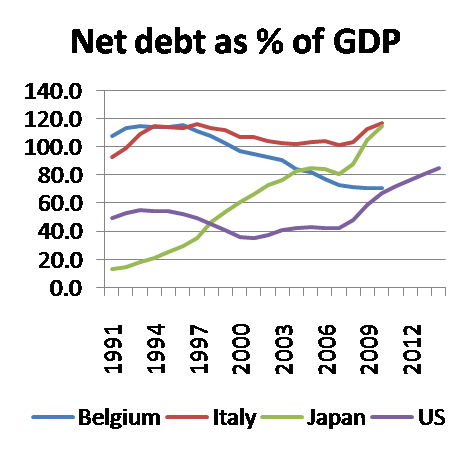
Speaking of debt, Paul Krugman chips in with we have no reason to worry; after all, Belgium, which will soon preside over the EU, is mired in a lot of debt, and provides this chart.

Ahem, while what was good for GM 60 years ago might have been good for the US then, what is good for Belgium being good for the US now?  Seriously, what happened to Krugman?

And, another page in the NY Times wants us to be afraid, really really afraid, of the debt situation:

With the national debt now topping $12 trillion, the White House estimates that the government’s tab for servicing the debt will exceed $700 billion a year in 2019, up from $202 billion this year, even if annual budget deficits shrink drastically. Other forecasters say the figure could be much higher.
In concrete terms, an additional $500 billion a year in interest expense would total more than the combined federal budgets this year for education, energy, homeland security and the wars in Iraq and Afghanistan.
So, who you gonna believe? :-)

Sunday, October 04, 2009

On the death of Saturn


I drive a Saturn now--the one in this photograph on the left.  We bought this five years ago after trading in the ten-year old Saturn Wagon.

So, you can understand why I am more than a tad sad and disappointed that Saturn will, in all probability, not be around for long.

It will be only a short matter of time before automobile historians dig into how Saturn could have saved GM, and how instead senior leadership at GM killed Saturn and ended up killing GM itself.  And if you thought it was the doing of GM's management that Michael Moore caricatured, well, they had equal partners in this homicide autocide--the UAW.
Saturn was killed by its creators, GM and the UAW. The company starved Saturn for new products, and the union waged war against Saturn's labor reforms to keep them from spreading to other GM factories.
Saturn came out at the right time--small cars that were fuel efficient, with a possibility of those cars evolving into hybrid and electric cars.  And it could have worked out so well for everybody.  I am simply pissed off!!!!!
Paul Ingrassia's piece ends on this note:
Meanwhile, the Saturn workers' sense of loss is expressed poignantly by Mike Bennett, their former union leader, who says, "I wake up at night sick, thinking about all the things that might have been."
I feel terrible for the fantastic people at Saturn.  The employees in the service wing of the dealership--both in Bakersfield and in Eugene--were some of the best I have had the pleasure of working with.  Rarely did our cars have problems, and never once did I have to think twice about the quality of the work they did, nor about the prices they charged, which always seemed reasonable.  They treated me so well.  The service manager at the local dealership was a friendly, jolly, guy named Darrel.  He would recognize my name on the phone's caller ID and pick up the phone with the friendliest hello and always pronounced my name way better than even how I can.  I wish him and everybody else well .....

Sunday, June 28, 2009

The United Printing Press, er, States of America :-(

Every once in a while, the master manipulator of metaphors, Thomas Friedman, comes up with something really, really good. Like this from his column:

Sometimes, I worry, though, that what oil money is to Russia, our ability to print money is to America. Look at the billions we just printed to bail out two dinosaurs: General Motors and Chrysler.

Lately, there has been way too much talk about minting dollars and too little about minting our next Thomas Edison, Bob Noyce, Steve Jobs, Bill Gates, Vint Cerf, Jerry Yang, Marc Andreessen, Sergey Brin, Bill Joy and Larry Page. Adding to that list is the only stimulus that matters. Otherwise, we’re just Russia with a printing press.
Hey, give credit where it is due, eh!

Friday, June 05, 2009

General Motors is now Government Motors!!!

Says Greg Mankiw:
Here is what President Obama said about the GM restructuring:
What we are not doing -- what I have no interest in doing -- is running GM. GM will be run by a private board of directors and management team with a track record in American manufacturing that reflects a commitment to innovation and quality. They -- and not the government -- will call the shots and make the decisions about how to turn this company around. The federal government will refrain from exercising its rights as a shareholder in all but the most fundamental corporate decisions. When a difficult decision has to be made on matters like where to open a new plant or what type of new car to make, the new GM, not the United States government, will make that decision.

In short, our goal is to get GM back on its feet, take a hands-off approach, and get out quickly.
Very well put. Apparently, however, the president's congressional allies did not get the memo. Today's Boston Globe reports:

Frank intervention extends life of GM's Norton center

General Motors Corp. will delay the closing of a Norton parts distribution center it planned to shutter by the end of the year, according to US Representative Barney Frank. The extension will temporarily preserve about 80 jobs....

The plant manager received word yesterday that Frank had successfully lobbied GM chief executive Fritz Henderson to delay the closing....

Frank, whose district includes Norton, said he told Henderson, "Look, I understand that these things have to happen but they don't have to happen in the midst of the worst recession in years."

Will the Obama administration call Congressman Frank and ask him to refrain from further politicization of GM business decisions? Or will it put aside its principles and defer to Congress on these matters?
Ouch!

So, does this mean that just as we have an "independent" base closing commission, we will soon have an independent and bipartisan commission on which auto dealerships to close, and which auto factories to close? Lordy lord!!!

Tuesday, June 02, 2009

Karl Marx, GM and Chrysler. More than surreal!

The workers are now, finally, significant owners of the means of production. The United Auto Workers control about 65 percent of Chrysler and 17.5 percent of General Motors.
Daniel Gross has, as always, an engaging column. The ending is even better:
A shrinking union accepts stakes in shrinking companies. It promises not to strike. The governance system muffles the union's voice by restricting its board presence. It sounds like an arrangement a union-hater like Jack Welch would have cooked up.

Monday, June 01, 2009

GM is an "economic Vietnam"

We should be concerned lest GM become a kind of economic Vietnam, where the federal government throws good money after bad, year after year, in a vain quest for victory.
Leave it to Richard Posner for clear thinking, and clear writing. Though am not always inclined to agree with him, in this case I am just convinced that Posner is correct.

Friday, May 29, 2009

The future of manufacturing, and American workers

Robert Reich has a fantastic piece on why we ought not to be insanely worried about the loss of manufacturing. Read the entire argument here. An excerpt:

Want to blame something? Blame new knowledge. Knowledge created the electronic gadgets and software that can now do almost any routine task. This goes well beyond the factory floor. America also used to have lots of elevator operators, telephone operators, bank tellers and service-station attendants. Remember? Most have been replaced by technology. Supermarket check-out clerks are being replaced by automatic scanners. The Internet has taken over the routine tasks of travel agents, real estate brokers, stock brokers and even accountants. With digitization and high-speed data networks a lot of back office work can now be done more cheaply abroad.

Any job that's even slightly routine is disappearing from the U.S. But this doesn't mean we are left with fewer jobs. It means only that we have fewer routine jobs, including traditional manufacturing. When the U.S. economy gets back on track, many routine jobs won't be returning--but new jobs will take their place. A quarter of all Americans now work in jobs that weren't listed in the Census Bureau's occupation codes in 1967. Technophobes, neo-Luddites and anti-globalists be warned: You're on the wrong side of history. You see only the loss of old jobs. You're overlooking all the new ones.

The reason they're so easy to overlook is that so much of the new value added is invisible. A growing percent of every consumer dollar goes to people who analyze, manipulate, innovate and create. These people are responsible for research and development, design and engineering. Or for high-level sales, marketing and advertising. They're composers, writers and producers. They're lawyers, journalists, doctors and management consultants. I call this "symbolic analytic" work because most of it has to do with analyzing, manipulating and communicating through numbers, shapes, words, ideas.

Tuesday, March 31, 2009

Carmageddon and the Car-Dealer-in-Chief :-)

I was listening to President Obama's remarks on the continuing GM/Chrysler saga when I was driving, and I could not understand why he talked about the government standing behind auto warranties. It felt bizarre. I felt the same way when he talked about weather-proofing roofs in the context of the stimulus bill discussions; remember that?

Thus, I was eagerly looking forward to Jon Stewart's satire, because I was that confident that it was one strangely humorous press conference. The Daily Show did not let me down. But, first, an excerpt from David Brooks' column:
by enmeshing the White House so deeply into G.M., Obama has increased the odds that March’s menacing threat will lead to June’s wobbly wiggle-out. The Obama administration and the Democratic Party are now completely implicated in the coming G.M. wreck. Over the next few months, the White House will be subject to a gigantic lobbying barrage. The Midwestern delegations, swing states all, will pull out all the stops to prevent plant foreclosures. Unions will be furious if the Obama-run company rips up the union contract. Is the White House ready for the headline “Obama to Middle America: Drop Dead”? It would take a party with a political death wish to see this through.
And now, Jon Stewart:

The Daily Show With Jon StewartM - Th 11p / 10c
Carmageddon '09 - Lemon Aid
comedycentral.com
Daily Show Full EpisodesEconomic CrisisPolitical Humor

Sunday, March 08, 2009

Stock markets will be down on Monday, Tuesday, ...

I will be surprised if they don't--after strong opinions like this:

John McCain and Richard Shelby, two high-profile Republican senators, said on Sunday that the government should allow a number of the biggest American banks to fail.

“Close them down, get them out of business,” Mr. Shelby, the senior Republican on the Banking Committee, told ABC’s “This Week With George Stephanopoulos.” “If they’re dead, they ought to be buried.”

While the Alabama senator did not say which banks to shutter, he suggested that Citigroup might be on that list, saying the bank has “always been a problem child.”

Mr. McCain, appearing on “Fox News Sunday,” echoed that sentiment without identifying any banks. Mr. McCain, who lost the presidential election last November, also accused the Treasury Department of avoiding the “hard decision” to let “these banks fail.”

And how about this one:
Republican Sens. John McCain of Arizona and Richard Shelby of Alabama said they want the automaker to seek bankruptcy protection, which would allow for reorganization.

"I think the best thing that could probably happen to General Motors, in my view, is they go into Chapter 11, they reorganize, they renegotiate their — the union management contracts and come out of it a stronger, better, leaner and more competitive automotive industry," McCain said on "Fox News Sunday."

Shelby, appearing on ABC's "This Week," said Chrysler and Ford as well as GM belong in Chapter 11 and then could get federal money as part of the process of reorganization.

Meanwhile, the treasury secretary, .... well, read this:
Henry Blodget thinks it is time for Timothy Geithner to go. So far, Geithner's performance has been shockingly unimpressive. It's not as if he's walking into the crisis anew; he's been the head of the New York Fed for years, and dealing with these issues from the very beginning. Yet on the really crucial problem of what to do about the banking system, he's been very nearly silent, going to Congress with a non-plan-plan that terrified the very markets it was supposed to reassure. Blodget also has a point when he says that Geithner has been mysteriously stuck on his original ideas. I would add that he seems mysteriously stuck on them, but not willing to pay the political cost of executing them, which is the worst of both worlds.

On the other hand, though I've so far been underwhelmed by his performance, we can hardly fire him, because who on earth would replace him?

Thursday, January 01, 2009

Car crisis could well be repeated

Like most Americans, I am conflicted over how we ought to deal with the crisis with the three car manufacturers — Ford, General Motors and Chrysler.

This is not an abstract public policy issue for me by any means. After all, the vehicles that our family currently owns are from one of these manufacturers — a Ford Focus, a Saturn Vue and a Jeep Cherokee. We also have owned a Ford Taurus and a Saturn station-wagon. The only “un-American” vehicle we ever had was a Nissan Sentra.

It is not that we were implementing a “Buy American” policy at home. It just so happens that the vehicles we bought met our preferences and budget constraints.

Earlier today, when I took my Saturn Vue to the dealership for the regular oil change, I began to wonder whether the brand will even exist in the future. News reports suggest that General Motors is planning to sell the division, or merge it with another. It’s possible Saturn could be shuttered completely.

On the one hand, the public policy person in me prefers inefficient economic enterprises to fade away without government intervention. I think about Pan Am, which symbolized air travel when I was a kid. It has been almost two decades since Pan Am closed down when it could not survive in a highly competitive global travel industry. It is the law of the jungle that inefficient businesses lose out to efficient ones. In order to pre-empt a Pan Am-like story, the auto manufacturers should have avoided the strategic errors they made, especially during the cash-flush decade from the mid-1990s when sport utility vehicles and minivans delivered billions of profits.

On the other hand, I recognize that government actively intervenes in practically every aspect of our economy. Heck, even my home is partly underwritten by the government, which permits us to write off the interest paid on the mortgage loan. Thus, if many other industries can be subsidized or bailed out, well, why not help out Saturn and its loyal and committed employees?

Even as policymakers try to figure out the current crisis, we might want to understand a few longer-term trends as well. “Planes, Trains and Automobiles” was a holiday season movie two decades ago; these same American manufacturing industries listed in the title also have been in decline. Trains, for all purposes, have been nearly relegated to history. The automobile industry is in a pickle — some might argue that it has been in denial since the energy crisis in the 1970s.

And all is not well in the aviation industry either — both in the manufacturing of planes and in passenger transportation. Boeing was the undisputed champ in its field, perhaps even more powerfully so than the American “Big Three” ever were. Slowly but steadily, Boeing has been losing its market share to other manufacturers. Twenty years ago, Airbus had barely 16 percent of the market; now it is nearly on par with Boeing in terms of the value of aircraft delivered.

Meanwhile, Brazil and Canada have become active in the manufacture of short-haul jets. China is the latest entry into this field; last month, the Commercial Aircraft Corporation of China announced the sale of five of its ARJ21s to General Electric’s aircraft leasing division, with an option for 20 more. The ARJ21 and other larger CACC-­manufactured jets are essentially China’s effort to crack the market dominated by Boeing and Airbus.

Over the last few years, we have come to realize that anything we do can be done cheaper in China. This means that, if we don’t watch out, here in the Pacific Northwest we could be worrying about Boeing 20 years from now, just as Americans are worrying about General Motors today.

Therefore, even as we try to mitigate the woes of the auto industry, and even as the manufacturers begin to articulate a long-term survival strategy, I hope we will learn one important lesson.

Global economic competition is real, and it will only get more intense in the future. If we don’t learn that lesson, another bottom line awaits us: History does repeat.

Published in the Register Guard Dec 16, 2008

Wednesday, December 10, 2008

Bailout for the auto manufacturers

Like most Americans, I too am conflicted over how we ought to deal with the crisis with the three automobile manufacturers—Ford, General Motors, and Chrysler.

This is not an abstract public policy issue for me by any means. After all, the three vehicles that our family currently owns are from each one of these manufacturers—Ford Focus, Saturn Vue, and Jeep Cherokee. We have also owned a Ford Taurus and a Saturn station-wagon in the past. The only “non-American” vehicle we have ever had was a Nissan Sentra.

It is not that we were implementing a “buy American” policy at home. It just so happens that the vehicles we bought met our preferences and budget constraints. Earlier today, when I took my Saturn Vue to the dealership for the regular oil change, I began to wonder whether the brand will even exist anymore. News reports suggest that General Motors is planning to sell the division, or merge it with another division. Even worse is the possibility that Saturn might be completely shuttered down.

On the one hand, the public policy person in me prefers inefficient economic enterprises to fade away without government intervention. I think about PanAm, which symbolized air travel when I was a kid. It has been almost two decades since PanAm closed down when it could not survive in a highly competitive global travel industry. It is the law of the jungle, so to say, where inefficient businesses lose out to efficient ones. In order to preempt a PanAm-like story, the auto manufacturers should have been watchful, and could have avoided the strategic errors they made, especially during the cash-flush decade from the mid-1990s when SUVs and minivans delivered billions of profits.

But, on the other hand, I recognize that government actively intervenes in practically every aspect of our economy. Heck, even my home is partly underwritten by the government, which permits us to write-off the interest paid on the mortgage loan. Thus, if many other industries can be subsidized or bailed out, well, why not help out Saturn and its loyal and committed employees? It is a tough question that can be an easy one only for dogmatic ideologues.

Even as policymakers try to figure out the current auto industry crisis, we might want to understand a few longer term trends as well. “Planes, Trains and Automobiles” was a holiday season movie two decades ago; these same American manufacturing industries listed in the title have also been in decline. Trains, for all purposes, have been relegated to history. The automobile industry is in a pickle—some might argue that it has been in denial since the energy crisis in the 1970s.

And not everything is well with the aviation industry either—both in the manufacturing of planes, and in passenger transportation. Boeing was the undisputed champ in its field, perhaps even more powerfully than the American “Big Three” auto manufacturers ever were. Slowly but steadily Boeing has been losing its market share to other aircraft manufacturers. Twenty years ago, in 1988, Airbus had barely 16 percent of the market and now it is nearly on par with Boeing in terms of the value of aircrafts delivered.

Meanwhile, Brazil and Canada have become active in the manufacturing of short-haul jets. China is the latest entry into this—last month, the Commercial Aircraft Corporation of China announced the sale of five of its ARJ21s (Advanced Regional Jets for the 21st Century) to General Electric’s aircraft leasing division, with an option for 20 additional aircrafts. The ARJ21 and other larger jets to be manufactured by CACC by 2020 are essentially China’s effort to crack the aircraft market dominated by Boeing and Airbus.

Over the last few years, we have come to realize that anything we do can be done cheaper in China. This means that, if we don’t watch out, here in the Pacific Northwest we could be worrying about Boeing twenty years from now, similar to the worries over General Motors today.

Therefore, even as we try to mitigate the woes of the auto industry, and even as the manufacturers begin to articulate a long-term survival strategy, I hope we will learn one important lesson—global economic competition is real, and will only get more intense than ever before. If we don’t get that lesson, another bottom line awaits us: history does repeat.