Showing posts with label COP21. Show all posts

Monday, June 05, 2017

What can one do?

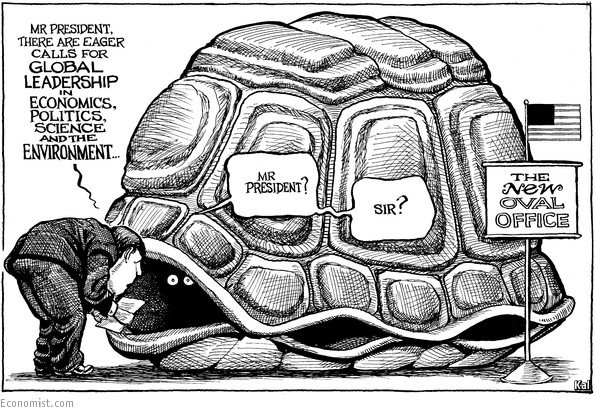
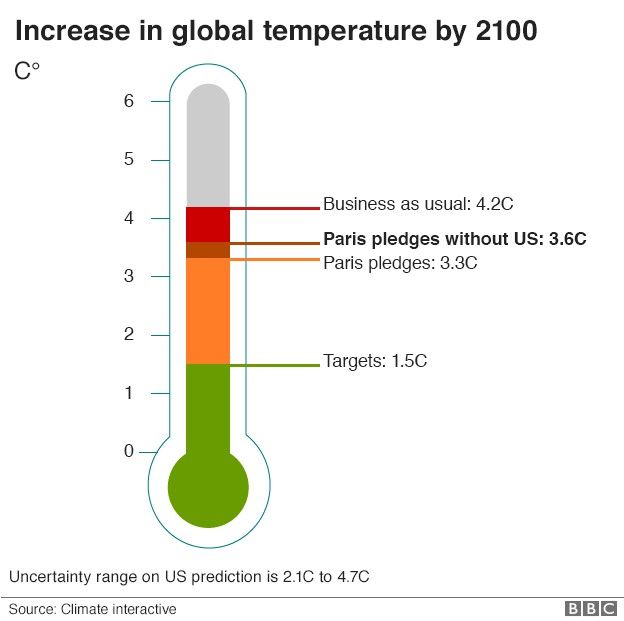
trump knows which campaign promises to keep in order to make sure his base is happy.  So, of course, he pulled the US out of the Paris agreement on limiting greenhouse gas emissions in order to try to keep the world from roasting.
Source

Der Spiegel notes in a lengthy editorial essay:
Trump's withdrawal is a catastrophe for the climate. The U.S. is the second-largest emitter of greenhouse gases -- behind China -- and is now no longer part of global efforts to put a stop to climate change. It's America against the rest of the world, along with Syria and Nicaragua, the only other countries that haven't signed the Paris deal.
But the effects on the geopolitical climate are likely to be just as catastrophic. Trump's speech provided only the most recent proof that discord between the U.S. and Europe is deeper now than at any time since the end of World War II.
Now, the Western community of values is standing in opposition to Donald Trump. The G-7 has become the G-6. The West is divided.
At this point, it seems like only a major volcanic eruption can cool the planet.  The downside to that eruption is, well, the the suddenness of it all will be catastrophic; be careful what you wish for!

So, what can one do on this World Environment Day, right?

Even if you are a New York billionaire--that other guy--there is not much you can do.
Unfortunately, private philanthropy is just not big enough to replace government funding. You can advocate. You can demonstrate.
As much as Bloomberg is putting his own money where his mouth is, we too can do things in our daily lives even as we continue to resist the maniac that 63 million people voted for.  Like, for instance, "You’re better off eating vegetables from Argentina than red meat from a local farm":
Eating local is lovely, but most carbon emissions involving food don’t come from transportation — they come from production, and the production of red meat and dairy is incredibly carbon-intensive.
And, yes, simplify your life:
It’s better not to consume the raw materials in the first place, so you may want to think carefully about whether you’re really going to use something before you buy it.
Oh, of course, continue to protest against the horrible human being and continue to shame the 63 million who voted for him.


Thursday, June 01, 2017

June 1, 2017: A date which will live in infamy

So, ... it finally happened.
President Trump announced Thursday that he will withdraw the United States from participation in the Paris climate accord
The asshole did it.

Source

I bet his 63 million voters, including two frequent commenters in the pre-election years, are orgasmic with this premature withdrawal.

It is not only the global climate change, about which I have blogged enough, that worries me.  This decision by the worst ever human being will mean that in the international politics of give and take, well, most of the rest of world will begin to work around the US.  And when we go knocking on their doors, they will flash their middle fingers to reciprocate trump's gesture.

The US as the "leader of the free world" no more.

I wish people would understand something that many serious people, and the insignificant me, have been saying ever since trump became a candidate: most of his policies are in tune with what most of the GOP is all about.  In this context, it is not merely trump who denies global climate change and the human causation of it--that is pretty much the mainstream GOP position.  trump just happens to speak crudely and plainly, whereas the "establishment" leaders use appropriate euphemisms!

Oh well ... I feel so exhausted. It is not even five months into the asshole's presidency.


Saturday, April 22, 2017

Carrying coal to Newcastle

In my classes, I often remind students that for all practical purposes, it is the last two hundred years that have made a huge difference in the human condition, and that the rest of this century will undergo transformations that will be of a scale even grander than that of the past two centuries.

All those pretty much began with the way we started using coal to power the transformative ideas.  This coal-based transformation of the world, the Industrial Revolution, began in England.  The same place where history was made this past Friday:
Friday was the first full day since the height of the Industrial Revolution that Britain did not burn coal to generate electricity, a development that officials and climate change activists celebrated as a watershed moment.
The accomplishment became official just before 11 p.m., when the 24-hour period ended.
...
Now on a path to phase out coal-fired power generation altogether by 2025, Britain, also the home of the first steam engine, is currently closing coal plants and stepping up generation from cleaner natural gas and renewables, like wind and solar.
“Symbolically, this is a milestone,” said Sean Kemp, a spokesman for National Grid, Britain’s power grid operator. “A kind of end of an era.”
I wish the coalman-in-chief in the White House and his 63 million toadies will get to at least hear about this, which their only news source--Faux Noose--will not cover, I am sure.
“The first day without coal in Britain since the Industrial Revolution marks a watershed in the energy transition,” Hannah Martin, head of energy at Greenpeace U.K., told The Guardian. “The direction of travel is that both in the U.K. and globally we are already moving towards a low carbon economy.”
If not for the fucked up GOP, we would have moved a lot more towards a low carbon economy!

Not that the world of business is any better either.  Which should worry us when business schools rarely, if at all, include sustainability in their curriculum.
Even if we stop or reduce greenhouse gas emissions, global temperatures will continue to rise for 100 or more years due to carbon dioxide emissions already in the atmosphere. Today’s business students who will be tomorrow’s business leaders are guaranteed to face sustainability challenges.
Tell that to the businessman-in-chief, when he is not busy grabbing pussies!


Saturday, November 28, 2015

I worry about climate change. So ... I contribute more to it?

I have been pissing people off all the time.  Throughout my entire life, it seems like.  It is that constant questioning approach that pisses people off.  Back when I was a student doing an internship to pay bills, my supervisor told me I was being a contrarian, which I am not--all because I questioned the ideas behind the project to which I was assigned.

It is difficult to consistently align one's ideas through all walks of life.  Those are the inconsistencies that people prefer to gloss over, which I question.  Even in my own life.

Take for instance my concern over climate change.  Unlike the deniers, I am convinced about the science behind it.  Climate change is for real.  When that is the case, then I have to ask myself what I do to help the cause.

I have blogged about the impacts of eating meat, for instance--the scientific analysis showing that being a vegetarian is significantly less of an impact on the environment unlike the effects of a carnivorous or omnivorous lifestyle.  I can feel good about myself.

I have also blogged about the very little trash that I generate--I barely have two small bags of trash for the garbage truck to haul away every two weeks.  Yep, one small bag of trash per week.

I rarely throw away food.  Because I do not buy a whole bunch and let it rot.  I do not cook a whole bunch and toss them away.  I do not eat out much either.  Good for the environment and good for my health, I gloat.

I continue to use old and outdated gadgets.  The music system that I use is a relic from the early 1990s.  My smartphone is so old that even the YouTube app has stopped working.  I feel smug that I am not participating in the wasteful disposable culture.

But, I also know I am one awful culprit.  I contribute way more than the average meat-eating, gadget-buying, food-wasting, middle-class American.  Consider, for instance, the following estimate of my carbon footprint, based on the average in the zipcode where I live and the income and household characteristics:

Check your footprint here

You see the travel component?  You see how it towers over food?  Over "other goods"?  Especially the air travel:
Flying is a luxury. Just 5 percent of the world’s population has ever set foot on an airplane. Of the almost 20 percent of Americans who have never flown, their household income is much more likely than average to be less than $30,000.
Imagine that!  A fifth of the American population has never, ever flown.  95 percent of the world's population has never, ever flown.  I, meanwhile, add up my frequent flier miles.

And, yes, flying is one hell of a contributor to climate change.  Yet, that source is the least regulated of all, compared to the stationary sources like factories and mobile sources like cars.  Why?
“Boeing is, by dollar value, the United States’ largest exporter,” she says. “The political clout of Boeing is huge.”
Actually it is more than Boeing alone.
Vera Pardee, the senior counsel for the Center for Biological Diversity, a party to the 2007 lawsuit, says recent related action by the European Union to force the industry into reducing its emissions via a carbon-trading platform also fell victim to industry influence. For nearly a decade, the European Union worked to establish an emissions-trading scheme that it wanted to apply to all aircraft landing in EU territory. In 2012, as the proposal was being finalized, Pardee says China, Brazil, and other countries threatened to cancel their orders with Airbus, which is based in France. Likely wanting to protect the bottom line of one of its biggest companies, the European Union agreed to “stop the clock” in 2013 on its enforcement of aviation emissions. According to Pardee, that’s evidence of the “amazing influence that the industry has over this entire process, and continues to have.”
I will continue to fly all the way across the continent for academic conferences, and all the way across the world for family reasons.  Yet, I refer to myself as environmentally conscious and that I worry about climate change.  Bah, humbug!

Oh well.  Soon the world's leaders and their scientists will fly to Paris for the global meeting on climate change.  And they will eat meat. And will drink bottled water. And will exchange notes via the latest electronic gadgets. And will wear fashionable clothes.  They too, like I am, are worried about global climate change.  Aren't we all!

How many will I have pissed off with this post? ;)
Monday, November 09, 2015

The dangerous denialists. Especially in climate change.

Until recently, I checked with three Oregon newspapers on a daily basis: Register Guard, Statesman Journal, and The Oregonian.  Of course, I have authored op-eds at all three, though the most are only in the Register Guard.  These days, I rarely ever bother to find out what The Oregonian has to say, particularly in the opinion section--it almost always seems to have nothing substantive, which is shame given that it is published from Portland where the economic weight of the state is located.

Today was one of those rare days when I scanned through the opinions at the Oregonian.  The title of one piece there got my attention: Is 'climate change' really the world's most pressing problem?  It had a wonderful beginning too:
Famed Nobel laureate in physics Richard Feynman once described science as "the belief in the ignorance of experts." The very first scientific society, The Royal Society, adopted the motto: "Take nobody's word for it." Questioning is the stock-in-trade of scientists; it is the way we discover new things and the way we keep science honest. Without the ability to question conclusions, science degenerates into politics and pseudo-religion.
As a big time Feynman fan, I was hooked.  And as one who always advises students not to simply take anybody's word--including mine--I was certainly curious about the opinion.

Alas, after that it was all crap.  It turned out to be one of those climate-change denying pieces.  And, get this, the author "holds a doctorate in physics from the University of Chicago's Laboratory for Astrophysics and Space Research."  Yep, a PhD from one of the most prestigious places for physics.  The very university that was home to Fermi and Chandrasekhar.

Questioning is, indeed, fundamental to science.  Scientists are skeptics.  However, we need to clearly and forcefully distinguish between skepticism and denialism.
In other words, we need to be able to tell when we believe or disbelieve in something based on high standards of evidence and when we are just engaging in a bit of motivated reasoning and letting our opinions take over. When we withhold belief because the evidence does not live up to the standards of science, we are skeptical. When we refuse to believe something, even in the face of what most others would take to be compelling evidence, we are engaging in denial. In most cases, we do this because at some level it upsets us to think that the theory is true.
At some level, the skepticism and denialism might even look the same to a casual observer:
Surely few would willingly embrace the title of “denialist.” It sounds so much more rigorous and fair-minded to maintain one’s “skepticism.” To hold that the facts are not yet settled. That there is so much more that we do not know. That the science isn’t certain. The problem here, however, is that this is based not only on a grave misunderstanding of science (which in a sense is never settled), but also of what it means to be a skeptic. Doubting the overwhelming consensus of scientists on an empirical question, for which one has only the spottiest ideologically-motivated “evidence,” is not skepticism, it is the height of gullibility. It is to claim that it is much more likely that there is a vast conspiracy among thousands of climate scientists than that they have instead all merely arrived at the same conclusion because that is where they were led by the evidence.
That's what I wrote in my response, too, when a reader/commenter questioned my embrace of climate change:
Notice though being a skeptic does not mean that there [is] nothing definitive. As far as we know, the evidence is overwhelming that climate change is not only for real but that human activities--the burning of carbon--is the prime reason for it. Yes, cows farting methane adds, but sources like that contribute way less than what can be traced back to humans. Dismissing the evidence is not how a skeptic works. 
A skeptic does not dismiss the evidence, nor cherry-picks through it.  A denialist, on the other hand, rejects the evidence as if it was a result of "a vast conspiracy" among scientists.
When we cynically pretend to withhold belief long past the point at which ample evidence should have convinced us that something is true, we have stumbled past skepticism and landed in the realm of willful ignorance. This is not the realm of science, but of ideological crackpots. 
I suppose the deniers will be out in full force all the way to, and through, the upcoming climate talks.  I hate to think that my intellectual energy will be consumed by deniers :(

Friday, November 06, 2015

American lifestyle can no longer remain non-negotiable

One of the many tough lessons that we learn while growing up is that life is unfair.  It is a tough lesson.  Even worse is the lesson that we humans will not work towards making life at least a tad less unfair.

Today's exhibit on unfairness: the global climate change discussions.

We are rapidly counting down the days towards that global meeting of the minds, which will happen in Paris from November 30th to December 11th.  It is the latest in a long-running series of meetings that began in 1979.

Except for a few nutcases, who operate mostly from the US and from within the Republican party, there is an overwhelming consensus on climate change and its potential to wreak havoc on conditions for human life, via the impacts on the natural environment.


Those nutcases aside,,
climate experts estimate that global greenhouse gas (GHG) emissions need to be reduced by 40-70% by 2050 and that carbon neutrality (zero emissions) needs to be reached by the end of the century at the latest.
But, that is where the "fairness" and "unfairness" begins.
Rancorous negotiations over a draft version of a universal climate treaty took place this week in Bonn, Germany. The treaty is supposed to be adopted by nearly 200 nations at the U.N. Climate Change Conference in Paris in December. The fight in Bonn is over how much the countries of the world should cut their emissions of greenhouse gases, by what year they should complete those cuts, and who should pay for the transition.
Remember those expressions like, "talk is cheap" or "put your money where your mouth is" and the like?  It is one thing to wish for a wonderful planet, but another when it comes to who has to the dirty work and how to pay for it.
Fairness and fair share arguments kick in, and they kick in faster than the time it takes you to yell "climate change":
The activists calculate that rich countries need to boost their domestic reductions from 5.5 billion tons to 9.1 billion tons. They also call for "a vast expansion of international finance, technology and capacity-building support." This means the rich countries should provide poor countries with the wherewithal to reduce by 15.1 billion tons the greenhouse gases they would otherwise have emitted. ...
What do the activists think is the U.S.'s fair share of reductions? Historically, the U.S. is responsible for about 30 percent of the cumulative emissions of carbon dioxide since 1850. The fair share activists calculate that the United States is promising to cut its annual emissions by only 2 billion tons by 2030. Without going into the arcana of the climate equity calculations, the activists argue that the U.S. should instead cut its emissions by the equivalent of 13 billion tons of carbon dioxide annually by 2030. 
If you even remotely think that the most affluent country that the planet has ever known will even remotely agree to paying for fairness, well, I have only these words for you: lobotomy by Dr. Carson!

Shikha Dalmia adds to these:
Western countries, especially America, have been arguing that China and India with their billion-plus people and dirty energy sources are a major part of the problem. Therefore, unless they do their "fair share" to cut — not just slow the rate of — their emissions, no amount of mitigation by the West will make a dent in global temperatures.
However, India and China counter by dragging out the West's historic emissions. ... As these countries see it, America (as the rest of the Western world) is in their ecological debt. It needs to put itself on a drastic energy diet — and effectively undo the industrial revolution that has generated untold wealth for it. Especially since India has used only 7 percent of its share. "For the sake of the world's future, American lifestyle can no longer remain non-negotiable," froths India's leading environmentalist, Sunita Narain.
The Indian stand is understandable:
Over 300 million Indians still live below the poverty line, earning less than $1 per day. India's per capita energy consumption is 15 times less than the United States'. India has to keep boosting its energy use — and therefore carbon emissions — for at least another two decades to eliminate dire poverty
The selfish gene is not wired for fairness, it seems.


Tuesday, August 25, 2015

Climate change is a moral issue. Ergo, it is a bigger problem than it would otherwise be.

There is that wonderful scene in Alfred Hitchcock's Torn Curtain, when Paul Newman's character traces with his shoe the symbol Ï€ on the dirt.  I am trusting my memory on this and refuse to Google for confirmation ;)

Oddly enough it was that movie scene that I was reminded when I came across the following image in yet another wonderful essay in the New Yorker by the Pulitzer-winning Elizabeth Kolbert:
Unlike Iron Curtain, Kolbert's essay is no spy thriller.  It is a rather depressing thriller in its own way--about the world's failure "to prevent “dangerous anthropogenic interference with the climate system.”"  Kolbert explains in plain English those words in quotes:
In plain English, it means global collapse.
I suspect that Kolbert intentionally used the word collapse--in discussions on climate change, collapse might remind us about Jared Diamond's book that was titled Collapse.  Anyway, Kolbert's essay is about the upcoming global meet in Paris, later in December, to arrive at a path that will be a lot more constructive than the environmental path that we are currently on.  The meeting will determine "the fate of the planet."

The person whose responsibility is to coordinate all these is profiled in Kolbert's essay--"a Costa Rican named Christiana Figueres."
Of all the jobs in the world, Figueres’s may possess the very highest ratio of responsibility (preventing global collapse) to authority (practically none). The role entails convincing a hundred and ninety-five countries—many of which rely on selling fossil fuels for their national income and almost all of which depend on burning them for the bulk of their energy—that giving up such fuels is a good idea.  
We could have been doing something already by now.  But, remember how the politics in DC began after the contested Bush v. Gore?
It was the United States that helped rescue the protocol—Vice-President Al Gore flew to Kyoto when the talks appeared to be foundering—and it was also the U.S. that very nearly killed it. The Senate refused to ratify the treaty, and shortly after George W. Bush entered the White House, in 2001, he announced that his Administration would not abide by its terms.
“Kyoto is dead” is how Condoleezza Rice, Bush’s national-security adviser, put it. In fact, the treaty survived, but in a zombielike state. The U.S. ignored it. The Canadians blew past their target and, midway through the period covered by Kyoto, withdrew from the agreement. Only the Europeans really took their goal seriously, not only meeting it but exceeding it.
Since then, the US got itself in quite some mess in Iraq and Afghanistan and seemingly everywhere, while China puffed out quite some smoke as the world's factory.
In the mid-nineties, China was emitting nearly a billion metric tons of carbon a year. By the mid-aughts, its output was twice that amount. In 2005, China surpassed the United States as the world’s largest emitter on an annual basis. (The U.S. still holds first place in terms of cumulative emissions.) Nowadays, China’s per-capita emissions are as high as Western Europe’s (though not nearly as high as those in the U.S.).
The net result?
During the last ice age, when much of North America was covered in glaciers a mile thick, carbon-dioxide levels in the atmosphere were around a hundred and eighty parts per million. For the ten thousand years leading up to the industrial revolution, they hovered around two hundred and eighty parts per million. By 1992, when the Framework Convention was drafted, they had reached three hundred and fifty parts per million. As MOP followed COP, carbon-dioxide levels kept rising. This spring, they topped four hundred parts per million.
China and India and all the developing countries want economic growth.  The world wants economic growth.  That is the straight line going up in that graphic.  The downward sloping arc?
The straight line was supposed to represent economic growth, past and future, the curved line the rise and fall of greenhouse-gas emissions.
“That’s where we are,” she said, drawing a dot right at the point where the two lines were about to diverge.
If Figueres is correct that we are about to decouple economic growth from greenhouse gas emissions, then our future looks good.  But, I think Figueres is being optimistic.  Overly optimistic.  But, hey, the world needs such optimists.

However, what if the December meeting fails, like how all the previous ones did not bring about real and significant changes?
“Ask all the islands,” she said finally. “Ask Bangladesh. We just can’t let that happen. Do we have the right to deprive people of their homes just because I want to own three S.U.V.s? It just doesn’t make any sense. And it’s not how we think of ourselves. We don’t think of ourselves as being egotistical, immoral individuals. And we’re not. Fundamentally, we all have a morality bedrock. Every single human being has that.”
Actions in response to climate change are moral decisions, indeed.  I have been arguing along those lines forever, it seems.  I searched through my emails because I remembered having argued that point with a colleague, well before he launched his divestment campaign on campus.  In that email back in February 2008, I wrote:
 As long as we folks in the rich countries are not willing to change our ways, we have absolutely no moral ground from which we can preach the right thing to the billions who are slowly clawing their way out of dark economic conditions.
Will the seven-billion-plus "egotistical, immoral individuals" work out a way to prevent a collapse?  I suppose I will find out, in the remaining twenty-four years that I have.


Saturday, June 06, 2015

King coal's final battle will be in ... India?

First, some good news about coal, before we get into bad news ;)
The biggest surprise is the slowdown in consumption in China, which burns half the world’s coal. Last year’s fall in demand no longer looks like a blip. In the first four months of 2015 it fell 8% year-on-year (and imports dropped by a stonking 38%). Environmental worries are spurring China to increase energy efficiency and boost its use of natural gas and renewables, particularly wind power.
Now, before you run out into the street rejoicing that coal is dead, that same report ends with this:
Coal may be unpopular, but it is not doomed. Its share of world primary-energy use is falling from a peak of 30% in 2010, but only to a likely 25% in 2035, according to BP’s annual energy forecast. For poor countries which prize growth over greenery, coal seems indispensable: cheap, abundant and reliable. India in particular is betting heavily on it.
India is betting on coal. Big time.

Ok, you sat up.  Good.

Think about the complex web of industries whose business is to manufacture equipment to use coal. If China is thinking twice about coal, then what would you do?
Just because momentum is shifting away from coal in China does not mean that the country is no longer part of the global coal boom. A glut in coal power equipment among Chinese manufacturers has led to China becoming a leading exporter — buoyed by state-affiliated banks and export-credits — with important implications for India’s power sector portfolio.
Yes, the coal train gets routed to India.
Over 60 per cent of India’s coal power equipment ordered by private developers in the past decade has come from Chinese vendors, commonly with the financial backing of Chinese state banks, amounting to over 100 GW of coal power installed or in the pipeline involving Chinese firms.
 With the world worried about coal, and with even China deeply concerned about using coal, you might wonder why India is betting so much on coal.  It is simple:
People living without electricity don’t just want to see in the dark, they want to live in light as others do.
And how many such people live in India without electricity?  More than the entire population of the United States!  If you want a taste of such a life, go completely off the grid for an entire day: nothing that involves electricity.  Nah, don't try that--I am worried you will go insane.  Instead, try to understand the coal situation in India before you get all high and mighty about banning coal and about divestment--especially when your money comes from selling fossil fuels!

So, back to India ... 
 If the coal power sector overcomes the current procedural and judicial barriers, growth could proceed quickly, aided by inexpensive imports from China. China and India’s coal power sectors are intertwined. How it plays out will have important climate impactions.
The world will increasingly note India's coal consumption.  In the fall, as scientists, reporters, and activists, gear up for the climate conference in Paris, expect to read and hear quite a bit about India's coal consumption.  
To many western environmentalists, who are determined to see a binding global deal to reduce greenhouse gas emissions at the UN climate change conference in Paris later this year, India’s rising coal use is anathema. However, across a broad range of Delhi politicians and policymakers there is near unanimity. There is, they say, simply no possibility that at this stage in its development India will agree to any form of emissions cap, let alone a cut.
When 400 million-plus people have no electricity, and when environment-friendly alternatives like solar and wind simply cannot be scaled up to meet that kind of a demand with the current technological capabilities, India will turn to coal a lot more.  Especially when coal prices start plunging, thanks to countries like Australia having placed their bets on China buying coal.   
[Navroz] Dubash, a lead author of the IPCC’s reports, is personally in no doubt as to the need to reduce global emissions. ... In India, he added, the number of people who consume as much energy as anyone deemed to be above the official poverty line in the developed world is, at most, a few tens of millions. Everyone else consumes less. “From a global perspective, you have to give India carbon headroom.”
Which means:
“By 2030, coal use is projected … to be 2.5-three times current levels,” the report says. Even with stringent policy action to increase the deployment of renewables and increase energy efficiency, “coal use is projected by all but one study to be more than two times current levels”.
With the result:
The consequence is that if, as the projections suggest, India’s emissions grow between two and three times by 2030, “India could be the second largest global emitter within the next decade.” Its projected output – between 4bn and 5.7bn tonnes of carbon dioxide each year – will surpass that of the US, which in 2011 was 5.3bn tonnes and falling, and be smaller only than China’s.
This projected emissions from India will be a big reason why there will be a lot of emphasis on the country that by 2028 will have a population that will exceed China's.  India's politicians and analysts are gearing up for the conference:
Nitin Desai is a retired UN diplomat, who organised the 1992 Earth Summit in Rio de Janeiro and later represented the UN secretary-general at international climate conferences. He is now a member of a small expert panel advising Modi in the lead-up to Paris. “In a country with blackouts and so many people without access to electricity, can I really manage without developing more coal?” he asked. “Why should we be accountable? The pressure should be on the countries whose per capita emissions are much higher. If you try to force India to adopt emissions targets, you will fail.”
Let's face it--the only way we can avoid the coal train wreck is if the developed, richer, countries--beginning with the US--make developing cheaper and scalable alternatives as important as, if not more important than, the mission to send humans to the moon and bring them back.  If we don't--and it looks like we don't care a shit about the urgency of developing alternatives--then we have to accept dramatic increases in coal consumption, and in GHG emissions, in India--even if it chokes the life out of people there :(

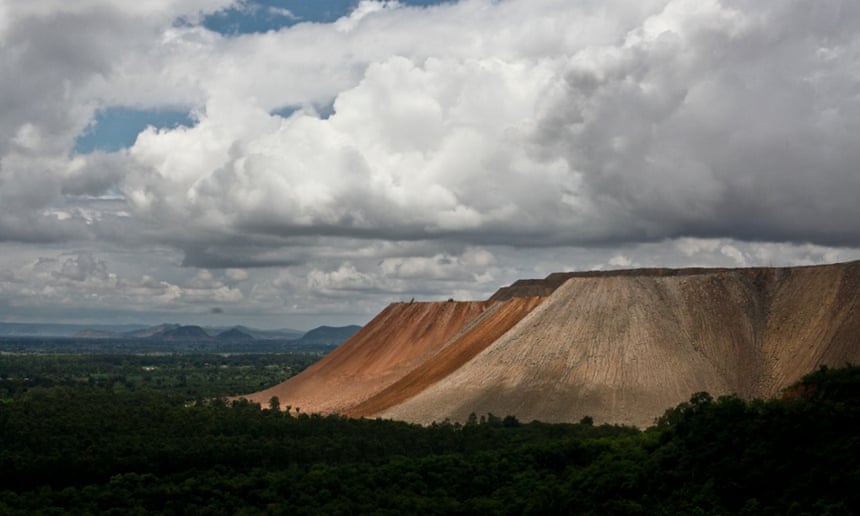
Caption at the source:
Mining overburden in the Singrauli coalfield. Photograph: Greenpeace/Sudhanshu Malhotra 

Friday, June 05, 2015

Drill, baby, drill. Who the frack cares!

One event and so many different headlines!


Who you gonna believe?

I wonder if it always was like this, or whether such contentious interpretations day in and day out are a modern phenomenon.  Even for a junkie like me, this is simply head-spinning.  Perhaps all the more why many simply decide to shut themselves off from this cacophony and instead rely on their favorite news sources.  You know, like the Faux News people!

What was the event that triggered all these headlines? In a weighty tome that can put anybody to sleep, the US EPA found "no signs of “widespread, systemic” drinking water pollution from hydraulic fracturing."

But, we are talking about energy and politics.  Not really science.  Which means:
it’s widely believed the Obama administration is deferential to natural gas fracking companies because the industry is more environmentally friendly than Big Coal but also robust enough to help drive much-needed economic growth. That attitude is shared by other members of the president’s part
Fight coal, but then a wink-wink towards natural gas.

Except, even the fighting coal is not really happening, notes the Pulitzer-winning writer at my favorite magazine:


So, where do all these  leave us?  Do the President and his people have any real energy policy at all? Kolbert writes, "the White House’s energy policies remain a muddle."  Great!  Can anything be done?
the Administration is undermining its own best efforts. But such a muddle is probably the best we can expect until and unless American voters demand something more coherent.
Ah! American voters demanding something coherent?  Good luck on that!

All these mean that after November 2016, we will most likely end up with a President and a Congress that will be a lot more fossil-fuel friendly than the friendly environment that currently exists.  Meanwhile, there is a climate conference coming up in December:


Good luck on that, rest of the world!