Showing posts sorted by relevance for query rohingya. Sort by date Show all posts

Tuesday, June 09, 2015

The Rohingya genocide, and Aung San Suu Kyi's silence

More than two years ago, back in April 2013, which now feels like it was a long time ago, I blogged about the atrocious treatment of the Muslim minority in Burma, where even the Buddhist monks--yes, the monks--were leading the genocidal attacks on the Muslims.

The situation has been deteriorating for the Rohingya community.  In November 2014, I blogged again when I noticed from the news reports that the situation was spinning out of control.

Here we are in June, and it is a crisis of epic scale.
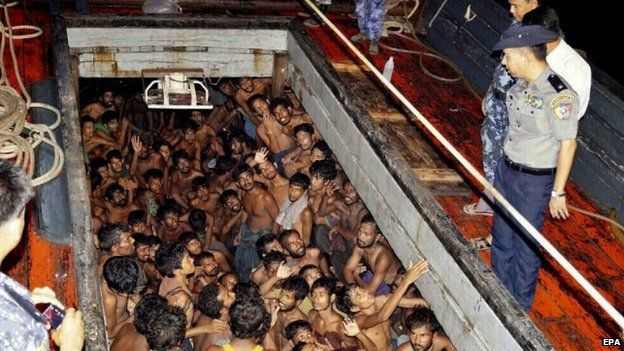
Source

I am not the only one who has been thinking all through, "where the hell is Aung San Suu Kyi?"

In case you forgot, Aung San Suu Kyi was awarded the Nobel Peace Prize for her committed opposition to the brutal military regime and for her insistence on non-violence.
"In awarding the Nobel Peace Prize. . . to Aung San Suu Kyi," the Norwegian Nobel Committee announced in 1991, it wished "to honour this woman for her unflagging efforts and to show its support for the many people throughout the world who are striving to attain democracy, human rights and ethnic conciliation by peaceful means."
Suu Kyi, the Committee added, was "an important symbol in the struggle against oppression."
We would then expect her to make public statements on, and to lead the opposition to, the violence against the Rohingya, right?

She is missing in action.  Big time.  What a shame!

Oops, she is not missing in action; she made a decision not to interfere!
Ms Suu Kyi, 69, has defended her reticence over alleged Rohingya persecution by saying she is a politician and not a human rights defender.
She argues that the problem of thousands of Rohingya migrants who have fled Myanmar - and are now believed to be stranded at sea - was for the government to solve.
What a shame!

Even the Dalai Lama couldn't get her to move on this:
The Dalai Lama has urged fellow Nobel Peace laureate Aung San Suu Kyi, a main opposition leader in Myanmar, to do more to help protect the persecuted Muslim Rohingya minority in her country amid a worsening migration crisis.
Despite thousands of Rohingya fleeing on harrowing boat journeys to Southeast Asia to escape a wave of deadly attacks and discriminatory treatment by the country's Buddhist majority, opposition leader Aung San Suu Kyi has yet to speak out against their plight.
The Tibetan Buddhist spiritual leader said on Thursday she must voice her opposition to the persecution, adding that he had already appealed twice to her in person since 2012, when deadly sectarian violence in Myanmar's Rakhine state pitted the Rohingya against local Buddhists, to do more on their behalf.
"It's very sad. In the Burmese (Myanmar) case I hope Aung San Suu Kyi, as a Nobel laureate, can do something," he told The Australian newspaper in an interview in advance of a visit to Australia next week.
What a shame!

From a country with its own terrible experiences, another Nobel Peace Prize recipient chimes in:
Archbishop Desmond Tutu of South Africa, another winner of the Nobel Peace Prize, said in a recorded message aired this week that aid donors, including the European Union, should make their funding for the impoverished country “conditional on the restoration of citizenship, nationality and basic human rights to the Rohingya.”
“A country that is not at peace with itself, that fails to acknowledge and protect the dignity and worth of all its people, is not a free country,” Archbishop Tutu said in remarks that were broadcast at a conference on the Rohingya in Oslo this week.
He said he agreed with those who say a “slow genocide” was being committed against the Rohingya.
What a shame that Aung San Suu Kyi has stayed silent all these years over the Rohingya genocide!

Oh, I suppose she is too busy traveling around, especially to countries that care not about human rights!

What a shame!

Saturday, November 08, 2014

Is the game over when even Buddhists engage in genocide?

Not too long ago, it was common for the United States to loudly complain about human rights issues in other parts of the world--in the Soviet Union, China, Cuba, Iran, ... a long list of countries.  Of course, the US had human rights issues within its own borders (and continues to have) and it also conveniently overlooked abuses in countries that were governed by "our son-of-a-bitch."

Now, it feels like the US has even stopped complaining, at least pretending to worry, about human rights issues.

President Obama will have plenty of opportunities to address human rights issues in the next few days, but my guess is that he will not.  In his post-shellacking 2.0, the President will be in China and then in Burma, and both countries have immense human rights issues, which he will certainly gloss over.

In addition to the lack of everyday democratic rights that people in those countries lack, there is that acutely worrying treatment of the Muslim minority in China and Burma.  With the economic ascent of China, the US has pretty much stopped even whispering about human rights there.  I would love to have a reporter ask the President a question such as, "Mr, President, what do you think about the student protests in Hong Kong?"  Or even, "President Obama, have you ever tasted traditional Uighur dishes?"

Money talks, and bullshit walks, as they say.

But, there isn't even money in Burma.  No nukes, a la North Korea, either.  Yet, we don't seem to care about human rights issues in that country, especially when it comes to the horrible treatment of a certain group:
The Myanmar government has given the estimated one million Rohingya people in this coastal region of the country a dispiriting choice: Prove your family has lived here for more than 60 years and qualify for second-class citizenship, or be placed in camps and face deportation.
The policy, accompanied by a wave of decrees and legislation, has made life for the Rohingya, a long-persecuted Muslim minority, ever more desperate, spurring the biggest flow of Rohingya refugees since a major exodus two years ago.
A few months back, I blogged here about Buddhist monks leading the protests to drive out the Rohingya.  Yes, Buddhist monks, who are supposedly the followers of the uber-pacifist Buddha!
The crisis has become an embarrassment to the White House ahead of a scheduled visit by President Obama to Myanmar next week. The administration considers Myanmar a foreign-policy success story in Asia but is worried that renewed conflict between Buddhist extremists, who are given a free hand by the government, and the Rohingya could derail the already rocky transition from military rule to democratic reform.
The news item mentions that:
Mr. Obama asked the Myanmar leader to revise the anti-Rohingya policies, specifically the resettlement plan. Myanmar must “support the civil and political rights of the Rohingya population,” he said.
A tiny little country Burma is, and all that the President of the mighty US can do is mildly ask his counterpart to do something.  The Burmese president is far from shaking in his military boots!
the government appears to be accelerating a strategy that human rights groups have described as ethnic cleansing.
The Burmese government knows how to keep the Americans off:
In a gesture in advance of Mr. Obama’s visit, the government released 15 political prisoners in early October, including three Rohingya. Among them was U Kyaw Hla Aung, 75, a prominent lawyer, who was jailed after the violence in Sittwe in 2012.
One of the few Rohingya trained as a lawyer — Rohingya have since been barred from studying law or medicine — Mr. Kyaw Hla Aung said it was illogical for the government to insist that Rohingya were not citizens.
Amartya Sen, is among a few who is intellectually involved with raising the awareness of this human rights issue and is even ready to use the "g" word:
Sen said it is important that the word “genocide” not be tossed around lightly, and he acknowledged that this situation looks different from the murderous examples of Nazi Germany and 1994 Rwanda. Still, he said, the term applies in this case, with lives lost not just to the outbursts of violence, but also to the denial of healthcare and the right to work.
Of course, the American people couldn't be bothered about all these.  For one, we are all into worrying about our First-World-problems.  If we do manage to look beyond our own petty problems, then there is that distraction of nude photos of celebrities.  Who cares about some genocide somewhere, particularly if it is Muslims who are targeted!


Friday, November 24, 2017

On teaching and blogging ...

A few years ago, a student remarked in class about my blog; he said that the more he kept reading a few old posts, the more he realized a striking similarity between the blog content and the class content.

Of course those were the old days before trump, when my writings here were rarely unprofessional.  Which is also why I have now stopped telling students about my tweeting and blogging.

But then, maybe I should, because it will be a powerful evidence that while I am highly charged and definitive about issues and people here in my private space, none of that spills over into the classroom.  In classes, even when students ask me what I think about whatever the issue is that we are discussing, my typical response is that while I certainly have my own opinions, my job is not to bring them to the classroom, but to push them into thinking from multiple perspectives.

You, dear reader, on the other hand, have never observed me in my classes.  And perhaps you have often wondered whether I am a ranting nutcase in the classroom.  Rest assured that I am one hell of a straitjacketed professor in the professional environment.

So, in that spirit, I provide here a task that I assigned a class.  You will notice that the topic is not new to this blog, but the tone is markedly different from how I would have written about it here.  Right?

Finally, you will also notice a parallel between blogging and teaching.  In both, the structure is the same: We lay out the arguments, and bring in appropriate quotes, right?  Even the task that I assigned is the same way ... The real difference between my teaching and blogging is how "professional" I am in my language ;)

Go ahead, and write up the 2,000-word essay, and I will give you feedback ;)
****************************************************************

In his op-ed (from class discussions on 11/15, or click here) the Dalai Lama writes:
The time has come to understand that we are the same human beings on this planet. Whether we want to or not, we must coexist.
He adds that “empathy is the basis of human coexistence.”

Such a coexistence, the Dalai Lama argues, requires the United States, too, “to think more about global-level issues.”

While the Dalai Lama does not refer to any specific event or issue in that particular op-ed, he has been vocal about the ongoing Rohingya crisis. In other contexts, he has also explicitly called on the global leaders, which includes the United States, to act on the Rohingya crisis.

The Rohingya crisis brings together, unfortunately, many aspects that we would want to understand: For instance, the role of religion and religious differences; the level of economic development; the structure of governance in the country/countries directly affected by the crisis; and even the “different” looks of the people. Thus, in a tragic manner, the Rohingya crisis makes an ideal candidate as a global issue, and also makes as a final exam topic.

Your task for the final paper is this: In addition to clarifying the complexity of the Rohingya crisis itself, do some background reading in order to understand:
  • What has the Dalai Lama said about the Rohingya crisis?
  • What has the current president of the US said about the Rohingya crisis?
  • What has the president’s secretary of state said about the Rohingya crisis?
  • How do their views compare/contrast with the Dalai Lama’s call “to think more about global-level issues” and with “empathy is the basis of human coexistence”?
Based on all that reading, and based on the relevant materials from the course, you will write an essay in response to the following:
Do the views of the president and his secretary of state agree with the Dalai Lama’s views—about the need for global thinking and about the Rohingya crisis? If they are not in sync, then whose position do you agree with and why?
In writing the essay, keep in mind that the essay is an end-of-term demonstration of how you have met the course goals:
  • Understand the complexity and interdependence of contemporary global issues.
  • Appreciate how one’s own culture and history affect one’s worldview and expectations.
  • Appreciate the vastness of the world and the opportunities to create a better future for all peoples.

Sunday, January 10, 2016

Peace is War. Slavery is Freedom. Strength is Ignorance.

The Nobel Peace Prize has never been without controversies.  Take the case of Mohandas "Mahatma" Gandhi, for instance:
Gandhi was nominated in 1937, 1938, 1939, 1947 and, finally, a few days before he was murdered in January 1948.
Gandhi was not recognized for the phenomenally peaceful methods he preached and practiced.
Up to 1960, the Nobel Peace Prize was awarded almost exclusively to Europeans and Americans. In retrospect, the horizon of the Norwegian Nobel Committee may seem too narrow.
"In retrospect" the Committee ought to feel awful about handing the prize to Barack Obama too, as I have often blogged about!


A few months ago, I blogged about another Nobel Peace Prize recipient behaving in ways that were anything but about peace.  "What a shame!" I commented about Aung San Suu Kyi's silence over the systematic campaign against the country's Rohingya.  She intentionally even shut off the strong advice from two other Peace Prize honorees: the Dalai Lama and Desmond Tutu.

In his column, Nicholas Kristof writes about the wily politician that Aung San Suu Kyi is:
She is now a politician, and oppressing a minority like the Rohingya is popular with mostly Buddhist voters.
Oh, wow, what a surprise!  How awful a politician is she?
Aung San Suu Kyi avoids even saying “Rohingya.”
Kristof writes:
Aung San Suu Kyi is also inheriting the worst ethnic cleansing you’ve never heard of, Myanmar’s destruction of a Muslim minority called the Rohingya.
A recent Yale study suggested that the abuse of the more than one million Rohingya may amount to genocide; at the least, a confidential United Nations report to the Security Council says it may constitute “crimes against humanity under international criminal law.”
Yet Aung San Suu Kyi seems to plan to continue this Myanmar version of apartheid.
Of course, I agree with Kristof when he concludes:
Defenders of Myanmar and of Aung San Suu Kyi note that the country has many problems; they see the Rohingya as one misfortune in a nation with a vast swath of misfortunes. The priorities, as they see them, are economic development, democracy and an end to the country’s many local conflicts, and they protest that it’s myopic to focus on the problems of one ethnic group in a nation so full of challenges.
Yet to me, there is something particularly horrifying about a government deliberately targeting an ethnic group for destruction, locking its members in concentration camps and denying them livelihood, education and health care. When kids are dying in concentration camps, after being confined there because of their ethnicity, that’s not just one more problem of global poverty. It’s a crime against humanity, and addressing it is the responsibility of all humanity.
Strip her of the Nobel, I say.

Tuesday, January 10, 2017

Never again should we bother with "never again" :(

Up until four years ago, I had no idea about the Rohingya--the Muslim community that stands out in a Buddhist Burma.  In fact, if things were going well, I would not have known about them at all.  Perhaps all the way till my own end.

But, I read about them because all was not well.  Buddhist maniacs, especially led by one with an ominous nickname--the Buddhist bin Laden--were engaging in violence of every possible kind in order to wipe out the Ronhingya from Burma.

It was even more depressing when the much lauded Nobel Peace Prize-winning Aung San Suu Kyi kept silent.  Not a word from her.

I understand that a nobody like me can express all the righteous indignation I want, but that politicians have to compromise on principles in order to get things done.  But, compromise is one thing, and ethnic-cleansing/genocide is entirely another.  This NY Times report is a tough read!

The NY Times editorial says everything that I want to say:
Last month, President Obama lifted sanctions against Myanmar, citing “substantial progress in improving human rights” following the historic election victory of the Nobel laureate Daw Aung San Suu Kyi’s National League for Democracy party in November 2015. Tragically, that praise is proving premature.
Premature because of "a military campaign against the Rohingya."  In addition to covering things up:
Myanmar’s government has barred independent journalists from the region, and dismissed reports of abuses as “fake news” and “fake rape.”
The US, under the demagogue and his minions, is now providing plenty of cover for regimes to criticize the media reports as fake.  A remarkably depressing beacon we have become for the world!  Further, with all the Muslim-bashing that the fuhrer and his people did and do, we have no moral ground to tell the likes of Burma to stop the atrocities.  Thanks, you atrocious Republican voters!

We will simply stand by and watch as more and more Rohingya sob while saying, “They killed my father and mother. What is left for me in this world?”  Or like this:
Noor Ankis, 25, said the next morning soldiers went from house to house looking for young women.
“They grouped the women together and brought them to one place,” she said. “The ones they liked they raped. It was just the girls and the military, no one else was there.”
She said the idea of trying to escape flickered through her head, but she was overcome by fatalism. “I felt there was no point in being alive,” she said.
"Never again" has become such a hollow phrase. Sad!

Monday, April 01, 2013

Kill the Buddha!

Four years ago, I stopped at Thailand on the way to India.  I was not ready for the heat and the humidity that  seemed to suck every bit of energy from my body.  But, hey, it goes with the territory and there was no point complaining about it.

So, I was off walking about like I always do.  And then went on a package tour to Ayutthaya and its environs.  I lost track of the number of bottles of water I had during that one-day trip and, yet, much to my surprise and worry, I wasn't peeing a whole lot either.

The history and the architecture were all wonderful and educational, confirming Ayutthaya's status as a UNESCO World Heritage site.  My grandmothers would have been happy that I at least went to this Ayutthaya, if not to the original Ayodhya itself.

It was, however, very troubling when I saw a headless Buddha.


Even more troubling it was to see a row of headless Buddha statues:


The destruction resulted from the Burmese invasion more than three centuries ago.  The Thai-Burma rivalry and wars was nothing new--history is full of neighbors warring with each other.  But, why destroy the statues of the Buddha?  It is not that the invading Burmese were fighting a religious war with the Thais to at least justify the destruction of the Buddha statues.  The Burma/China warriors and kings were Buddhists too!

I suppose this is also a long-running thread in history--to kill, even when the religion's founder might have been crystal clear about the primacy of peace and non-violence.  It is perhaps a surprise, therefore, that quite a few weren't damaged at all, and we have to be thankful for that and count our blessings!  (All these were later affected by the massive floods two years ago.)


In the contemporary Western world, far removed from the Buddhist populations, and based on an understanding of the Buddha as a peace-promoter, we walk around with highly caricatured images of regular people in those cultures as peaceful and meditative and pensive and everything else.  But, the closer we look, the more they come across as everybody else.

Overlay on all these the British Raj and its notorious policies of divide and rule.  And then remove the Raj and replace it with anti-democratic military rulers.  Then, remove the military rulers and suddenly allow for people to express their feelings.  Not any peaceful Buddhist scenario that is now unfolding in Burma:
mobs of Buddhist bigots and extreme Rakhine nationalists exercised their newly gained freedoms by marching through town past the charred remains of Rohingya houses and mosques. They screamed hatred at Muslims and denounced countries such as Turkey that want to aid the helpless refugees. Buddhist monks, heroes of the 2007 “saffron revolution” that tried to unseat the old military regime, egg on the crowds and help organise the protests. 
Buddhist monks help organize the protests against Muslims?  The followers of the Buddha did that?
ethnic Burman Buddhists have always resented the descendants of Indian Muslims who arrived on the coat-tails of the British in the 19th century to take all the best jobs and, to their mind, swamp the local cultures. ... The 2.5m people of Indian origin who remain are stigmatised and vulnerable; most have no citizenship. In this sense the Buddhist mobs are finishing off what the Burman chauvinist generals started in the 1960s. 
Are we talking about the same Buddha anymore?

(BTW, there are also Burmese refugees living in India. That is a separate story!)

The irony gets even more bitter:
This is the looking-glass world of the new Myanmar. Now it is only the once-reviled army that stands between minority Muslims and the bloodlust of Buddhist chauvinists.
How terrible!

These are the kinds of contexts when I really have to question Steven Pinker's thesis that we live in a lot more peaceful world now.

Update:
The WSJ reports:
A fire at a mosque in downtown Yangon that killed 13 schoolchildren Tuesday fueled fears among Myanmar's minority Muslim population that they had been targeted, though officials quickly insisted that the blaze had been caused by an accidental electrical short-circuit.  ...
The latest fire broke out around 2:30 a.m. Tuesday, witnesses said, at a downtown mosque minutes away from offices, hotels and restaurants frequented by international businesspeople and tourists. The two-story complex includes a school and a dormitory that housed about 70 children, many of them orphans, who were asleep. Most escaped safely, according to state media reports, except for the 13—age 12 to 16 years old—who died of smoke inhalation.  Hundreds of Muslims clustered uneasily as firefighters battled the flames, expressing fears that arson had caused the fire. Such rumors persisted throughout the day

Tuesday, February 18, 2020

"constant change; no enduring essence; the inevitability of suffering"

The New Yorker has an essay profiling Yuval Noah Harari.  Helps me understand him as a person, and not merely as an author/thinker.  The author probes about the Buddhist way of thinking permeating through Harari's interpretations:
 I asked if it was fair to think of “Sapiens” as an attempt to transmit Buddhist principles, not just through its references to meditation—and to the possibility of finding serenity in self-knowledge—but through its narrative shape. The story of “Sapiens” echoes the Buddha’s “basic realities”: constant change; no enduring essence; the inevitability of suffering.
“Yes, to some extent,” Harari said. “It’s definitely not a conscious project. It’s not ‘O.K.! Now I believe in these three principles, and now I need to convince the world, but I can’t state it directly, because this would be a missionary thing.’ ” Rather, he said, the experience of meditation “imbues your entire thinking.”
He added, “I definitely don’t think that the solution to all the world’s problems is to convert everybody to Buddhism, or to have everybody meditating. I meditate, I know how difficult it is. There’s no chance you can get eight billion people to meditate, and, even if they try, in many cases it could backfire in a terrible way. It’s very easy to become self-absorbed, to become megalomaniacal.” He referred to Ashin Wirathu, an ultranationalist Buddhist monk in Myanmar, who has incited violence against Rohingya Muslims.
In “Sapiens,” Harari went on, part of the task had been “to show how everything is impermanent, and what we think of as eternal social structures—even family, money, religion, nations—everything is changing, nothing is eternal, everything came out of some historical process.” These were Buddhist thoughts, he said, but they were easy enough to access without Buddhism. “Maybe biology is permanent, but in society nothing is permanent,” he said. “There’s no essence, no essence to any nation. You don’t need to meditate for two hours a day to realize that.”
Go ahead and read the entire essay.
********

I have blogged before referring to Harari.  This was the earliest one, from March 2017.

My favorite, however, is this one, which I blogged in May 2017. It is my favorite because of a very unique perspective that Harari provides about religion.

Read them all.  Even if you disagree with Harari, he does provide you plenty to meditate about ;)