Tuesday, May 10, 2016

An Arab in the plane is the new Black on the sidewalk

In three years, in 2019, we will mark a very dark anniversary--four hundred years since the first Africans were sold as slaves in Virginia.  Between the old country's caste system and its untouchables, and slavery and African-Americans here in the adopted home country, I feel like I always carry an unbearable burden of the sins of the past.

I have no idea how a young black man makes peace with how his life has been screwed up forever thanks to this history.  It is beyond my wildest imagination.  Which is all the more why I am blown away by Martin Luther King's commitment to non-violence in the struggle for civil rights.

It took me a few years of living in this country to understand the deep effects that slavery and white supremacy have had on everyday life.  I am continuing to understand my own deep-seated biases as well, and am trying my best to rid myself of those.  The earliest learning experience was in graduate school when the friends from Nigeria and Ghana laughingly observed how people switched to the other side of the road in order to avoid walking up to them on the sidewalk.  Kayode and Seth laughed about it because they had a great sense of humor.  But, I suppose other than laughing about it what else could they have done anyway!

Now, we have added one more category to such awful behavior: An Arab, or anybody who even looks Arabic while on a plane is now viewed with suspicion.  But, unlike the sidewalks where people crossed the street, racists cannot get down and climb into a different plane.  Which is why things like this happen:
A college student who came to the United States as an Iraqi refugee was removed from a Southwest Airlines flight in California earlier this month after another passenger became alarmed when she heard him speaking Arabic.
That was a month ago.
The student, Khairuldeen Makhzoomi, a senior at the University of California, Berkeley, was taken off a flight from Los Angeles International Airport to Oakland on April 6 after he called an uncle in Baghdad to tell him about an event he attended that included a speech by United Nations Secretary General Ban Ki-moon.
“I was very excited about the event so I called my uncle to tell him about it,” he said.
It turns out that one does not even have to speak Arabic.  One does not even have to wear a jubba for a fellow passenger to get all worked up.  You are a danger if you even look like this:
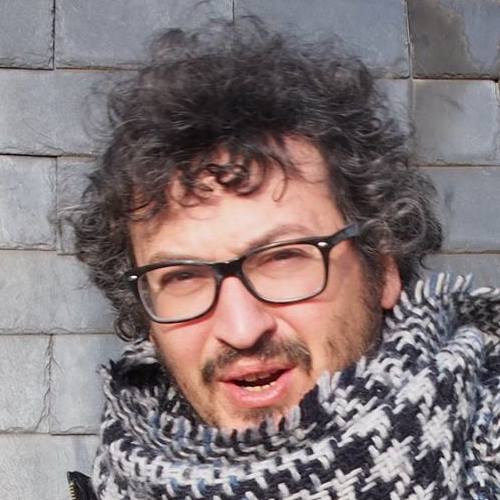
Source

Who is he?
Had the crew or security members perhaps quickly googled this good-natured, bespectacled passenger before waylaying everyone for several hours, they might have learned that he — Guido Menzio — is a young but decorated Ivy League economist. And that he’s best known for his relatively technical work on search theory, which helped earn him a tenured associate professorship at the University of Pennsylvania as well as stints at Princeton and Stanford’s Hoover Institution.
So, if he was not speaking Arabic, or wearing a jubba , then what happened for him to be forced off the plane?  His seatmate, who was "a blond-haired, 30-something woman sporting flip-flops and a red tote bag" "had Seen Something, and so she had Said Something":
That Something she’d seen had been her seatmate’s cryptic notes, scrawled in a script she didn’t recognize. Maybe it was code, or some foreign lettering, possibly the details of a plot to destroy the dozens of innocent lives aboard American Airlines Flight 3950. She may have felt it her duty to alert the authorities just to be safe. The curly-haired man was, the agent informed him politely, suspected of terrorism.
And what exactly was Menzio scribbling?  Math!  "A differential equation, to be exact."

After reading the news report, I tweeted:
The trolls showed up right away.  Such is life in these United States, which will only get more awful if the fascist gets elected in November!  I shudder thinking that it could be President Donald Trump addressing the nation in 2019, marking the tragic anniversary!

Monday, May 09, 2016

Shooting and hacking far away on the other side of the planet

Of course we are all mortals.  Which is why we worry about everything all around us.  If we were eternal, then we would not care. Not even a bit.  As Dana Gioia put it:
One of your primary experiences of reality is to be mortal.  A human life is a linear structure of time in your natural world which repeats itself so every spring everything is new again except for you. If you are a Christian and you also believe there is the eternity.  There is a level of existence outside of the linearity, outside of the natural cycle so time becomes a reality and a paradox.  ... If we were not mortal, if we did not exist in time, you would have forever and nothing would matter
Life matters because we do not live forever.

It becomes even more troubling when this mortal existence is unnaturally ended, which is increasingly the case in India's siblings--Pakistan and Bangladesh.  In the essay in the New Yorker profiling the Pakistani novelist/writer/journalist Mohammed Hanif, I came across this:
Last April, Sabeen Mahmud, a close friend of Hanif’s who ran a local event space called the Second Floor, was planning a panel discussion involving Baloch leaders. Worried that the I.S.I. would react badly, she turned to Hanif for advice. He told her that it would be very risky, but Mahmud decided to go ahead anyway.
Hanif was out of town the night of the discussion, but he followed it on Twitter, and was relieved when it came to an end without incident. A few minutes later, he got a call from a friend: gunmen had pulled alongside Mahmud’s car and opened fire, killing her and wounding her mother. “It really shook me,” he said. “I used to think, like Sabeen, that we were really small fry. Who the hell cares about a hundred and twenty people sitting in a room talking, a bunch of like-minded losers?” Mahmud’s death was a measure of how much things had changed in Pakistan. 
And today in the news, reports that yet another activist--Khurram Zaki--was shot dead in Karachi by unidentified gunmen.  Zaki was forty:
This was the third high-profile killing of a rights activist in Karachi in recent years and pointed to the immense dangers faced by activists in a country troubled by religious extremism and intolerance. Last year, Sabeen Mahmud, the director of a popular arts center in Karachi, was gunned down in the city after she hosted an event on human rights abuses in southwestern Baluchistan Province. Parween Rahman, a social justice activist, was killed in 2013.
Miles away, on the other side of India, a Sufi leader was the latest who was hacked to death in Bangladesh:
Similar attacks on intellectuals, secular writers and others have taken place over the last two years in Bangladesh. The attacks have seemed to increase in recent weeks, with a Hindu tailor being hacked to death last month, as were two gay rights activists, among others. Several of the assaults have been claimed by the Islamic State or by a branch of Al Qaeda, according to the SITE Intelligence Group, which monitors extremist websites. An English professor was hacked to death, also in Rajshahi, last month, in an attack that was claimed by the Islamic State and that police said they believed was connected to Islamist militants.
I--and, hopefully you too--worry about these because we--and that includes you, too--are mortals. Mere mortals.

Sunday, May 08, 2016

The endangered conservative professors on American campuses

To the campus faculty, at least in the hallway in the building where my office is, there is only one presidential candidate who matters, and who can change the country--and, thereby the world--for the better: Bernie Sanders.

So much that the prevailing sentiment seems to be, well, let me put it this way: if you don't feel the Bern, then you are an idiot.  I don't feel the Bern, which means ... ;)

The other day, one of the Bernies told me that if Sanders doesn't win the nomination then he would even skip voting for a presidential candidate.  "Even if that means Trump wins?" I asked the colleague.  Such is the Bernie fever on campus.

Even a casual reader of this blog, leave alone this guy who has racked up quite a few frequent-commenter bonus points, knows from my posts that my campus, like most higher education institutions, is loaded with way-left-of-center faculty.  So ideological is the tilt, so out there to the left, that an independent thinking person that I am have been forced off the conversations and told to shut up.  Apparently my "input and perspectives" are met with "disdain."  And I am not even a right-wing conservative!

Given such an ethos, I am even surprised anymore when commentators bother to write about the lack of diversity of thought in higher education.  It is, after all, old, old, old, stale news.  But, they write and I, too, blog about it!

In that liberal rag, the New York Times, the liberal columnist, Nicholas Kristof--an Oregon native--complains about the lack of diversity:
Conservatives can be spotted in the sciences and in economics, but they are virtually an endangered species in fields like anthropology, sociology, history and literature. One study found that only 2 percent of English professors are Republicans (although a large share are independents).
In contrast, some 18 percent of social scientists say they are Marxist. So it’s easier to find a Marxist in some disciplines than a Republican.
Of course it is far too easy to find Marxists and Socialists among faculty.  Heck, we have two who even contested in elections as socialists!  A Republican social scientist is an endangered species.  For that matter, even the likes of the late Daniel Patrick Moynihan might be persona non grata at campuses like mine because they won't be liberal enough!

It is not only the politics, but also the closely related religious beliefs:
The discrimination becomes worse if the applicant is an evangelical Christian. According to Yancey’s study, 59 percent of anthropologists and 53 percent of English professors would be less likely to hire someone they found out was an evangelical.
“Of course there are biases against evangelicals on campuses,” notes Jonathan L. Walton, the Plummer Professor of Christian Morals at Harvard. Walton, a black evangelical, adds that the condescension toward evangelicals echoes the patronizing attitude toward racial minorities: “The same arguments I hear people make about evangelicals sound so familiar to the ways people often describe folk of color, i.e. politically unsophisticated, lacking education, angry, bitter, emotional, poor.”
Over the years, I have had plenty of conservative and religious students work closely with me, confide their angsts with me, even though they know well that I am an atheist and who is largely left-of-center on many issues.  Because, I do not treat them as "politically unsophisticated, lacking education, angry, bitter, emotional, poor" and instead give them the same professional treatment that I give anybody else.  

Kristof concludes with:
Universities should be a hubbub of the full range of political perspectives from A to Z, not just from V to Z. So maybe we progressives could take a brief break from attacking the other side and more broadly incorporate values that we supposedly cherish — like diversity — in our own dominions.
Dream on!  This will never, ever happen.