Showing posts with label toilet. Show all posts

Monday, May 20, 2019

Toilet Talk

With some regularity, I blog about shit. 

I am surprised that more people don't talk about shit.  I don't mean about one's daily bowel movements and whether or not one needs more fiber in the diet.  Nope. I am interested in aspects of shit like in this post or this one, for  instance.  Remember the piss-pot?  (Yep, there is more for any interested reader.)

So, yes, it is time to blog about shit again.

Imagine Rome about 2,000 years ago.  How did people take care of their shit?  For that matter, where did they pee?

These are genuinely interesting questions, if only one turned their attention away from the latest video of cats playing the piano!

Anyway, back to the Romans 2,000 years ago.  Where did all their pee go?
As best we can tell from historic and archaeological data, ancient Romans peed in small pots in their homes, offices, and shops. When those small pots became full, they dumped them into large jars out in the street. Just like with your garbage, a crew came by once a week to collect those hefty pots of pee and bring them to the laundromat.
They took them to the laundromat?
Why? Because ancient Romans washed their togas and tunics in pee!
WTF! Holy shit!

So, why did the Romans wash their clothes in pee?
Human urine is full of ammonia and other chemicals that are great natural detergents. If you worked in a Roman laundromat, your job was to stomp on clothes all day long—barefoot and ankle deep in colossal vats of human pee.
I decided I needed more details.  The internet delivers:
If you’ve investigated the ingredients in your household cleaners, you may have noticed a prevalent ingredient: ammonia. As a base, ammonia is a useful cleanser because dirt and grease–which are slightly acidic–get neutralized by the ammonia. Even though early Europeans knew about soap, many launderers preferred to use urine for its ammonia to get tough stains out of cloth. In fact, in ancient Rome, vessels for collecting urine were commonplace on streets–passers-by would relieve themselves into them and when the vats were full their contents were taken to a fullonica (a laundry), diluted with water and poured over dirty clothes. A worker would stand in the tub of urine and stomp on the clothes, similar to modern washing machine’s agitator.
And you thought your job sucked! ;)

This photograph tells us a lot about how Romans shat (or is shitted?) back in the day:
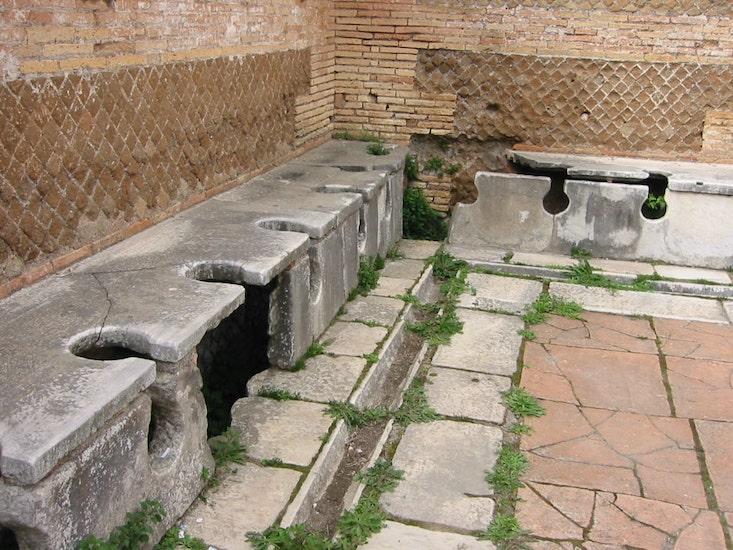

Oh my!

Don't you want to know how they cleaned up after shitting?  Read that essay and find out for yourself!

Why don't they teach such stuff in history classes?  Maybe in a few years, I should offer a freshman seminar titled "Piss, Shit, and Fart--But Never Simultaneously" ;)

Our lives are so different from washing clothes in pee and shitting in the public with people all around.
So the next time you’re enjoying a morning constitutional, think about the fact that defecation and urination are more than biological functions; they are cultural activities that involve artifacts and technologies that change through time.
Indeed. Thankfully!

Friday, January 04, 2013

What I learnt about Pattamadai thanks to talking shit!

Who would have thought that talking shit can yield some valuable details, like how the legendary Mukesh ended up staying at my grandmother's home when he visited the village!

It was one of those conversations when we were recalling the awful toilet conditions in grandmas' villages back when we were kids.  As I have often noted in this blog, most recently here, sewage and sanitation gets marginalized in India and perhaps even subconsciously I end up bringing this topic up for discussions when I am in India. 

We were chuckling away, with a little bit of discomfort recalling those unpleasant experiences, when my father hit a home run (or a sixer, in the Indian contexts!) when he said, "did you know that Mukesh stayed at our home because of those very issues?"

Yes, that very Mukesh. And, yes, in grandma's village of Pattamadai.

Sit up for "the rest of the story," as Paul Harvey often said!

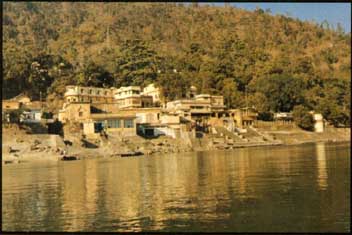
Source
The remote village of Pattamadai was where Sivananda was born--well, his name was Kuppuswamy before he took up monastic life.

With his ashram far, far away from Pattamadai, in the very north of India, it is not any surprise that Sivananda had very few followers even in the town where he was born.

While my father and grandmother were not Sivananda's followers, for as long as I can remember, we have always had at home a small figurine--about nine inches high--of Sivananda in a meditative posture.    That pose itself is miniaturization of a life-size statue that is at Pattamadai.  It is this life-size marble statue that ties the story together.

Soon after Sivananda's demise, his followers decided that they needed to do something to honor and commemorate Sivananda in his birthplace, Pattamadai.  The first of these was to build a small prayer hall with a Sivananda statue.  According to my father (the researcher in me always worries that I do not have evidence to crosscheck!) a great number of Sivananda's followers came to the village, led by the then head of the Ashram at Rishikesh--Chithananda.  Mukesh, too, came with them. 

The monks might not have worried about indoor plumbing and toilets.  But, the majority of the visitors were city folks who had gotten used to taking care of the biological daily business within closed doors.  The village had very few homes that had indoor toilets--most at that time had the open-latrines at best.  My grandmother's home was one of those very few equipped with indoor toilets (which, by the way, my brother and I did not like much because we had experienced better ones in Neyveli.) 

Now it is not that difficult to imagine Mukesh being at my grandmother's home, is it?

Monday, August 30, 2010

Image of the day: scatalogical?

Why this image?

It is from a link in an essay at Slate, which argues that:
sitting on toilets—a recent phenomenon, stemming from the invention of the flush toilet in 1591—might be unhealthy. ...
For most of human history—several hundred thousand years—we've squatted. Today, 1.2 billion people squat because they simply don't have a toilet, while many, many more in Asia, the Middle East, and parts of Europe use toilets designed specifically for squatting.
So, how about squatting in America?  Well, the same Slate essay notes:
Americans, now fatter than ever, are having trouble standing up from a sit, never mind a squat.
I have blogged often about the toilet issue, or the lack of, in many parts of the world, particularly in India.

Even now when I travel in India, it is disheartening that the country that spends gazillions on military infrastructure can't seem to put sanitation as a priority.  For 63 years since independence.  Unfortunate.