Showing posts with label rajasthan. Show all posts

Friday, November 27, 2015

The times they are a changin

I was a prized grandson.  Not because I the most charming baby ever; I suspect I was as ugly as I now am.  Not because I was a child prodigy; have always been dumber than a doorknob.  But, because after having daughters, and then after the first two daughters in turn having daughters each, well, the grandparents were excited that I came along.  A boy!

Those were the days of old India where boys were considered assets and girls were seen as liabilities.  What an awful view of life that was!

Source

That kind of a systematic ill-treatment of girls, especially in the less literate and developed areas of India, and similar practices in China and a few other Asian countries, were why demographers and thinkers--especially Amartya Sen--wrote and spoke about the missing hundred million women:
In 1990, Amartya Sen, the Nobel Prize-winning Indian economist, shocked the world with an article in the New York Review of Books that estimated there were 100 million missing women because of discrimination.
Since then, demographers have devised more precise methods of calculating missing women in each country. They factor in the toll caused by malnutrition and poor medical care and, more significantly, also the numbers lost to abortions of female fetuses, a problem recognized in the years after Dr. Sen wrote his article.
In June of 2015, the Population Council, a New York City-based research organization, published a study saying there were 88 million missing women world-wide in 1990, when Mr. Sen wrote his article, and that there were 126 million missing in 2010, roughly half of them attributable to prenatal sex selection. Of those, more than 112 million were in Asia.
The paper, by John Bongaarts, a distinguished scholar at the Population Council, and Dr. Guilmoto, projects an increase to 150 million missing by 2035 and then a slight decrease to 142 million by 2050.
Of course, as one can expect, the missing women will also mean a whole bunch of problems for men who will be looking for spouses.

But, that is not the problem that I want to blog about.  Because it has been talked about a lot--it is one of those serious issues over which there is often a lot of talk and very little action.  Instead, I want to write about something impressive about women in the very areas in India that have had decades of gender issues.

Rajasthan in India is notorious for the lopsided female/male ratios, and for unequal treatment of women.  Yet, even there, there are wonderful stories like two sisters, Rimppi Kumari and Karamjit, who farm on their own.  Yes, women farmers.  Not on some tiny strip of ancestral land either:
"When my father died seven years ago I decided to take up farming. We own a lot of land, around 32 acres," [Rimppi Kumari] says, a smile playing on her lips.
How awesome is that!  And, there is more:
Rimppi gave up a job in information technology to grow soyabean, wheat and rice.
She is making more money out of the land than even her father did, helped by her decision to embrace modern farming techniques.
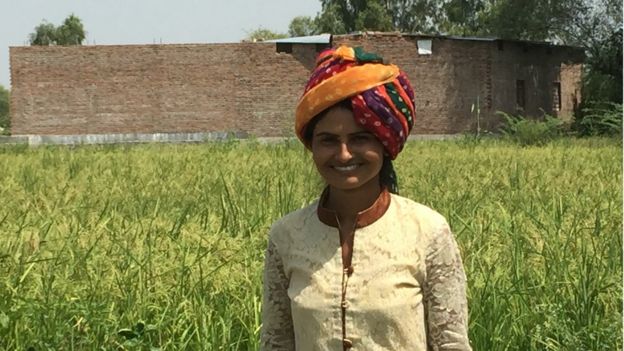
What?  Giving up IT?  How dare she! ;)

Caption at the source:
                     Rimppi is queen of all she surveys on her farm which is making more money than ever                 

Of course, the larger population is not in support:
But despite their success, the sisters are viewed with disapproval in their village.
Eighty-year-old Sardar Karamjeet Singh voices the opinion of many others when he says that "what these two sisters are doing is wrong. They should have been married by now".
"We don't allow our women to leave the house. Forget about farming."
The eighty-year old perhaps has no idea that the world is changing, and changing rapidly.

But, who cares about the world of eighty-year olds when the girls have an important woman backing them--their mother, Sukhdev Kaur:
"If you give opportunities to girls, if you allow them to grow, they can fly high," 60-year-old Sukhdev Kaur says.
"They just need their wings unclipped. I have always believed in my daughters. They show that daughters can surpass sons."
Indeed.  The daughters can, and will, surpass sons.  Well, especially the prized ones will be the ones left behind in the dirt.  Wait, why am I covered in dirt? ;)


Tuesday, January 14, 2014

Is holy cow an udder waste?

Over the years, my parents and my sister have gotten into an interesting way to mark birthdays and other events--they donate money to institutions whose missions they are passionate about.  One of those is a goshala that is a little outside of Chennai.

Cows are, of course, sacred animals in the Hindu faith.  That upbringing is also why when I was walking around in Costa Rica, I was reminded of the kamadhenu. Despite my atheism! 


The reverence for the cow is more than for any utilitarian calculations of milk and manure. The belief is that the animal represents life itself. The mother of life.

When we impose an utilitarian calculation on such a value for a cow, well, of course we might then conclude that a cow is not worth the investment:
India is home to more than a sixth of the world’s population and also more than one quarter of the world’s estimated cattle population. The study’s authors Santosh Anagol, Alvin Etang and Dean Karlan analyzed data from a sample of households in northern India that were asked questions about livestock, farming practices, land holdings, assets, household consumption and income history, savings, borrowing, and shocks. The survey data also provided information on the costs of milk production and data on animal outputs such as milk and calves.
The researchers found that when valuing labor at market wages, these households earned a negative 64% average return for holding cows and a negative 39% return for buffaloes. If the household’s labor is valued at zero, these estimated average returns increase to negative 6% for cows and positive 13% for buffaloes.
Yes, we might want to highlight such a result to those thinking of buying a cow or a buffalo (water buffalo, for you Americans reading this!) with a calculation that selling milk from these animals will lead them to unimaginable riches.

A goshala, on the other hand, is not about making money at all. It is simply a sanctuary of sorts for the cows.  And, yes, the cows are milked as in any other dairy.  But the enterprise is not to make money from the milk.

What I like about the concept of the goshala is that it is a voluntary effort.  If people like my parents want to contribute to it, they do. If they don't, well, there is nothing to force them.

And then there is the insane Indian politics.  Which makes a mockery of anything!
Rajasthan’s right-wing Hindu administration is set to establish a government department for the preservation and protection of cows and to start research institutions, or cow science universities, focused on the rearing and health of the animal.
The Bharatiya Janata Party, which came to power in the desert state, India’s largest by area, in December, is fulfilling a key pledge from its manifesto and plans to declare the cow as the state animal.
Seriously?

Doesn't Rajasthan have a lot more pressing problems, like this one?
In Rajasthan, where cow slaughter is banned, the ruling BJP wants to review and toughen up the existing laws governing cow smuggling for slaughter and plans to give up to 3.5 billion rupees ($57 million) every year to nonprofits and government agencies running cattle smallholdings for feed and upkeep.
To protect cows reared in cowsheds, there will also be a state-wide  campaign to provide them proper health care with clinics held twice a month for cattle, according to the states’ animal husbandry department’s plan for its first 60 days in office.
In other words, government subsidized goshalas. Which will then slowly become government run goshalas. Which will eventually lead to government ill-treatment of the cows themselves!

India is one strange place!

Tuesday, September 17, 2013

What women want ...

Our annual summer holidays were almost always spent at grandmas' villages.  (My mother would argue that Sengottai, unlike Pattamadai, was no village but a modern town with piped water and electricity even back when she was a kid.)

During one such vacation, I watched with a mix of fascination and sadness my father's cousin sister pleading with her father that she be allowed to continue with her college education.  She had completed the undergraduate program in economics, which itself was a notable achievement for those days, and wanted to work on the master's degree.

A more recent Pattamadai--in 2005

She was one strong-willed woman, but her life was severely circumscribed by the role that men had in society.  Thus, when her father flatly negated her plan for higher studies, well, that was the end.  I remember getting teary-eyed myself when she was crying--hey, I was a kid!

As a male, I will never truly understand what women went through, and what women go through even now.  I merely have a feel for some of the issues they have to grapple with.  Issues that typically might not even blip in my male life.

Conditions have changed a lot for women over the decades since that summer when my aunt was devastated that she had to terminate her college plans.  Many of my own classmates, for instance, went on to become doctors and scientists and managers.  The generations that followed have had more and more choices to choose from.

The array of choices does not mean that life for women has gotten any better.  Given the biological aspect that only the female can reproduce, well, it is all the more a struggle to figure out what it is to be a female. It seems very easy for them to get damned if they did and to be damned if they didn't.  It is one tough life, I would imagine, to be a woman in this contemporary settings.  Perhaps in a strange way even tougher now than it was a few generations ago?

Take the case of Facebook's chief operating officer Sheryl Sandberg.  Ever since she went on her book tour promoting Lean In and her version of feminism, it has been one heck of a controversy.  Of course, that itself is happening while we were still trying to understand whether women can really have it all, or should they simply admit that there are some serious tradeoff decisions to make.  Even a question of whether or not a young woman should decide in favor of an MBA is far more complicated than how that same question would be for a typical male.

All these facets--India's villages, women, MBA, corporate executives--interestingly came together in a story in the Wall Street Journal about "Chhavi Rajawat, the current sarpanch of Soda village in Rajasthan, who left a corporate job to help her ancestral village develop."


"Lean in" of a completely different kind.
WSJ: If you’d had a family and children to look after, would you still have been able to take up this job?Ms. Rajawat: I have been able to do it because I have my family’s support. I am single, but there have been so many women who have been able to do things despite having families to look after. If there is family support, it is easy to do a lot of things.
WSJ: As a woman leader, what message would you give to young girls and other working women?Ms. Rajawat: I think each one of us is a leader in our own capacity. We just need to realize that. As women, we have tremendous inner strength which enables us to take on multiple roles and do well even as we stretch beyond our comfort zones.
A long, long way have we come since that summer when my aunt sat crying.  Here is to hoping that it is a much shorter distance ahead.

Tuesday, July 16, 2013

Lakshmi and the olive tree

When I read it, I was impressed, amazed, blown away.

What an example of how constructive things can happen, even with dysfunctional governments.  While making a desert bloom.

In India!

Holy cow!

What was that news, you ask?
In a field in India's western desert state of Rajasthan, row after row of trees covered in lush, green leaves stretch into the distance as the sun beams down from a pale blue sky.
A farm worker kneels down and fights off the wind to grab hold of a thin branch with a few olives on it.
"You see that they are green. Slowly, they will turn red and will be ready to be made into oil in a few months during harvest," he says.
How wonderful!
Yogesh Verma from Rajasthan Olive Cultivation Limited, a state government-funded agency spearheading the project, says that since 2008, more than 144,000 olive trees have been planted on almost 260 hectares (642 acres) of government and private land in the state, which, with its long, dry summers and short, cool winters, offers the perfect conditions for growing olives.
"In 2007, no-one even believed that olives can grow here," Mr Verma said. "But look now."
What a contrast to the story of the "pomegranate trees" that I have assigned students over the years!


As I read that BBC news item, my mind raced with the thoughts of olive trees being grown in the dry lands of Israel and Palestine.  (Hence the title of this post.)

Turns out that I was, ahem, barking at the right tree!
Over the last five years, Indian farmers have joined hands with Israeli agribusiness to produce a crop that the majority on the subcontinent have only seen in books and films: fresh, green olives.
The project started out as a joint venture between Israeli firm Indolive and the agricultural board representing the Indian state of Rajasthan, a desert state on the western border.

This is getting to be really, really, exciting.
Ghatpande says farmers in Rajasthan are still keen to get in on olive cultivation despite the crop’s limited exposure to the Indian markets.
“Farmers are now willing to jump from their current crops to olives because the yields on many crops in Rajasthan are declining,” says Ghatpande. Given that most of the olive crop is for exporting, farmers see this venture as lucrative in the long term.
How awesome.  I am now kicking myself for not having known about this all these years!

May more olive trees bloom in the Thar Desert!