Showing posts with label raj. Show all posts

Tuesday, November 17, 2020

Burn After Reading!

My favorite contemporary public intellectual has an essay in the recent issue of The New Yorker.  The title of the piece will draw one in: Will tRump burn the evidence?

I will read it after I get the physical copy in the mail.

Corrupt regimes trying to burn the evidence is not anything new.  As always, the bastard raj perfected that too.  I remembered blogging about it, and pulled it up.  The post is from October 6, 2016.

October 6, 2016.  The election was barely a month away. 

It is shocking to now read the comments that two commenters had left.

One commenter wrote there:

Sure, the British did a lot of horrible things during the Raj. They did a little good too. ...

Forget your election. Its not as relevant as you lot think it is. You are just going to have more years of gridlock whoever "wins".

Another commenter wrote:

You seem to discount everything the British did as horrible, discriminatory, racist and evil. There has to be something positive from that time, and the positives should not be ignored completely, no matter how awful the negatives. The positives don't compensate for the negatives necessarily, but they deserve recognition as well.

Shocking!

I stand by my response there:

"Other than that, Mrs. Lincoln ..." applies to the White Supremacist Raj too ;) 

I don't refer to all the British then as white supremacists. But, the Raj was very much built on that notion. One of the "positives" that even people in India refer to as an example is the railway network. But that was not built out of any goodness of the heart--it was merely to make the extraction/plunder easier.

Do not put the history away so fast, my friend. Pause enough to acknowledge it. Denounce clearly the colonization. Shine the light enough on the white supremacy that messed up the lives of millions forever ... 

"Forget your election" is not something that we--you included--can afford to. The xenophobic, misogynistic, maniacal Trump's odds of winning are not good. Yes. But:

1. One can't be lax until it is all really over.

2. The nasty underbelly that Trump has exposed will not go away after his defeat. I am convinced that the nasty white supremacy will be more openly vitriolic.

Oh, yes, the bastard raj destroyed as much evidence as they could.  Read that post.  And read Jill Lepore's essay.

Saturday, June 13, 2020

Coming to terms with history

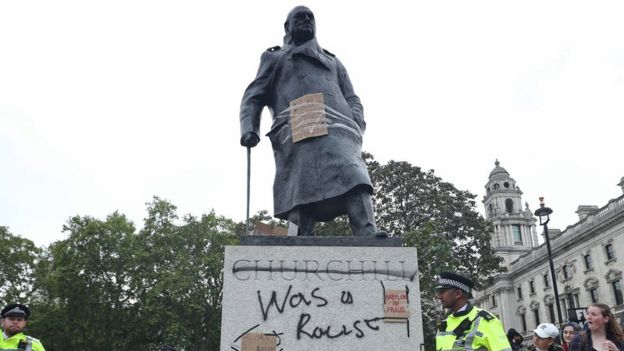
The Bastard Empire and one of its greatest bastards are in the news, in the wake of the Black Lives Matter movement that has gone global.

As an adult, I was always at a loss understanding how people born in India could not be angry.  Did they not care that the Bastard Empire ruined everything?  Even the loss of a historical continuity, and the very fact that here I am thinking and blogging in English?  Why such a worship of the barbarians who decimated life all around the world?  (Not that the rest of the world, including the old country, was a paradise otherwise.)

Over the years, I have blogged in plenty ranting about the Bastard Empire, and even celebrating the mess when the Conservatives tumble.  I am mighty glad that it has once again become a small island that is irrelevant to the rest of the world, as it was for most of human history.

So, of course, I read with delight the tweets about the statue of a slave trader being toppled and dumped in the water.  It is beyond my wildest imagination how that bastard could have branded the enslaved.  Branded?  Seriously, branded?
Between 1672 and 1689, Colston’s Royal African Company shipped about 100,000 enslaved people from West Africa to the Americas and the Caribbean, branding them on their chests with his corporation’s acronym, RAC. Disease and dehydration killed more than 20,000 people taken onto those ships by Colston’s company, and their bodies were thrown into the ocean. Yet Colston’s bronze statue, which was erected in 1895 in Bristol, was engraved with the inscription “ … one of the most virtuous and wise sons” of the city.
What a bastard!  Honorable men they are!


The history that we were taught in middle and high school didn't present such unvarnished truths.  Instead, the UK-educated Anglophiles presented the bastards as heroes!
The following is an unedited re-post from October 28, 2010:
***************************************************

Soutik Biswas writes in reviewing Madhusree Mukherjee's Churchill's Secret War:
Some three million Indians died in the famine of 1943. The majority of the deaths were in Bengal. In a shocking new book, Churchill's Secret War, journalist Madhusree Mukherjee blames Mr Churchill's policies for being largely responsible for one of the worst famines in India's history.
Why is the war time prime minister, Churchill, to be blamed?  Well, the acute shortage of food
was caused by large-scale exports of food from India for use in the war theatres and consumption in Britain - India exported more than 70,000 tonnes of rice between January and July 1943, even as the famine set in. This would have kept nearly 400,000 people alive for a full year. Mr Churchill turned down fervent pleas to export food to India citing a shortage of ships - this when shiploads of Australian wheat, for example, would pass by India to be stored for future consumption in Europe. As imports dropped, prices shot up and hoarders made a killing. Mr Churchill also pushed a scorched earth policy - which went by the sinister name of Denial Policy - in coastal Bengal where the colonisers feared the Japanese would land. So authorities removed boats (the lifeline of the region) and the police destroyed and seized rice stocks.
And, what was Churchill's response when this was discussed at cabinet meetings?  The soon to be appointed Viceroy, Archibald Wavell, writes:
"Apparently it is more important to save the Greeks and liberated countries than the Indians and there is reluctance either to provide shipping or to reduce stocks in this country," writes Sir Wavell in his account of the meetings. Mr Amery is more direct. "Winston may be right in saying that the starvation of anyhow under-fed Bengalis is less serious than sturdy Greeks, but he makes no sufficient allowance for the sense of Empire responsibility in this country," he writes.
As Shakespeare wrote, "And Brutus is an honourable man" .... :(

Thursday, October 06, 2016

The F*ing British Empire

Four decades of life since the early teenage anger against the murderous thugs who (mis)ruled the old country has dampened my anger and disgust only a tad.  If I believed in hell, I could at least curse those white supremacists to the darkest chambers of hell!

My anger over the colonial white supremacists gets regularly stoked with news reports and analyses of the white supremacists empire and its actions.  Or, it will be better if I rephrased it as whatever historical records that the empire and its loyalists did not destroy.  Yep, after all the rape and plunder was done, the empire on its way out made sure to also destroy the historical records.
The Colonial Office devised a system known as “Operation Legacy” that worked on the principle of parallel registries. Reliable civil servants, which in the government’s eyes meant only those who were “British subjects of European descent”, were given charge of identifying and collecting all “sensitive” documents and passing them up the bureaucratic chain. This meant that when the moment of independence came, if not before, they could either be destroyed on site or removed (“migrated” became the official term) to the UK. As to the so-called “Legacy” files that the colony’s new government would inherit, it was important that they gave an impression of completeness, either by creating false documents to replace those that had been weeded out or by making sure there was no reference to them in the files that remained.
So, they burned the papers.  And more.
According to official instruction, the waste left by bonfires “should be reduced to ash and the ashes broken up”. If burning was thought to be too difficult or unsuitable, then the sea offered an alternative. Officials in Kenya were told that documents could be “packed in weighted crates and dumped in very deep and current-free waters at maximum practicable distance from the coast”.
We don't have to wonder why:
Operation Legacy was intended to ensure that “the British way of doing things” would be remembered with “fondness and respect” – that the conduct of its imperial retreat would be seen as exemplary.
What a sophisticated PR campaign, eh!  They plundered and raped, and then the rapists and plunderers wanted to be "remembered with “fondness and respect.""  I think I am going to puke!

Of course, it is not as if life in the old country was all wonderful before the White Supremacist Raj was established.  Far from that.  For starters, the caste system as it was practiced then--including by my ancestors--along with horrific customs like sati, made sure that life for an overwhelming majority was nasty and hellish.  But, that does not make the White Supremacist Raj any nobler.

Which is also why I worry over the possibility of young boys and men in countries around the world who could be angry at my adopted country.  I have no idea how the female mind works in these contexts, but we have rich historical evidence of angry young men causing destruction to life and property--after all, not all angry young men are also committed to nonviolence as a few of us are.  But, the presidential candidate of the party that is mostly supported only by whites seems all out to create more angry young men all around the world :(

I can't wait for the end of supremacy of any kind.

Monday, May 02, 2016

Stinking history!

(I have sent this across to the editor)

Higher education has been afire with discussions—substantive and rhetorical—about the dark histories of the people after whom buildings and colleges have been named. Locally, at the University of Oregon, two buildings, Deady and Dunn Halls, have made us rethink the biographies of the namesakes. The older the university, the more the possibility of controversial history. For instance, recently, Georgetown University has been in the news for how it sold its 227 slaves in 1838 in order to pay off the debts and sustain the financially struggling college.

We humans have been struggling forever, it seems, to figure out how to respond and react to the origins of wealth that is then used for honorable causes, like education. By and large, we seem to have operated along the lines of a Latin phrase that is almost two thousand years old—“Pecunia non olet” which translates to “money does not stink.”

The “stink” of the money is, thus, not new by any means. It is just that we conveniently opted not to talk about it. The recent discussions about Georgetown and Deady and Dunn have, thankfully, brought to the forefront those difficult and inconvenient issues.

Many of us from India have often pointed to Yale University as an example of “Pecunia non olet.” In order to understand this, we need to know more about the namesake. Elihu Yale was a Bostonian by birth, but was mostly raised in London because his father found the New England Puritanism too stifling. Growing up in England, Yale signed up for the promising and pioneering multinational corporation of the seventeenth century—the East India Company.

In 1670, Yale was assigned to work in one of the most profitable operations—in Madras, which is in southern India. (This city, where my parents and sister live, was renamed Chennai in 1996.) It was in Madras that Yale even got married—to his friend’s widow—and it was in the same city that his three-year old son was buried after an untimely death.

Yale’s personal, professional, and political lives were all made in India after his relatively humble economic beginnings. As one author put it, “Yale had come to India with the entry-level title of a company "writer" and an annual salary of £10—about half a shilling a day at a time when an English cloth suit cost around 15 shillings.” Yale proved that he knew a thing or two about the art of making a deal and he quickly made himself rich and powerful, while helping make the East India Company rich and powerful. Thus, from a lowly “writer” Yale quickly rose to become the governor of Madras. His aggressive methods also led to his downfall—he was fired from the post in 1692 after which he returned to England.

The two decades-plus in Madras had made Elihu Yale a wealthy man. As he got older, and because he did not have children to whom he could have willed the inheritance, Yale’s fortunes were sought by many. One of the beneficiaries of his largesse was the Collegiate School in Connecticut that was later renamed to Yale College in 1718, as a way of honoring Yale’s contributions.

Because of the connections to Madras that provided Yale University with its name, some of us from that part of the world joke that we deserve legacy admissions with free tuition. After all, the East India Company was more than a mere trading corporation, and a monopoly at that. In a matter of years, the company became a mighty political force with its own military forces with which it ruled a vast territory in the Subcontinent.

The land became the British Raj after the monarch assumed direct control. India, which accounted for more than a quarter of the entire world’s economy when these mercantile operations began more than three hundred years ago, was reduced to a poster-child for poverty, starvation, and beggars by the time the British government reluctantly granted independence in August 1947 to the newly created countries of India and Pakistan.

Thus, whether it is Yale or Georgetown or the United Kingdom of today, the question is the same one from the Roman days: Does money have a smell?

Perhaps the best approaches in these troubling issues will begin with an honest recognition of the patron’s past, especially regarding the wealth they accumulated. History cannot be undone, of course. We can constructively move forward by learning from history, and by establishing procedures whereby philanthropy will be appropriately vetted for the money’s olfactory backstories.

Thursday, August 14, 2008

Independence Day in India and Pakistan

61 years ago, these two countries became independent, carved out of the colonial Raj. Here are two different perspectives on this anniversary:

From the Economic Times of India:
[It] is becoming clear that the much-maligned neo-liberal policies have contributed more to the alleviation of distress than the tax-and-spend socialistic policies of the past. The latest figures show that there has been a fall in the number of people below the poverty line to 24 percent compared to 36 percent in 1993 and 51 percent in 1977-78.
If India does become a major economic power over the next two decades, as is predicted, historians will look to the present period to assess the individuals who were responsible for the magical transformation from the land of tigers and snake charmers to one of Information Technology and nine percent growth. And among those who will be remembered are Rajiv Gandhi, who inaugurated the age of computers in the mid-1980s, and Manmohan Singh, who launched the economic reforms under the tutelage of then prime minister P V Narasimha Rao in 1991, and carried on the process after becoming prime minister himself in 2004. There is little doubt, therefore, that the positive aspects of the present times score over the negative features.

And from the Daily Times of Pakistan:
Everybody thinks President Pervez Musharraf has no way to go but resign from office. Some think he is going to announce his decision to bow out on Thursday (today). Newspapers are reporting on the advice being offered to him: most of it is in favour of resigning.
The ecstasy produced by the ritual of immolating President Musharraf is going to wear off pretty quickly in the post-Musharraf era. At this juncture, we should pause to ask whether we are not all becoming a collection of angry posses with single-item agendas. It is dangerous that, at the end of our “struggle”, there is the lone figure of Pervez Musharraf tied to a stake. Tunnel vision is no vision.