Showing posts with label innovation. Show all posts

Saturday, February 20, 2016

If only students would listen to me!

The older I get, the more I am temped to respond with a "doh!" when I read stuff that I have been saying/writing forever.  But then other than the few losers, er, readers here, who cares about what I have to say, right? ;)

In this essay on the importance of innovation, I read the following sentence:
GPA was associated with innovation, but maybe not in the direction you’d think.
Why the "doh!" you wonder, eh ... let me tell you that first before I report on the innovation essay.

For starters, I have this post from December 2012, with the title "Education does not equal pursuing the GPA" in which I quoted a better known person:
The pursuit of the perfect GPA is a distraction that leads too many students away from the challenges they should be facing in their undergraduate years.
You can already see the connection, right?  In the American system (with which I am most familiar) students can follow a number of strategies in order to pursue the GPA.  They can, for instance, avoid the sciences if they think they are not quite strong in that field--even if they are genuinely interested in science.  They can bypass learning a foreign language if that is not their best suit.  Or, even within these, they can avoid mean old professors like sriram who have may earned a reputation for being intense.  Very rational, if the goal is the GPA.  But, the un-challenged mind is not good at creativity and innovation!

As I wrote in this post from March 2013:
Thus, we end up graduating students with high GPAs, making sure that all students being above-average is not merely the case in a fictional Lake Wobegon!  Commencement ceremonies now routinely have magna- and summa-cum-laudes by the dozens--of course, very, very few of them from math and science, and nobody seems to even acknowledge that!  Once, when I participated in the university's deliberations on choosing the outstanding graduates, I made a mistake of commenting that it would not be fair to compare GPAs of students who were in different majors; I was surprised that there was no discussion on that point. Keep ignoring and eventually people like me will go away, I suppose!  It worked--it has been years since I participated in those discussions.
 Have I established by now that I have always been railing against the GPA?  If only students understand that.  No, correct that.  If only faculty understood that and passed along to students that an easy A or an easy C or easy whatever is not going to help them at all.  It is no longer a world in which every college graduate can immediately transition to that successful middle class life.

Back to the innovation essay then:
From our findings, we speculate that this relationship may have to do with what innovators prioritize in their college environment: taking on new challenges, developing strategies in response to new opportunities and brainstorming new ideas with classmates.
Time spent in these areas might really benefit innovation, but not necessarily GPA.
Additionally, findings elsewhere strongly suggest that innovators tend to be intrinsically motivated – that is, they are interested in engaging pursuits that are personally meaningful, but might not be immediately rewarded by others.
We see this work as confirmation of our findings – grades, by their very nature, tend to reflect the abilities of individuals motivated by receiving external validation for the quality of their efforts.
Perhaps, for these reasons, the head of people operations at Google has noted:
GPAs are worthless as a criteria for hiring.
If only students understood that! :(

And, the essay presents everything that I tell every one of my classes.  Like this:
Classroom practices make a difference: students who indicated that their college assessments encouraged problem-solving and argument development were more likely to want to innovate. Such an assessment frequently involves evaluating students in their abilities to create and answer their own questions; to develop case studies based on readings as opposed to responding to hypothetical cases; and/or to make and defend arguments.
Any student who has been in any of my classes, even if that student slept through, knows well that my courses are structured exactly along those lines.  I emphasize over and over the importance of the ability "to create and answer their own questions."  Of course, I have posted about that too:
Higher education is then about understanding concepts enough to be able to ask questions.  In the format that most of higher education is, students rarely are taught how to ask questions.  And if they never figure this out after four years of university education, then all the access that Google provides will be of zero value.
Despite the "doh!" it does feel good to know that I am not alone in this cosmos ;)

If only students would listen to me though--for their own good!

Wednesday, January 13, 2016

Going down. Price of oil, that is!

A year ago, I blogged about the collapsing oil prices, in which I quoted from a Project Syndicate op-ed:
economics and history suggest that today’s price should be viewed as a probable ceiling for a much lower trading range, which may stretch all the way down toward $20. 
Apparently we are getting closer to the $20 floor-price!
AAA and GasBuddy, two organizations that follow gasoline prices, say that gasoline prices below $2 will not be unusual in most of the United States. As oil prices fall, and refinery capacity stays strong, the price of gas could reach $1 a gallon in some areas, a level last reached in 1999. As a matter of fact, the entire states of Alabama, Arkansas, Missouri, Oklahoma and South Caroline have gas prices that average at or below $1.75.
The dollar at the pump seems overly optimistic.  But, I get the point--prices will fall some more before refineries are forced to shift to a different mixture in the spring.

Source
Less than two dollars a gallon.  Oh my!  I wonder what all those left-environmentalists who complained that oil corporations were conspiring to keep the prices high are now talking about; damn, if only I hadn't pissed off the faculty colleagues, I could have asked them ;)

The eternal optimists at Reason are, rightfully, dancing with I-told-you-so moves:
In fact, it is very likely that the world is now experiencing the downward sloping side of latest commodity super-cycle. Generally speaking, as each succeeding super-cycle unfolds resource prices eventually reach levels even lower than the nadir of the previous cycle. In any case, depletionist innovation-deniers need to be publicly shamed.
And oil prices are dropping because?
Oil is priced in dollars, so a stronger dollar makes oil relatively more expensive for all consumers using currencies other than the dollar. Morgan Stanley says that while the oil glut is responsible for oil prices falling from triple digits down below $60 per barrel, the fall from $55 to around $35 largely comes from the strong performance of the U.S. dollar over the past year.
So, what should I tell students about the future price of oil?
Last fall, Goldman Sachs even suggested that the current oil price slump mirrors what happened when oil prices collapsed in the 1980s and remained low throughout the 1990s. In other words, humanity may enjoy low oil prices for perhaps another 15 years.
What?

How good are those oil price predictions?  We need to keep in mind a quote that Reason offered a year ago:
When contemplating the future of oil prices, one should always keep in mind U.S. foreign service officer James Akins’ observation, “Oil experts, economists, and government officials who have attempted in recent years to predict the future demand and the prices of oil have had only marginally better success than those who foretell the advent of earthquakes or the second coming of the Messiah.” Akins wrote that in 1973.
As Yogi Berra famously said, making predictions is difficult--especially about the future ;)

Sunday, July 13, 2014

Higher education and the gospel of innovation

Jill Lepore, who is a professor of history at Harvard, takes on one of the buzzwords of recent times--"disruptive innovation"--in her essay in the New Yorker:
Disruptive innovation as an explanation for how change happens is everywhere. Ideas that come from business schools are exceptionally well marketed. Faith in disruption is the best illustration, and the worst case, of a larger historical transformation having to do with secularization, and what happens when the invisible hand replaces the hand of God as explanation and justification. Innovation and disruption are ideas that originated in the arena of business but which have since been applied to arenas whose values and goals are remote from the values and goals of business. People aren’t disk drives. Public schools, colleges and universities, churches, museums, and many hospitals, all of which have been subjected to disruptive innovation, have revenues and expenses and infrastructures, but they aren’t industries in the same way that manufacturers of hard-disk drives or truck engines or drygoods are industries.
Whether or not disruptive innovation is a law of nature that can even explain change in the economic/business world is immaterial to me.  What worries me more is this: an unholy alliance of half-baked consultants, educational administrators, and politicians who think they are smarter than everybody else, latching on to soundbites like "disruptive innovation" and beginning to go after the good in higher education while completely overlooking the godawful aspects of it.

Lepore writes:
In “The Innovative University,” written with Henry J. Eyring, who used to work at the Monitor Group, a consulting firm co-founded by Michael Porter, Christensen subjected Harvard, a college founded by seventeenth-century theocrats, to his case-study analysis. “Studying the university’s history,” Christensen and Eyring wrote, “will allow us to move beyond the forlorn language of crisis to hopeful and practical strategies for success.” On the basis of this research, Christensen and Eyring’s recommendations for the disruption of the modern university include a “mix of face-to-face and online learning.” The publication of “The Innovative University,” in 2011, contributed to a frenzy for Massive Open Online Courses, or MOOCs, at colleges and universities across the country, including a collaboration between Harvard and M.I.T., which was announced in May of 2012. Shortly afterward, the University of Virginia’s panicked board of trustees attempted to fire the president, charging her with jeopardizing the institution’s future by failing to disruptively innovate with sufficient speed; the vice-chair of the board forwarded to the chair a Times column written by David Brooks, “The Campus Tsunami,” in which he cited Christensen.
What happens at Harvard does not stay at Harvard, but trickles down to universities like the one where I teach.  But, by the time it reaches us, the message and the idea get horribly warped.  With a faculty body that typically does not pay attention to discussions outside, no wonder then that even a bureaucratic administrator can bamboozle a faculty committee about how we need to worry about costs because of disruptive innovations like MOOC.  Yes, this really happened in fall 2012.  At the meeting, even as I was mentally phrasing my objection before articulating the question to him, the neck-buried-in-the-sand faculty who felt their head yanked out meekly asked "what is MOOC?"  Game over when playing with the ill-informed!

As much as I am forever criticizing higher education, and as much as I have been teaching online for years now, I am not a huge fan of MOOC.  Fundamentally because "learning" is not a business. My criticism of higher education is primarily because opportunists have made it into a third-rate business that has tragically figured out how to screw a captive customer base.

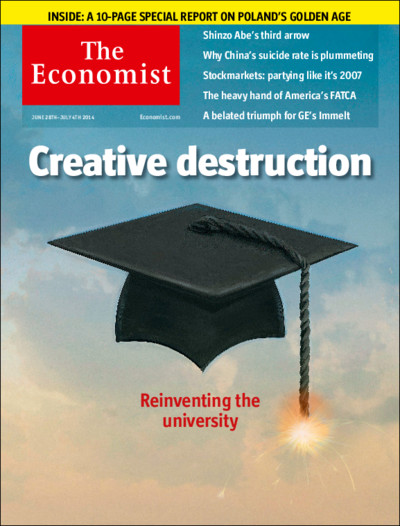
Thus, I cringed when I saw this cover on the Economist:


The Economist, to its credit, does acknowledge this much:
For all their potential, MOOCs have yet to unleash a Schumpetarian gale of disruption. Most universities and employers still see online education as an addition to traditional degree courses, rather than a replacement. Many prestigious institutions, including Oxford and Cambridge, have declined to use the new platforms.
Disruption is a long way off because learning is not a widget that can be replaced by a better widget or one that can be manufactured elsewhere less expensively.  As Lepore noted, " people aren’t disk drives."  Learning is not merely about faster processing or larger memory capacity or about the cost of labor in China.

The Economist concludes on an even tone after weighing the issue:
In “The Idea of a University”, published in 1858, John Henry Newman, an English Catholic cardinal, summarised the post-Enlightenment university as “a place for the communication and circulation of thought, by means of personal intercourse, through a wide extent of country”. This ideal still inspires in the era when the options for personal intercourse via the internet are virtually limitless. But the Cardinal had a warning: without the personal touch, higher education could become “an icebound, petrified, cast-iron university”. That is what the new wave of high-tech online courses should not become. But as an alternative to an overstretched, expensive model of higher education, they are more likely to prosper than fade.
Unfortunately, the higher education ideal long ago lost "the personal touch" and even now a typical institution that has classes of anything from 300 to 1,000 students meeting not in classrooms but in auditoriums (auditoria?) is already nothing but “an icebound, petrified, cast-iron university.”  Which is why, perhaps, to most students and their sponsors MOOC is not any worse.

I would cheer on the MOOC disruption if it can bankrupt the NCAA millionaires who have grossly profited by horribly distorting "the idea of a university."

Saturday, September 19, 2009