Saturday, August 05, 2017

Our own moral awakening

More than a year ago, I received a letter from a then 96-year old woman--"a member of the WWII generation."  She wrote in the letter, which was in response to my op-ed on homelessness in America:
You and no one living in the USA at this moment would be where he or she is if my generation had not made it possible.  That includes the dropping of the bomb.
This pacifist hates wars. Hates conflicts. The older I get, the less I am able to tolerate fights and destruction even in movies.  Therefore, it is always jarring to me when people defend the destruction to civilian life and property from the bombs that were dropped in Hiroshima--on August 6th--and three days later on Nagasaki.

The interpretations of the historical happenings are conflicted.  I am biased; I believe that the war could have, would have, been brought to an end without America flexing its nuclear muscles. My preferences for peace are why I find it discouraging that there is a majority in America that agrees with the letter writer regarding the bomb:
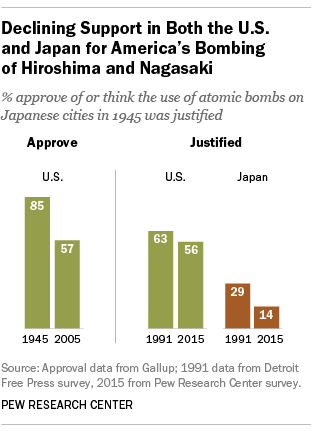
Source

A year ago, Obama visited Hiroshima, ahead of the anniversary of the tragic event.  In all these years since 1945, Obama was the first sitting president to visit the Hiroshima Peace Memorial.  In a moving speech, Obama noted how the world changed since "death fell from the sky" on that cloudless August morning in Japan:
Those who died, they are like us. Ordinary people understand this, I think. They do not want more war. They would rather that the wonders of science be focused on improving life and not eliminating it. When the choices made by nations, when the choices made by leaders, reflect this simple wisdom, then the lesson of Hiroshima is done.
The world was forever changed here, but today the children of this city will go through their day in peace. What a precious thing that is. It is worth protecting, and then extending to every child. That is a future we can choose, a future in which Hiroshima and Nagasaki are known not as the dawn of atomic warfare but as the start of our own moral awakening.
These are dark times.  But, one has to be hopeful; what other choice do we have.  Here is to hoping that despite the effects of the fateful elections this past November, we will get on to the path of our own moral awakening--sooner than later.

Friday, August 04, 2017

Is this the real life? Is this just fantasy?

There are more and more homeless people in town.  And our town is no exception--growing numbers of homeless is an issue that seemingly every American city is dealing with.  At the same time, the economy is humming along and unemployment rate is down to 4.3 percent, which should convince anybody that homelessness is not simply an economic issue--it is not merely about poverty.

I do wonder whether the homeless, despite all the hardship, are more in tune with real life and what it means to be human than most of the rest of us who live disconnected from all things real.

We live increasingly in artificial environments.  We live online, via texts, blogs, emails, tweets, Instagrams, and--of course--Facebook.  Through most of our waking hours, we are completely disconnected from "real" and deal only with the virtual.

The homeless--the mentally competent and otherwise--deal with the real all the time.  Real people. Real heat. Real cold. Real hunger. ... So, who is really leading a real life?

The older I get, the more I worry about this.  The more there is technology, the more I worry about this.  I am reminded of the science fiction from a century ago, about which I have blogged before: E.M. Forster's The Machine Stops.

As I noted in this post two years ago:
We live in a world that Forster wrote about back in 1909.  Screen time of all kinds.  Instant messages.  Tweets and Facebook status reports and blog posts like this all passing of as knowledge, just as Forster had feared.  We have replaced real human interactions with virtual ones.  So "satisfied" with the virtual interactions, and thinking that the virtual even eliminates the need for real interactions, we seem to believe that visiting with parents, children, friends, is not needed anymore.  We live in our own cells.
We already live in a world in which the machine has taken over our lives.  The machine even knows way more about us than we do about ourselves.  We can try to run from it, but we can never hide from the machine.

And, of course, homelessness is especially worse in cities that are home to the creators of the machine.  Like San Francisco and the Silicon Valley.   It is a bizarre juxtaposition of affluence and unimaginable high technology, versus shaggy men and women pushing carts mumbling to themselves.

The digital high tech industry is rapidly leading us into an increasingly virtual world, where we humans become disposable.  We real humans matter less and less to the machine.  We humans, in turn, care less and less about all things real.
Cannot you see, cannot all you lecturers see, that it is we that are dying, and that down here the only thing that really lives in the Machine? We created the Machine, to do our will, but we cannot make it do our will now. It was robbed us of the sense of space and of the sense of touch, it has blurred every human relation and narrowed down love to a carnal act, it has paralysed our bodies and our wills, and now it compels us to worship it. The Machine develops - but not on our lies. The Machine proceeds - but not to our goal. We only exist as the blood corpuscles that course through its arteries, and if it could work without us, it would let us die.
PS:
Click here to read The Machine Stops, if you have never read that before.
The blog-post resulted from reading this book review essay in the LRB.

Thursday, August 03, 2017

From riches to rags! :(

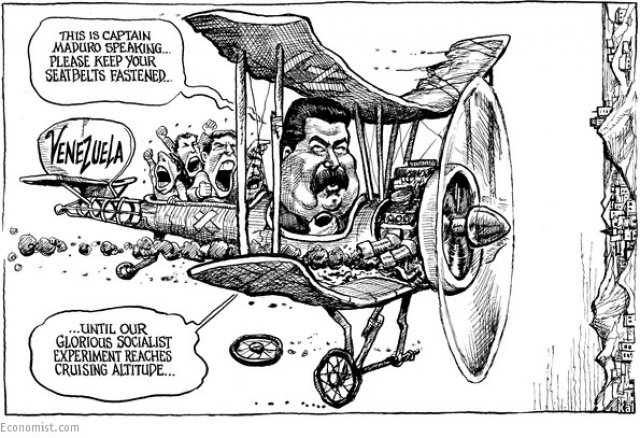
It was once the richest country in the continent. Now, its people are fleeing. Some of its women try to make a living by doing sex work in the neighboring country.  Those who haven't fled are terribly undernourished.

No, it is not some cliched African country.  But, a country that until recently was a darling of the left.  Venezuela!
According to the International Monetary Fund, Venezuela’s GDP in 2017 is 35% below 2013 levels, or 40% in per capita terms. That is a significantly sharper contraction than during the 1929-1933 Great Depression in the United States, when US GDP is estimated to have fallen 28%. It is slightly bigger than the decline in Russia (1990-1994), Cuba (1989-1993), and Albania (1989-1993)
Just awful!
Venezuela is now the world’s most indebted country. No country has a larger public external debt as a share of GDP or of exports, or faces higher debt service as a share of exports.

So, where is the fucking intellectual left that used to adore Chavez, whose policies set Venezuela down this hell hole?
The list of Western leftists who once sang the Venezuelan government’s praises is long, and Naomi Klein figures near the top.
In 2004, she signed a petition headlined, “We would vote for Hugo Chavez.” Three years later, she lauded Venezuela as a place where “citizens had renewed their faith in the power of democracy to improve their lives.” In her 2007 book, “The Shock Doctrine,” she portrayed capitalism as a sort of global conspiracy that instigates financial crises and exploits poor countries in the wake of natural disasters. But Klein declared that Venezuela had been rendered immune to the “shocks” administered by free market fundamentalists thanks to Chavez’s “21st Century Socialism,” which had created “a zone of relative economic calm and predictability.”
How about the big guy himself?  You know the one. Noam Chomsky?
Chomsky, whose anti-capitalist teachings have inspired millions of American college students, praised Chavez's "sharp poverty reduction, probably the greatest in the Americas." Chavez returned the compliment by holding up Chomsky's book during a speech at the U.N., making it a best-seller.
Is Chomsky embarrassed by that today? "No," he wrote me. He praised Chavez "in 2006. Here's the situation as of two years later." He linked to a 2008 article by a writer of Oliver Stone's movie who said, "Venezuela has seen a remarkable reduction in poverty."
I asked him, "Should you now say to the students who've learned from you, 'Socialism, in practice, often wrecks people's lives'?"
Chomsky replied, "I never described Chavez's state capitalist government as 'socialist' or even hinted at such an absurdity. It was quite remote from socialism. Private capitalism remained ... Capitalists were free to undermine the economy in all sorts of ways, like massive export of capital."
What? Capitalists "undermine the economy" by fleeing?
Chomsky has always been good with words, and knows how to use them in order to make sure he comes across as the wise sage.  Godawful!

Just because I will not forget nor forgive the 63 million who have unleashed trump and his demons on us, does not mean that I will be soft on the near mirror image on the left: the Berniacs, whose economic policies are nearly as insane with their anti-globalization and America-first rhetoric.  Which is why I will wrap up this post with this:
In the age of Trump, Brexit and a wider backlash against globalization, left-wing economic populists are enjoying a resurgence in mainstream credibility by railing against free trade and “neoliberals.” This is a scandal. For in the form of the Bolivarian Republic of Venezuela, the world has a petri dish in which to judge the sort of policies endorsed by Jones, Klein, British Labor Party leader Jeremy Corbyn, homegrown socialist Sen. Bernie Sanders and countless other deluded utopians.
There, the ghastly failures of their ideas are playing out for everyone to see; a real-time rebuke, as if another were needed, to socialism. That these people are considered authorities on anything other than purchasing Birkenstocks, much less running a country, is absurd.
When you buy the socialist rhetoric, Caveat emptor, as "neoliberal" economists like to say!