Sunday, November 22, 2009

Meanwhile at Government Motors, er, at GM ...

You know what attracted me to this op-ed in the NY Times?  The leader "Portland, Ore."  To think that a NY Times op-ed on GM would be authored from somebody here in Oregon .... I was trapped :-)

It was a bad, bad idea for the government to run this automobile sinkhole company.  Anyway, we are where we are.  This op-ed argues that:
Maintaining a majority stake in a struggling G.M. as the 2012 election approaches will only increase the liability. If G.M. has to use taxpayer money to bail out Opel and Daewoo, its Korean division (which lost billions on currency speculation, no less), the issue of bailout money being sent abroad will undoubtedly be a campaign issue.
G.M.’s global interests are far too diverse for it to serve its taxpayer owners faithfully, and it can’t afford to subjugate its business prerogatives to the political needs of its major shareholder in the White House. So, unless Americans develop a sudden obsession with G.M.’s $40,000 Volt electric car just in time for an I.P.O., taxpayers will be stuck with tens of billions of dollars in losses.
I wonder if the logic is why worry about tens of billions of dollars in debt, when we are piled high in gazillions of dollars of debt.


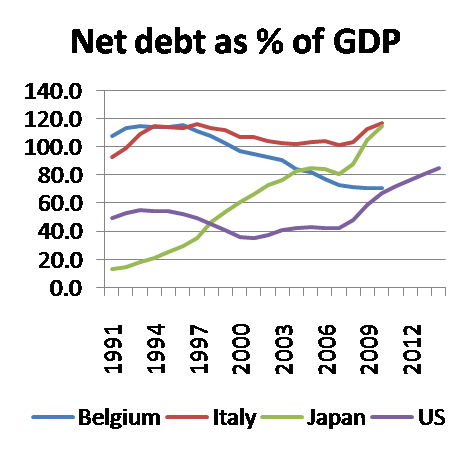
Speaking of debt, Paul Krugman chips in with we have no reason to worry; after all, Belgium, which will soon preside over the EU, is mired in a lot of debt, and provides this chart.

Ahem, while what was good for GM 60 years ago might have been good for the US then, what is good for Belgium being good for the US now?  Seriously, what happened to Krugman?

And, another page in the NY Times wants us to be afraid, really really afraid, of the debt situation:

With the national debt now topping $12 trillion, the White House estimates that the government’s tab for servicing the debt will exceed $700 billion a year in 2019, up from $202 billion this year, even if annual budget deficits shrink drastically. Other forecasters say the figure could be much higher.
In concrete terms, an additional $500 billion a year in interest expense would total more than the combined federal budgets this year for education, energy, homeland security and the wars in Iraq and Afghanistan.
So, who you gonna believe? :-)

The autonomous jihad in America

The ending sentence in this opinion piece is an attention getter that should have been the opening sentence:
Once distant enemies now pose a real threat to the U.S. at home.
Now, before you jump to conclusions, no, the opinion piece is not in the context of the incident at Fort Hood.  In fact, the essay makes no mention of Texas, or Fort Hood, or Hasan.  Which is why the piece is all the more interesting.  I have no idea about the data in the column, but the publication is a reliable one.
And, you know what?  It is not any war-obsessive right-wing American publication either.

This column is from The Hindu.  I copied and pasted the title of the column, for the title of this post.  It is clear that the author wants to make a case that Pakistan is the area that is most connected to terrorist acts anywhere:
Even as it moves to address the causes of the rising tide of jihadist violence at home — among them resentment over foreign policy, racism, religious bigotry, and Islamist institutions that exploit them — the U.S. will have to work to dismantle the infrastructure of terrorist groups in Pakistan.
But, in trying to make this point, the essay does not make it easy for the reader; not quite an example of wonderful writing.  Check it out though.

Waiting to exhale on Afghanistan ... egalitarian faux-democracy?

I have made my position clear.  Now, I am with billions of others on the planet waiting for Obama to tell us what his decision is.

If he still planning on a surge, hey may want to think more about it.  Why? Pakistan is not keen on a surge, particularly if the US does not share its plans. (ht)
Pakistan expressed fear Friday that a large increase in foreign troops in Afghanistan could push militants across the border into its territory and called on the U.S. to factor in that concern as part of its new war strategy.....
...The Pakistani concerns, raised by the prime minister during a meeting with visiting CIA director Leon Panetta, could pose another headache for President Barack Obama as he weighs military proposals to send 10,000 to 40,000 additional U.S. troops to Afghanistan next year.
And, that same AP story ends with this BTW kind of an observation, which is a nasty reminder of how we got to where we are:
Pakistan helped nurture a generation of Islamic militants after the Soviet Union invaded Afghanistan in 1979. Following the Soviet withdrawal a decade later, Pakistan helped the Taliban seize control. Many of these militants fled to Pakistan after the U.S.-led invasion of Afghanistan in late 2001.
Meanwhile, Obama taking his longest time trying to come up with a solution that pleases all is beginning to get noticed, finally.  The ever caustic Dowd, who is good at playing with words (I don't care for her columns at all; but, to borrow from Rumsfeld--did I really quote this war criminal?--we have to go to engage in discussions with the columnists we have!)
If we could see a Reduced Shakespeare summary of Obama’s presidency so far, it would read:
Dither, dither, speech. Foreign trip, bow, reassure. Seminar, summit. Shoot a jump shot with the guys, throw out the first pitch in mom jeans. Compromise, concede, close the deal. Dither, dither, water down, news conference.
It’s time for the president to reinvent this formula and convey a more three-dimensional person.
Lee Siegel describes the un-decider's approach as:
egalitarian faux-democracy, in which the illusion of responding to every side in a debate undercuts the democratic process of actually arriving at a decision.
How exactly does this work? Siegel explains:
This illusion of national participation in his decision-making process, with the promise of a happy ending that excludes no one, has been Obama’s method almost from Day One. Call it the American Idol style of governing—except that no possibility ever gets voted out of the competition.
No one must feel marginalized by a tyrannical majority. Obama allows the responses of the public, and the political establishment, and the media to break down every issue into a million parts, so that the multi-faceted clamor outside his head ends up looking a lot like the multi-faceted way he considers the world from inside his head. And by the time a decision comes—and yet it seems that Obama has not come to a single consequential decision since his inauguration—some people will feel unsatisfied, but no one will feel defeated.
Not looking good, man.  Not looking good at all. 
Update: later I was reminded of this comment on candidate Obama by Robert Samuelson--back in June 2008 that he might be the best graduate student ever:
I cannot detect powerful convictions in Obama. He seems merely expedient in peddling his convenient conflicts. He strikes me as a super-successful graduate student: the brightest, quickest, most articulate guy in the seminar. In his career, he has advanced mainly by talking and writing -- not doing -- and may harbor a delusion common to the well-educated: that he can argue and explain his way around any problem.