Showing posts with label tourism. Show all posts

Saturday, July 18, 2015

A not so sorry sari story

Attending a wedding in India, which I did this past December, was awesome for many reasons one of which was this: not only older women but most of the younger women too were wrapped in saris.
Silk saris.
In a mind-blowing array of colors of designs.
No two saris looked the same.
And every woman seemed to delight in the sari that she was wearing.

Right from a young age, I was impressed with the beauty of the sari.  I had no idea about the differences that the elders talked about: Kanchipuram silk versus Benares silk, for instance.  All I knew was that saris were gorgeous and that I liked some more than others.  It was exciting when I was asked for my opinions on the saris and I was always willing to jump in with my comments on the color scheme, the pattern, the "border," and whether it will look good for that particular woman.  I think it is a surprise that I never had even the faintest interest in wrapping myself in one! Thankfully ;)

Of course, there was no equivalent for the males, whose traditional outfits at weddings was nothing but a white veshti and an angavastram.

No Angavastram though! ;)
Thus, it is no surprise that I could sympathize with Sashi Tharoor's lament that women were ditching the traditional saris.   Of course, the intellectual me also felt right away that it was atrocious for Tharoor to complain about the loss of traditions after his own life far, far away from the traditions.  But, I suppose people like us will always talk and write about the rapid changes that lead to the tossing overboard of traditional practices--even saris.  Why, even the half-saris! ;)

As women ditch the traditional saris, the industry that once employed hundreds of thousands has been rapidly changing as well.  In the place of human hands weaving those silk threads into colorful patterns that the silk saris become, machines have taken over.  The artisan and artistic craft is dying.  While Kanchipuram silk continues to flourish for various reasons, Benares silk is long past its glory days.  It is now being sustained in ways that makes this sari-fan jump with joy:
The jobs of the Varanasi weavers, once estimated at a half million men, may have been fading out back then, but on a trip in late 2013 I discovered that efforts were underway by two companies — the socially conscious New York fashion label Maiyet and the Mumbai chain Taj Hotels Resorts and Palaces — to reinvigorate the ancient skill by employing the weavers and inviting tourists to visit them as they work. About 700 people have taken Maiyet’s tour; more than 650 have gone on Taj’s.
Hurrah for capitalism and the profit motive!
The fashion line’s work in Varanasi got the attention of David Adjaye, a star British architect whose international works include the design of the Smithsonian National Museum of African-American History and Culture in Washington. Mr. Adjaye is now designing Maiyet’s building for the weavers, which is to be completed in 2016.
Meanwhile, Taj had started resurrecting the desolate village of Sarai Mohana, five miles from Varanasi, which has a large concentration of weavers. Taj’s plan was to have the weavers make saris for its employees and guests. Since then, the village has been turned into something of a tourist attraction.
How awesome!  
For centuries Varanasi was a hub for the silk trade. The gossamer fabric, woven by hand on long wooden looms, is recognizable to aficionados by its refined feel, substantial weight and audible rustle. ...
Weaving in India dates to 500 B.C. and flourished during the Mughal period from the early 16th to mid-18th centuries. Since Islam traditionally forbids the images of people and animals, weavers created floral brocades for saris and scarves, much like the gold flower pattern on mine.
Weavers, nearly all men, pass down their skills to their sons or male relatives. But their trade has been shaken over the last few decades as power looms offer a cheaper and faster way to produce the same goods, six to 12 meters of material a day, depending on the design; it can take a weaver weeks to create the same amount. This technology left many of the artisans facing starvation and selling the wood from their looms for firewood.
Yes, it is that old tale of technology condemning artisans to starvation. The Luddites found out years ago as the Industrial Revolution unfolded in England that fighting the change is hopeless. Adapt or die.  It was literally the death of one weaver that, ironically, led the hotel chain to employ some:
It was this plight that in 2005 caught the attention of Ratna Krishnakumar, the wife of R.K. Krishnakumar, who was at the time the vice chairman of Indian Hotels Company Limited, of which Taj is a part.
“I had heard about how bad the situation was for these weavers, but the final clinching point came when I was watching the evening news and heard about a weaver in his 30s who had died from overselling his blood to feed his family,” she said in a telephone interview from her Mumbai home.
Mrs. Krishnakumar, 66, came up with the idea of tapping the men to make the saris for Taj’s female front-office staff. The weavers now make saris for 550 women who work at 11 of Taj’s 114 hotels in India.
Mrs. Krishnakumar deserves high praise,don't you think so too?
The project started in 2008 with a dozen weavers but now has more than 40. Mr. Ramrakhiani said that they have woven more than 1,000 saris for the hotel employees. Another group of 12 to 15 master weavers creates saris that are sold at 15 of the hotel’s gift boutiques, including at its properties in New Delhi and London.
Like Mrs. Krishnakumar of Taj, Maiyet’s co-founder and chief executive, Paul van Zyl, was aware of weavers’ problems.
“We naturally hit on Varanasi when we were looking for skilled weavers,” said Mr. van Zyl, 44, the former executive secretary of the Truth and Reconciliation Commission of South Africa, which was set up to deal with aftereffects of apartheid. The high-end line that he started is now available at 50 retailers worldwide, including Barneys New York.
If only the business world can always look a little beyond it's narrow and short-term interests--we will all then be collectively much better off.


Sunday, February 26, 2012

A sari-clad Gujarati with a cowgirl hat in Nagerkoil? Not your grandfather's India!

We stepped out through the Padmanabhapuram Palace gates and stopped for tender coconut, when a young couple--perhaps in their late twenties--stood next to me and started what seemed to be a verbal fight.  The man barely said five words for every hundred from the woman.  Her voice kept getting louder.

All these didn't fascinate me as much as the language they were speaking: it was not Tamil or Malayalam, which are the local languages, nor English or Hindi. 

I thought I heard a couple of Bengali words or at least that tone.  Or, was it Oriya, I wondered.

I had to ask them to get this cleared.

But, their fight seemed to be getting more and more intense, but I didn't care. 

"What language are you fighting in?" I asked them. 

Nah!  That is the question I wanted to ask them.  Instead, I was polite.  "What language are you two talking in" I asked them.

The woman glared at me.  I mean, if her eyes were lasers, I would have been annihilated right there.  End of blogging!  Perhaps she was having one heck of an interesting fight, and I butted in.  Worse than coitus interruptus, perhaps, is an interruption in a heated argument :)

The man said, "Bengali."  I thanked them and walked away before the woman could launch any assaults directed at me.

This Bengali-fighting-speaking couple fits the trend that I have been noting throughout this strange secular pilgrimage of mine--Indian tourists are everywhere, far away from the lands of their languages. Unrecognizable sounds all over.  Bengali at practically the southern tip of India is, therefore, not a surprise at all.

What was surprising, however, was to see this woman, in the photo on the right. Let me back up a tad, in order to explain ...

There were tourists by the busloads at this palace.  These tourists from all parts of India often seemed to hurry past, so much so that all I had to do was wait a couple of seconds and then have the exhibit all to myself.

There was one group that was majority-female, all middle-aged and seemingly from Gujarat and Rajasthan.  At least, that is my guess based on their saris.

As I was nearing the exit gate, I spotted this woman wearing a sari, sitting with a whole bunch of women, and wearing this cowgirl hat.  In India!  Off Nagercoil!

Times they are a changin ...

Tuesday, July 13, 2010

The travelling Indians .. in Switzerland, too :)

The Roma set the trend in trotting around the world, starting from India.  For a while, I think people from India lost their wanderlust--perhaps that coincided with the European colonialism and then, to quote from my graduate school days, the systematic development of underdevelopment

Now, once again, we are wandering around, sometimes as tourists and other times as immigrants.  Sometimes, it is both--as immigrant tourists--which is what happened over the Fourth of July weekend when my cousin, her husband, and I went to Crater Lake.  The three were in three different political categories: he is an American by birth to parents who immigrated from India.  She is an immigrant who is a permanent resident.  And I am a naturalized American.

At Crater Lake, it seemed as if every third tourist had Indian blood.  I helped a couple (both Indians) take photos with the lake as the background, and the wife seemed like she was relatively new in the country.  Vans and cars of traveling Indian families ... A chai wallah could have made quite a few dollars there :)

Apparently, Indians are crisscrossing all over, and up in the Swiss mountains too, as this NY Times story reports (ht).  However, the Indo-Swiss tourist connection is thanks to Bollywood:
For years, Bollywood’s producers and directors have favored the pristine backdrop of Switzerland for their films. The greatest of the Bollywood filmmakers, Yash Chopra, is a self-professed romantic who has made a point of including in virtually all his films scenes shot on location in this country’s high Alpine meadows, around its serene lakes, and in its charming towns and cities to convey an ideal of sunshine, happiness and tranquillity.
In the process, they have created an enormous curiosity about things Swiss in generations of middle-class Indians, who are now earning enough to travel here in search of their dreams.
“The moment you cross the border it is something else,” Mr. Purohit said, “where the scenario changes.”
“No noise, no pollution, no crowds,” said Kamalakar Tarkasband, 72, a retired army officer.
Swiss tourism officials and their Indian counterparts are capitalizing on this obsession. The number of nights spent by Indian tourists, who come mostly in summer (few ski), has doubled in the last decade to 325,000, and the numbers continue to grow.
It is a similar story with people from China too.  As the Chinese gain disposable incomes, they too are exploring the planet.  Good for all of them, I say.  It is a sign of growing affluence in countries that were once depressingly poor (though, as I noted even earlier in the day, poverty persists!)

Anyway, as the Roma know well, "different" could also mean trouble, as even that NY Times piece reports:
In June, the Zurich newspaper Tages-Anzeiger featured an article with the headline “Into the Luxury Hotel with a Gas Cooker,” noting that “in some hotels an entire caste of guests is no longer desired: the Indians.”
The article catalogued the complaints of hotel managers: guests who cook curry dishes on camping stoves in their rooms; guests who use bath oils that blacken tubs; guests who book for a husband and wife, only to show up with the entire family.
In Engelberg, where a visitor is more likely to encounter a woman in a sari than hear the clang of a cowbell, some European tourists are unsettled.
Well, here is a song/dance clip from one of the movies mentioned in the NY Times piece--Sangam:

Yes, the songs from this movie are all classics.  An uncle had a record player, and when I was a kid I recall him playing another song from this movie for me because he said it was dad's favorite ... and that one is:

Saturday, January 23, 2010

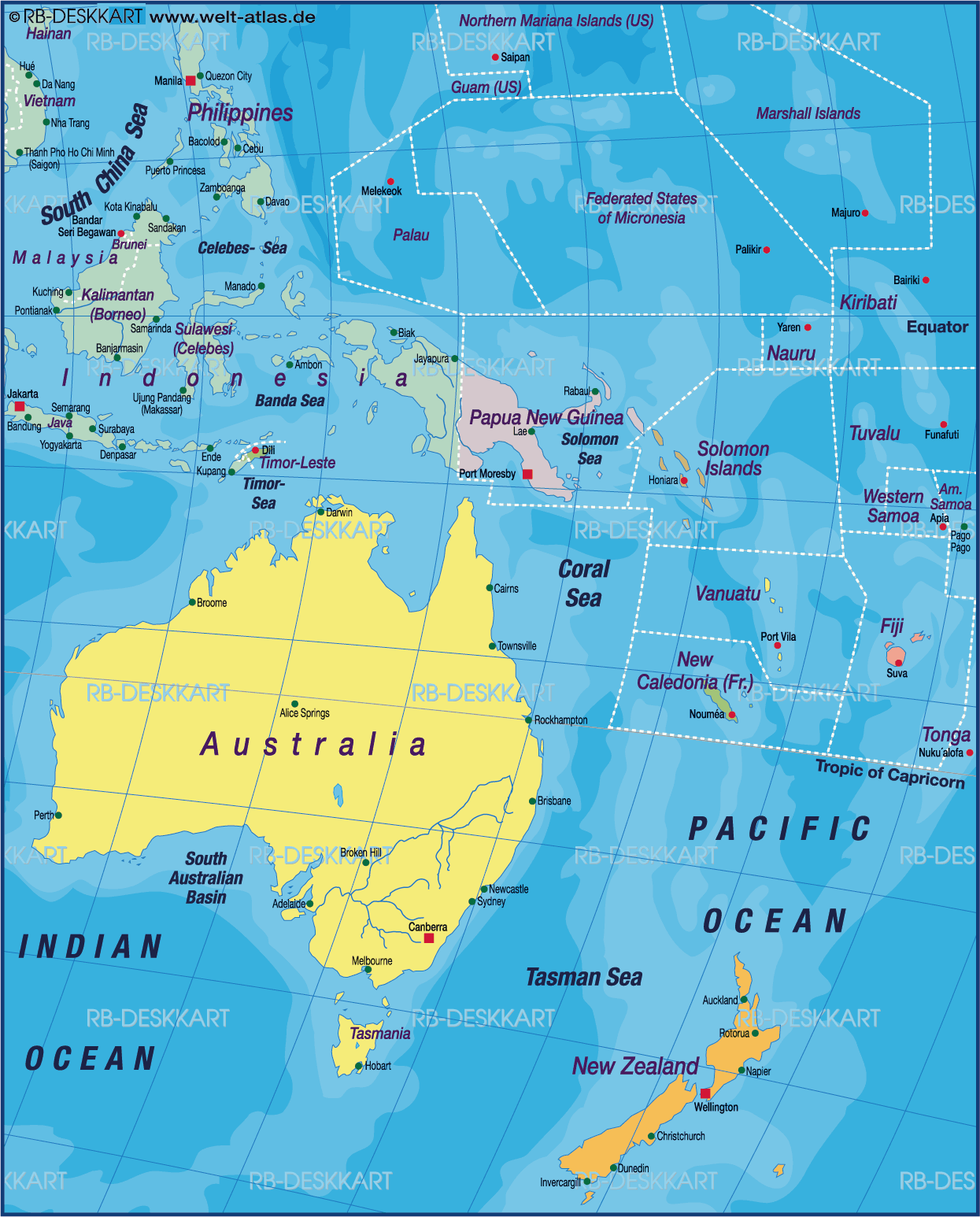
"Can I catch a train from Fiji to New Zealand?"

ALDaily had a link to a report on dumb questions that tourists ask, which is from where I got the title of this post.  A hilarious read.
A few excerpts from the questions that were reportedly asked by tourists:
 "Why did they build so many ruined castles and abbeys in England?"
"if they would end up in Holland if they drove through New York's Holland Tunnel."
"what type of car they would need to drive overnight from the Great Barrier Reef to Perth'
BTW, in case you are still wondering where Fiji is, here is a map that shows Fiji relative to New Zealand and Australia :)

Sunday, April 19, 2009

Slumdog Millionaire. Poverty porn. Child star for sale.

Nothing ever surprises me anymore about life in this world.
More so when the news is from India, which everyday offers more plot twists and turns than any soap opera can.
Here is another example. A child actor from Slumdog Millionaire is (or was potentially) up for sale! I have excerpted the following from a news item in the Times of India, which investigates about the reports of the potential sale:
‘We expect
Rubina
Rubina More Pics
compensation’


Slumdog Millionaire child actress Rubina Ali’s father has, reportedly, decided to put her on sale. In a bid to cash in on Rubina’s international stardom, her father Rafiq Qureshi has put her up for adoption, demanding nearly 200,000 pounds (Rs 1.8 crore approx). He offered the deal to an undercover fake sheikh from the international tabloid News of the World. “Yes, we’re considering Rubina’s future,” Rafiq told the undercover reporter. “I have to consider what’s best for me, my family and Rubina’s future,” he added.

Rafiq blamed Hollywood bosses for forcing him to put his daughter up for sale and claims, “We’ve got nothing out of this film.” News of the World’s undercover reporter approached Rafiq acting as the representative of a wealthy Arab sheikh, who wanted to adopt the girl. “Yes, we’re considering Rubina’s future,” Rafiq replied, and asked him to talk to his brother-in-law.

Rubina’s uncle Rajan More confirmed, “Yes, we’re interested in securing our girl’s future. Rubina’s life is miserable and she lives with her stepmother. Most of the time she stays with me because she’s not happy at her parents’ home. Obviously, if you wanted to adopt, we could discuss this, but her parents would also expect some proper compensation. We’re talking of around 50,000 pounds for this to happen.”
Just awful. But, in a way it also exposes the reality of life in the slums.

Was, therefore, reminded of the stinging criticism of the movie a couple of months ago--that the movie is nothing but "poverty porn". A quick google search, and here is an excerpt from that Times column:
Like the bestselling novel by the Americanised Afghan Khaled Hosseini, A Thousand Splendid Suns, Slumdog Millionaire is not a million miles away from a form of pornographic voyeurism. A Thousand Splendid Suns is obsessed with rape and violence against women, the reader asked to pore over every last horrible detail. Slumdog Millionaire is poverty porn.
The columnist then noted:
When we are suckered into enjoying scenes of absolute horror among children in slums on the other side of the world, even dubbing them comedy, we ought to question where our moral compass is pointing.
And, this observation in Huffington Post certainly makes us wonder about "poverty porn":
Apparently, tours of Mumbai slums are experiencing a boon since Slumdog Millionaire won eight Academy Awards -- more evidence that this film created an emotional connection between Western audiences and the characters it depicts.
A report in USA Today certainly adds credibility to the notion that the movie has triggered a touristy interest in poverty:

The movie's recent premiere in Mumbai (formerly known as Bombay) sparked complaints among some of Dharavi's estimated 1 million residents, who live and work in an area smaller than New York's Central Park. But it also has boosted business for Reality Tours and Travel, which leads eight to 15 tourists a day on guided tours of the slum.

Reality Tours co-founder Chris Way estimates that sales are up by about 25% since Slumdog Millionaire's release. Though he credits some of the increase to a gradual rebound in tourism after terrorist attacks in Mumbai killed more than 170 people in November, publicity surrounding the film has played a big role.

Oh well ....

Tuesday, July 29, 2008

Fertility tourism in India

Life and economics get more and more surreal: here is an example of that from The Guardian.

The fertility tourists
The ads are brazen: 'healthy young women - superovulated exclusively for you!'. The fees are half those of UK clinics ('flights and hotel included!'). And the industry is unregulated, leaving doctors free of legal and ethical constraints. No wonder more and more Europeans are going to India for fertility treatment.

Read more at The Guardian