Thursday, October 27, 2016

Where does the neighborhood end?

Usually when I call my parents, thanks to life on opposite sides of the world, I end up calling them when they have just about wrapped up a hot breakfast, and when they are contemplating what to prepare for lunch.  Usually.

Not that one day.  Their lunch prep was on hold.

The preparations had to wait because the neighbor had died and they did not want to get the kitchen operations going until the body was taken away.  Whatever be the religious reasons, there is a basic humanitarian reason for such a delay, which you may have already figured out.  Indian cooking releases a gazillion mouth-watering aromas (or, strong odors, if you don't care for them) and such an act while the neighbor's family is sitting with the dead person is simply an awfully discourteous behavior.

In the old days, in my grandmothers' villages, one of the reasons for a quick disposal of the body was to also make sure that the neighbors were not put to a great inconvenience--after all, when tragedy strikes in our life, it is not a tragedy for everybody, right?

Which is what I want to get to in this post.  Where does that neighborhood boundary end?

Tragedies happen every minute of every day all around the world.  But, that does not stop us from cooking delicious meals, traveling, having sex, ... whatever.  While it is a wonderful survival mechanism to make sure that we don't involved with the tragedies all around, my objective in this post is a much simpler one: For us to be reminded that there are real people all around with real problems that are far more compelling than our problems with the overcast skies and crappy cellphone coverage.

One of those tragedies was this image that appeared in my Twitter feed:
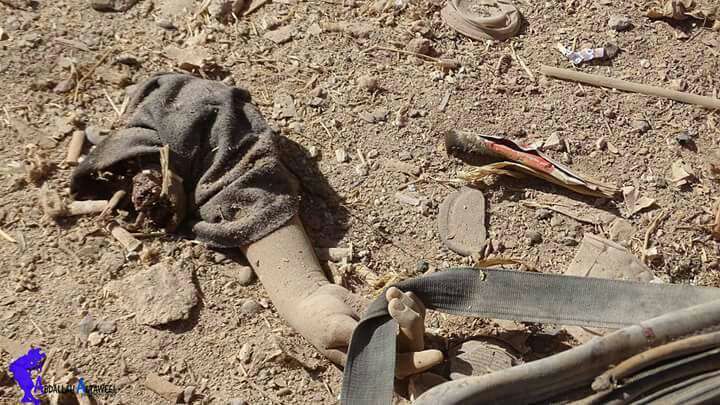

The tweet noted:
it's a kid arm holding to his bag after today's bombing
Yet another tragic day in Syria :(

I started following that Twitter feed after reading a Nick Kristof column, in which he had included details about a kid and her mother in Aleppo.  Now, thanks to that, I am reminded every day that life is not normal in Syria.  The image of a kid's severed arm lying on the ground with the fingers wrapped around a school bag is, sadly, only the latest of the horrific images that we have seen over the past couple of years.

Later, news reports provided a complete picture related to that image:
A school compound in a rebel-held part of northern Syria was repeatedly hit by airstrikes on Wednesday in an assault that monitoring groups and rescuers said had left dozens of people dead, including many children.
Unicef, the United Nations Children’s Fund, said the assault in Idlib Province may have been the deadliest on a school since the Syrian war began more than five years ago.
Twenty-two children and six teachers were killed in the strikes, Unicef said. 
Neither my parents nor I stop our lunch and dinner preparations in order to honor and respect the dead in Aleppo. Or in Mosul. Or in wherever.  Because ... they aren't our neighbors?!

Wednesday, October 26, 2016

What if we, the people, are just not rational?

Decision-making within the 35-home neighborhood where I live became a tad contentious.  The rhetoric got heated.  I followed Harry Truman's "if you can't stand the heat, get out of the kitchen" and quit the governing board.

If a 35-home neighborhood can generate enough political heat for me to throw in that metaphorical towel, do you think I will be able to stand even one tweet from Adolf Trump?

What shocks me more than Drumpf  as the major party candidate is this: There are tens of millions of people who support him, despite all the horrible tweets of his, and despite all the horrible things he has said about a whole bunch of people not only this country but even outside the US.

We cannot dismiss this as a freakish outlier.  To me, this is all the more evidence that there is a wide gulf between the democracy that we idealize and the reality of it all.  This gulf has existed all the time; it is not anything new.  But, never before has it become this glaringly in our face, which means we can't really be in denial anymore.

When it comes to democracy in America:
[Maybe] the problem is that we were expecting too much out of it in the first place ... It's time to stop pretending that there's such a thing as a rational voter.
I agree.  Maybe it is time we lowered the expectations. And lowered it a great deal.  It is the unrealistic expectations that also then end up with the complications like the ballot measures that we regular people simply cannot even understand and, yet, are asked to vote on.  The same unrealistic expectations of rational voters thinking through issues is also how the Brexit screw-up happened.  It is the same story in any democracy, not only here in the US.
"Can ordinary people, busy with their lives and with no firsthand experience of policy making or public administration, do what the theory expects them to do?" Of course not. "Mostly," Achen and Bartels write, "they identify with ethnic, racial, occupation, religious or other sorts of groups, and often — whether through group ties or hereditary loyalties — with a political party."
Exactly.  Back in the old country, I was always shocked at how ethnic, religious, and other affiliations seemed to lead plenty--perhaps an overwhelming majority even--to vote.  I tell ya, my adopted country is no different from my old country!

The author writes, "it’s finally time to make peace with a simple fact of political life: Informed, individualistic rationality is a chimera."   I am ready.  I made my own peace with it a long time ago, which is also why until a month ago, I never ruled out Hitler winning on November 8th.  It is also why I was not that surprised that Bush won a second term.

The friend always asks me for some kind of a constructive takeaway.  Here, it is simple: Stop imagining about the utopia and work with the reality.  Do not deny the reality that you observe.  And, more than anything else, do not ever think that more education means a better democracy.  Nope!
For the good-government reform community, this suggests something equally radical: giving up on the deeply held belief that American democracy can be solved by giving citizens more opportunities to participate by emailing Congress or voting, and an end to thinking all would be better if more people would just "get informed on the issues. ...
It also means coming to terms with the fact that we don’t think for ourselves; we think together. And maybe that’s fine. Partisanship and group loyalties are inevitable, and they can even be good things if they can help us realize shared interests.
Have a nice day! ;)

Tuesday, October 25, 2016

Dust thou art, and unto dust shalt thou return

A few years ago, in an academic exchange, somebody remarked that the line in the burial scenes in movies--ashes to ashes, and dust to dust--is not literally there in the bible, but is a paraphrase of the idea.  I tell ya, academics are very particular about the words used.  I remember two colleagues arguing about the meaning of the word "intrinsic."  Whatever floats one's boat, right?

Anyway, about the burial scenes in movies.  A few days ago, my father was recalling old stories and about a death in the extended family.  He said only a couple of people went to the burial ground.  I suppose I forgot I was talking with my father, and as if I was in a classroom I asked him, "when it is cremation that is done, why the usage of 'burial ground'"?  He thinks it might have been from the British days, which is how English words became a part of the vocabulary.  Because the Christian British referred to the burial ground, well, even cremation grounds became "burial grounds."  Methinks I should stop asking questions! ;)

The atheist that I am, even if it were not for my Hindu upbringing, I favor cremation.  After all, death renders the person as nothing but "the body."  When alive, I am sriram, but after I die, the question will not be "what are you going to do with sriram?"  Nope.  The question will be "what about the body?"

As Neil deGrasse Tyson wonderfully put it in this talk, our body is nothing but cosmic dust.  The periodic table elements in us matches the elements in the universe.  The universe is within us, and we are the universe.  It is one heck of a spiritual way to appreciate our place in this universe.  So, after death, cremating and converting me to ashes sounds logical.  Return me to dust.

Of course, to many believers, in the Judeo-Christian faith, cremation is not, ahem, kosher.  Which means that new doctrinal interpretations have to be developed by those who can read the mind of god.  The Roman Catholic institution is now caught up in the, ahem, dust:
On Tuesday, the Vatican responded to what it called an “unstoppable increase” in cremation and set down new guidelines barring the scattering of ashes “in the air, on land, at sea or in some other way.”
When new guidelines are issued, I would think that those we quickly refer to as fundamentalists go berserk.  Either something was the instruction from god, or it was not.  So, what happens to the old instruction that the dead body should not be cremated because of the belief "in the resurrection of the body"?  Not my hassle--it is for the believers to sort out the new software update, so to speak.
Burial prevents the forgetting of the loved one, as well as “unfitting or superstitious practices,” the document states.
For that reason, the Vatican said that cremation urns should not be kept at home, save for “grave and exceptional cases dependent on cultural conditions of a localized nature.”
My conversations with my father are evidence that cremation does not mean we have forgotten the people who went before us.  We share plenty of stories about those whose bodies were cremated; a marker in the graveyard  is not needed by any means to remember and respect the dead.

But then, maybe I am being a cantankerous academic ;)