Showing posts with label bill bishop. Show all posts

Wednesday, February 04, 2009

Ideological Melting Pot, v. the Postmodern Salad Bowl

I am a member of a small group of people from India who switched careers after doing an undergraduate degree in electrical or electronics engineering. Sometimes other fields too. While I am not sure what the reasons for the rest are, in my case it was a simple one: when I was in high school, it was a given that the smart kids went on to engineering or medicine, and the rest went somewhere else. Well, that is what we were brainwashed into thinking, and how wise can a 17-year old be anyway!

Here is another such example (though I am not sure if the guy was born in India, or here in the US) Shankar Vedantam is a national correspondent writing about science and human behavior for the Washington Post. Vedantam has a master's degree in journalism from Stanford University and an undergraduate degree in electronics engineering. BTW, the name sounds very much like a Tamil name--I wonder about the degrees of separation between him and me :-)
Vedantam notes that:

About two in three Americans say they prefer to live around people belonging to different races, religions and income groups. In reality, however, survey research shows that people are increasingly clustering together among those who are just like themselves, especially on the one attribute that ties the others together -- political affiliation.

Nearly half of all Americans live in "landslide counties" where Democrats or Republicans regularly win in a rout. In the 2008 election, 48 percent of the votes for president were cast in counties where President-elect Barack Obama or Sen. John McCain (R-Ariz.) won by more than 20 percentage points, according to the Pew Research Center.

The clustering of Democrats in Democratic areas and Republicans in Republican areas has been intensifying for at least three decades: In 1976, only about a quarter of all Americans lived in landslide counties. In 1992, a little more than a third of America was landslide country.

As I read this, I was thinking that it sounded more like Bill Bishop's arguments that I have blogged about before. Sure enough, later Vedantam quotes Bishop:

"These are the kinds of differences that are political in America today," Bishop and Cushing said in an e-mail they composed together. "People don't see themselves as members of demographic groups -- a white working-class man, an educated woman. Like the woman in California who described herself to us as an 'ocean-oriented person,' Americans define themselves by their interests: the bands they listen to, the foods they eat, the sports they follow, the spiritual beliefs they adopt."

Political polarization, according to this explanation, is a consumer phenomenon: You like Cheerios; I like Wheaties. Americans have lots of choices -- you can live in a cul-de-sac surrounded by fellow Mormons, or in a gay enclave, or in a neighborhood where yoga studios outnumber fast-food outlets.

I bet the Public Choice people are thrilled every time they see such arguments.

I like Vedantam's concluding remarks:
The yoga people simply can't stand what the lawn-chemical people represent, and vice versa. This might explain why, despite all of Obama's calls for an America that is larger than its differences, political polarization at the county level intensified between 2004 and 2008.

Tuesday, November 11, 2008

So, are we "polarized" or "unified"?

Bill Bishop, whose thesis is that we continue to sort ourselves with respect to our religious, social, and political preferences, which is reflected in our spatial aggregation, says that the 2008 elections have only divided the country even further. In his final entry in the blog at Slate, Bishop concludes that:

The vote last week was transformative in a sense. In many ways, however, the election produced no change at all. The country is split in much the same way it was divided four and eight years ago. People continue to sort by age and by way of life. As a result, our communities (and states) are growing more like-minded.
Oh, and there is the continuing and stark racial division in both the geography and how Americans live. In Republican-landslide counties, blacks and Hispanics are distinct minorities. Where McCain won by 20 percentage points or more, there were five Anglos of voting age for every black or Hispanic, Cushing found. In Obama-landslide counties, there are 1.3 whites for every black or Hispanic. Obama counties and McCain counties are very different places.
Liberals and Democrats seem to think the country's divisions have disappeared just because their man won. And it is easy to ignore people on the other side when they aren't your neighbors. But that doesn't mean the country is less polarized-because it isn't.
In his regular blogging place, Daily Yonder, Julie Ardery notes the importance that college towns played in Obama's victory, and reports on how one student made his decision:

According to an Indianapolis news station, "An IU student who identified himself as a Republican said he threw his support to Obama at the last minute because of the something the Democrat said on ‘Monday Night Football.’
"'He was asked, "What would you change in college football," and he said he wanted a playoff system,' said IU student Ben Dyar. 'It was really tied before that, but that pretty much sent me over the edge. I decided to vote for Obama.'"
Oh well.

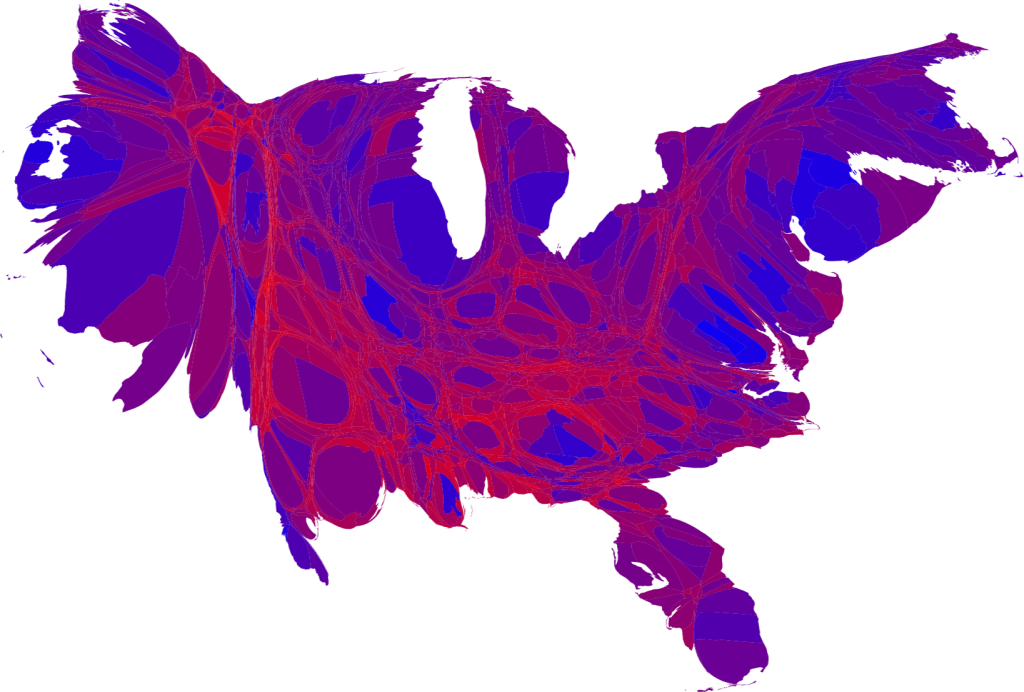
Meanwhile, the guys who analyzed the 2000 election data and showed that the red-state/blue-state divide is not accurate, and that the country is varying shades of purple, have more interesting cartograms based on the 2008 data. They note that:

large portions of the country are quite evenly divided, appearing in various shades of purple, although a number of strongly Democratic (blue) areas are visible too, mostly in the larger cities. There are also some strongly Republican areas, but most of them have relatively small populations and hence appear quite small on this map.