Thursday, June 04, 2015

Meditate on this!

She wasn't looking her cheery self at all as I waited in line at the checkout lane.  The former body-builder looked tired.  When she looked at me, past the customer she was serving, her smile seemed forced and her eyes a tad tired.

"How are you?" I asked her as I moved up.  I am old enough to know that asking anybody, especially middle-aged women, why they look tired might not be the best way to start a conversation.

"Tired and sleepy."

"I have not been able to sleep" she added.  "I think I have slept for a long time when I wake up and it turns out that it has been only two hours.  And then I simply lie there thinking, and not being able to go back to sleep."

Scientists haven't quite cracked what functions sleep serves.  All we know for certain is that our physical and mental health is affected when we don't get enough sleep.

"Yes, sleep is extremely important" I replied.

"Do you get enough sleep?" she asked.

I do.  I suppose I am lucky in that.

I heard her ask me "do you medicate?"  I told her that I am on Claritin for the grass seed pollen season.  The puzzled expression on her face made me rethink my response, and then rethink her question.

"Oh, you asked me whether I meditate?  I heard it as medicate!  No wonder you were wondering why I was talking about Claritin ..."

"If you mean whether I shut the lights and sound off and sit quietly for a while, nope.  To me everything that I do is meditation.  The cooking, the cleaning, the reading, the writing ..."

She didn't seem satisfied with that response.  Maybe for once I have let her down with my reply.  But, hey, spend enough time with me and I am bound to offer responses that won't always please you.  My thoughts on atheism might not please some, while others might find my criticisms of Modi to be off-putting.  Or, my intellectual inquiries about shit and sex work.  All these work for me; my blood pressure is normal and I sleep well ;)

Yesterday, when talking with the parents, father updated me on the problems that a few extended family members were dealing with.  "I think I am the only one with problems.  But, everybody has problems, and many of those problems are more troublesome than mine" he said.

I agreed with him.  Problems are in plenty.  Who doesn't have them!  Further, as my daughter advised me years ago, each person's pain is that person's pain and we can't dismiss that by comparison.

"Observing problems makes one a philosopher" father continued.  "That's how Siddhartha became Buddha."

I wanted to add there that the world will be better off if every one of us spent some time every day understanding our own problems, and those that our neighbors or friends or family go through.  But, I didn't.

With the Buddha, at one of the Ajanta caves

Wednesday, June 03, 2015

How does sex work get priced?

A while ago, the Economist published a story with this warning up front:
We rarely feel the need to alert readers to explicit content. But our discussion of the online sex trade requires frank language, and some may find the topic distasteful.
Yes, the Economist!

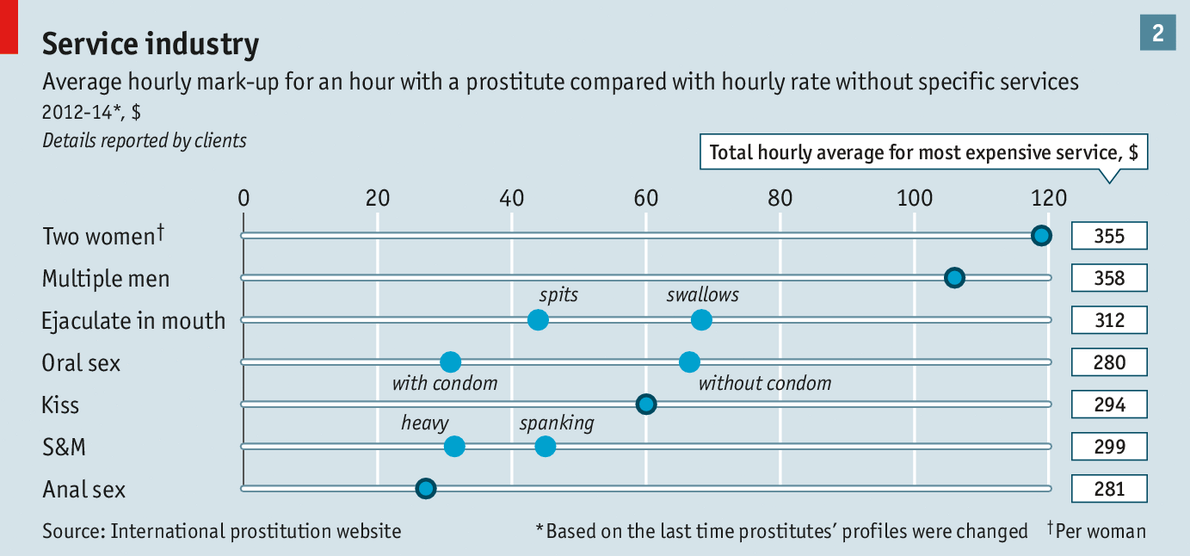
The warning was in place for a good reason; it had charts like the one below and words that can be challenging when a kid is around:


While the vast majority of us are clueless about this industry, we know well that sex is traded as much as various illegal drugs are.  If you are like me, you wonder how they decide to price things?  From a supplier perspective, how do they know what to charge?  What if they are underpricing their services?  What if they can raise their prices, have fewer customers, and still generate higher incomes?  From a demand perspective, how do the Johns know what is a good deal?  Do they comparison shop and, if they do, where are those prices listed?

You see how fascinating the world is?  Every single day is about asking new questions, and finding out that I have no clue whatsoever!

The magazine noted,
Women who are considering entering the industry often seek advice online from those already in it before making up their minds.
Today, I read in another British publication, The New Statesman, which historically has been way left of the Economist, in which a porn actor. Stoya, writes about the need for transparency in how actors are paid.
one thing we rarely talk about openly is pay. Which makes us a lot like many other workers.
Are you thinking about what I am thinking?  How do they even find out about the job openings in the first place?  The magic of the "invisible hand," I suppose!
A well-known performer who had her heyday in the late 2000s once told me that her rate for a double penetration scene was $12,000. I’d just started performing and was under exclusive contract with a single studio – a situation much more like being a direct employee than an independent ­contractor – and had no experience with agencies or booking my own freelance gigs to check this figure against.
Her rate seemed plausible, though – ­being penetrated by two male-bodied people at the same time, one in the anus and one in the vagina, certainly seemed to carry a higher risk of mechanical trauma. Double penetration scenes were rare, as were performers willing to be the receptive partner in them, and rarity tends to add value in any market.
So, when I decided that I wanted to perform in a double penetration scene and the owners of the studio I was with asked how much I wanted to be paid for it, I told them I wanted $12,000. We settled in the middle. Years later it turned out that the performer who had set my expectations so exorbitantly high was actually paid 12 – or possibly 14 – hundred dollars for those sorts of scenes.
Studio contract? Independent contractor?  Freelance gigs? WTF is doubly appropriate here ;)

She writes that "the lack of transparency around rates and my belief in an outrageous lie worked in my favour."  How does the market put a price on a sex act?  This is way too bizarre!
Capitalism, near as I can tell, involves a lot of companies trying to get as much out of a worker as they can for as little pay as possible. In these relationships, the worker should aim for the most pay they can get for the least work. There’s a very important emphasis on “can get”, though, because a luxuriously high rate does absolutely no good if no one is able or willing to pay it.
Stoya articulates one of the toughest issues in market economics--pricing.  That mystery of the marketplace is also why Google hired away an authority on pricing as its Chief Economist.  Yes, the World Bank and the IMF have Chief Economists, and so does Google!
Why does Google even need a chief economist? The simplest reason is that the company is an economy unto itself. The ad auction, marinated in that special sauce, is a seething laboratory of fiduciary forensics, with customers ranging from giant multinationals to dorm-room entrepreneurs, all billed by the world's largest micropayment system.
Google depends on economic principles to hone what has become the search engine of choice for more than 60 percent of all Internet surfers, and the company uses auction theory to grease the skids of its own operations. All these calculations require an army of math geeks, algorithms of Ramanujanian complexity
I don't suppose Google and Varian will want to help out Stoya ;)

Source

Tuesday, June 02, 2015

A life of rebellion ...against quiet desperation?

When I was young, we never seemed to have enough money for me to buy books.  Throughout my life in the old country, my parents, like most ones of their generation, had budgetary worries and with the household budget and accounting done in the presence of us kids, well, I knew well it was a luxury for me to buy books.

Thus, I relied on the local library, which more than fit my needs of those days.  Heck, that library even had Fahrenheit 451, and The Prophet, which are evidence enough that it was not a bad library by any means.  When we moved to the big city of Madras, I then made wonderful use of the libraries at the American and British consulates.

Attending graduate school at a university with more libraries than I could have imagined, with more books than I could have ever dreamt of, meant that I now had even less of an incentive to purchase books.

But, every once in a while, I do buy books.  And am always ready to loan them to anybody who is interested.  (There are a few books that are ultra-special to me and the fear of losing them means I shall never loan them!!!)  A student had borrowed my copy of Mario Vargas Llosa's Letters to a Young Novelist.  And it came back to me yesterday, which gave me an opportunity to scan through the book and re-read a few of my favorite sentences and paragraphs there.

Perhaps you wonder why I purchased that book when I have no plans ever of writing a novel.  Non-fiction essay writing shares in plenty with writing novels.  For that matter, the existential drive to be an academic has a lot in common with the angst that drives fiction writers.  Consider the following sentences that Llosa writes:


At peace with themselves!  Which is why I went through all those career changes--ditching electrical engineering, quitting professional planning--even though those, especially engineering, would have made me worry less about my financial well-being.  As I blogged a while ago, I don't want that life most people lead, which Thoreau noted:
Most men lead lives of quiet desperation and go to the grave with the song still in them
So, "what is the origin of this early inclination" to choose this vocation?  Why this nagging feeling that without pursuing this vocation we won't be true to ourselves?  Llosa provides an answer that sums it up really well for me: "The answer, I think, is rebellion."  A rebellion "against authority, the establishment, or sanctioned beliefs."  Yes, to rebel, even if seems like I have no cause!

This existence means that I never truly take a holiday from my work.  Why would I, when this is all I want to do?  Llosa writes regarding the literary vocation:
The literary vocation is not a hobby, a sport, a pleasant leisure-time activity.  It is an all-encompassing, all-excluding occupation, an urgent priority, a freely chosen servitude that turns its victims (its lucky victims) into slaves.
I live that kind of a life so much so that one of my biggest problem is that most teachers do not view themselves the same way.  Instead, they view their vocation as one that pays them so that they can do whatever else that really interests them.

Llosa also consoles me about my failures--having failed at getting promoted to the rank of full professor, not being recognized by my peers, ... when he writes about "confusing literary ambition with a hunger for glory and for the financial gains that literature affords certain writers"


This academic life of reading, thinking, writing, learning, and teaching, is, indeed, the best thing that ever happened to me.  Here's to hoping that it will continue for a while more.