Wednesday, June 07, 2017

Wait for ... 200 years!

Even as I read the tweet that linked to an essay, I knew that I would tweet about that myself.  Which I then did.
As an atheist, I am always amused when the religious folks make fun of "cults."  The other day, a born-again Christian neighbor was having jokes at the expense of Adventists.  Believers of practically every kind routinely make fun of Scientologists.  To me, ahem, I wish I could make fun of the older established cults of all kinds.

Which is also one of the reasons I liked Harari's description that I blogged about a month ago:
 What is a religion if not a big virtual reality game played by millions of people together? Religions such as Islam and Christianity invent imaginary laws, such as “don’t eat pork”, “repeat the same prayers a set number of times each day”, “don’t have sex with somebody from your own gender” and so forth. These laws exist only in the human imagination. No natural law requires the repetition of magical formulas, and no natural law forbids homosexuality or eating pork. Muslims and Christians go through life trying to gain points in their favorite virtual reality game. If you pray every day, you get points. If you forget to pray, you lose points. If by the end of your life you gain enough points, then after you die you go to the next level of the game (aka heaven).
A cult makes up bizarre rules to play the game as much as any religion has bizarre rules.
The historian J Gordon Melton of Baylor University in Texas says that the word ‘cult’ is meaningless: it merely assumes a normative framework that legitimises some exertions of religious power – those associated with mainstream organisations – while condemning others. Groups that have approved, ‘orthodox’ beliefs are considered legitimate, while groups whose interpretation of a sacred text differs from established norms are delegitimised on that basis alone. Such definitions also depend on who is doing the defining.
It is a power play.
Of course, the uncomfortable truth here is that even true church (large, established, tradition-claiming church) and cult aren’t so far apart – at least when it comes to counting up red flags. The presence of a charismatic leader? What was John Calvin? (Heck, what was Jesus Christ?) A tradition of secrecy around specialised texts or practices divulged only to select initiates? Just look at the practitioners of the Eleusinian mysteries in Ancient Greece, or contemporary mystics in a variety of spiritual traditions, from the Jewish Kabbalah to the Vajrayāna Buddhist tradition. Isolated living on a compound? Consider contemporary convents or monasteries. A financial obligation? Christianity, Judaism and Islam all promote regular tithing back into the religious community. A toxic relationship of abuse between spiritual leaders and their flock? The instances are too numerous and obvious to list.
If we refuse any neat separation between cult and religion, aren’t we therefore obligated to condemn both?
I have no hassles condemning both )

One of the earliest benefits of my decision to bolt out of India came in the form of my friendship with Shahab.  It was from listening to his personal, family, stories, and about their fleeing the Ayatollahized Iran, that I came to know about the religion that they had traditionally practiced--in secret for the most part--for centuries: Mithraism.

The way he broached that topic I remember all too well--because he was terribly disappointed that I had never even heard of Mithraism.  I hadn't.  Why do I bring up Mithraism in this context?  Because, back when the religion of Jesus was a new thing in Rome, Mithraism was rapidly spreading among Romans.  Christianity was a new cult, and Mithraism was an older cult.  They were competing for followers.  Mithraism lost out.  Christianity grew from a cult to a religion.  As kings converted to this new religion, so did their subjects and the people in the conquered territories.
Cults don’t come out of nowhere; they fill a vacuum, for individuals and, as we’ve seen, for society at large. Even Christianity itself proliferated most widely as a result of a similar vacuum: the relative decline of state religious observance, and political hegemony, in the Roman Empire
In the US, we have plenty of new cults: professional football. golf, ... and we pay plenty of taxes to support these cults ;)

Tuesday, June 06, 2017

The answer is blowing in ... liberal education

It was nearing bed time, but I decided to check my news-feed anyway.  I am glad I did.

I spotted one that referred to Bob Dylan's Nobel lecture.

I pulled up the text that kept my attention focused as I listened to him with the jazzy piano in the background.  It was a delight, as he talked about things that were familiar to me, and to many that were alien to me.  Many that I had no idea about; like this:
John Donne as well, the poet-priest who lived in the time of Shakespeare, wrote these words, "The Sestos and Abydos of her breasts. Not of two lovers, but two loves, the nests."
Sestos? Abydos?

I suppose Dylan knew that there would be blokes like me listening.  Which is why adds there:
I don't know what it means, either. But it sounds good. And you want your songs to sound good.
Dylan then talked about Moby Dick, All Quiet on the Western Front and The Odyssey.
I had principals and sensibilities and an informed view of the world. And I had had that for a while. Learned it all in grammar school. Don Quixote, Ivanhoe, Robinson Crusoe, Gulliver's Travels, Tale of Two Cities, all the rest – typical grammar school reading that gave you a way of looking at life, an understanding of human nature, and a standard to measure things by. I took all that with me when I started composing lyrics. And the themes from those books worked their way into many of my songs, either knowingly or unintentionally.
In grammar school? We don't do those books, or their equivalents, even in college level these days.  If the learning material is more than two screens of scrolling, well, forget it!

I love how Dylan talks about those classics.  Not merely his interpretations, which are wonderful by themselves.  But, more importantly, about how those classics provided him with "an understanding of human nature, and a standard to measure things by."  Which is also what I often I blog about--how short-stories and full-length fiction help me understand the human condition, and how they give me a frame of reference.  And, yes, "either knowingly or unintentionally" those awesome works find their way into my own teaching and writing.

Instead of grounding ourselves on such a broad understanding, which is what liberal education is all about, we increasingly focus on the tricks of the trade.  We train programmers.  We train statisticians, lab technicians, graphic designers, ... We do not educate anymore, it seems.


Monday, June 05, 2017

What can one do?

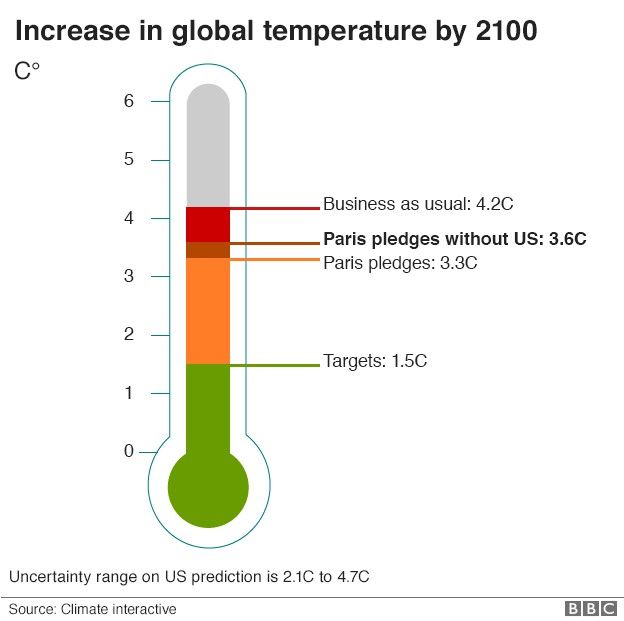
trump knows which campaign promises to keep in order to make sure his base is happy.  So, of course, he pulled the US out of the Paris agreement on limiting greenhouse gas emissions in order to try to keep the world from roasting.
Source

Der Spiegel notes in a lengthy editorial essay:
Trump's withdrawal is a catastrophe for the climate. The U.S. is the second-largest emitter of greenhouse gases -- behind China -- and is now no longer part of global efforts to put a stop to climate change. It's America against the rest of the world, along with Syria and Nicaragua, the only other countries that haven't signed the Paris deal.
But the effects on the geopolitical climate are likely to be just as catastrophic. Trump's speech provided only the most recent proof that discord between the U.S. and Europe is deeper now than at any time since the end of World War II.
Now, the Western community of values is standing in opposition to Donald Trump. The G-7 has become the G-6. The West is divided.
At this point, it seems like only a major volcanic eruption can cool the planet.  The downside to that eruption is, well, the the suddenness of it all will be catastrophic; be careful what you wish for!

So, what can one do on this World Environment Day, right?

Even if you are a New York billionaire--that other guy--there is not much you can do.
Unfortunately, private philanthropy is just not big enough to replace government funding. You can advocate. You can demonstrate.
As much as Bloomberg is putting his own money where his mouth is, we too can do things in our daily lives even as we continue to resist the maniac that 63 million people voted for.  Like, for instance, "You’re better off eating vegetables from Argentina than red meat from a local farm":
Eating local is lovely, but most carbon emissions involving food don’t come from transportation — they come from production, and the production of red meat and dairy is incredibly carbon-intensive.
And, yes, simplify your life:
It’s better not to consume the raw materials in the first place, so you may want to think carefully about whether you’re really going to use something before you buy it.
Oh, of course, continue to protest against the horrible human being and continue to shame the 63 million who voted for him.