Showing posts with label sciences. Show all posts

Wednesday, July 15, 2015

What the heck is this life all about?

Having been conditioned in recent years by online reading, and that too reading pieces that are not too long, and where we skip around saying "tl; dr," I was worried that I might have lost whatever ability that I had to read lengthy and deep essays.  Online, I am always tempted to click on a hyperlink, which takes me elsewhere, from where some other hyperlink leads me to something completely different from where I began.

Worry no more for me.  I am doing just fine reading Tolstoy.  But then, it is perhaps a credit to Tolstoy's writings--he has drawn me to a subject that has always been a fascination.  To questions that have always dogged me, for which I am explicitly and implicitly always seeking the answer. Tolstoy writes:
The question is this: What will come from what I do and from what I will do tomorrow--what will come from my whole life?
Expressed differently, the question would be this: Why should I live, why should I wish for anything, why should I do anything?  One can put the question differently again: Is there any meaning in my life that wouldn't be destroyed by the death that inevitably awaits me?
It took me only a little bit of exposure to the world of math and science to sense that those subjects would not give me the answers.  On the other hand, there is no definitive answer via the humanities and the social sciences--at least science gives precise answers for precisely defined narrow questions.  Thus, over the years, I have come to conclude that it will be a lifelong struggle to figure out the meaning of my existence.

I suppose I am really, really enjoying Tolstoy because he is delivering sentences full of ideas that only validate my own jumbled views and writes as if I am undergoing the very experiences that he went through!  Consider this, for instance, that he notes about the sciences:
[They] are precise and clear in inverse proportion to their application to the questions of life, the more precise and clear they are; the more they attempt to give solutions to the questions of life, the more and unclear and unattractive they become. ... These sciences directly ignore the questions of life.  They say, "We have no answers to 'What are you?' and 'Why do you live?' and are not concerned with this; but if you need to know the laws of light, of chemical compounds, the laws of the development of organisms, if you need to know the laws of bodies and their forms and the relation of numbers and quantities, if you need to know the laws of your own mind, to all that we have clear, precise, and unquestionable answers."
Yep. I quit engineering!  I could not figure out the big and fundamental questions via electrical engineering.

What about something like philosophy?
And if it keeps firmly to its subject, then to the question, "What am I and what is the whole world?" it can give no other answer but "Everything and nothing"; and to the question, "Why does the world exist and why do I exist?" just the answer "I don't know." ...
[Although] all the theoretical work is directed precisely toward my question, there is no answer, and instead of an answer one gets the same question, only in a more complicated form.
Yep, only more complicated questions.

This is all exhilarating.  There is so much "life" in trying to understand my existence.  I will end this post with Tolstoy quoting Socrates:
"We will come near truth only inasmuch as we depart from life" said Socrates, preparing for death.
Looks like it will an interesting quest over the remaining third of my life ;)


Thursday, October 02, 2014

May a thousand mallipoo bloom! ... On women in the sciences

After all my schooling that was focused on science and technology, I joined graduate school in the US to study the social sciences.  While the university had a number of graduate students from India, most of them, perhaps an overwhelming majority of them, were across the campus in the engineering buildings.

Every time I walked across the lovely campus from the social science end, it was not difficult to notice the rapid decrease in the number of "native" students, especially females, in the science and engineering areas.

A shock it was to me that female students in the US did not care much to pursue science and engineering.  What a contrast it was, and continues to be, to my experiences in India.

Back in the old country, girls did not shy away from science if they were capable and if they were interested in the subject.  Their behavior was no different from that of the boys.  My sister studied science and topped her class.  A number of female classmates went on to college to study science-related fields.  The two other engineering colleges in the town where I did my undergraduate studies were flooded with female students, so much so that one seemed like it was a women's college.

A shock it was, therefore, to understand that science and females don't typically go together here in the US.  It continues to shock me, as a higher education insider.  Yes, I am intentionally using the word "shock" over and over.

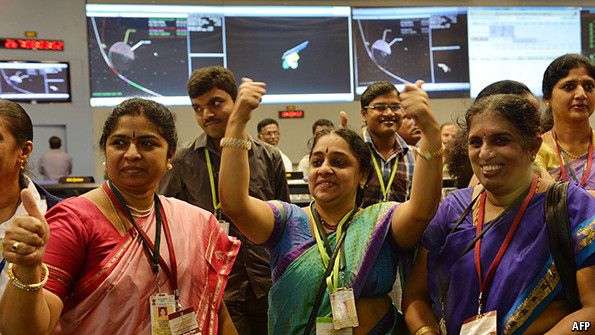
Females in science and technology in the old country became evident during the news coverage of India's success with the Mars orbiter.  I posted on Facebook the following photo from the Economist, and wrote there, "the awesomest aspect of this photo related to India's mission to Mars ... The number of women scientists in this celebratory scene."

Source

Women scientists.
Attired in the traditional saris.
With the traditional hairstyles.
Awesome is the word for it.

What a contrast to the photo and movie scenes of NASA's control rooms, right?

Another photo, from the BBC, was even more fascinating:


Notice the flowers strung along the hair in the old, traditional way?  Not only do women do science and technology, they do it even when fully immersed in the old cultures.  How can one not describe this as awesome?  And notice in the left corner a woman with what seems like a shirt and a blazer?  Women do science and technology even as they transition out of the old cultures.

An old classmate commented on Facebook,
All in their pattu pavadai and mallipoo finery for the big occasion. Indeed, I saw tweet by a non Indian woman saying that the live feed was great because you saw so many women in the control room!
(Silk saris and jasmine (mallipoo) flowers--the traditional celebratory combination.  Though, we gave him a hard time for referring to the "pudavai"--sari--as "pavadai," which is a skirt!)

So, why is there such a low rate of female participation in the sciences here in the US?

If only we knew how to correct that!

But, it is not only females but also males who shy away from the sciences, even when they are capable, because, well, more than anything else, it is hard work.  Much harder to get an A in physics than it is in my geography class.  (Not that an easy A in geography is attracting a whole bunch of students either!)

Perhaps the behavior to avoid hard work comes with affluence.  During my undergraduate years, there was a rich classmate who always came to college riding his motorbike, wearing well-tailored clothes, and with the indulgences of tobacco and alcohol too. He was a fun guy, with a sharp mind.  But, he could not care about classes and exams.  I doubt if he ever read anything either.  Perhaps contemporary America has a whole bunch of kids like him--after all, we are one heck of an affluent country.  So, why work hard!

A couple of years ago, when I reconnected with a few classmates from those college years, I inquired about that rich guy too.  And was saddened to hear that his life did not turn out well--the affluence had messed him up.

At least the women in India are kicking some butts, despite the affluence they have climbed up to and despite the hard work the climb would have been.  Good for them.  And good for all of us.