Showing posts with label genome. Show all posts

Wednesday, May 18, 2016

Sex is for fun ... and a lab will be for reproduction?

My  comment at this post was tongue-in-cheek about sex being a cornerstone of most, if not all, religious beliefs.  Science and technology have continually pushed our understanding of sex and reproduction.  From preventing reproduction--thereby, rendering sex recreational--to various fertility enhancement technologies as well; the pill and the condom, on one side, and test-tube baby and womb-to-rent on the other side, have generated quite some headaches for the believers and their leaders.

As much as I have fun at the expense of believers in all these issues, I certainly empathize with their fundamental problem--the scientific and technological advancements challenge an understanding of what it means to be human.  If life--a baby--can be created in a petri-dish, then what does it mean to be human?  If materials from three "donor" parents can be assembled in a lab, and then that compound begins to grow in a womb as a baby, what does it mean to be human?  This atheist and many sincere believers struggle with that question of what it means to be human, while the vast majority--who are believers--seem to go about as if such technologies do not change a damn thing.

Everybody ought to think about that though.  Such thinking should not be outsourced to experts or--worse--to half-baked people like me.  But, most don't seem to be bothered--after all, there are a gazillion television channels to watch on top of those internet videos of cats playing piano!  While people are in a stupor with mind-dulling entertainment, there are more creepy things happening in the world of science.  Like this headline from the New York Times
Scientists Talk Privately About Creating a Synthetic Human Genome
It should have made people sit up and worry.  But, of course, this may not have even blipped through all those ballgames and viral videos!

What was that meeting about anyway?
Scientists are now contemplating the fabrication of a human genome, meaning they would use chemicals to manufacture all the DNA contained in human chromosomes.
The prospect is spurring both intrigue and concern in the life sciences community because it might be possible, such as through cloning, to use a synthetic genome to create human beings without biological parents.
While the project is still in the idea phase, and also involves efforts to improve DNA synthesis in general, it was discussed at a closed-door meeting on Tuesday at Harvard Medical School in Boston.
Routine news.  Yawn!  Bring on that video of a cat playing soccer!

Of course, we are a long way from creating humans in labs from chemical molecules without involving biological parents.  But, it is the trend line that should alert us.  Trends like this:
Right now, synthesizing DNA is difficult and error-prone. Existing techniques can reliably make strands that are only about 200 base pairs long, with the base pairs being the chemical units in DNA. A single gene can be hundreds or thousands of base pairs long. To synthesize one of those, multiple 200-unit segments have to be spliced together.
But the cost and capabilities are rapidly improving. Dr. Endy of Stanford, who is a co-founder of a DNA synthesis company called Gen9, said the cost of synthesizing genes has plummeted from $4 per base pair in 2003 to 3 cents now. But even at that rate, the cost for three billion letters would be $90 million. He said if costs continued to decline at the same pace, that figure could reach $100,000 in 20 years.
So, it is not that unimaginable that a breakthrough in the future would mean creating a fetus without bothering about an egg and a sperm.  A chemical kit that will be assembled.  Sex, for those humans who want it, will be recreational.  The end of sex as we know it:
The End of Sex is eye-opening about the prospects created by biomedical technology. Regardless of how we end up applying it, biotech has already transformed our view of what it means to be(come) human. ...
Yet the important question that Greely’s book raises is not so much whether his vision of near-universal “sex-free conception” will come to pass, but how we will cope with what current biological technologies make (literally) conceivable. On two occasions he confesses that, despite having studied this field for many years, he was caught unawares by suggestions of how the technologies might be used. One is “uniparenting”, whereby a person (either male or female) has both eggs and sperm made from their somatic cells and used to create a child – who would, because of the recombination of chromosomes during conception, not then be a clone in the strict sense. “The other is “multiplex parenting”, in which two people make an embryo which then in effect conceives a child through IVF with another embryo, by mixing their gametes. It would, says Greely, allow a couple to have their “child” mate with someone else without even first being born, let alone reaching puberty.” Such ideas, he concludes, are “evidence of just how wide-ranging and non-intuitive the implications of new biological technologies may be for human reproduction”. Even the experts concede that their imagination is boggled by the possibilities.
Imagine theologians trying to explain god's take on "multiplex parenting"!  

Saturday, April 20, 2013

Will race disappear once we ID our genetic formula?

Turns out that the Boston bombers were of Chechen origin.   The younger brother, the one who is alive, was a naturalized citizen as well.  The Islamophobes who now will consider any Muslim with ultra-suspicion might be shocked to know that the brothers are Caucasians.

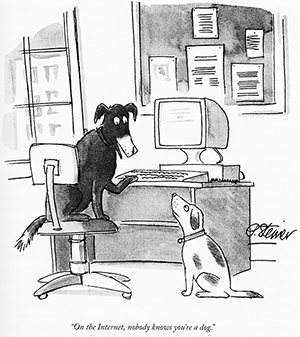
We are a strange people ready to classify fellow humans into various categories simply based on how we look.  White and brown and black and yellow and red.  Whites aren't really white, and there was never any "red" Indian either.  It is all in our imaginations.  Here on the web, nobody knows what color your skin is, and everybody is just a dog.

Source
Even the government systematically collects information on our "race."  I have almost always picked "other" or "white" when responding to those questions.  "Other" because I am usually pissed at the data collection, and "white" because I want to make a point that I, too, am a Caucasian if that is how they define a white.

However, I had no idea, until reading this essay by Amitai Etzioni, that whenever I chose "other" the Census folks were imputing a race for me anyway:
[Never] underestimate our government. The Census Bureau has used a statistical procedure to assign racial categories to those millions of us who sought to butt out of this divisive classification scheme. Federal regulations outlined by the Office of Management and Budget, a White House agency, ruled that the Census must “impute” a specific race to those who do not choose one. For several key public policy purposes, a good deal of social and economic data must be aggregated into five racial groups: white, black, Asian, American Indian or Alaska Native, and native Hawaiian or other Pacific Islander. How does the government pick a race for a person who checked the “Other” box? They turn to the answers for other Census questions: for example, income, neighborhood, education level, or last name. The resulting profiles of the U.S. population (referred to as the “age-race modified profile”) are then used by government agencies in allotting public funds and for other official and public purposes.
I wonder what race I was assigned to when I bubbled in "other."  Do I exist as a white, or a black?  How bizarre!

I agree with Etzioni's simple request:
Let us begin with a fairly modest request of the powers that be: Give us a chance. Don’t make me define my children and myself in racial terms; don’t “impute” a race to me or to any of the millions of Americans who feel as I do. Allow us to describe ourselves simply as Americans. I bet my 50 years as a sociologist that we will all be better for it.
Yes.

Simply as "Americans" will be wonderful especially when we are all nothing but a collection of genes underneath.  With an origin in Africa.
Our ancient mother, the mother of us all, lived in Africa some 150,000 years ago. She was one individual in a world population of Homo sapiens—recently evolved out of Homo erectus—amounting to 2,000 individuals at most. There were other females of course, but their lines died out long before historical times. Everyone alive today descends from this one woman, from one of her two daughters. This is the astonishing news revealed by the book of the human genome, the book whose pages we are just beginning to turn.
I noted nearly a year ago, based on the results of my DNA analysis, about my forefather:
The man who gave rise to the first genetic marker in your lineage probably lived in northeast Africa in the region of the Rift Valley, perhaps in present-day Ethiopia, Kenya, or Tanzania, some 31,000 to 79,000 years ago. Scientists put the most likely date for when he lived at around 50,000 years ago. His descendants became the only lineage to survive outside of Africa, making him the common ancestor of every non-African man living today.

We then invented the languages that separate us.  We invented the religions that separate us. Our adaptation to the natural settings helped us develop the color of skin and hair and everything else that separate us.  If we are all given our respective genomes, will we begin to understand that we are not any different at all?
One way to show how contrived racial divisions actually are is to recall that practically all of the DNA in all human beings is the same. Our differences are truly skin deep. Moreover, the notion that most of us are of one race or another has little basis in science. The Human Genome Project informs us not only that 99.9 percent of genetic material is shared by all humans, but also that variation in the remaining 0.1 percent is greater within racial groups than across them. That is, not only are 99.9 percent of the genes of a black person the same as those of a white person, but the genes of a particular black person may be more similar to the genes of a white person than they are to another black person.
We humans are so awful that we will want to focus on the 0.1 percent.  We will then finely dice that into components that will reveal the 0.00000001 percent that makes us different from some group and that 0.00000001 percent will be the basis for discrimination. For stereotyping. "Those people, you know."  Crappy apes we are!