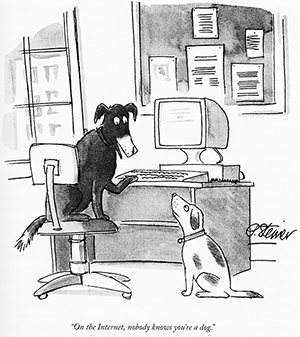
We are a strange people ready to classify fellow humans into various categories simply based on how we look. White and brown and black and yellow and red. Whites aren't really white, and there was never any "red" Indian either. It is all in our imaginations. Here on the web, nobody knows what color your skin is, and everybody is just a dog.
 |
| Source |
However, I had no idea, until reading this essay by Amitai Etzioni, that whenever I chose "other" the Census folks were imputing a race for me anyway:
[Never] underestimate our government. The Census Bureau has used a statistical procedure to assign racial categories to those millions of us who sought to butt out of this divisive classification scheme. Federal regulations outlined by the Office of Management and Budget, a White House agency, ruled that the Census must “impute” a specific race to those who do not choose one. For several key public policy purposes, a good deal of social and economic data must be aggregated into five racial groups: white, black, Asian, American Indian or Alaska Native, and native Hawaiian or other Pacific Islander. How does the government pick a race for a person who checked the “Other” box? They turn to the answers for other Census questions: for example, income, neighborhood, education level, or last name. The resulting profiles of the U.S. population (referred to as the “age-race modified profile”) are then used by government agencies in allotting public funds and for other official and public purposes.I wonder what race I was assigned to when I bubbled in "other." Do I exist as a white, or a black? How bizarre!
I agree with Etzioni's simple request:
Let us begin with a fairly modest request of the powers that be: Give us a chance. Don’t make me define my children and myself in racial terms; don’t “impute” a race to me or to any of the millions of Americans who feel as I do. Allow us to describe ourselves simply as Americans. I bet my 50 years as a sociologist that we will all be better for it.Yes.
Simply as "Americans" will be wonderful especially when we are all nothing but a collection of genes underneath. With an origin in Africa.
Our ancient mother, the mother of us all, lived in Africa some 150,000 years ago. She was one individual in a world population of Homo sapiens—recently evolved out of Homo erectus—amounting to 2,000 individuals at most. There were other females of course, but their lines died out long before historical times. Everyone alive today descends from this one woman, from one of her two daughters. This is the astonishing news revealed by the book of the human genome, the book whose pages we are just beginning to turn.I noted nearly a year ago, based on the results of my DNA analysis, about my forefather:
The man who gave rise to the first genetic marker in your lineage probably lived in northeast Africa in the region of the Rift Valley, perhaps in present-day Ethiopia, Kenya, or Tanzania, some 31,000 to 79,000 years ago. Scientists put the most likely date for when he lived at around 50,000 years ago. His descendants became the only lineage to survive outside of Africa, making him the common ancestor of every non-African man living today.

We then invented the languages that separate us. We invented the religions that separate us. Our adaptation to the natural settings helped us develop the color of skin and hair and everything else that separate us. If we are all given our respective genomes, will we begin to understand that we are not any different at all?
One way to show how contrived racial divisions actually are is to recall that practically all of the DNA in all human beings is the same. Our differences are truly skin deep. Moreover, the notion that most of us are of one race or another has little basis in science. The Human Genome Project informs us not only that 99.9 percent of genetic material is shared by all humans, but also that variation in the remaining 0.1 percent is greater within racial groups than across them. That is, not only are 99.9 percent of the genes of a black person the same as those of a white person, but the genes of a particular black person may be more similar to the genes of a white person than they are to another black person.We humans are so awful that we will want to focus on the 0.1 percent. We will then finely dice that into components that will reveal the 0.00000001 percent that makes us different from some group and that 0.00000001 percent will be the basis for discrimination. For stereotyping. "Those people, you know." Crappy apes we are!
