Showing posts with label discrimination. Show all posts

Friday, November 27, 2015

The times they are a changin

I was a prized grandson.  Not because I the most charming baby ever; I suspect I was as ugly as I now am.  Not because I was a child prodigy; have always been dumber than a doorknob.  But, because after having daughters, and then after the first two daughters in turn having daughters each, well, the grandparents were excited that I came along.  A boy!

Those were the days of old India where boys were considered assets and girls were seen as liabilities.  What an awful view of life that was!

Source

That kind of a systematic ill-treatment of girls, especially in the less literate and developed areas of India, and similar practices in China and a few other Asian countries, were why demographers and thinkers--especially Amartya Sen--wrote and spoke about the missing hundred million women:
In 1990, Amartya Sen, the Nobel Prize-winning Indian economist, shocked the world with an article in the New York Review of Books that estimated there were 100 million missing women because of discrimination.
Since then, demographers have devised more precise methods of calculating missing women in each country. They factor in the toll caused by malnutrition and poor medical care and, more significantly, also the numbers lost to abortions of female fetuses, a problem recognized in the years after Dr. Sen wrote his article.
In June of 2015, the Population Council, a New York City-based research organization, published a study saying there were 88 million missing women world-wide in 1990, when Mr. Sen wrote his article, and that there were 126 million missing in 2010, roughly half of them attributable to prenatal sex selection. Of those, more than 112 million were in Asia.
The paper, by John Bongaarts, a distinguished scholar at the Population Council, and Dr. Guilmoto, projects an increase to 150 million missing by 2035 and then a slight decrease to 142 million by 2050.
Of course, as one can expect, the missing women will also mean a whole bunch of problems for men who will be looking for spouses.

But, that is not the problem that I want to blog about.  Because it has been talked about a lot--it is one of those serious issues over which there is often a lot of talk and very little action.  Instead, I want to write about something impressive about women in the very areas in India that have had decades of gender issues.

Rajasthan in India is notorious for the lopsided female/male ratios, and for unequal treatment of women.  Yet, even there, there are wonderful stories like two sisters, Rimppi Kumari and Karamjit, who farm on their own.  Yes, women farmers.  Not on some tiny strip of ancestral land either:
"When my father died seven years ago I decided to take up farming. We own a lot of land, around 32 acres," [Rimppi Kumari] says, a smile playing on her lips.
How awesome is that!  And, there is more:
Rimppi gave up a job in information technology to grow soyabean, wheat and rice.
She is making more money out of the land than even her father did, helped by her decision to embrace modern farming techniques.
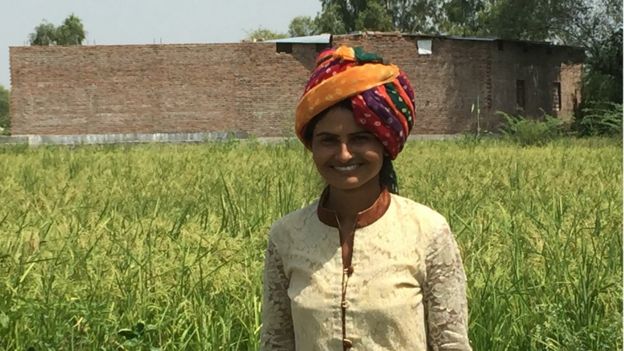
What?  Giving up IT?  How dare she! ;)

Caption at the source:
                     Rimppi is queen of all she surveys on her farm which is making more money than ever                 

Of course, the larger population is not in support:
But despite their success, the sisters are viewed with disapproval in their village.
Eighty-year-old Sardar Karamjeet Singh voices the opinion of many others when he says that "what these two sisters are doing is wrong. They should have been married by now".
"We don't allow our women to leave the house. Forget about farming."
The eighty-year old perhaps has no idea that the world is changing, and changing rapidly.

But, who cares about the world of eighty-year olds when the girls have an important woman backing them--their mother, Sukhdev Kaur:
"If you give opportunities to girls, if you allow them to grow, they can fly high," 60-year-old Sukhdev Kaur says.
"They just need their wings unclipped. I have always believed in my daughters. They show that daughters can surpass sons."
Indeed.  The daughters can, and will, surpass sons.  Well, especially the prized ones will be the ones left behind in the dirt.  Wait, why am I covered in dirt? ;)


Wednesday, May 27, 2015

Pity the nation divided into fragments, each fragment deeming itself a nation

Every visit to India, I worry that most interactions amongst people are defined by the "in group" and "others" criteria.  In the non-work social space, there appears to be a great deal of conscious and subconscious decision-making on whom to associate with based on various "in group" attributes, especially religion, and caste and sub-caste.

It worries me even more than that this gets spatially reflected: neighborhoods with dominant "in group" demographics.  Worry is an understatement--it freaks me out.

Such a geographic separation of "in group" and "others" was not uncommon here in the US, too.  After all, for instance, the history of "white flight" as a response to racial integration is not easily forgettable.  Fair housing laws and a lot more inter-racial and inter-cultural mixing, along with education and understanding, has decreased a great deal of geographic exclusion of the "others."  Thankfully!

Sometimes, I think of the geographic exclusion in India as non-violent and passive-aggressive "ethnic cleansing" of neighborhoods.  It freaks me out even more.

India, with its long history of the awful caste system, has a terrible history of geographic separation of people.  My grandmothers' villages were classic examples of these.  In the small village of Pattamadai, the brahmins, for instance, lived in "agraharams" while Muslims lived in a different part of town, and the non-brahmins in yet another part of town.

In my other grandmother's place, in Sengottai, it was no different.

 In the map on the right, which is of the eastern half of Sengottai, the brahmin neighborhoods were clustered about the center.  (Click on the figure for a clearer image.)  As is typical of the "agraharams," temples were the focus of the neighborhoods. 

The Muslim part of town was across on the west side.  In between are the traditional non-brahmin neighborhoods, including the one where the my high school friend's grandfather's home is located.

During my childhood, I have spent many summer breaks in Sengottai and Pattamadai.  But, never had I even remotely wandered into the Muslim areas.  It was much later that I walked around and got a sense of the layout of the town.  Graduate schooling, which helped me better understand these issues, furthered my intellectual and personal curiosities. 

The good news is that even these villages and small towns are beginning to change.  A few years ago, during Christmas time, I was pleasantly surprised to see a lit up decorative star hanging outside one home in a agraharam.  A Christian family had moved in to the neighborhood, I was told, when I casually asked my uncle.  Of course, it was at the end of the street, far away from the temple.  To me, it was progress.  A huge progress.  Over the years, many non-brahmins have also moved into those agraharams.

I never saw a Muslim household though.

Now, it could be that I had not taken any systematic census, and could have overlooked a Muslim-occupied home or two.  But, my sense is that Muslims hadn't moved in.

If that was the case in the villages, changes in cities are also very slow, compared to the phenomenal changes in the economy.

Given that open notices about sale or lease are rare in India, and with space availability information transmitted more by word of mouth, well, the words are transmitted only to the in-group in the first place. And when the word is out, they employ euphemisms and proxies--urbanites being more literate and worldly-wise know that outright discrimination is not correct. .  For instance, "I don't want to rent out my house to those who cook beef"--excludes Muslims and Christians right away. Or, "I don't like the smell of cooking with mustard oil" is a way to keep away the population from Bengal and the Northeast parts of India.  Imagine if in the contemporary US, an apartment manager denies an Indian immigrant family an apartment because of the curry smells from the kitchen!

Of course, change is difficult for those whom the status quo has served well.  But, that status quo is simply unfair.  The more people are resistant to change, the more the unfairness continues, like in this news item about a young woman in Mumbai who "was denied a flat in the city just because she is a Muslim":
After a hard search, Ms. Quadri found a tidy 3-BHK apartment at Sanghvi Heights in Wadala. Her new flatmates — two working women, in their early twenties and Hindu — found her on Facebook.
However, a day before Ms. Quadri was to shift, the apartment’s broker warned that the housing society did not accept Muslim tenants.
Long story short, after signing "a “no-objection certificate” and ready for any harassment from her neighbours because of her religion," she was forced to leave the place.  And this:
Incidentally, the other women had to pay a price for sheltering a Muslim; they have vacated the house unwillingly.
The big world city of Mumbai is no different from the very small town of Sengottai!  Or perhaps the big city is even worse!

ps: the title of this post is from Khalil Gibran's poem, Pity the Nation