Showing posts with label churchill. Show all posts

Wednesday, June 23, 2021

The white man's burden

As an adult, I was always at a loss understanding how people born in India could not be angry.  Did they not care that the Bastard Empire ruined everything?  Even the loss of a historical continuity, and the very fact that here I am thinking and blogging in English?  Why such a worship of the barbarians who decimated life all around the world?  (Not that the rest of the world, including the old country, was a paradise otherwise.)

Over the years, I have blogged in plenty ranting about the Bastard Empire, and even celebrating the mess when the Conservatives tumble.  I am mighty glad that it has once again become a small island that is irrelevant to the rest of the world, as it was for most of human history.

One bastard, however, successfully managed to paint himself as the savior of western democracies.  Yep, this post is about the cigar chomping racist bastard.  It is beyond time to rewrite his history, like how Priya Satia writes in this essay.

(You may also want to read this book-review essay in the NYRB on the imperial delusions of the bastards; one of the books reviewed there is Priya Satia's Time's Monster.)

Satia, who is an endowed chair professor at Stanford, writes that Churchill had a godawful "sense of historical birthright, of masculine, upper-class entitlement to make history without accountability for human costs."

In every time, including ours, multiple value systems are in contest. Churchill’s decisions were guided less by intellectual consistency than an unapologetic sense of entitlement to make decisions (often opportunistically) based on his romantic intuitions.

I thought I had by now known enough about the bastard; yet, this was a shocker to me:

He praised Mussolini through the 1930s and continued to flatter him during the war itself. He sided with the fascists in the Spanish Civil War and admired Hitler, who also garnered a chapter in “Great Contemporaries.” He didn’t object to fascism but to the threatening continental expansionism that it inspired in Germany. 

I am reminded of George Carlin's punchline that the Allies were upset with Hitler because he cut in on their action.  It was not Hitler's Aryan supremacy and hitlerism that bothered the likes of Churchill, but that the fact that he went on an expansionist rampage into their own territories!

As we move forward in time, even those like Churchill who tried to engineer their stories will be defeated by the unfolding of history.  That is the fate that also awaits the contemporary GOP and the Republican "leaders" who, too, view "dominance as a birthright."

Saturday, June 13, 2020

Coming to terms with history

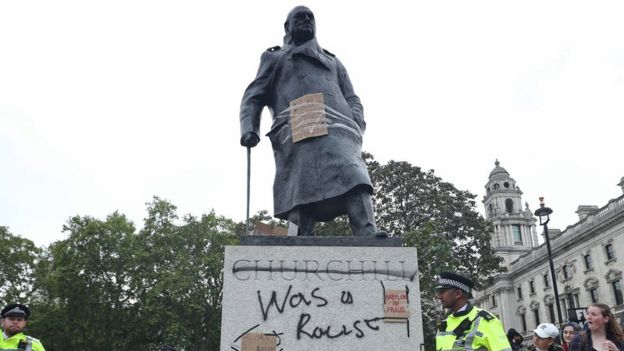
The Bastard Empire and one of its greatest bastards are in the news, in the wake of the Black Lives Matter movement that has gone global.

As an adult, I was always at a loss understanding how people born in India could not be angry.  Did they not care that the Bastard Empire ruined everything?  Even the loss of a historical continuity, and the very fact that here I am thinking and blogging in English?  Why such a worship of the barbarians who decimated life all around the world?  (Not that the rest of the world, including the old country, was a paradise otherwise.)

Over the years, I have blogged in plenty ranting about the Bastard Empire, and even celebrating the mess when the Conservatives tumble.  I am mighty glad that it has once again become a small island that is irrelevant to the rest of the world, as it was for most of human history.

So, of course, I read with delight the tweets about the statue of a slave trader being toppled and dumped in the water.  It is beyond my wildest imagination how that bastard could have branded the enslaved.  Branded?  Seriously, branded?
Between 1672 and 1689, Colston’s Royal African Company shipped about 100,000 enslaved people from West Africa to the Americas and the Caribbean, branding them on their chests with his corporation’s acronym, RAC. Disease and dehydration killed more than 20,000 people taken onto those ships by Colston’s company, and their bodies were thrown into the ocean. Yet Colston’s bronze statue, which was erected in 1895 in Bristol, was engraved with the inscription “ … one of the most virtuous and wise sons” of the city.
What a bastard!  Honorable men they are!


The history that we were taught in middle and high school didn't present such unvarnished truths.  Instead, the UK-educated Anglophiles presented the bastards as heroes!
The following is an unedited re-post from October 28, 2010:
***************************************************

Soutik Biswas writes in reviewing Madhusree Mukherjee's Churchill's Secret War:
Some three million Indians died in the famine of 1943. The majority of the deaths were in Bengal. In a shocking new book, Churchill's Secret War, journalist Madhusree Mukherjee blames Mr Churchill's policies for being largely responsible for one of the worst famines in India's history.
Why is the war time prime minister, Churchill, to be blamed?  Well, the acute shortage of food
was caused by large-scale exports of food from India for use in the war theatres and consumption in Britain - India exported more than 70,000 tonnes of rice between January and July 1943, even as the famine set in. This would have kept nearly 400,000 people alive for a full year. Mr Churchill turned down fervent pleas to export food to India citing a shortage of ships - this when shiploads of Australian wheat, for example, would pass by India to be stored for future consumption in Europe. As imports dropped, prices shot up and hoarders made a killing. Mr Churchill also pushed a scorched earth policy - which went by the sinister name of Denial Policy - in coastal Bengal where the colonisers feared the Japanese would land. So authorities removed boats (the lifeline of the region) and the police destroyed and seized rice stocks.
And, what was Churchill's response when this was discussed at cabinet meetings?  The soon to be appointed Viceroy, Archibald Wavell, writes:
"Apparently it is more important to save the Greeks and liberated countries than the Indians and there is reluctance either to provide shipping or to reduce stocks in this country," writes Sir Wavell in his account of the meetings. Mr Amery is more direct. "Winston may be right in saying that the starvation of anyhow under-fed Bengalis is less serious than sturdy Greeks, but he makes no sufficient allowance for the sense of Empire responsibility in this country," he writes.
As Shakespeare wrote, "And Brutus is an honourable man" .... :(

Tuesday, October 31, 2017

One bastard versus another bastard!

When Bret Stephens wrote his first column for the NY Times, there were protests online.  A few wrote about canceling their subscriptions altogether.  If you need a refresher about that episode, click here to read his first column.

Today, he showed yet again that he knows how to pick and choose in order to advance his argument.  First, what was his column about?  To some extent, Stephens has a legitimate point, like with this one:
Do the same people who rightly demand the removal of Confederate statues ever feel even a shiver of inner revulsion at hipsters in Lenin or Mao T-shirts?
I have written about this, too.  (What have I not blogged about, eh!)  In this post, for instance, I wrote:
Che's use of violence to achieve his version of utopia is no different from how Osama bin Laden didn't find anything wrong in killing civilians. Yet, while no rational person would walk around wearing an Osama t-shirt, thousands all across the world, including here in the US, think it is cool to wear a Che t-shirt. ...
I wish the world would stop applauding Che and making a saint out of this killer and, instead, remember him for what he was
Che was a secular jihadist.

And when Fidel Castro died, the title of my post says it all: Ding dong. The dictator is dead!

So, yes, I agree with Stephens that we should denounce Lenin and Mao and Castro, with as much loudness as we demand the removal of confederate monuments.

But then, Stephens resorts to quoting the big time empire-building white supremacist bastard, winston churchill.

Oh please, churchill was not all that better than Castro.  churchill was the guy who intentionally let millions of people in Bengal die.  churchill was a passionate defender of the British right to rule over the brown-skinned even when there were plenty around him who were increasingly uncomfortable with the brutal colonization.  churchill's rhetoric was all about saving the white skin; the browns be damned!  He openly said things like this:
I do not admit for instance, that a great wrong has been done to the Red Indians of America or the black people of Australia. I do not admit that a wrong has been done to these people by the fact that a stronger race, a higher-grade race, a more worldly wise race to put it that way, has come in and taken their place.
As Shashi Tharoor says, churchill has as much blood on his hand as hitler does.  I wish people would stop making a saint out of churchill.  Fuck churchill!

Let's not cherry pick our way through; instead, let's be honest and admit that evil comes in all flavors--not merely the communist type.


Saturday, June 13, 2015

Engines were made for men, not men for engines

The end is nigh, as they say.

No, not that end, but the grading.  A few more papers and then I will be done with the term and with the year.

An unlucky number--thirteen--of years at this place.  In my career, this is by far the most number of years I have worked for the same employer, who will perhaps remain my employer until I retire or die.  Almost six years was the other long stint.  The shortest was three weeks.

The three-week job, along with the three-months and the six-months at other two places, clarified for me that I am not here in order to work with machines almost to the point of working for the machines.  I wanted to think for myself--at any cost.

Which is why the quote that I came across today, which is the title of this post, appealed to me, though the "statesman" who uttered it shall ever remain in my books as a white supremacist!

That racist apparently said at the University of Miami in 1946:
Expert knowledge, however indispensable, is no substitute for a generous and comprehending outlook upon the human story with all its sadness and with all its unquenchable hope.
It is that human story that I am after in my own way.  While I might be formally employed to teach in the department of geography, my hope is that I am guiding students towards articulating for themselves what it means to be human, what it means to belong to the humankind, and how we fit into the grander narrative.

At least one student figured it out--a few years ago, in a third course that he was taking with me, he remarked loudly in the classroom, "you teach the same stuff in all your classes."  Guilty as charged!  My courses are not really about geography or economics or cities--those are merely the stories that I use so that students can think about those fundamental questions for themselves.

Why is that thinking for/by themselves about their own place in the grand narrative so important?
we're living at a time when public moral deliberation is rapidly moving away from considerations of ultimate ends, ideals of human flourishing, in favor of a morality of rights that is largely indifferent to what individuals do with their freedom. As long as you refrain from harming others, you are free to pursue happiness however you like, no questions asked.
Politically speaking, this might be the best available strategy for people who disagree about the highest good to live together pluralistically in relative peace. But this doesn't mean that it's possible for individual human beings to forego the question of how to live, to bypass the question of human flourishing — what it consists in, and how to achieve it. In fact, with the retreat of institutions that once proposed compelling comprehensive visions of the good life, the burden of choosing among various ways of life falls more than ever on the shoulders of individuals.
I worry that college education increasingly fails at this. Instead, education is almost always treated as if humans were made for engines of various kinds.  A "mercenary expedition" is how I characterized higher education in a work-related email yesterday!

Oh well; it is a good thing that even that end is not far away.

Saturday, February 12, 2011

Fox News and freedom in Egypt. They oppose it!

I am by no means an unequivocal fan of revolutions; I do not believe that human rights are universal and timeless, rather than the product of evolving and contingent political beliefs.  But I could better stomach the right-wing media’s effort to discredit the Egyptian revolution and to portray it as a failure of Obama’s diplomacy if they had not given such unthinking jingoistic support to Bush’s Freedom Agenda, if Sean Hannity’s theme song was not “Let Freedom Ring,” if they didn’t claim a divine mandate to lead the world towards American-style democracy.
That was the ever clear Heather Mac Donald writing about the insanity that characterizes Faux Noose, and Rush Limbaugh too.

It is one thing to doggedly fight the opposition party, but it is another to carry it to such lengths ... But, wait, it is after all Faux Noose.  What else can one expect, right?

Reminds me of politics in Tamil Nadu--the state in India where I was born and raised.  There are two principal political parties.  Well, one spun off the main one, the DMK, which itself grew out of the DK.  The only thing they seem to do is criticize whatever the other does while in power.  Even if the party in power were to draft a resolution that the earth is not flat, the opposition would oppose it for the sake of opposing anything coming from "them" ... If only we had a viable alternative to the democracy as we know it, right?  What says you, oh great one, who observed that we are stuck with this system because everything else is worse, and who once apparently said "I hate Indians. They are a beastly people with a beastly religion." :)

Saturday, October 30, 2010

Americans do the right thing--after trying Republicans and everything else

Every once in a rare while Maureen Dowd writes something that is worth quoting; in her latest column, Dowd writes about President Obama:
In 2008, the message was him. The promise was him. And that’s why 2010 is a referendum on him. 
That is a neat way to summarize the dynamics of this election.  Which is also why it is bloody dangerous to have personality-driven politics and leaders.  Bill Clinton's re-election was not about Clinton the person at all--not with all that baggage he carried around.  But, during the campaign season, the stock that Obama sold was himself, and now as President he has a tougher problem making a repeat sale.

Meanwhile, Nicholas Kristof, who seems to have taken time off from the gruesome stories that otherwise he forces us to recognize, wants us to give Obama a break:
go ahead and hold Mr. Obama’s feet to the fire. He deserves to be held accountable. But let’s not allow economic malaise to cloud our judgment and magnify America’s problems in ways that become self-fulfilling.
I am not so sure about this argument. 

The problem is that the alternative, in terms of Republican leadership, is an even more pathetic joke.  If the GOP takes over the house, Kevin McCarthy will become number 3?  I remember him from my days in Bakersfield, and a few days ago I watched him on C-Span and the guy is as lacking as ever.  At least Bill Thomas, whose retirement paved the way for McCarthy, was a really sharp guy and, unfortunately, even more ruthless!

So, to some extent, I am with Paul Krugman who is worried about a Republican Congress:
This is going to be terrible. In fact, future historians will probably look back at the 2010 election as a catastrophe for America, one that condemned the nation to years of political chaos and economic weakness.
However, I wish, for the nth time, that Krugman would be less shrill and less hyperbolic, and engaged more like the economist he is; did he really have to write "Be afraid. Be very afraid" ...?


David Brooks lays out what Obama's problem is going to be if (when?) Republicans take over the House (and Senate?):
[If] Obama is to rebound, he is going to have to suppress his natural competitive instincts. If he gets caught up in the Beltway fight club, the Republicans will emerge as the party of limited government and he’ll emerge as the spokesman for big government — surely a losing proposition.
Thomas "master manipulator of metaphors" Friedman, too, has something sensible, for a change, when he writes on why this election matters, as he looks at it from India while talking with some of his favorites (does Friedman talk to the 400 million poor there, I wonder!):

It looks, said Srivastava, as if “what is happening in America is a loss of self-confidence. We don’t want America to lose self-confidence. Who else is there to take over America’s moral leadership? American’s leadership was never because you had more arms. It was because of ideas, imagination, and meritocracy.” If America turns away from its core values, he added, “there is nobody else to take that leadership. Do we want China as the world’s moral leader? No. We desperately want America to succeed.”
This isn’t just so American values triumph. With a rising China on one side and a crumbling Pakistan on the other, India’s newfound friendship with America has taken on strategic importance. “It is very worrying to live in a world that no longer has the balance of power we’ve had for 60 years,” said Shekhar Gupta, editor of The Indian Express newspaper. “That is why everyone is concerned about America.”
Well, we--in the US and in the entire world--will find out real soon.

My long term bets are always on the good ol' US of A.  As Winston Churchill said, “You can always count on Americans to do the right thing - after they've tried everything else.”  And with a Republican victory in the midterms, we would have exhausted everything, and we will start doing the right thing.

Thursday, October 28, 2010

How Winston Churchill starved India. Literally :(

Soutik Biswas writes in reviewing Madhusree Mukherjee's Churchill's Secret War:
Some three million Indians died in the famine of 1943. The majority of the deaths were in Bengal. In a shocking new book, Churchill's Secret War, journalist Madhusree Mukherjee blames Mr Churchill's policies for being largely responsible for one of the worst famines in India's history.
Why is the war time prime minister, Churchill, to be blamed?  Well, the acute shortage of food
was caused by large-scale exports of food from India for use in the war theatres and consumption in Britain - India exported more than 70,000 tonnes of rice between January and July 1943, even as the famine set in. This would have kept nearly 400,000 people alive for a full year. Mr Churchill turned down fervent pleas to export food to India citing a shortage of ships - this when shiploads of Australian wheat, for example, would pass by India to be stored for future consumption in Europe. As imports dropped, prices shot up and hoarders made a killing. Mr Churchill also pushed a scorched earth policy - which went by the sinister name of Denial Policy - in coastal Bengal where the colonisers feared the Japanese would land. So authorities removed boats (the lifeline of the region) and the police destroyed and seized rice stocks.
And, what was Churchill's response when this was discussed at cabinet meetings?  The soon to be appointed Viceroy, Archibald Wavell, writes:
"Apparently it is more important to save the Greeks and liberated countries than the Indians and there is reluctance either to provide shipping or to reduce stocks in this country," writes Sir Wavell in his account of the meetings. Mr Amery is more direct. "Winston may be right in saying that the starvation of anyhow under-fed Bengalis is less serious than sturdy Greeks, but he makes no sufficient allowance for the sense of Empire responsibility in this country," he writes.
As Shakespeare wrote, "And Brutus is an honourable man" .... :(

Friday, June 18, 2010

Thank you for smoking!

Ok, if you are like me, well, I am sorry for you :)
No, seriously, if your childhood was similar to mine, then you looked forward to the newspaper or the magazine that had a puzzle for children--to spot the differences between two drawings.

Well, play that game again--this time with the photos of Churchill here.
There is only one difference between the two photos; did you see what it is?
Done?

You think there might be a back story? As Palin might say, "you betcha!"
In the well-known original image, Churchill makes a "V" shaped symbol with his fingers – while gripping a cigar in the corner of his mouth.
But in a reproduction of the picture, hanging over the main entrance to a London museum celebrating the wartime leader, he has been made into a non-smoker through the use of image-altering techniques
Get this: it was at  "The Winston Churchill's Britain at War Experience"
And we thought that Winston Smith lived only in the fictional 1984!

Tuesday, June 01, 2010

Photo, and story, of the day: Somerset Maugham

The photo is of Maugham with Churchill and H.G. Wells.
Talk about the combined literature talent there :)

I lifted that photo from this review of a Maugham biography.  It was because of Maugham and O.Henry that, even as a kid, I got hooked on to short stories.  My favorite Maugham short story is about two brothers, and plays on the old fable of the ant and the grasshopper. (There were/are some wonderful storytellers in Tamil, too, that I read way back when ... Maybe I ought to check whether there are English translations of some of those ...)

Even now, I way prefer short stories to full-length fiction.  There is something magical about conveying a profound tale within a few pages.  Roddy Doyle's piece in the New Yorker is the latest short story I read.  And, yes, check out the Atlantic's 2010 fiction special.  I liked the Nigerian story the best.  BTW, an exercise for the reader: compare and contrast the husband's emotions in Doyle's story and this one, titled "Hopefulness" :)

Anyway, until I read this review, I had no idea that
Some 98 films were made from Maugham's material during his lifetime — "Rain" helped establish the career of Joan Crawford, while "Of Human Bondage" and "The Letter" provided Bette Davis with characters from which to shape her smart, ruthless screen persona.
98? Wow!

Of course, apparently the book discusses Maugham's (homo)sexuality, and the legal issues related to his estate and his daughter.  But, that is not news, really.
But, I did not know about Maugham's end:
Decades of wary plotting and carefully keeping the world at arm's length exploded. As Gore Vidal has noted, Maugham built his own monument — and then blew it up. He published "Looking Back," a vicious, ill-advised memoir, and slid into Alzheimer's. Nothing grates like hate, and by the time Maugham died soon thereafter, in 1965 at age 91, the world had changed its view of the grandest of grand, old literary men. The man who had known "everyone, from Henry James to Winston Churchill, from Dorothy Parker to D.H. Lawrence" came to his sad end, raving like King Lear.
Ouch!
ht