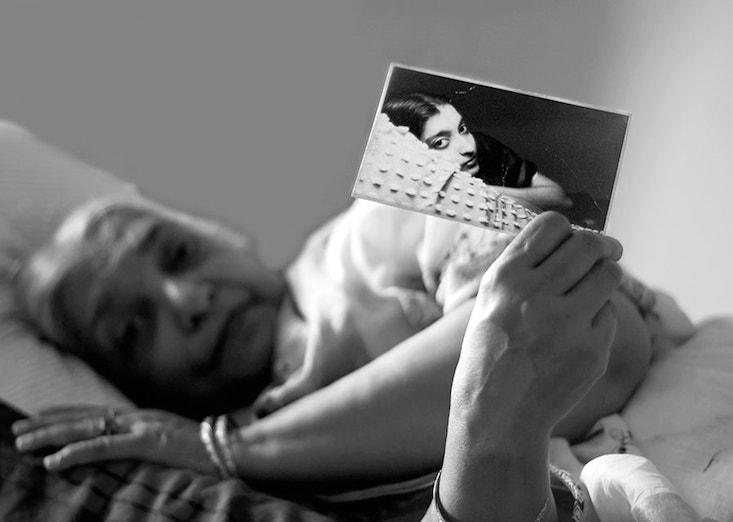
An older woman holding up a photograph of her younger self. And Indian looking.
The older woman looked like my mother. Her younger self in the photo that she was holding reminded me of a cousin.
 |
| Source |
It led me to the description here:
My grandmother has lived with me for fifteen years, my whole life. If I had to name three of the most influential people in my life, she would definitely be one of them, and this shot is a tribute to her. The picture she is holding was taking by my grandfather in 1959; she was 25. In the near half-century between then and now, my grandmother moved from India to America, had two sons, two grandchildren. I hoped to capture the essence of this wonderful woman in this photograph and display her life story. And even today, at 73 years of age, she still teaches little kids, and still continues to touch many people around her.That was in 2007.
The essay itself is about narrative identity and how aging shapes and changes it.
It’s a story you’ve got about how you came to be, who you are, and where your life’s going. That’s not your whole identity—there are a lot of other things that are part of your identity—but it’s a really important part, and it’s a neglected part.It is different from autoethnography, which is "a form of qualitative research in which an author uses self-reflection and writing to explore anecdotal and personal experience and connect this autobiographical story to wider cultural, political, and social meanings and understandings". Narrative identity is simply about the person--"the story of who we are and where we’re going." Readers of this blog can immediately see why I am drawn to this!
When telling our stories, are the memories that we use to construct our narrative identity always true?
So you live your life and you collect material as you’re going along for your life’s story and you’ve always got this material, but you could reshape it—you can rewrite it. It could be a problem, but it’s also an opportunity. I think we’ve evolved not to have perfect memory but to have strategic memory, memory that helps us accomplish our goals and so forth. We all grow up in a certain culture and we learn how to tell stories, and what’s a convincing story. Cultures differ on that.The "strategic memory" is perhaps what I have often referred to as "selective amnesia" when trying to figure out why I don't remember events and people that my siblings or cousins bring up. As I noted in a different context--a very different context--"The nerd in me remembers a whole lot of ideas and concepts, while maintaining a selective amnesia about people and events."
Now, about the woman in the photograph. If she was 73 in 2007, and 12 years have gone by ... The photographer was "a junior in high school" back then, in Coppell, Texas, which according to Google maps is adjacent to the Dallas-Fort Worth airport. Practically a neighbor to my grandmother's sister, who lives in another Dallas suburb!
The world makes a lot more sense through such stories. This requires a lot of reflection on how we came to be, who we are, and where our lives are going. Why wouldn't we want to do more of this before the narrative ends?
