Showing posts with label Welfare State. Show all posts

Sunday, March 31, 2013

The awful tax we are imposing on the younger generations

So, a couple of days ago I blogged this in which I commented:
here is the real problem: it is not only difficult to draw people's attention to these issues, but even more difficult to make them understand that there are tradeoffs involved in every decision--public and private.  If we want to put every drug user in prison for a few years, well, we will have only pennies to spend on higher education.  If we want Medicare to pay for the 82-year old grandpa's Viagra pills, we will have pennies to spend on the youth.  Spending three trillion dollars on wars mean that we won't have money for a lot of domestic needs.
As my graduate school professor once commented (perhaps in jest, but that is how we often present truth anyway!) it is not what you say but who you are whenever you say anything.  In my case, I am a lonely nutcase in a small town working at a small university.  So, hey, most of the time even you readers don't care about what I have to say, and I don't blame you either ;)

How about if I bring in the big guns?  (See how much the "gun culture" is a part of our vocabulary?)  Simon Jonhson, a MIT professor who was also a chief economist for the IMF, writes:
America can easily afford to do better, of course. Its large budget deficits reflect the impact of tax breaks that favor the wealthy and upper middle class; an unfunded expansion of Medicare coverage to include prescription medicines; two foreign wars; and, most important, a banking system that was allowed to get out of control, inflicting massive disruption on the real economy (and thus on tax revenue).
Today’s children did not play a role in any of these policy mistakes. The preschoolers who are about to lose access to Head Start weren’t even born when they were made.
Imposing austerity on poor children is not just unfair; it is also bad economics
Economic policymaking is not brain surgery.  It is about common sense and critical thinking.  Unfortunately, it is difficult to find either one in the brains of most elected officials.  Nor are we educating the young about the importance of these two, especially critical thinking.

I am surprised that college students are not up in arms and protesting widely, even violently, about how they are being robbed in broad daylight.  Have they become so brainwashed through their K-12 years that they have become what a former colleague in California feared we are producing in education: automatons?  Are teachers not being subversive enough?

Mezels, France (2011)

Wednesday, March 27, 2013

The increasing student loan debt is a huge generational tax

It always amazes me when fired-up youth passionately argue in the classroom that welfare moms are the reason why we are in trouble.  I suspect that they arrived at that conclusion based on the phrase "welfare state" that is often talked about even on talk radio, and how households in poverty receive "welfare checks." So, in their haste, they think of the word "welfare" in both and equate them. End of story.

Correcting a misinformed opinion is awfully difficult.  How much ever I try, I know that the evidence and clarification rarely penetrates through.  Those are the occasions when I think that Sisyphus had an easier time.

Readers of this blog know better. A growth in demand for those welfare expenditures, particularly with Medicare and Social Security, thanks to the high life expectancy and the high costs of supporting life into the eighties and nineties of people's lives, means the state has less to allocate for other line items, assuming there will not be a huge increase in revenue.

Meanwhile, at the state level, we have also vastly decreased our tolerance on crimes, even if they are only for drug possession, which leaves less for other expenditures.

Does it really take a brain surgeon then to figure out that the math simply won't add up?

Here in Oregon, this report from 2009 said it all in a wonderful graphic:

You simply can't have it all, and higher education lost as states started spending more and more on criminal justice.

It doesn't surprise me at all, therefore, that Oregon is the third from the top with a 43.6 percent reduction in state spending per student in the last five years, from where the previous chart left off:
Source
The cost of higher education, via tuition and fees that students pay, has been on the rise not only because of decrease in state support at public institutions, but also because of the explosive growth in "student life bureaucracy" and spending on athletics.

Source
Which means, we would naturally expect students to pay much higher shares of the cost of higher education, than ever before.  How would they do that?  By taking on debt, of course:

Source
Notice on the chart on the right that there is one delinquency that has sharply risen, even while others have dropped--some more than others?
Moreover, the delinquency rate is expected to rise in the near future as more student loans move beyond their forbearance period, when no repayment is expected, to the time when borrowers must pay.  Many of those who borrowed no doubt envisioned that a college education would yield a better financial future for themselves.
Student loans are becoming difficult to pay back.  Why?  Because college grads are finding out way too late in the game that the jobs they do get, if they do manage to get them, do not pay well enough.  In most cases, the jobs don't even require a college credential.
But, here is the real problem: it is not only difficult to draw people's attention to these issues, but even more difficult to make them understand that there are tradeoffs involved in every decision--public and private.  If we want to put every drug user in prison for a few years, well, we will have only pennies to spend on higher education.  If we want Medicare to pay for the 82-year old grandpa's Viagra pills, we will have pennies to spend on the youth.  Spending three trillion dollars on wars mean that we won't have money for a lot of domestic needs.

At the end of it all, who gets screwed?  Not the senior citizens. Not the police officers.  Not the higher education faculty. Not the military. Not the politicians. ... The youth are paying big time for all our irresponsible decisions. But, youth being youth, their focus might not be in the metaphorical screw but in the literal one, and it will be a while before they will realize how much we have messed them up!

Monday, March 18, 2013

Cyprus, Euro, and the Welfare State. A re-telling of Ant and the Grasshopper

A few weeks ago, while on my walk by the river, I had company that I had not planned on, when I slowed down to my neighbor's speed for most of the walk.  And we chatted.  While discussing our respective hobbies--I have none--he talked about this music interests.  "There must be a way for society to help out struggling musicians" he said.

I was not sure how seriously I needed to follow-up on that.  This was, after all, at a walk by the river.  But, I couldn't let that slide either.  I went for it.

"That is the kind of issues we are now struggling with.  Different kinds of work have varying levels of incomes associated with them.  So, if one chooses to follow a certain path that doesn't have the returns one expects, then should we really require those who opted for a different path to subsidize the former?  Or, should society worry only about those who, for physical or mental reasons, are unable to fend for themselves?"

I effectively killed that topic.  We continued on with other less controversial topics.

Before the birth of the modern welfare state, we might not even have had any need to engage in such discussions.  It was an unfair world where opportunities were highly unequal, based on the social class into which one was born--something beyond anybody's control.  Liberal democracies, especially in the post-WWII era, have been experimenting with policies that attempt to equalize those opportunities.  Some try to equalize the outcomes, which is what my neighbor seemed to want our society to do in the case of musicians.

The welfare state, with its heavy focus on equalizing outcomes, is a big factor in the ongoing Eurozone crisis. High levels of taxation on those with higher earnings helped pay for those who, like my neighbor's musician friend, either were in occupations that didn't pay much, or, even worse, opted to retire at 55 and spend the rest of their lives on pension from the state.

It really doesn't require that metaphorical PhD in rocket science to figure out that such a system is unsustainable.

Cyprus happens to be a collateral damage in this unsustainable setup, even though it was in a much better state than even its immediate neighbor, Greece.  In fact, it is that very neighbor that has messed up Cyprus:
Greece happened. Cypriot banks were heavily exposed to the Greek debt crisis, by virtue of having large bonds holdings of Greek debt, both public and private. The value of that debt took a nosedive, destroying the balance sheets of Cypriot banks. 
Here in the US, thanks to the myth of anybody making it, we are more interested in the equality of opportunities than in the equality of outcomes.  But, of course, we can't really make it an even playing field.  There is a limit to which government can intervene and make opportunities less unequal.  Truly equal it can/will never be.  Born into President Bush's family will result in opportunities that will be in plenty compared to being born to John and Jane Doe in Anytown, USA.

Where do we then draw the line on equalizing opportunities, or outcomes, or both?

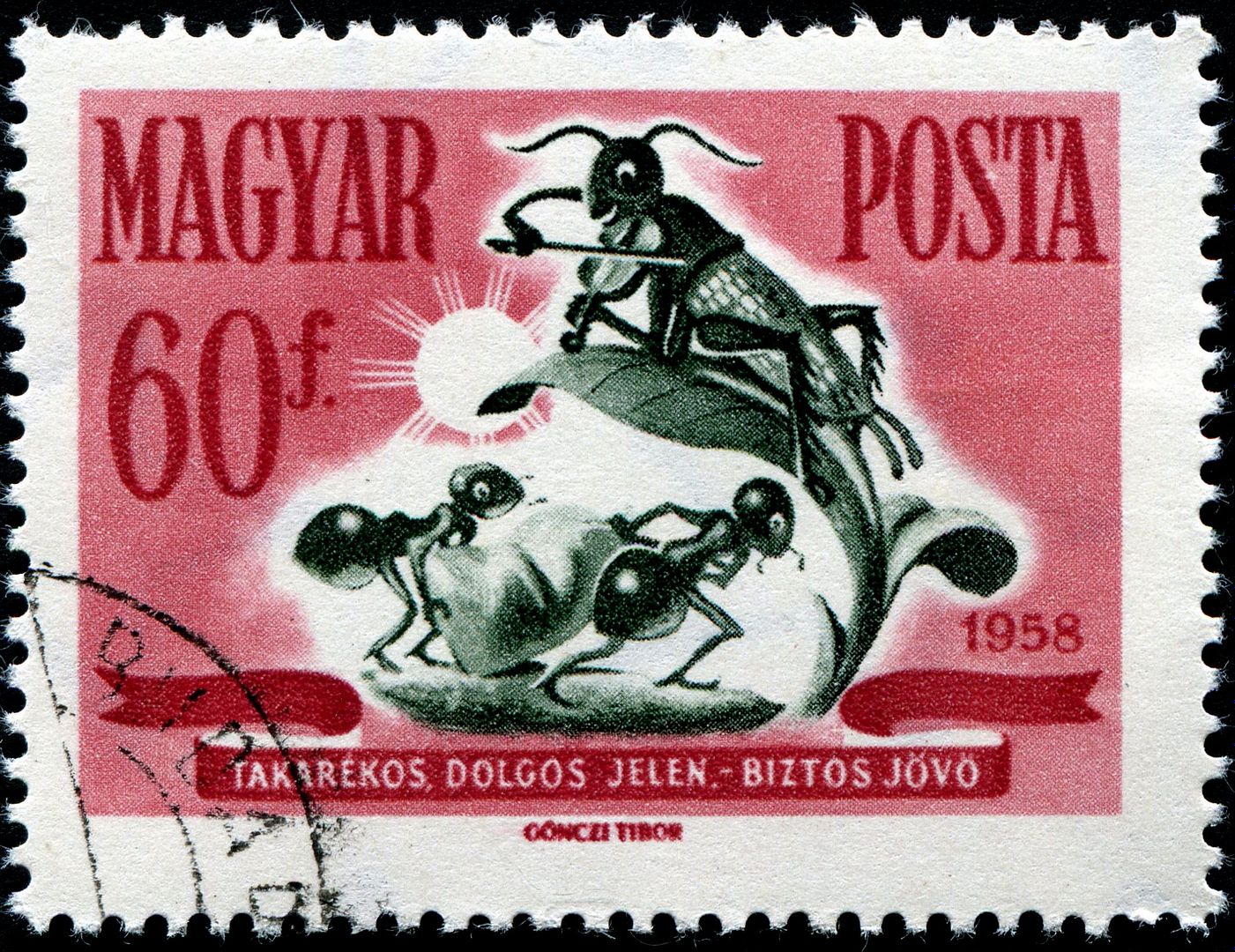
Aesop dealt with something similar in the tale of the Ant and the Grasshopper.  The grasshopper has a good time feeding on the abundant food in the summer, singing and dancing away, while the ant toils away to save for the rainy days that were bound to follow the long summer days.  One can easily imagine what happens to the grasshopper when the rains and cold weather settle in over the winter.

Somerset Maugham authored a wonderful twist to this story, which is what perhaps the Greeks and everybody else hoped would happen to them also.

But, even Maugham couldn't have written the irony that is unfolding in the Euro area: the ants are being penalized and asked to pay for the grasshoppers who sang and danced away.

The longer I live, the more I realize that life is a fascinating series of retelling, and new interpretations, of old stories.  Fascinating only as long as I am not the grasshopper shivering and starving on a rainy, cold, winter night, of which we have in plenty here in Oregon.
Source