Showing posts with label mental health. Show all posts

Sunday, October 11, 2015

It's a Mad, Mad, Mad, Mad World

Back through all the formative years of my life in the old country, I recall being feeling troubled and helpless when coming across, to use the new country language, "special" people.  For instance, across from grandmother's home was a guy who had mental health issues.  As a young boy I was then, I was even terrified by the sounds that came from him across the street--he was perhaps only ten or fifteen years older than me.  Or, the classmate whose older brother had serious mental health issues and visiting with my classmate meant I had to figure out how to navigate my own issues with him.  Or, the family friend's son, who was my age--he was such a good looking fellow, but with mental health problems that could not get resolved despite all the efforts of his physician grandfather who consulted with all the experts of the day.

So much was I bothered by these, that when I heard about something called Down's Syndrome and that a large forehead is one of the physical symptoms for it, I worried that my big forehead doomed me into a life of a பைத்தியம் (literally, mad.)

The question always remained: whatever happens to kids and adults with mental illness?

My life is now in the United States and my professional life allows me to pursue such questions for my own understanding, though even here we don't talk about the mental health issues responsibly and honestly.

These are not easy issues to inquire into and sometimes I avoid reading up about them, for my own peace of mind.  Thus, I intentionally skip some news items, like this one in the NY Times.  But then the friend's email compelled me to read it.  So, I did. I watched the video too.  I tweeted about it.  No, it was not about how India handles its mentally-challenged population, but about a different part of this world--West Africa.
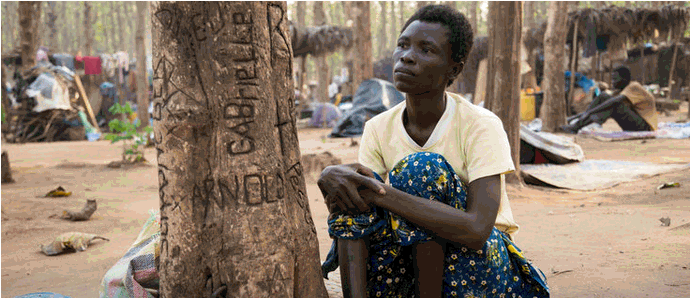
Every society struggles to care for people with mental illness. In parts of West Africa, where psychiatry is virtually unknown, the chain is often a last resort for desperate families who cannot control a loved one in the grip of psychosis. Religious retreats, known as prayer camps, set up makeshift psychiatric wards, usually with prayer as the only intervention.
You might think that "camps" are good.  Except that many remain "chained by the ankle to a tree or concrete block":

Good estimates of the number of West Africans with mental illnesses living in chains are not available, in part because people are shackled out of sight — by family members, traditional healers and at prayer camps.
For all the affluent country that the US is, we do not treat the mentally ill with care and respect all the time.  Many of the homeless on the streets have varying levels of mental health problems.  Like the one described in an op-ed in today's local paper:
During my most recent visits he demonstrated truly schizophrenic behavior, shouting at imaginary demons with a continual spiel of disjointed thoughts. As time goes by, his mental condition seems to worsen.
The op-ed writer argues:
We will conclude that some form of coercion, bordering on incarceration, in a mental health facility is really not politically incorrect, but is what a civilized society should do. 
I suppose it is easier to ignore them on the streets.  I suppose it is easier to chain them to trees and hope that the lord will treat them.  But, if that is how we will treat the mentally ill, then we certainly have some atrociously screwed up understanding of what it means to be human and what it means to belong to humankind!  We humans are idiots!


Monday, January 20, 2014

A spoon is more than a spoon

We do not always toss away things once they become useless. We might hold on to them because that "useless" stuff means something significant. Something profound.

Like this spoon here.


Looking at it, you might think there is no reason for me to even consider it as useless. After all, it looks like a spoon that is functional.

But, appearances can be deceptive.

I don't use this spoon because it is all wobbly and with even the slightest of pressures, it breaks down to its parts:


I don't use the spoon. Yet, I have not tossed it away. All because of memories that are now a quarter-century old.

In 1989, before heading to India for the first time since coming over to the US for graduate studies, I thought I had an understanding with another student that we would share an apartment. Apparently he thought otherwise!

It was a crude shock that I had no place to stay when I returned. I had to search for a place to live and for another student who would share the costs with me.

It was thus that I met GB, who was a newbie from India, thanks to a postdoc I knew who was friends with GB's cousin.  GB came over with his cousin and cousin's wife, and brought with him his couple of suitcases, and the minimum kitchen stuff.  We became roommates.

If I thought I was introverted, GB made me look like I was a party animal at a fraternity. He rarely spoke. He walked alone to the university. After a couple of weeks, it was clear that he had not made any acquaintances.  The weekends, his cousin came to pick him up and GB was gone.

A couple more weeks in, GB was gone even on weekdays to his cousin's. He was gone for stretches for four and five days.

There was something that was not adding up.  But, I didn't know what it was.

The semester ended. GB went to his cousin's for the break.  And did not come back.

The spring semester began.

I got a call from his cousin to tell me that it might be a while before GB returned to the apartment and that I didn't have to worry about GB's share of the rent and utilities--they would send me the checks.

And then the reason for GB's absence.

GB was not well.  He had been undergoing psychiatric treatment, and was on medication as well. And, no, it was not a result of coming to the US--he was unwell even back in India.

I was shocked.

A few weeks into the second semester, GB came with his cousin-couple.  While he was packing up his stuff, the cousin and I traded stories about our respective beards. He told me that I didn't have to struggle with the trimming with a comb and scissors and that instead I could use a beard trimmer similar to how there were electric shavers. I remember feeling surprised there was a gadget to trim beards!

GB was all packed up. The cousin's wife told me that they were leaving behind GB's kitchen stuff, and that I could use them or do whatever I wanted.  They left.

I now had an apartment all to myself. But, I could not be happy about it.

The year ended.  As always, it seemed like only we students from other countries were around during the summer months. It also meant that we often met with other international students over coffee and dinners. I think it was towards the end of the summer that I ran into that postdoc friend. I asked her about GB.  She said that GB had returned to India.

It was clear that the postdoc had something else to add. And she did.

Not too long after going back home, GB had committed suicide by hanging himself.

I still have a couple of plates of GB's.  The spoon I retain because of an important lesson that I learnt in the process about the invisible mental health. A fracture, a cut that bleeds, a cough, or any such health issue are out in the open and we check with the people if they are ok. How would we ever know about the mental health of others when it is all hidden within their heads?  And, even worse, how do we know we are not making their conditions worse?  Even now, I wonder if there was something that I did or said that could have aggravated GB's conditions.  Or, perhaps I could have said or done something that could have helped him.

Now, with the last of GB's spoon's breaking apart, the image of the whole spoon serves as a metaphor as well that something that looks normal doesn't have to be normal, and that it could be all be broken up within.

Life is immensely complex. As I get older, it only seems to get even more complex.