Showing posts with label heat. Show all posts

Friday, August 03, 2018

The steamy details!

In a recent email, a cousin referred to Chennai as "the hottest place on earth!"  I suspect that there was not much snark in that comment :(

Chennai, like seemingly all the places on this planet, appears to be getting hotter and hotter every year.  More than that heat itself, the humidity of this coastal city can suck the energy in a matter of minutes.

First, let's make sure we understand sweating: "Humans shed heat by sweating and letting the evaporating moisture carry excess heat away."  We cool down thanks to the stinky sweat.  If sweat smelled like perfume, well, I will be a walking cologne factory!

When you have a whole bunch of sweaty people in the tropics, hey, this is a big reason why women wear fragrant flowers on their hair and bodies, and men apply sandal paste on themselves.  We humans stink otherwise!

Climate change is not merely about the temperature.  It will also affect the humidity.  What happens then?
“It’s not the heat that kills you. It’s the humidity.” As climate change progresses, this is likely to become gruesomely true, according to a new study published Friday in Environmental Research Letters. Climate change–induced increases in humidity could actually exacerbate the effects of heat to the point of making certain places in the world uninhabitable later this century.
Why?  Because it alters the mechanics of the sweat-cooling process:
when humidity is too high, your sweat doesn’t evaporate as fast, because there’s already tons of moisture in the air. The cooling process is stymied, and your body can’t lower its temperature. Every part of you starts to feel tired, and if you can’t get inside to climate-controlled conditions, heat exhaustion or a heat stroke could take effect.
This is when you begin to think that maybe a place like Las Vegas is better because it is only dry heat. Think again!

There are no signs of any reversal of the hockey-stick trendline.  Which means:
If global greenhouse gas emissions continue at their current pace, they say, heat and humidity levels could become unbearable, especially for the poor.
And there is the heat-island effect.  The rich can hide only a little bit in air-conditioned cocoons.  They, too, will be screwed.


if current warming trends continued, by the end of the century, wet bulb temperatures — a measure of heat and humidity that can indicate the point when the body can no longer cool itself — would be so high that people directly exposed for six hours or more would not survive.
So, the wet bulb temperature. The heat index that factors in humidity also.  Consider Chennai's 90 degree heat (we refuse to use Celsius, dammit!!!) with 50% humidity.  That is the equivalent of 95 degrees.

Now, think of a 95 degree day in Chennai with 55% humidity.  It is 109 degrees!

You think trump and the Republicans care?
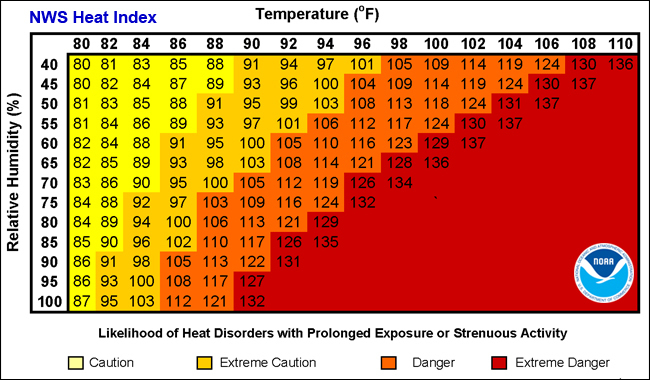
Source

Saturday, December 02, 2017

Frosty the ... sun man?

About this time of the year, by now we would have had quite a few frosty nights and mornings.  And dense fog.  My first November here fifteen years ago, the temperature one night dipped down to 16 degrees.  Thanksgiving days have always involved chattering teeth and icy proximities.

This past November has been awesome.  As we walked up to our friend's home for Thanksgiving, I joked that it is great to have Thanksgiving in the summer.

We are not the only ones to experience such above-normal temperature.
Nearly every corner of the country is warmer than normal.
How much warmer?
Temperatures in the Rockies, for example, are more typical of mid-June than late-November. On Monday, Denver reached 81 degrees—some 34 degrees above normal and warmer than Los Angeles, Houston, or Tampa, Florida—the warmest temperature ever recorded there during the month of November. On the same day, it was so unusually warm in Salt Lake City that the city broke its record high—at 2:20 a.m. Tucson, Arizona, set record highs all four days of the long Thanksgiving weekend, peaking at 92 degrees on Sunday—the highest reading ever measured there so late in the year.
No wonder the camelia that blooms in late fall has been going strong this year.  The flowers keep on coming, and we are already into December!
The warm weather isn't just confined to the U.S. Parts of Australia, China, and the Arctic are all experiencing similarly intense heat waves. In Greenland, temperatures on Thursday are a whopping 36 degrees above normal.
Wait, what?  36 degrees above normal?

Why are the seasons becoming so confusing?
There's some science to what's happening here. Human-caused climate change is shrinking the duration of winter around the world, with cold days arriving later in the fall and not persisting as long during early spring. Winter is the fastest-warming season for most of the U.S. in part because, as snow packs shrink, darker surfaces like soil and plants are able to retain the sun's energy better.
What a scam.  Our president has assured us that climate change is a hoax.  If only he can get rid of all these fake news, so that we can all go about grabbing p*s in the warm December days!


Wednesday, July 22, 2015

Heat doesn’t kill people ... poverty does

The following is an op-ed essay that I emailed the newspaper editor a while ago as the old country was getting set for the monsoon after yet another intense summer.  But, the essay hasn't made it to print, for whatever reason.  So, hey, as the editor/publisher of this blog, I can always "publish" that here ;)
*************

If there were a weather lobby that is the equivalent of the National Rifle Association, then the argument might be “heat doesn’t kill people, but poverty does.”

The monsoon season has set in the Indian Subcontinent and, as always, the summer that preceded it was intense, hot, and deadly. In India, where large areas of the country experienced triple-digit temperatures, with a high of 117 degrees in a couple of places, more than 2,000 died during the nasty heat wave. Pakistan, which has a much smaller population than India’s, registered nearly 1,300 deaths, most of them in the city of Karachi.

For those of us here in the gorgeous and temperate Pacific Northwest, even 90-plus degree days are insufferable. But, we are well aware that in the United States too there are a number of regions and cities that routinely experience triple-digit summer temperatures for weeks. In Las Vegas, for instance, it is a rare day in July that the daytime high stays below 100 and nighttime lows seldom fall below 85. Summers in Texas and Oklahoma are legendary.

We don’t always pause to wonder why people don’t die in huge numbers when Vegas broils, while people seem to drop dead in Karachi’s heat.

One might also wonder why India’s neighbor, Bangladesh, did not suffer comparable deaths during the summer. For one, the high temperature on a typical summer day in Bangladesh might only be in the high 90s. But, more importantly, Bangladesh has invested a lot more into human development than even India. This is evident in one of the most important measures of human existence: life expectancy at birth in Bangladesh is 71 years, compared to 66 in India.

India, with 1.25 billion people is a lot bigger than Bangladesh that has only 156 million. Aggregating the billion-plus into one huge country masks the differences that exist within, and hides away the acute poverty that is sometimes even worse than the conditions in Sub-Saharan Africa. Even within India, there are plenty of places where the summer heat seems like a killer but doesn’t really kill—because those places have remarkably lower poverty rates. In the city of Chennai, where my parents live, my father complains that the hot days of summer that began in mid-April do not seem to be ending anytime soon. But, the city and the state in which it is located—Tamil Nadu—have much better Human Development Indicators than most of the rest of India and, thus, the heat doesn’t kill people.

The poorest of the poor in countries like India or Pakistan do not find it easy to escape from the heat, especially if they are sidewalk dwellers. Access to potable water can be a challenge, particularly in rural areas where water supplies might be limited and which only the monsoon will replenish. It was a double-whammy this summer in Karachi—Ramadan coincided with the heatwave. Even if a thirsty urban poor was ready to pay top rupees for a glass of water, commercial food and drink establishments were closed in order to comply with the religious and government rules on respecting the Ramadan fasting during the day. It is, after all, the poor who are out and about in the heat, which is why we do not read about the business and political leaders of Pakistan succumbing to the heat.

Fasting during Ramadan is, of course, the practice in Saudi Arabia or Iran. Summers in those countries are brutal as well. Yet, reports of heat-wave deaths from those countries do not make the news, not because of any censorship but because there are no such happenings in large numbers. The acute poverty that one finds in some parts of India or Pakistan is not to be found in Iran. Simply put, it is poverty that kills!

The worst of the heat and dust of the Subcontinent has yielded to the monsoons. Again, it is typically the poorest whose lives will be severely affected when the rains come down in a hurry. To complicate things, experts predict that extreme heat and flooding will be even more worrisome with global climate change.

If there is any good news here, it is that the poverty rate has been significantly reduced over the past couple of decades. Along with that, with governments investing in people—via schools, health programs, water supply and sanitation, for instance—the human condition has been improving as well. The more such positive changes happen, the lower are the chances of thousands dying from the heat-waves. Now, if only those changes can happen as rapidly as ice cubes melting in the Karachi summer!