Showing posts with label Orwell. Show all posts

Monday, November 12, 2018

Elections and consequences

Ever since Robert Mueller was assigned the task of investigating the Russian interference into the 2016 elections and the trump team's dealing with them, the President and his toadies have attacked Mueller.   Especially because the assignment included "any matters that arose or may arise directly from the investigation." 

trump and his toadies tried everything possible to undermine the investigation.  All in plain sight.  So worried that a few--a tiny few--Republican senators were that they, along with their Democratic counterparts in a committee voted to protect the investigation.

The Senate majority leader simply refused to take the bill to the Senate floor for all the senators to vote on.

What can one do then?

All the stalling and maneuvering by Republicans remind us this: We can have all the laws in the land, yes.  But, "the law is no protection," as George Orwell wrote.  It depends on the public opinion, he argued.

Meanwhile, that kind of a question was answered in the House, where the Republicans playing similar games have lost their majority.  In a few weeks, Democrats will get to decide what will be done.  Orwell's public opinion.

While Orwell wrote that in the context of freedom of speech, the thesis that it all depends on the public opinion is valid in every way.
The point is that the relative freedom which we enjoy depends of public opinion. The law is no protection. Governments make laws, but whether they are carried out, and how the police behave, depends on the general temper in the country. If large numbers of people are interested in freedom of speech, there will be freedom of speech, even if the law forbids it; if public opinion is sluggish, inconvenient minorities will be persecuted, even if laws exist to protect them.
The law by itself does not guarantee any damn thing, especially when the executive charged with carrying out those laws couldn't care about them.

As I wrote a few days ago, participating in the resistance in order to counter this President's propaganda to corrupt the public opinion has been simply exhausting.  I am not the only tired one, of course.  There are lots of others, including Charles Blow.  He reminds us that it is ok to rest a little:
Don’t beat yourself up if you need to tune out every now and then and take a mental health break. There is no shame in it. This is a forever fight.
Forever fight!

Looks like the public opinion is that we are ready for this forever fight. Bring it on!

Sunday, June 10, 2018

A nation under siege?

I have been following politics for such a long time that I cannot even recall when it began.  This trump era is unlike anything that I have experienced.

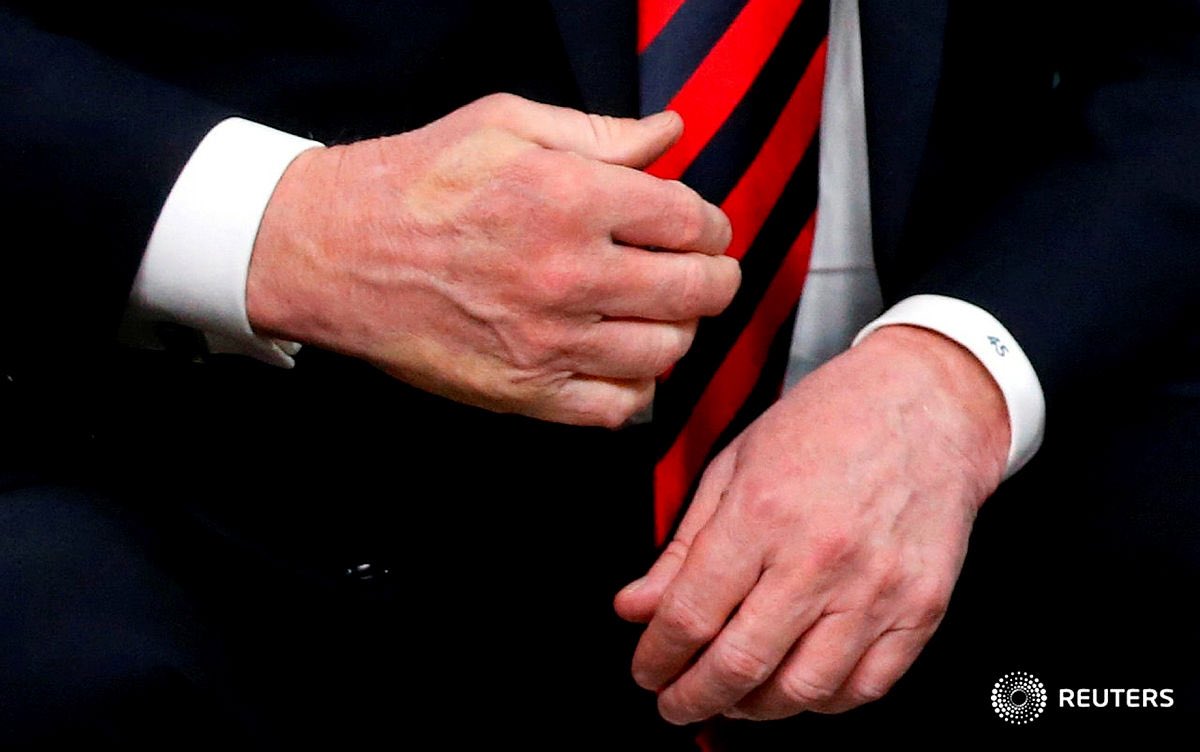
Even something as trivial as a handshake.  Political leaders shaking hands is not news.  But, trump's strange handshake maneuvers became newsworthy!  And it leaves a mark. Literally.

The presidents of France and the US shook hands.  And then this happened.
French President Emmanuel Macron was at it again Friday night, showing the world that he could beat President Donald Trump at his own crazy handshake antics.
Yep, handshakes are news now, thanks to the madman.

Macron left an imprint on trump!

Source

As one can imagine, such a thumb-war can be painful, especially for a septuagenarian:


I worry that my downtime is being consumed by trump news.  But, that's what happens when such a madman is in power.  People in many other countries have experienced similar situations for a very long time.

Masha Gessen reminds us that George Orwell worried about such preoccupation under totalitarians:
Orwell suggests one more way in which totalitarianism kills writing. “Serious prose,” he writes, “has to be composed in solitude.” Totalitarianism, as Arendt famously wrote, eliminates the space between humans, turning them into One Man of gigantic proportions. Separately, she spoke about the peculiar illusion of warmth and closeness that totalitarianism engenders. Totalitarian societies mobilize everyone. Supporters of the regime may be gathered in the big square, chanting their support for the leader, but opponents band together in tiny clumps that are always under siege, always in struggle to hold on to a patch of knowable truth.
Always under siege, and in a struggle to hold on to truth.  Sounds familiar, right?

In this siege mentality, I am not sure I want to delight in thumb wars, even though they do give me momentary relief like the warmth that we could get from peeing on ourselves when it is cold!  I can't wait to be free again so that my mind can wander about on all things profound and inane.


Thursday, January 11, 2018

2 + 2 = 5

As I have often remarked here, 1984 was one of the books that made me seriously rethink my commie interpretations of life and how to make the world a better place.  Ultimately, all those books led to the decision to come to the United States as well.

In 1984, Winston Smith holds a minor job in the Ministry of Truth.  He, like other workers there, are engaged in the never ending work of rewriting history in order to make sure that the Party is absolute and never wrong.

After three decades of life in America, I would never have imagined that the US would engage in constant rewriting of history in order to project the infallibility of the Party and its Dear Leader.  Yet, truth is stranger than fiction, yet again!
Climate information has been condensed or excised from the websites of at least six federal agencies under the first year of the Trump administration, according to a report released Wednesday.
The most extensive changes have occurred on the Environmental Protection Agency’s website, which has dropped “climate” from various program names and removed hundreds of pages and links to climate resources.
The Department of Energy, Department of the Interior, State Department, and others have also seen changes, according to the report, compiled by the Environmental Data and Governance Initiative (EDGI) that’s been tracking website changes since Trump took office.
At this rate, it is only a matter of time before those of us who refuse to accept the "alternative facts" are taken to Room 101 in the Ministry of Love, where, after a few days or months, we will begin to truly believe that 2 + 2 has always equaled 5 and that there has never been anything called gravity.

The Ministry of Truth has also been hard at work:
The Department of Health and Human Services tried to play down on Saturday a report that officials at the Centers for Disease Control and Prevention had been barred from using seven words or phrases, including “science-based,” “fetus,” “transgender” and “vulnerable,” in agency budget documents.
MiniTrue also had helpful suggestions:
Instead of “science-based,” or “evidence-based,” The Post reported, “the suggested phrase is ‘C.D.C. bases its recommendations on science in consideration with community standards and wishes.’’’
63 million fucking voters!


Monday, July 20, 2015

Do I deserve this face? Really!

One of the many wonderful things about reading the Economist is this: the correspondents bring in quotes that are just charming.

The trigger for such a post is this: the latest issue of the Economist has a special on Singapore, to mark the city-state's fiftieth birthday.  The lead essay begins with:
At 50, according to George Orwell, everyone has the face he deserves. Singapore, which on August 9th marks its 50th anniversary as an independent country, can be proud of its youthful vigour.
It took me a while to get past the opening sentences.  After all, it was not too long ago that I crossed the five-oh.  "everyone has the face he deserves"?  I don't deserve to look better than this?  I don't deserve to look like George Clooney or a Bradley Cooper? ;)

Here's the unfortunate aspect of it all--Orwell himself did not live to look at himself in the mirror and decide whether he deserved that face.  He was only 47 years old when he lost the battle against tuberculosis.

I wonder whether Nabokov thought he deserved the face that he had when he wrote Lolita; he was a little over fifty at that time.  He was in Oregon when he finished writing that novel.  In Ashland.  And he apparently wrote a poem, titled "Lines written in Oregon."  Guess where it was published?  Yep, the New Yorker!  This is all way too fascinating how the different things are inter-connected ;)
Esmeralda! now we rest
Here, in the bewitched and blest
Mountain forests of the West.
Here the very air is stranger.
Damzel, anchoret, and ranger
Share the woodland’s dream and danger.
And to think I deemed you dead!
(In a dungeon, it was said;
Tortured, strangled); but instead –
Blue birds from the bluest fable,
Bear and hare in coats of sable,
Peacock moth on picnic table.
Huddled roadsigns softly speak
Of Lake Merlin, Castle Creek,
And (obliterated) Peak.
Do you recognize that clover?
Dandelions, l’or du pauvre?
(Europe, nonetheless, is over).
Up the turk, along the burn
Latin lilies climb and turn
Into Gothic fir and fern.
Cornfields have befouled the prairies
But these canyons laugh! And there is
Still the forest with its fairies.
And I rest where I awoke
In the sea shade – l’ombre glauque –
Of a legendary oak;
Where the woods get ever dimmer,
Where the Phantom Orchids glimmer –
Esmeralda, immer, immer.
But this means that I have to now struggle to figure out what the poem is really about!  No wonder Singapore's Lee Kuan Yew didn't care about poems and feelings;  in that same essay in which it quoted Orwell, the Economist notes that Lee's maxim was "poetry is a luxury we cannot afford,”

I wonder whether Lee deserved his face when he was fifty! ;)

Wednesday, July 01, 2015

War is peace. Freedom is slavery. Ignorance is strength

As I get older, I am forgetting the details.  As a good chunk of life fades in the rear-view mirror--I know, I shouldn't be looking there--I am glad that I am able to recall whatever it is that I am able to.

The principal of the wonderful school--where I always longed to look at that girl--had plenty of laudable goals that were always badly executed.  We students had many mean jokes about him, and continue to do that even now whenever we get together.  One of his goals was that students ought to be interested in local and global current affairs.  Thus, during the weekly assembly under the morning hot sun, we students stood there as one of his hand-picked favorites read a few news stories for a couple of minutes.  (No, I have never been any teacher's favorite..Not anybody's.  Not even my parents' favorite. The story of my life!!!)

One day, the guy who read it out uttered "Mr. Ayatollah" while referring to the then-new leader of Iran, Ayatollah Khomeini.  The news junkie that I was even back then, I thought it was bizarre that he said "Mr. Ayatollah."  Those were beginnings of the Iran-Iraq war and not a day passed without the The Hindu providing reports on the war, and that war was a big reason why "Mr. Ayatollah" was often mentioned at the news reports during the weekly assembly.

The war, coming on the heels of the revolution that forced the Shah of Iran to flee the country, continues to haunt the world's affairs, especially the ongoing negotiations over the nuclear deal, writes Robin Wright:
Iran suffered more than a hundred and fifty thousand dead between 1980 and 1988. In Tehran, it’s called the Sacred Defense. In the final stages, U.S. aid to Iraq contributed to Iran’s decision to pursue nuclear capability—the very program that six world powers are now negotiating to contain.
Keep in mind that this was not a war that Iran launched.  It was Saddam Hussein's war.  And, in the realpolitik of American "diplomacy," Saddam was "our son of a bitch."  Ah, yes, the twisted and tangled webs that we have woven and into which we are now trapped!
Back in the eighties, Western intelligence agencies questioned whether Iran’s eighteen-month-old revolution could survive for even a few weeks after Saddam Hussein’s surprise invasion. Tehran scrambled to mobilize remnants of the Shah’s army, the new Revolutionary Guards, and almost anyone, of any age, for a volunteer paramilitary. Tehran’s Holy Defense Museum has pictures of thirteen-year-old kids and eighty-year-old men who signed up. (Three per cent of the dead were fourteen or younger.)
Instead, the war dragged on for eight years.
 The CIA got rid of a democratically elected government in Iran so that the US and its allies could install in power the Shah of Iran who would serve as "our son of a bitch."  When the Shah was thrown out two decades later, we looked across the border and encouraged the madman Saddam.  Robin Wright narrates how that messed up things:
In 1988, for the final big Iraqi offensive, the Reagan Administration spent months advising Baghdad on how to retake the strategic Faw Peninsula, where the Shatt al Arab waterway flows into the Persian Gulf.
I was curious about the location of the Faw Peninsula.  Unlike the final year of my high school, I now have Google at my disposal, which easily informs me where this peninsula is:


Wright says this battle got worse, thanks to the madman Saddam.
Iraq also used U.S. intelligence to unleash chemical weapons against the Iranians in Faw. U.N. weapons inspectors documented Iraq’s repeated use of both mustard gas and nerve agents between 1983 and 1988. Washington opted to ignore it. At Faw, thousands of Iranians died. Syringes were littered next to bodies, a U.S. intelligence source told me; Iranian forces had tried to inject themselves with antidotes. The battle lasted only thirty-six hours; it was Iraq’s biggest gain in more than seven years. The war ended four months later, when Iran agreed to a cease-fire.
The apologies that the US owes to people all around the world! :(
Iranian officials told me that the theocracy debated countering Iraq with chemical weapons, but opted against it. However, aware that Baghdad had a nuclear-weapons program, Iran decided to resume the nuclear research-and-development program initiated by the Shah. After the war, Tehran decided to keep it.
I think it is remarkable that Iran didn't unleash its chemical weapons against the Iraqi forces.  
The Iraq war still haunts Iran—and shapes the theocracy’s positions at the negotiating table—partly because tens of thousands are still dying from chemical weapons, according to the Society for Chemical Weapons Victims Support. Years after the war ended, Iranian doctors noticed a pattern of patients reporting chronic pulmonary, skin, and corneal conditions associated with mustard gas. They were diagnosed with what is now known as low-dose exposure.
Wright notes this:
During my recent visit, Iran was gripped by news that the bodies of a hundred and seventy-five military divers had been recovered in Iraq—three decades after their capture by Saddam Hussein’s forces. The men had reportedly been buried alive after their wrists were tied together with wire. Tehran released gruesome pictures of the recovery, and of the decayed and bound corpses still dressed in diving gear.
The country was consumed with mourning yet again—even young people, born after the war ended, were deeply moved.
 To think that the US encouraged Saddam all those years that he was in power!  For what?
 As the country’s diplomats prepared to return to Vienna for the nuclear talks, [Mohsen Rezai, who commanded the Revolutionary Guards during the war] declared, “Iran’s enemies stood by Saddam for the whole eight years of the Sacred Defense.” It was clear that he included the United States among them.
Soon after the war ended, Saddam was no longer "our son of a bitch." 

It is unfortunate that we have never truly given peace a chance.  Oceania will always be at war, ably helped by its Ministry of Peace, wrote George Orwell in that memorable 1984. 

Perhaps it is time to start another war. Maybe against Eurasia; after all, Putin is not "our son of a bitch."