Showing posts with label Indian-American. Show all posts

Wednesday, April 27, 2016

On "the dispassionate pursuit of passion"

Beauty is in the eye of the beholder, sure, but, it is not because I am an Indian-American that I see Indian-Americans everywhere! I open the latest issue of the Atlantic and there is an Indian-American: Anand Gopal has a lengthy and informative tragic piece the hell that Iraq is as ISIS recedes:
The Sunni refugees I met have little hope for a peaceful Iraq; whatever ideas they may have had about reclaiming their place in Iraqi society or undoing Shia-dominated rule have come unraveled, replaced by the most basic imperative of all: Stay alive.
And then at the magazine's website today, there is an interview with Raj Raghunathan.  Raghunathan, Gopal, ... I tell ya, not only Indian-Americans but the names suggest origins from my part of the world in the old country.  Trump can make all the moronic fun he wants to of the Indian accent, but beige is in, baby!

Raj Raghunathan is a professor of marketing at The University of Texas at Austin’s McCombs School of Business, who has written a book on an approach that will make people happy, instead of  the route that smart people seem to take in which "people may have a sense of what will make them happy, but they approach those things in ways that don’t maximize happiness"
which is to become a little more aware of what it is that you're really good at, and what you enjoy doing. When you don't need to compare yourself to other people, you gravitate towards things that you instinctively enjoy doing, and you're good at, and if you just focus on that for a long enough time, then chances are very, very high that you're going to progress towards mastery anyway, and the fame and the power and the money and everything will come as a byproduct, rather than something that you chase directly in trying to be superior to other people.
Hey, the rational research that leads Raghunathan to these conclusions is no different from that old philosophical idea from the old country.  The one that is familiar to even the Hindu who could not be bothered with the old texts: "Let not the fruits of action be your motive"

Interesting how much we forget such fundamental aspects of a meaningful and happy life.  More from Raghunathan:
Ultimately, what we need in order to be happy is at some level pretty simple. It requires doing something that you find meaningful, that you can kind of get lost in on a daily basis.
Wait a second, I have been blogging about this for a long time and the management friend of mine did not help me monetize my thoughts?

Raghunathan has a valid point here:
In the big picture, the business world’s messages are a little jumbled. In business schools, I see that there's a huge push towards corporate social responsibility and finding a passion, but at the same time, if you look at the kinds of people who get invited to come give keynote addresses, or what it is that we focus on to improve our Businessweek rankings, it's things that are extrinsic. We invite people who made a million bucks, and we look at incoming MBA students and their outgoing salaries.
Exactly!  Whether it is MBA or undergraduate liberal arts, whether it is multinational corporations or otherwise, we talk one talk but then walk a completely different walk and end up valuing people based on the extrinsic measures like their earnings.  

Any parting words, Professor Raghunathan, on "the dispassionate pursuit of passion"?
There are expectations that if you achieve some given thing, you're going to be happy. But it turns out that's not true. And a large part of that is due to adaptation, but a large part of it also is that you see this mountain in front of you and you want to climb over it. And when you do, it turns out there are more mountains to climb.
Which means?
basically the concept boils down to not tethering your happiness to the achievement of outcomes. 
Amen, brother!

Friday, April 08, 2016

Dotbusters, Dothead, ...

As a fresh off the boat newbie graduate student, I had a great time spending hours in the libraries at the university.  I couldn't believe there were multiple libraries on campus.  Of course, this was also before the dawn of the internet age and, therefore, it was in the libraries that I could read the newspapers from around the country and the world.

One of the news stories from those newbie days was about the "Dotbusters" in New Jersey.  I tracked down a New York Times report on that, from October 12, 1987:
For years, Indians living in blue-collar enclaves here have been taunted with ethnic epithets by white, black and Hispanic youths, according to the city's Indian leadership and many other people here.
But in recent weeks, Indians here say, the violence has taken on a new and uglier cast. One Jersey City Indian was beaten to death in Hoboken. Another remains in a coma after being discovered beaten unconscious on a busy street corner here earlier this month. And in a crudely handwritten letter, partially printed in The Jersey Journal, someone wrote, ''We will go to any extreme to get Indians to move out of Jersey City.'' The note was signed ''The Dotbusters.''         
I remember many of us Indian students talking about the "Dotbusters" and how the Los Angeles area, where I was, seemed more welcoming.  But, it shocked us that the violence was not in some remote part of the US, or in the Deep South, but in New Jersey!
  A 40-year-old Indian shop owner looked out on to Central Avenue and wondered aloud.
''Why do they want to hurt the Indian?'' she said, apologizing for her broken English. ''We want to make America beautiful. We don't want to spoil it.
''America is a land of chances,'' she said, too fearful to have her name published. ''That's why everybody is here.''
Yes, that's why everybody is here and would love to come here.  Like why I am here and not back in India, nor was I interested to go anywhere else.

An Indian-American was on NPR yesterday, and stirred the stories lodged in my memories from nearly three decades ago.  Amit Majmudar is yet another Indian-American who makes me feel like I am nothing but a blabbering idiot who does nothing.  Majmudar is a radiologist, novelist, poet, and writes commentaries.  And, yes, he is a family man.  Seriously, isn't that supposed to be four different people?  And, oh, he is yet to turn forty! I hate such people who make a good-for-nothing out of me!!! ;)

Majmudar was featured in the NPR segment because he has been appointed "Ohio's first ever poet laureate."  How about that!  Does Ohio's governor, John Kasich, know about this? ;)

Majmudar's "new collection of poems, has as its title an ethnic slur, "Dothead.""  Why?
Well, if you look at racial slurs like this, there is a way to retake it, the N-word, for example. Rappers have taken that word back. And it's still off-limits to those outside of the sort of circle. But internally, it's something that they call each other. And in this way, you kind of take it back from the people who use it against you. And "Dothead" actually relates to something very beautiful and eloquent related to Hindu symbolism. And for me, the dot on the head is something that I associate with my mom. My wife wears one every once in a while when we go to, you know, an Indian wedding or something like that. And above all, it has this religious meaning for me. And so I wanted to take it back, and I wanted to make a poem out of it.
April being poetry month, here's Majmudar's poem:

"Dothead"

by Amit Majmudar
Well yes, I said, my mother wears a dot.
I know they said "third eye" in class, but it's not
an eye eye, not like that. It's not some freak
third eye that opens on your forehead like
on some Chernobyl baby. What it means
is, what it's showing is, there's this unseen
eye, on the inside. And she's marking it.
It's how the X that says where treasure's at
is not the treasure, but as good as treasure.—
All right. What I said wasn't half so measured.
In fact, I didn't say a thing. Their laughter
had made my mouth go dry. Lunch was after
World History; that week was India—myths,
caste system, suttee, all the Greatest Hits.
The white kids I was sitting with were friends,
at least as I defined a friend back then.
So wait, said Nick, does your mom wear a dot?
I nodded, and I caught a smirk on Todd—
She wear it to the shower? And to bed?—
while Jesse sucked his chocolate milk and Brad
was getting ready for another stab.
I said, Hand me that ketchup packet there.
And Nick said, What? I snatched it, twitched the tear,
and squeezed a dollop on my thumb and worked
circles till the red planet entered the house of war
and on my forehead for the world to see
my third eye burned those schoolboys in their seats,
their flesh in little puddles underneath,
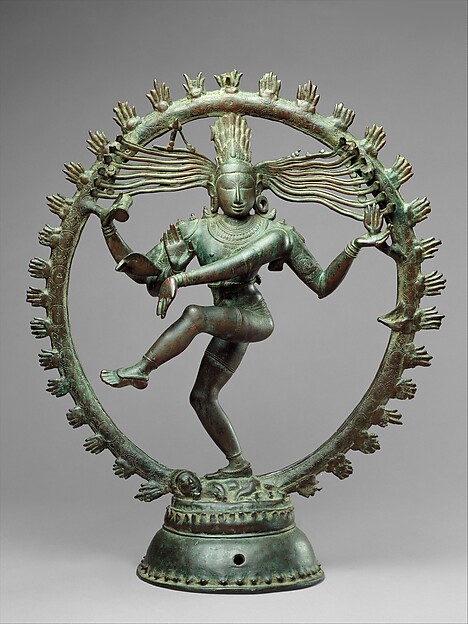
pale pools where Nataraja cooled his feet.

From Dothead by Amit Majmudar. Copyright 2016 by Amit Majmudar. Excerpted by permission of Alfred A. Knopf.

Nataraja (ca 11th century) at the Met

Sunday, February 14, 2016

Srikanth "Sri" Srinivasan as Antonin Scalia's replacement?

With Justice Scalia's sudden demise, there is intense speculation on the replacement.  A name that seems to pop up in most commentators' list: Srikanth "Sri" Srinivasan

Nearly three years ago, when Srinivasan was in the news, I authored an op-ed in the Register Guard; am re-posting it here:

Srikanth "Sri" Srinivasan received an overwhelming Senate confirmation as a judge for the U.S. Court of Appeals for the District of Columbia Circuit, and was sworn in on June 18th.  The Senate confirmed his appointment with a 97-0 vote.  Yes, this same current Senate, where bills routinely go to die, found his credentials to be so compelling that apparently they had nothing but congratulatory remarks.  Who would not want to be loved thus?


Srinivasan is the first Indian-American, and the first South-Asian too, to have reached that stratified judicial atmosphere.  Further, with the commentary on the DC Circuit Court as a springboard for nominations to the Supreme Court, and with all the uniformly lavish praise for Srinivasan, there is a distinct possibility that he could very well become the first Indian-American justice at the highest court of the land.  Is it any surprise at all, therefore, that Srinivasan’s ascent did not go unnoticed not only by Indian-Americans like me, but even in my old country?  It was a judicial appointment that echoed all the way on the other side of the planet.


Many of the biographic sketches that accompanied the reports on his nomination included the name of the village in southern India where his family roots are--Mela Thiruvenkatanathapuram.  Try that for a tongue-twister!  When I learnt from a Google search that this village could be located very near the village where my father grew up, I called him up right away.  Indeed, the two villages are not that far apart and are located along the banks of the same river, Thamirabarani.  

The Thamirabarani at Srivaikuntam

Father added that there was extensive coverage of the nomination in the newspapers and on television.  He joked that we were not related to the Srinivasan family, but it seemed that father was a tad disappointed over that!


Srinivasan was born and raised far from this small village, in the northern part of India where his father, T.P. Srinivasan, was on the faculty of the University of Punjab.  Sri Srinivasan was four years old when the family immigrated to the United States as a result of his father taking up an academic position initially at Berkeley, before moving to Kansas.  I would imagine that an immigrant Indian family in Kansas in the early 1970s would have been quite an exotic addition.


My excitement about Srinivasan is not at all about identity-politics.  The intention is not to categorize and count the population by the respective hyphenations and demand any proportional representation.  Instead, it is a profound appreciation for this adopted country of mine where it matters very little anymore where we came from.  My excitement about Srinivasan is to celebrate the fact that one can come to the United States from any corner of the world and potentially become a Supreme Court judge.  


In a country where even only a couple of decades ago life was not easy for those who were not White Anglo Saxon Protestant, it is simply fascinating how different the contemporary landscape is.  In the current Supreme Court, three justices are Jewish and the rest, including the Chief Justice, are Catholic.  While we might have our own disagreements with the court’s opinions, we attribute those differences to legal interpretations of the Constitution that might be colored by politics.  The religious backgrounds of the justices do not matter to us. What a remarkably healthy change this is over the years past.   


If Srinivasan were to join the Supreme Court to fill a vacancy created by the retirement or demise of a current justice, he would then become the first who was raised in a religious background outside of the Judeo-Christian beliefs.  It is almost impossible to believe that a mere ninety years ago, a Supreme Court justice refused to speak with Louis Brandieis and sit with him for the court’s official portrait because Brandies was Jewish, and now it is entirely possible for one of Hindu origin to join that very court!  To borrow the comedian Yakov Smirnoff’s line, “America, what a country!”


With Srinivasan, we have yet another evidence that the Indian-American group is more than Spelling Bee champions, and math and science nerds.  There are Indian-Americans in movies and television shows, in the literary and corporate worlds, and even as animated fictional characters like Apu in “The Simpsons.”  If only there were a Cy Young award-winning Indian-American pitcher--and a southpaw at that--to complete the all-American composite image!


Monday, November 30, 2015

Masala for your heart

Back in graduate school, a friend who was Jewish joked that his family always scanned the news for Jewish names.  He laughed while acknowledging that he, too, did that.  I joined in the laughter because I found myself watching out for Indian-American names.  Yes, even when I was fresh off the boat.

More than two decades later, it seems like Indian-American names are popping up all over the place.  It used to be only in the academic circles, or in the research wings of those large multinational corporations.  Now, Indian-Americans are seemingly everywhere.  Even governors and stand-up comedians.  Thankfully, no gun-crazy Indian-American on a shooting spree!

The NY Times had a Sunday review essay on heart diseases, which was authored by Sandeep Jauhar, who has authored a few pieces for the Times, and has also been at other major media outlets.  An interesting background too--he decided to pursue the medical profession while he was a PhD student in physics at the University of California, Berkeley!  How do people become such brainiacs?

Anyway, back to the NY Times essay by Jauhar.  It is on heart diseases.  What is of interest is this:
Heart disease is the leading cause of death in India, Pakistan and Bangladesh, and rates have risen over the past several decades. South Asian immigrants to the United States, like me, develop earlier and more malignant heart disease and have higher death rates than any other major ethnic group in this country.
The reasons for this have not been determined. 
One grandfather of mine--my mother's father--died from a cardiac event that, incidentally, was not his first either.  My grandmother--father's mother--died from an enlarged heart condition.  Whether or not that elevates my risk level is, well, we will find out within the next twenty-four years ;)

Jauhar writes about the Farmingham study that was initiated in 1948 with a key goal "to establish risk factors for coronary heart disease."  He quickly reviews there the research that went into identifying the risk factors that we now think is common sense--like high blood pressure, diabetes, smoking.  

But, those were about people who were of White European stock.  
Traditional cardiac risk models, developed by studying mostly white Americans, don’t fully apply to ethnic communities. This is a knowledge gap that must be filled in the coming years.
I need to remind myself that this was a guy who was on track to get his PhD in physics and after a career change, has been a cardiologist for years now!

So, why the "masala" in the title?  Did I have it there in order to provide a hint that the spices are killing South Asians?  Nope.
Fortunately, the National Institutes of Health have started such a study. Named Mediators of Atherosclerosis in South Asians Living in America, or Masala, it has enrolled about 900 South Asian men and women in two large metropolitan areas, the San Francisco Bay Area and Chicago.
I think that the researchers had decided a priori that the study would have a name that would also be a cultural reference, and then they came up with an acceptable scientific expansion of "Masala" ;)
Researchers are focusing on novel risk factors, including malignant forms of cholesterol (previous research has suggested that South Asians may have smaller and denser cholesterol particles that are more prone to causing hardening of the arteries), as well as other social, cultural and genetic determinants.
Hmmm ... for all I know, the tasty European butter that I prefer is transforming into artery-hardening cholesterol!  Oh yeah, there is a cardiologist in the family--he is not an Indian-American but is married to one though ;)