Friday, October 30, 2020

Death is in the air

"You were right about your prediction. About covid."

Small talk is rare at the grocery store.  When it happens, it is not so easy to understand the other with the words coming through our ill-fitting masks.

"What prediction?  What did I say"

I was genuinely curious.  For one, that she had paid attention to what I had told her.  And, I was right?

"When it began, you said this will take a year or more.  And that is what's happening," she said.

Of course I am no epidemiologist.  But, I did read and watch experts, including Bill Gates.  They were pretty darn clear that it would take between a year and two before the world got a firm grip over this.

"Oh ... the science is clear.  We can try to deny it as much as we want to ..." I replied.

The science-denying President, who believes that he is the foremost expert on any topic including the global epidemic, goes to rally after rally yelling in his grating tone that we've turned the corner.

The reality is a complete contrast to his world of alternative facts and truthful hyperbole!

I hope the 63 million who voted for the sociopath are fucking happy with their decision!


We often don't know about happenings in our own backyards

Reading never fails to underscore how much I don't know any damn thing.  I could spend all my hours reading, not wasting time playing bridge or doing any of my "wasteful" acts, and I will still not know any damn thing.

Yet, the alternative--to not read--is not appealing either.  Yes, people who don't know anything but claim to be the only one to know it all can get to positions of power and fame.  But, I don't want to be in that universe.

Karthika Nair's interpretation of the Mahabharata is a case in point.  One of the voices that she channels is that of Ulupi, whose connection to the Kuru family is through Arjuna.  A queen of the Nagas, Ulupi has a son, Aravan, through Arjuna during his exile years.  Nair refers to Aravan (Iravan) being celebrated by a few Tamils in the Koothandavar cult.

Koothandavar? Cult?

The first result in a Google search for Koothandavar is Koovagam.

It is famous for its annual festival of transgender and transvestite individuals, which takes fifteen days in the Tamil month of Chitrai (April/May) ... The festival takes place at the Koothandavar Temple dedicated to Iruvan (Koothandavar).

Aravan aka Koothandavar, who was born from the union of Arjuna and Ulupi, is celebrated thousands of miles away in the southern tip of the subcontinent?

It turns out that Koovagam is located not far away from Neyveli, which is where I grew up!


A mere 25 miles away from Neyveli is this place where annual celebrations for Aravan are held, and I am finding out about it when I am 10,000 miles away?

Maybe I didn't know because it brings transgenders and transvestites to the temple, and the mainstream--definitely back then--did not care much about them and tried to only marginalize them?

Too many questions!

Wikipedia adds:

The participants marry the Lord Koothandavar, thus reenacting an ancient history of Lord Vishnu/Krishna who married him after taking a form of a woman called Mohini. The next day, they mourn the god Koothandavar's death through ritualistic dances and by breaking their bangles. An annual beauty pageant and several other competitions like singing contests are held.

The more I read, it turns out that there is much more to know about.  So, read and learn I shall.

Wednesday, October 28, 2020

The Mahabharata echoes even after all the years

The doorbell chimed.

I saw a man in brown leave.

I knew what it was about, and rushed to open the door.

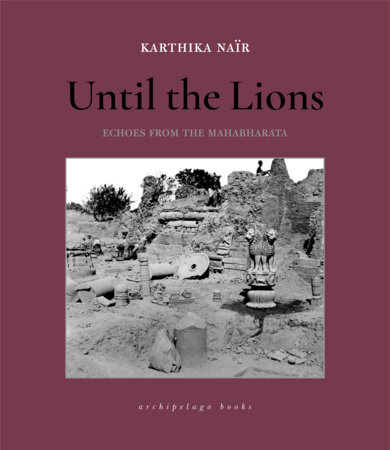
I hurriedly opened the parcel to reveal the book.


I scanned through.  I was convinced that the reviewer had not exaggerated one bit. "The poems of Until the Lions are graphically typeset on the page so that they seem to be dancing, a celebration of visible sound."

Later in the night, I got to reading the book.  Yes, it is unconventional and impressive.  Even the simple explanation that Nair gives in the introduction for choosing the Mahabharata over the other Hindu epic, Ramayana: Unlike in the Ramayana, where the enemy is far away and some Other, here "that mortal enemy is one's own kin; the blood the heroes spill is all their own."

Think about the family disputes, among the rich and the poor alike.  While there might not be any literal blood spilling, the emotions are not that different from those described in the epic.  The Mahabharata is the one that I have always favored over the Ramayana, as I noted back in 2013:

I loved those epics.  Phenomenal works of literature from centuries ago.  What I read were mere re-telling; I can easily imagine that the works in the original will be quite a treat for those well-versed in Sanskrit.  The Mahabharata, which I prefer a tad over the Ramayana, was Rajaji's version that I read and it was one gripping page turner when I read that as a kid.

Nair lists the key characters from the Mahabharata who are featured in her innovative interpretation.  Those descriptions alone are enough compensation for the price of the book.  Consider the following about Vyasa:


"in his spare time."  What an editorial comment!

Over the decades of living in my adopted country, I have forgotten some of the characters.  Nair reminds me about them.  But, there was one in her listing that was new: Sauvali.  Dhritarashra chose her as a "concubine during Gandhari's pregnancy."  Yuyutsu was the son.  He was the only son among the Kauravas who survives the war, and performs "the last rites for all his fallen kin."

Not having known anything about Sauvali, I chose to read the chapter about her first, ahead of everything else.  Nair does not mince words--she writes about the rape of Sauvali.


 There's so much to understand about the human condition, which is what great authors have been doing over the centuries of storytelling.