Sunday, July 03, 2016

How do people come to know themselves?

One of the critical questions in Hindu philosophy is an existential question that people of any faith, or infidels like me, also worry about--or should worry about: Who am I?

I am sure that thinkers in cultures all around the world raised that very question.  The ancient Greeks, for instance, inscribed "Know Thyself" (well, not in English but in Greek, of course!) at the Temple of Apollo, and later Socrates declared that "the unexamined life is not worth living."

Source

My summer readings, on top of the different bits that I read and blog about, are essentially my attempts to keep after that question of "who am I?"  Instead of abstract philosophy, which I don't much care for, I ask that question in the contexts in which I find myself, in relation to the situations that surround me, especially because of my conviction that there is nothing after death, and it is all in the here and the now.  Thus, blogging about the Ebola crisis, or the Syrian refugees, or tweeting about the fascist, are all more than merely about Ebola or Syria or fascism--they are explorations into understanding who I am.

In an essay about James Baldwin, the author--Nathaniel Rich--quotes Baldwin:
The difficulty is to remain in touch with the private life. The private life, his own and that of others, is the writer’s subject—his key and ours to his achievement. Nothing, I submit, is more difficult than deciphering what the citizens of this time and place actually feel and think. They do not know themselves….
Rich follows that with his own observation:
How do people come to know themselves? One way is by reading fiction. The profound act of empathy demanded by a novel, forcing the reader to suspend disbelief and embody a stranger’s skin, prompts reflection and self-questioning. But most people don’t read novels.
The novel does not refer to the likes of Ian Fleming's James Bond series or the old Mills & Boon series or Fifty Shades of Grey ;)  I am reminded of a forum on campus, a little more than a year ago, when one faculty colleague referred to the "great books" approach at St. John's.  Another colleague, who is so convinced about his superiority that he never can even remotely understand how much of  an idiot he is, remarked that it is all relative on what "great books" mean and then went on to list some of the books that he has read, which made many of us gasp and wonder how such an idiot could possibly inhabit the world of higher education.  I suppose he doesn't know himself!  Hmmm ... where was I before this digression? ;)

In that same Baldwin essay, Rich notes:
Baldwin made the racial question personal, reducing a society-wide problem to a matter of one’s private conscience. He was not alone in this approach, but he was alone in bringing a novelist’s sensitivity to bear on it. In Baldwin’s writing racism is, among other things, a failure of empathy.
Indeed.  Racism, hate, or any systematic put down of "those people" is a failure of empathy.  Anybody who has any sense of empathy will not be able to generate the kind of rhetoric that foams from the mouth of the contemporary American fascist leader, and his ardent supporters equally suffer from a lack of empathy.  As this piece notes:
Trump deals in hates that dare not speak their names
This fascist leader:
enhances the force of a whole series of interlocking hates—black hate, Muslim hate, woman hate, and “Mexican” hate.
I would think that the fascist leader's short fingers have never ever touched the "great books" and the novels that compel the reader to reflect on "who am I?"

I wonder what James Baldwin would have said and written about this fascist leader!

Saturday, July 02, 2016

If you are so smart, ...

Two friends from the old California days visited with me.  I cooked lunch for them and had everything ready because I knew they didn't have a whole lot of time to spare.

Later, I recalled to the friend how amazingly capable one of them in particular is.  She can fix machines, automobiles, work on wood, do glass etching, do any kind of home building work, create and maintain well designed gardens at homes, manage people and projects, and more.  Compared to her, I am a one-note player--and barely even that much.

In my classes, sometimes I explicitly remind students that who they are as humans is not defined by the grade they earn in my classes.  I tell them that if people were to grade me on how much I know about gardening, home repairs, auto maintenance--especially changing tires, craftwork, art, music, swimming, ..., my grade will be a big, fat, F.  There is more to life than the smarts--as in intelligence--I tell them.  I really do.  But, I am confident that they do not listen to me saying that either.

The older I get, the more I think I detest the primacy of "intelligence" as if that is the measure of a human.  I have even joked in some classes that while we think of Einstein as the smartest guy ever, he had no idea about Tamil and could not speak even a sentence in that language, while a two year old in Tamil Nadu can rattle off quite a few Tamil sentences.  The smart guy that he was, Einstein himself made a memorable, quote-worthy, comment about this, remember?

My point is that "intelligence" is highly specific.  It is just that a few particular kinds of intelligence are valued in a market economy, while others are not--ask any poet who can craft verses on the fly how much the market values her intelligence!

But, as with everything else, I am in a rapidly shrinking minority:
Meanwhile, our fetishization of IQ now extends far beyond the workplace. Intelligence and academic achievement have steadily been moving up on rankings of traits desired in a mate; researchers at the University of Iowa report that intelligence now rates above domestic skills, financial success, looks, sociability, and health.
The older I get, the more I value the good-heartedness in people.  They can be Harvard grads, but if they seem to be incapable of empathy, well, they do not deserve my time.
We must stop glorifying intelligence and treating our society as a playground for the smart minority. We should instead begin shaping our economy, our schools, even our culture with an eye to the abilities and needs of the majority, and to the full range of human capacity.
Exactly!  But, oh yeah, I keep forgetting that the market economy does not care about "the full range of human capacity" and instead only wants to know how much money you can make.  If you are so smart, how come you ain't rich, right?
When Michael Young, a British sociologist, coined the term meritocracy in 1958, it was in a dystopian satire. At the time, the world he imagined, in which intelligence fully determined who thrived and who languished, was understood to be predatory, pathological, far-fetched. Today, however, we’ve almost finished installing such a system, and we have embraced the idea of a meritocracy with few reservations, even treating it as virtuous. That can’t be right. Smart people should feel entitled to make the most of their gift. But they should not be permitted to reshape society so as to instate giftedness as a universal yardstick of human worth.
Oh well, yet another way in which the imagined dystopian future is already here.


Friday, July 01, 2016

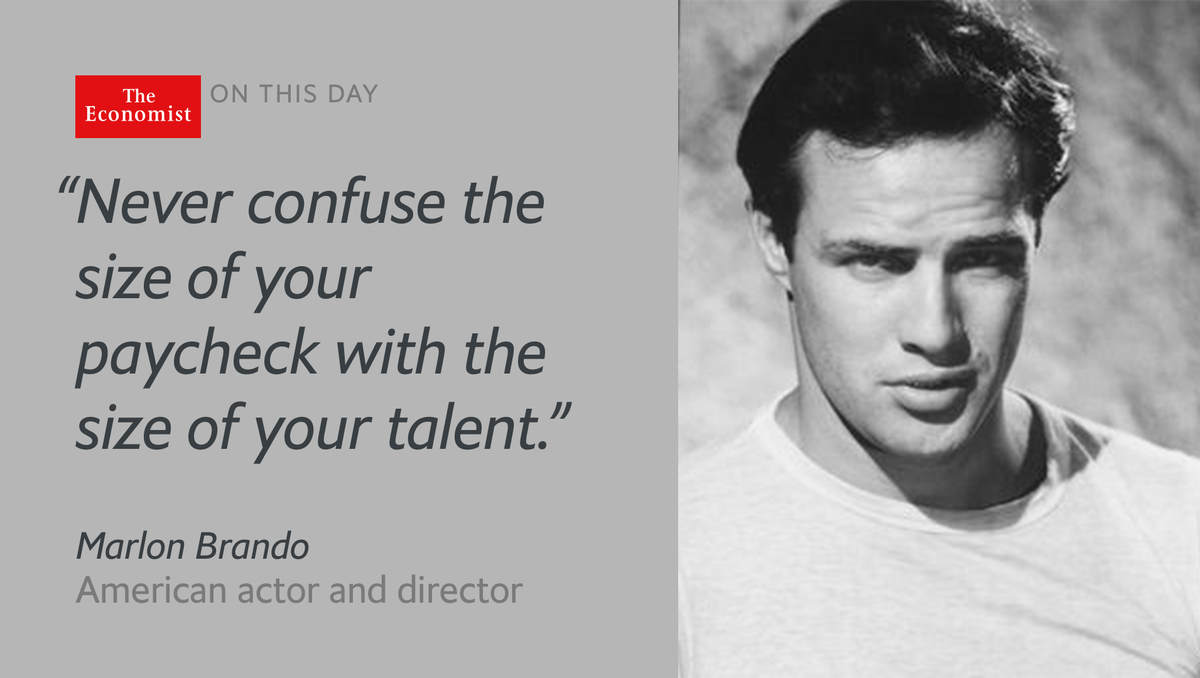
Money! Money! Money!

The old Soviet system couldn't care a shit about gods; after all, they were implementing the ideas of a thinker who declared that religion was the opium of the masses.  Commies were godless and were anti-market.

The pro-market America was all about god and bible-thumping politicians.  "God bless America" became a mantra that if not faithfully rendered made one a dirty commie.  Can you imagine an American President not concluding a serious address to the nation with a "God bless America"?  It is like how beauty pageant contestants wish for world peace ;)

In that lies an interesting irony. The faith in god requires many beliefs, including that there is a higher purpose to life, with the path leading to god.  The market, on the other hand, is built on the exact opposite idea--there is no purpose to any damn thing.  If you want to sell and if there are buyers for it, the transaction happens.  If you can't sell, you lose.  If you make money out of it, so be it.  The market simply is.  The commies, on the other hand, firmly believed in a political economic system that served a higher purpose.  They were, ahem, religious about it.

Perhaps it would be more consistent if the god-believing "non-commies" designed their political economy in order to serve a higher purpose, while the godless "commies" lives in the anything-goes system.  But, inconsistency is what life is, I guess.

Apparently god likes the purpose-less free market of anything, and cursed the godless "higher purpose" commies to collapse ;)

The sudden death of the command and control Soviet economy features a lot in Svetlana Alexievich's Secondhand Time.  One of the people, who talks to the author dropped out of the university after his second year, says "the market became our university ... Maybe it's going too far to call it a university, but an elementary school for life, definitely."
I feel sorry for my parents because they were told flat out that they were pathetic sovoks whose lives had been wasted for less than a sniff of tobacco, that everything was their fault, beginning with Noah's Ark, and that now, no one needed them anymore.  Imagine working that hard, your whole life, only to end up with nothing.  All of it took the ground out from underneath them, their world was shattered; they still haven't recovered, they couldn't assimilate into the drastically new reality.  My younger brother would wash cars after class, sell chewing gum and other junk in the subway, and he made more money than our father--our father was a scientist. A PhD! ... This was how capitalism came into our lives ...
Whether or not we believe in gods and religions, every one of us--consciously or subconsciously--attempt to create a meaning for the insanely short times that we have in this cosmos.  When that meaning is shattered, the existential crisis becomes unbearable.  When people here in the US suddenly lose their jobs for no fault of theirs, the existential struggle is as real as the Russian PhD who was not needed anymore.  The tragedy is that the pro-market but god-believing people, who vastly outnumber us infidels, rarely want to spare a dime and help ease that existential struggle of the "losers."  But then that's what the "free market" is all about, I suppose.