Showing posts with label uncle vanya. Show all posts

Monday, September 07, 2015

Burn, baby, burn. Burn a few books!

In a hallway in the building where my office is located, the esteemed ladies and gentlemen who protect themselves with feathers and robes, emblems and degrees have display shelves that are, as I blogged earlier, a monument to faculty, by faculty, for faculty.  What are displayed there, you ask?  Grab a chair; this will take a while! ;)

You, dear reader, like reading.  You have a thirst for understanding.  You perhaps even checked out books from your local library.  But, there is a good chance that you never knew about a genre of books that go straight from the publisher to university libraries where they remain forever without ever being moved even once.  The complimentary copies that the authors receive sometimes end up in display shelves like the one in my office hallway.

Increasingly, academics write books that nobody ever reads.  They are weightier than the journal articles that academics write which nobody ever reads.  Most academic "research," especially outside of the "hard sciences" is not read by anybody it seems.  It was this revelation, even when I was in graduate school decades ago, that further convinced me that I didn't want to waste my time writing stuff that will be nothing but intellectual onanism.

I did write an essay about this, which was read by a few.  It was not a traditional journal article, however.  In that essay, which was published back in October 2001, I wrote about the "aha moment" when I read Chekov's Uncle Vanya (yes, those Russians have been constant companions in my life!):
Would people be disillusioned if they knew that only a few of professors' publications are ever read by more than a handful of other scholars? Would people be disappointed in higher education if they realized that most academics' publications would not sell even for a penny? Would people agree with Uncle Vanya that professors who write but are rarely read and cited are swindlers? Could it be that people already grasp the truth, and that their knowledge is one cause of the decline in the prestige our society accords to faculty members?
It is a racket. A scam.  A huge ripoff.  In The Guardian, an anonymous academic (no, not me--I love to say these in the open!) writes about his personal experience in this book-publishing scam:
A few months ago, an editor from an academic publisher got in touch to ask if I was interested in writing a book for them.
I’ve ignored these requests in the past. I know of too many colleagues who have responded to such invitations, only to see their books disappear on to a university library shelf in a distant corner of the world.
If someone tried to buy said book – I mean, like a real human being – they would have to pay the equivalent of a return ticket to a sunny destination or a month’s child benefit. These books start at around £60, but they can cost double that, or even more.
This time, however, I decided to play along.
 The entire essay (and the comments too) is worth reading, especially if you didn't know about such "scholarly" tomes that end up in the masturbatory display shelves or in the remote corners of university libraries.  The anonymous academic writes there:
These may sound like stories of concern to academics alone. But the problem is this: much of the time that goes into writing these books is made possible through taxpayers’ money. And who buys these books? Well, university libraries – and they, too, are paid for by taxpayers.
 No different a point about taxpayers from what I had written in 2001, right?

You might then wonder, as the rational thinking person that you are, why this ripoff continues even when academics know that most books are never ever read by anybody.  I will remind you about the name for this blog: Every profession is a conspiracy against the laity.

Monday, August 02, 2010

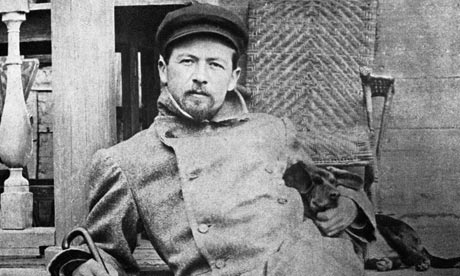
Anton Chekov's 150th birthday

One of the few books I own is a collection of few of Chekov's plays.  His plays are not merely theatre, but are profound discussions of humanity and everyday life.

In an essay in the Chronicle Review, almost ten years ago, in which I discussed the wastefulness and pretentiousness of most of the academic "research," I quoted from Anton Chekov's "Uncle Vanya."  In that play, Vanya goes after the professor:
"All our thoughts and feelings pertained to you alone. Our days were spent talking of you and your work, we were proud of you, we uttered your name with reverence, our nights were wasted reading books and magazines for which I now have the deepest contempt! ... But now my eyes have been opened! I see everything! You write about art, but you understand nothing of art! All your works, which I used to love, are not worth a copper kopeck. You've swindled us!"

Chekov always has a simple way of saying things that are profound.  I then wrote:
The passage from Uncle Vanya reminded me of the public, whose taxes make it possible for universities like mine to exist. Would people be disillusioned if they knew that only a few of professors' publications are ever read by more than a handful of other scholars? Would people be disappointed in higher education if they realized that most academics' publications would not sell even for a penny? Would people agree with Uncle Vanya that professors who write but are rarely read and cited are swindlers? Could it be that people already grasp the truth, and that their knowledge is one cause of the decline in the prestige our society accords to faculty members? If I did not teach at a university, would I agree with Uncle Vanya? 
Life has never been the same ever since Chekov's Uncle Vanya helped crystallize the thoughts that had been fuzzy up until that point.  (Though, this approach to research and higher education, and a generally disgusted feeling towards the pretentious faculty colleagues, doesn't help me in the real world!)

The Guardian features an essay about Chekov and his plays, on the occasion of his 150th anniversary of his birth. (ht)
his stories are full of people who espouse views very similar to the above – enlightened misfits, philanthropic gentry, civilised professionals (often doctors like himself) holding a candle for reason, justice and all the rest.
The author then notes:
There had been sceptics, agnostics, doubters, questioners of every kind before Chekhov, but perhaps no writer in whom the utter mysteriousness of existence was felt so deeply, or counterpoised by such ­inexhaustible interest in the teeming variety of forms – human and otherwise – in which it manifests itself. To have found a way of expressing both, with such profligate inventiveness and such apparent ease, was, above all else, the mark of Chekhov's genius; his unsurpassed greatness as a teller of stories.

Friday, October 03, 2008

How can lap dancers increase their incomes?

One of the Ig Nobel winners announced yesterday looked at this very question.
ECONOMICS PRIZE. Geoffrey Miller, Joshua Tybur and Brent Jordan of the University of New Mexico, USA, for discovering that a professional lap dancer's ovulatory cycle affects her tip earnings. REFERENCE: "Ovulatory Cycle Effects on Tip Earnings by Lap Dancers: Economic Evidence for Human Estrus?" Geoffrey Miller, Joshua M. Tybur, Brent D. Jordan, Evolution and Human Behavior, vol. 28, 2007, pp. 375-81

Such research and publications are triggered by the stupidly insane approach in universities that we characterize as "publish or perish." So, hey, such research is a rational response to an irrational system.

I wrote about this in an essay that was published in the Chronicle Review, back in 2001. In that, I wrote:

Last summer, I literally shouted "Aha!" in the middle of one night as I read the following sentences in Anton Chekhov's Uncle Vanya, in which the title character yells at a retired professor: "All our thoughts and feelings pertained to you alone. Our days were spent talking of you and your work, we were proud of you, we uttered your name with reverence, our nights were wasted reading books and magazines for which I now have the deepest contempt! ... But now my eyes have been opened! I see everything! You write about art, but you understand nothing of art! All your works, which I used to love, are not worth a copper kopeck. You've swindled us!"

The passage from Uncle Vanya reminded me of the public, whose taxes make it possible for universities like mine to exist. Would people be disillusioned if they knew that only a few of professors' publications are ever read by more than a handful of other scholars? Would people be disappointed in higher education if they realized that most academics' publications would not sell even for a penny? Would people agree with Uncle Vanya that professors who write but are rarely read and cited are swindlers? Could it be that people already grasp the truth, and that their knowledge is one cause of the decline in the prestige our society accords to faculty members? If I did not teach at a university, would I agree with Uncle Vanya?