Showing posts with label newspapers. Show all posts

Wednesday, February 21, 2018

Extra! Extra!

When I moved to Oregon, the print media was very much alive.  The Oregonian had won Pulitzers; the newspaper from the state capital, Salem, was vibrant; and the Register Guard was still publishing the broadsheet papers that I find only in India.

And then shit happened.

First the newspapers trimmed down their breadth.  Literally, the paper shrank in size.  The number of sheets reduced.  Newspapers were on a diet and they were slimming down fast.  The Oregonian even stopped printing the news on a daily basis, and it became more of an online presence.  The Statesman Journal stopped being a local newspaper after it became a part of the USA Today group.

The Register Guard was the lone one standing, and proud.  The paper celebrated its 150 years of being a family-owned paper that thought big.

And then shit happened.
GateHouse officially takes ownership on March 1 of the company’s media properties, which include the daily newspaper, its companion digital products, the weekly Emerald Valley Shopper newspaper and a commercial printing operation.
GateHouse is part of publicly traded New Media Investment Group. ...
The company, based in Fairport in upstate New York, has publications in 36 states.
What do the new owners say is their approach?
Our strategy is to acquire and operate traditional local media businesses and transform them from print-centric operations to dynamic multi-media operations, through our existing online advertising and digital marketing businesses.
Meanwhile, the NY Times CEO says that its print products might be around for another ten years.  And then ...?

What will happen to all the local reporting?  Who will cover what the local elected officials and corporations are up to?

There are a lot more people worried about this and are doing something. Like Report for America:
a new journalism training corps blending the traditional job-education organization with a model for sustainable reporting. The emphasis is on hiring a diverse group of journalists to cover underrepresented regions of the United States.
Similar to Teach for America. But more than that.
Report for America's pilot program, which launched last month, placed three early-career reporters in Appalachian newsrooms, at West Virginia Public Broadcasting, the Lexington World-Herald, and the Charleston Gazette-Mail. The program includes mentorship and training programs, and just like their cohorts in urban newsrooms, the journalists are expected to file stories regularly and will receive a salary equivalent to other entry-level reporters.
Report for America's first class consists of three reporters familiar with Appalachia: Caity Coyne, a recent graduate of West Virginia University reporting for the Charleston Gazette-Mail; Molly Born, a West Virginia native reporting for West Virginia Public Broadcasting; and Will Wright, a recent graduate of the University of Kentucky reporting for the Lexington Herald-Leader.
Back when I was a kid in India, I loved how my favorite newspaper covered the news from around the world.  I was mighty proud of that, until a visitor burst that bubble.  One of those in the way, way, way extended family, the kind of connections that only my father can track right in his head, this visitor said that India's problem was that news organizations did not look at their own backyards, but were covering President Carter more.  Until that day, I had never thought about the importance of local news.  I was even mighty condescending towards the local news.  But, my opinion changed.

When I came to the US, I was in newspaper heaven.  In the university library, I read the NY Times and the WSJ, and subscribed to the LA  Times.  After graduating and getting into the real world, when I no longer had the university library to supply drugs to this news junkie, there was a time that I subscribed to the NY Times, the WSJ, the LA Times, and the Bakersfield Californian.  I lugged a lot a newspaper to the recycling bins ;)

Locally, the countdown to that d-day has begun.  We will soon find out how local our local newspaper will be.


Friday, March 25, 2011

Wisdom, according to "Pickles." One good reason for newspapers!

The local newspaper, likes most papers, runs the comic strip only in black/white on all days of the week except on Sundays.  I so wish that the funny pages will be in color all seven days of the week.  But then how many people read the newspapers in print form anymore, eh :(


When I travel outside the US, which is mostly to India these days, I miss the funny pages the most.  We are in comics heaven here in America.  Our paper features two pages of comics every day, and then a grander and colorful Sunday edition.  I wonder what the reason is for us Americans (note how I identify with this adopted land!) to enjoy comic strips that much.

It is not that newspapers in India are dying either; in fact, the dailies there have a lot more pages than here.  The state of newspapers in India seem to be perhaps as healthy as the industry was here in the 1970s.  But, not a huge spread of comics though.  Don't other people like to smile and laugh every morning at least to temporarily forget all the depression that results from the news pages?

Wednesday, October 13, 2010

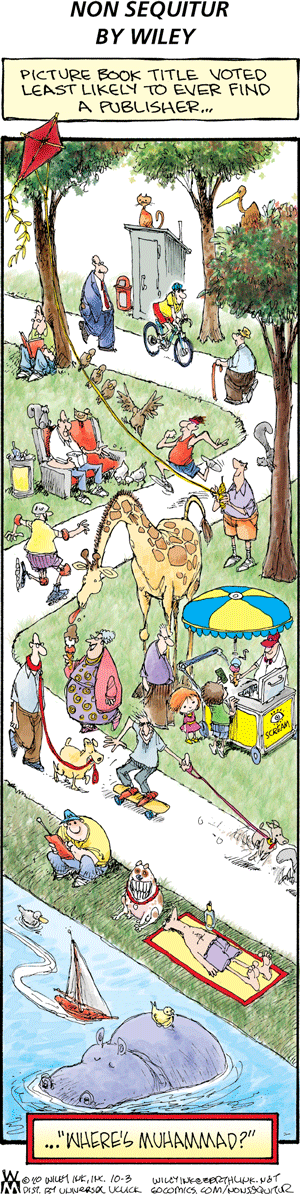
This comic was not published?

Over to Matt Welch:
As Radley Balko noted in yesterday's Morning Links, the Washington Post and other newspapers pulled Wiley Miller's syndicated "Non Sequitur" cartoon from their comics pages two Sundays back, because Miller pulled a familiar-to-Reason-readers "where's Waldo?" gag with the Prophet Muhammad, satirizing the new 21st century taboo on the depiction of even jokes about the fear of depicting a historical figure who really existed.
As is typical of the genre, Washington Post editors tried to play their own "where's Waldo" with the censorship process:
Style editor Ned Martel said he decided to yank it, after conferring with others, including Executive Editor Marcus W. Brauchli, because "it seemed a deliberate provocation without a clear message." He added that "the point of the joke was not immediately clear" and that readers might think that Muhammad was somewhere in the drawing.
If the Post's new standard for comics is to make jokes "immediately clear," then it might be time to kill the comics page altogether. No, Martel/Brauchli, you pulled the cartoon because your fear of Muslims outweighs your commitment to free expression, period.
Now comes L.A. Times media critic James Rainey, who, even while concluding that the cartoon should have run (the L.A. Times, to no one's surprise, suppressed it), makes sure we understand that fear was not a factor, nosiree:
That's not to agree with some commentators who have called the refusal to run the comic a cowardly retreat from radicals. I'd say the ax that fell on "Non Sequitur" had more to do expediency. Moving in a hurry, with many other decisions that seemed more pressing at the time, editors probably killed the item rather than face the possibility of a furor for a piece they honestly felt was not of high quality.
Uh-huh.

Tuesday, September 01, 2009

You pay for Faux News, but not for the NY Times?

More than a decade ago, after returning from our Europe trip, I contacted the cable company and asked them whether I could get rid of CNN and instead get CNN-international, because the international version of CNN was infinitely better then. The cable company said I could purchase the CNN-international channel at an extra cost, and explained that there was no possibility of picking and choosing my own channels.

I hated this bundling then, and hate it even now. After Faux News came on to the scene, and the more it became insanely partisan, I simply programmed the television to skip that channel when we surfed looking for something interesting to watch.

You can see, therefore, why I like the way Peter Osnos frames this television channel bundling and contrasts with the "free" newspaper/magazine journalism:

Once aware that they are supporting Bill O'Reilly et al, most of my interlocutors shrug and say something about bundling charges on cable or their combined bill, which includes broadband access and even, in many cases, telephones. Paying these bills, which on average are well over $100 per month, is routine now in the overwhelming majority of American homes. There was a movement a few years ago to consider "a la carte" pricing for cable, which would allow customers to choose the channels they wanted. That concept went nowhere because it meant that only popular channels would flourish. Those favored by smaller numbers--my relatively esoteric cable favorites are the Independent Film Channel, Turner Classic Movies, and C-Span-would probably disappear or certainly suffer.

In the current economic media crisis, cable companies have remained consistently strong because of this fee structure, even in the face of a reduced (but steady) stream of advertising, and because cable is among the last things that struggling households would cancel.

Few readers of this piece, I suspect, would be surprised by what I have written so far. But the point of reviewing the issue now is the next question I put to people. "How much would you pay for a monthly Internet subscription to the New York Times?" The answers range from "name the price" to "why should I pay? I already get it for free." And therein resides the challenge: Americans willing to pay for cable television subscriptions to channels they never watch must be persuaded to subscribe to online versions of the publications they read in print or on the Internet.

Sunday, July 05, 2009

The death of the newspapers.

It is not an exaggeration by any means. Megan McArdle writes:

Journalism is not being brought low by excess supply of content; it's being steadily eroded by insufficient demand for advertising pages. For most of history, most publications lost money, or at best broke even, on their subscription base, which just about paid for the cost of printing and distributing the papers. Advertising was what paid the bills. To be sure, some of that advertising is migrating to blogs and similar new media. But most of it is simply being siphoned out of journalism altogether. Craigslist ate the classified ads. eHarmony stole the personals. Google took those tiny ads for weird products. And Macy's can email its own damn customers to announce a sale.

We could herd every new media type into camps and force them to become shorthand/typists, and newspapers would still be in just as bad shape as they are now. We could take down Google News, and it would barely register in their bottom lines. Even if every newspaper and magazine in the country entered into a binding cartel agreement not to put more than a smidgen of free content on their websites, newspapers would still be losing money, and closing by the dozens. It's the economics, stupid.

We're not witnessing the breakup of a monopoly, in which more players make more modest incomes providing more stuff, and everyone flourishes (except the monopolist). We're witnessing the death of a business model. And no one has figured out how to pay for hard news. Hard news stories take a great deal of time to write--more time than most amateurs can afford, which is why blogs tend to do opinion rather than journalism. Moreover, they are at least greatly improved when their authors are not worried about losing their jobs if what they write pisses off a local power broker.

This is a genuine loss for the American public.
Yes, it is a genuine loss. Papers, particularly local papers, if they do good work, can be wonderful for the local communities. And, many of them do. As they close shop, I wonder what will happen.

Wednesday, January 28, 2009

How to keep alive newspapers, which are dying fast

I like this idea:

we are dangerously close to having a government without newspapers. American newspapers shoulder the burden of considerable indebtedness with little cash on hand, as their profit margins have diminished or disappeared. Readers turn increasingly to the Internet for information — even though the Internet has the potential to be, in the words of the chief executive of Google, Eric Schmidt, “a cesspool” of false information. If Jefferson was right that a well-informed citizenry is the foundation of our democracy, then newspapers must be saved.

Although the problems that the newspaper industry faces are well known, no one has offered a satisfactory solution. But there is an option that might not only save newspapers but also make them stronger: Turn them into nonprofit, endowed institutions — like colleges and universities. Endowments would enhance newspapers’ autonomy while shielding them from the economic forces that are now tearing them down.