Tony Judt, a frequent contributor to the NY Review of Books, is a bold thinker who does not shy away from controversies, and is now battling ALS--Lou Gehrig's disease. Even as the disease slows him down (read
this moving piece by him on his daily life), Judt has been writing, and he recaps his (and his generation's) active involvement in the protests of the 1960s.
Judt writes:
Looking back, I can’t help feeling we missed the boat. Marxists? Then why weren’t we in Warsaw debating the last shards of Communist revisionism with the great Leszek Kolakowski and his students? Rebels? In what cause? At what price? Even those few brave souls of my acquaintance who were unfortunate enough to spend a night in jail were usually home in time for lunch. What did we know of the courage it took to withstand weeks of interrogation in Warsaw prisons, followed by jail sentences of one, two, or three years for students who had dared to demand the things we took for granted?
For all our grandstanding theories of history, then, we failed to notice one of its seminal turning points. It was in Prague and Warsaw, in those summer months of 1968, that Marxism ran itself into the ground. It was the student rebels of Central Europe who went on to undermine, discredit, and overthrow not just a couple of dilapidated Communist regimes but the very Communist idea itself. Had we cared a little more about the fate of ideas we tossed around so glibly, we might have paid greater attention to the actions and opinions of those who had been brought up in their shadow.
No one should feel guilty for being born in the right place at the right time. We in the West were a lucky generation. We did not change the world; rather, the world changed obligingly for us. Everything seemed possible: unlike young people today we never doubted that there would be an interesting job for us, and thus felt no need to fritter away our time on anything as degrading as “business school.” Most of us went on to useful employment in education or public service. We devoted energy to discussing what was wrong with the world and how to change it. We protested the things we didn’t like, and we were right to do so. In our own eyes at least, we were a revolutionary generation. Pity we missed the revolution.
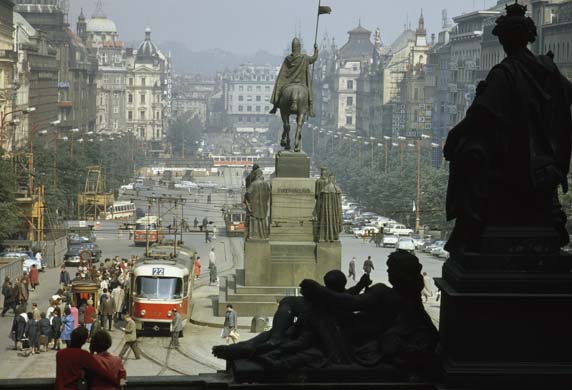
Prague in 1968 (photo and text here from
The Guardian):
Warsaw Pact tanks invade Prague. People are depicted going about their daily business as the tanks sit just a short distance from them