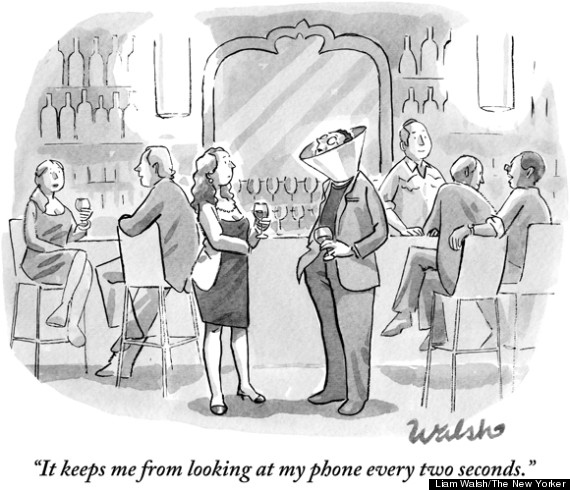
Of course it was not Moses. It was Charleton Heston who played that role. And, no, he did not utter those lines when walking around as Moses. Heston was scaring the cult, er, the NRA, that the government was coming to get their guns. This was 18 years ago, when the NRA was campaigning against Al Gore.
No, this is not a post about guns.
It is about smartphones about which most people will defiantly declare that they will never be separated from them. "From my cold, dead hands!"
If I’m honest, much of what I did on my phone could be characterized as
mindless. I can’t count the number of times I pulled out my phone just
for the feeling of unlocking the screen and swiping through
applications, whether out of comfort—like a baby sucking her thumb—or
boredom—like a teenager at school, tapping his fingers on a desk. In
those cases, I sought not mental stimulation, but physical release.
In the old days, at the airports, for instance, people might have even attempted to talk to the people next to them. Or, maybe they walked up and down observing people and wandering into stores. Now, it is all about the smartphone--even if they are only aimlessly and mindlessly locking and unlocking their phones!
If personal technology is improving the world of thought, what is it doing to the world of our moving, breathing bodies?
What is it doing to us?
The author of that essay has given up her smartphone.
Without my phone, I’m more fully myself, both in mind and body. And now,
more than ever, I know that looking at my phone is nothing compared to
looking at my daughter while the room sways as I rock her to sleep, or
how shades of indigo and orange pour in through the window and cast a
dusky glow over her room, or the way her warm, milky breath escapes in
tiny exhalations from her lips, or how the crickets outside sing their
breathless, spring lullaby.
I don't believe in giving up the smartphone. But, I do believe in moderation. I believe in making sure that I own the phone, and that the iPhone does not own me. Often, just to make sure I know how to operate in this world without the smartphone, I go about running errands without carrying my phone. As much as possible, I refuse to use the map app. I don't have to die in order to give up my iPhone.
Remember that powerful line from The Bridge on the River Kwai? "What have I done!"
That's the sentiment that slowly some of the technology folks are beginning to express.Like some early Facebook employees, who now worry "about the monster they have created."
It is not merely with Facebook. It is the same with Twitter, Instagram, Snapchat, ... the list is endless.
Why? The reason is a simple one, which I have discussed a lot in this blog. But, we need to be reminded over and over again:
One of the problems is that these platforms act, in many ways, like
drugs. Facebook, and every other social-media outlet, knows that all too
well. Your phone vibrates a dozen times an hour with alerts about likes
and comments and retweets and faves. The combined effect is one of just
trying to suck you back in, so their numbers look better for their next
quarterly earnings report. Sean Parker, one of Facebook’s earliest investors and the company’s first president, came right out and said what we all know:
the whole intention of Facebook is to act like a drug, by “[giving] you
a little dopamine hit every once in a while, because someone liked or
commented on a photo or a post or whatever.” That, Parker said, was by
design. These companies are “exploiting a vulnerability in human
psychology.” Former Facebook executive Chamath Palihapitiya has echoed this, too. “Do I feel guilty?” he asked rhetorically on CNN about the role Facebook is playing in society. “Absolutely I feel guilt.”
It is easy for the likes of Sean Parker to say that now, right? After all, he has made his gazillions; Wikipedia notes that he is worth $2.4 billion! Our addiction is their dollars. If only users paused to question why they are getting these services for free. No free lunch, as economists always remind us.
People who know me sometimes even make fun of my regimented life. I stick to my eating regimen, my sleeping regimen, and ... Even when playing bridge, I commit myself to ending the playing by typing to other players that I will play one final game and after that game, well, I sign off. It is all because I know well how delightful it is to have that extra chocolate. That extra cookie. More time in bed. One more ... We humans are wired for such addictions. And technology is now explicitly and intentionally tapping into our addictive personalities.
[A] rigorous technology of the mind is really what we need now as a
civilization because the thing that’s killing people nowadays is too
much Facebook and cheeseburgers. We solved the problems of the
biological age by vaccines and antibiotics and discovering all these
things, and stopping the things that were killing people, and we’re not
going to find the technologies to fix these behavioral problems of
addiction, technology overuse, overconsumption of everything by walking
away from the technologies of the mind. We’re going to solve them by
getting rigorous and having a complete science and technology so that
people can reprogram themselves into the people they want to be.
We need to "reprogram" ourselves? Ain't gonna happen!
Over the years, I have come up with many arrangements in order to manage technology in my life. After I switched to the smartphone--which I did only because my old phone became non-functional--I made sure that notifications were turned off. I set it up such that unless I activated email or Facebook or Twitter, well, there would not be any automatic downloading of the latest.
On top of all these, I almost always went for my favorite walk by the river without my phone. It was me, the river, the trees, the birds, the everything but technology. Sometimes, even my grocery and other errands were without the iPhone, which I would leave behind at home.
All because for the longest time I have operated with a clear notion that I get to decide how to use technology, and that technology should not begin to redefine my life.
Perhaps it is this distrust of technology at an instinct-level that also contributed to my wanting to ditch engineering at the earliest. I am all the happier that such a good instinct has guided my life ;)
It is more than instinct, of course. There is an increasing body of evidence that people of all ages, and the younger ones in particular, are addicted to the gadgets because of the number of apps that specifically prey on our wiring for addiction. Yes, as much as the tobacco industry knew how nicotine is addictive, these app developers also know how addicting it can be.
While some blame our collective tech addiction on personal failings,
like weak willpower, [Tristan] Harris points a finger at the software itself. That
itch to glance at our phone is a natural reaction to apps and websites
engineered to get us scrolling as frequently as possible. The attention
economy, which showers profits on companies that seize our focus, has
kicked off what Harris calls a “race to the bottom of the brain stem.”
“You could say that it’s my responsibility” to exert self-control when
it comes to digital usage, he explains, “but that’s not acknowledging
that there’s a thousand people on the other side of the screen whose job
is to break down whatever responsibility I can maintain.” In short,
we’ve lost control of our relationship with technology because
technology has become better at controlling us.
You, dear reader, are like me in how much you are fighting against the technology that wants to control our lives. But, we are in a minority. A shrinking minority. A rapidly shrinking minority.
One of the main centers that has spawned highly intelligent software professionals who create such addictive apps is the Persuasive Technology Lab, at Stanford.
Run by the experimental psychologist B.
J. Fogg, the lab has earned a cultlike following among entrepreneurs
hoping to master Fogg’s principles of “behavior design”—a euphemism for
what sometimes amounts to building software that nudges us toward the
habits a company seeks to instill. (One of Instagram’s co-founders is an
alumnus.) In Fogg’s course, Harris studied the psychology of behavior
change, such as how clicker training for dogs, among other methods of
conditioning, can inspire products for people. For example, rewarding
someone with an instantaneous “like” after they post a photo can
reinforce the action, and potentially shift it from an occasional to a
daily activity.
Pause and think about this. Highly intelligent people are sitting around and systematically creating ways in which people can become addicted to the apps they create. You think a great number of humans will be able to fight such a concerted effort? It is a losing battle for most people, my friend.
One of the examples cited there was something that I had not known about--the Snapstreak feature in Snapchat. After reading the article--which I did offline the old fashioned way by holding The Atlantic in my hands--I had to Google "snapstreak" to understand it. Check it out, if you are like me and you have no idea what that is. Here is an effect that the addictive Snapstreak has:
Research shared with Harris by Emily Weinstein, a Harvard doctoral
candidate, shows that Snapstreak is driving some teenagers nuts—to the
point that before going on vacation, they give friends their log-in
information and beg them to snap in their stead.
Of course we know why they have to make things more and more and more addictive:
“They want to make things more sugary and more tasty, and pull you in,
and justify billions of dollars of valuation and hundreds of millions of
dollars [in] VC funds.”
Tristan Harris is also a young tech dude, but is leading a good fight on behalf of us. "Under the auspices of Time Well Spent, Harris is leading a movement to change the fundamentals of software design."
A few months ago, I sent a link about Harris and his "Hippocratic oath" to a student who was working on her thesis with my guidance. I am always awed by people like Harris who are willing to give up gazillions in order to do good things. I will end this post with one of his talks on this subject. After reading this, and after watching his video, put your phone and laptop away, shut off the television, and go talk with a human. Make eye contact. Hold their hand. Contemplate on what it means to be human. You will be healthier--and wealthier too.
Some might think that people already spend too much time on the social
network. According to one estimate, most Americans spend the equivalent
of two full workdays each month on Facebook. In the future, might they
pass even more time? Mark Zuckerberg is hoping so.
Or this:
Facebook has attracted and engaged so many users by engineering
features that are highly addictive and relevant to their lives, so
people keep coming back for more hits
With all the time spent on Facebook and on various entertainment options, is it any wonder we can't get people, especially students, to focus on ... hey, hey, listen to what I have to say and do not open your Facebook messenger window! ;)
We are now living in a world that was imagined in Ray Bradbury's Fahrenheit 451 and EM Forster's The Machine Stops. Our daily lives are dedicated to watching electronic screens for entertainment of different kinds and we seem to be less and less keen on interactions with the real world as we rush towards virtual reality.
To some extent, Bradbury was wrong when he imagined that the future would include a government department whose responsibility would be to burn books and make sure people did not accidentally read any--it turns out that there is no real need to impose anything like that because ... hey, hey, listen to what I have to say and do not open your Facebook messenger window! ;)
Facebook is expected to announce more plans for turning Messenger, one
of its messaging services, into a portal through which people can
fulfill tasks, like ordering taxis and communicating with businesses. Mr
Zuckerberg is hoping that Facebook will be an even bigger part of the
mobile ecosystem in the future. Being both useful and addictive could
win Facebook even more friends
As I noted in this post from a mere days ago, Zuckerberg knows well that to keep the addicts on a high will mean increasing the hits, which is where the new "live video" also kicks in.
On Facebook.com, you can now view a live map of broadcasts taking place around the world.
And you can now broadcast live to specific audiences, such as those in a
Facebook group or those invited to an event, rather than to the public
at large. Those watching a live video can send reaction emojis in real
time, rather than just liking the video as a whole. When you watch a
replay, you’ll see the reaction emojis pop up on the screen at the same
point in the video when people sent them. You can also invite friends to
join you in watching a live video and they’ll get a push notification
linking to the feed. Live, live, live!
It is unfortunate that Facebook has made "live" as it relates to "life" into an obscene four-letter word of "live." Guess what? It is delivering hits to the addicts:
the approach seems to be resonating: On average, Facebook says people
are commenting 10 times more on live videos than they do on regular
videos.
The ruler of this drug empire is thrilled:
“We’re entering this new golden age of video,” Zuckerberg told BuzzFeed.
“I wouldn’t be surprised if you fast-forward five years and most of the
content that people see on Facebook and are sharing on a day-to-day
basis is video.”
Hey, selling this addiction has made the young drug-lord worth more than 35 billion dollars! Are you not entertained?
I have blogged in plenty about my love-hate relationship with Facebook and, therefore, I will stay away from reciting the ten things I hate about Facebook. Let me, instead, tell you what I did.
A few days ago, I thought it might be a great time to conduct an experiment--to go off Facebook for a week. Just like that. Without leaving any note on Facebook.
My hypothesis was that I would not miss anything by staying away from Facebook. After all, if there was anything important, then friends--the real ones, that is--will email or text or even call me. If the real friends wonder about my absence, then they will email or text or even call me inquiring if I am ok.
What I did not expect was this: Facebook got worried that I was not logging in. After a couple of days, the Facebook algorithm started bugging me with emails like this:
It is understandable that Facebook will care--the business model is based not merely on the number of users but on the time that users spend on Facebook. What if quite a few more users behave like me and do not login for a few days? That's not a user behavior that will work for the shareholders.
The insidious, distracting suck of the Internet has become seemingly
inescapable. Calling us from our pockets, lurking behind work documents,
it’s merely a click away. Studies have shown that each day we spend, on average, five and a half hours on digital media, and glance at our phones 221 times.
And just like the tobacco industry that went after the human fascination for an addictive nicotine, the highly qualified programmers systematically write apps for us to waste our time:
Meanwhile, the developers of websites and phone apps all exploit human
behavioral tendencies, designing their products and sites in ways that
attract our gaze – and retain it.
Yep, they systematically cultivate this addictive behavior:
Content on the net isn’t only designed to grab our attention; some of
it is specifically built to keep us coming back for more: notifications
when someone replies to a posts, or power rankings based on up-votes.
These cues trigger the reward system in our brains because they’ve become associated with the potent reinforcer of social approval.
Not surprisingly, Internet use is often framed in the language of addiction.
What might one then do, right? Let me tell you how I have now worked it out with Facebook--I do not login unless I have something to post there that will appeal to my real friends. Like when I posted this photograph of flowers from the friend:
Then, in a manner of veni, vidi, vici, I exit Facebook before its sirens can trap me there for a long stay. Which is the kind of an approach that researchers also suggest--"the best trick is to commit ourselves to a different course of action in advance – with force, if necessary."
The key is that self-control and resisting temptation are not the same thing. Odysseus had one, but not the other.
Instead, good self-control was characterized by the ability to avoid
temptations in the first place. We often think of self-control as the
ability to white-knuckle our way through temptation, but studies such as
this one indicate that self-control can also be as simple as planning
ahead to avoid those traps.
The next time you need to get something done, consider precommitting
to avoiding the Internet altogether. Like Odysseus, realize that if you
find yourself facing temptation directly, the battle may already be
lost.
If only I can make sure that students in high schools and colleges--at least those in my classes--will read all these and think this through. But then I cannot even get them to pay attention to what I say--while standing right in front of them! Maybe I am not addictive ;)
It was class meeting unlike any other day. No, I didn't receive any award. No, the students did not sing my praises.
Why was that class meeting special? Students were talking, and talking loudly with each other during the break. It was noisy, in contrast to the quiet time that the breaks are when students work their smartphones.
Of course, I made sure I remarked about that as we resumed the discussions.
A hermit I am, but I worry a lot that we are rapidly moving away from face-to-face real-time conversations. I worry about this not because I am a neo-Luddite; but because my instincts tell me that the more we move away from face-to-face conversations, the more we lose whatever ability that we might have to empathize with fellow humans. To me, erosion of empathy is a serious threat to what it means to be human.
Why might too much digital participation be corroding empathy, whether online or offline?
It is complicated to summarize here; read the essay.
Digital technology and the internet are also messing us up in ways that we tend to not think about. Remember the following quote from a few months ago?
“The
Net,” Carr writes, “is by design an interruption system, a machine
geared for dividing attention. Frequent interruptions scatter our
thoughts, weaken our memory, and make us tense and anxious. The more
complex the train of thought we’re involved in, the greater the
impairment the distractions cause.”
Or
as the economist and Nobel laureate Herbert A. Simon put it even more
presciently in 1971, “What information consumes is rather obvious: It
consumes the attention of its recipients. Hence a wealth of information
creates a poverty of attention.”
That itself is not as worrisome as this: apps are designed to cause these interruptions and to get your time and attention.
Nir Eyal, offers a practical guide in his book Hooked: How to Build Habit-Forming Products.
A former game designer and professor of “applied consumer psychology”
at Stanford’s Graduate School of Business, Eyal explains why
applications like Facebook are so effective. A successful app, he
writes, creates a “persistent routine” or behavioral loop. The app both
triggers a need and provides the momentary solution to it. “Feelings of
boredom, loneliness, frustration, confusion, and indecisiveness often
instigate a slight pain or irritation and prompt an almost instantaneous
and often mindless action to quell the negative sensation,” he writes. “Gradually, these bonds cement into a habit as users turn to your product when experiencing certain internal triggers.”
The
financial value of an app is largely determined by how much time
consumers spend using it, on the assumption that usage translates into
advertising revenue.
If product design has a conscience at the moment, it may be Tristan
Harris, a former B.J. Fogg student at Stanford who worked until recently
as an engineer at Google. In several lectures available on YouTube,
Harris argues that an “attention economy” is pushing us all to spend
time in ways we recognize as unproductive and unsatisfying, but that we
have limited capacity to control. Tech companies are engaged in “a race
to the bottom of the brain stem,” in which rewards go not to those that
help us spend our time wisely, but to those that keep us mindlessly
pulling the lever at the casino.
Harris wants us think about this way: we are like the casino gambling addicts at the slot machines. The longer the casinos can retain the gamblers at the machines, the more money the house makes. Note here that the gamblers are not playing with hundred dollar bills--it is mostly coins they bet every time. Nickels and dimes and quarters. But, the longer they stay in the casino, those coins add up. The more we get hooked onto to those time-consuming apps, the more "they" earn and the more we lose.
Weisberg ends the essay on a depressing note:
Aspirations for humanistic digital design have been overwhelmed so far
by the imperatives of the startup economy. As long as software engineers
are able to deliver free, addictive products directly to children,
parents who are themselves compulsive users have little hope of
asserting control. We can’t defend ourselves ...
The software guys (almost always guys!) are making sure the house will always win! :(
I suspect that the idea of fasting happened upon humans when they worried that eating and drinking every day might make them forget the value and importance of food. Further, the more they ate and drank the less they paid attention to their souls. Thus, humans in different cultural contexts developed a system of fasting, usually within the religious contexts as well.
The cleansing detox programs like fasting, I like to imagine, date back to when humans began producing enough surplus for them to start building cities and creating what we refer to as civilizations.
As we materially progressed and prospered, the detox programs also took on different variations. Food detox programs continue, of course. Detox against shopping. Against driving. Against watching television. Recall MTV's "Unplugged" program? That was a detox of a different kind.
The latest along that is detox from social media and the internet itself.
There are now resorts that guarantee you that you won't be able to access the internet. You hand over your gadgets when you check in and then for the rest of the stay there, well, you are on a digital detox. The Travel Channel even suggests the best unplugged vacation places! You prefer advice on that from the Wall Street Journal?
We forget that the internet and the digital applications are not the problem by themselves, writes this author at Wired.com:
We all know that social media is a mixed bag. Regular studies connect its use to anxiety, and episodes of depression. There are legitimate questions about its impact on our brains. But it has also transformed many tasks, made us more productive, and at times, helped us to feel more connected. Like any technology, it’s not the tool that poses the problem. It’s how we use that tool.
Even when acknowledging it, he writes about taking off from social media for the entire month of August. He is off on a digital detox--his third annual treatment!
Meanwhile, over at the NY Times is this piece about "struggling to disconnect from our digital lives"
The first step for me this month will be to shore up and seal my digital borders. I have learned from too many failed experiments that there is no resisting the Pavlovian pull of a ping announcing a new email, the vibration of my phone or the seductions of the Internet once I call up even a single site.
The only way to avoid these interruptions, I have learned, is to turn them off completely. If something requires my urgent attention this month, my away message directs senders to a colleague, who knows how to reach me and also knows how much I hope he won’t try.
I’m painfully aware that letting go won’t happen easily. I’m a lab rat now, deeply accustomed to tapping that lever over and over for the tiny pellets of brief stimulation and shallow gratification that life on the Internet provides.
People have apparently been driven so much into anxiety thanks to being connected 24x7 that they are willing to pay money to get away from it all. Or, they even sign up for the "Sabbath manifesto" and get away from all gadgets and technology on the "national day of unplugging." I want to tell them all that they can run but cannot hide! It is in your head!
I have my own routines to make sure I don't become a gadget zombie. But, I cannot imagine ever going on the detox route. I have never been a fan of fasting; it is all in the moderation. As they say in my part of the old country, "அளவுக்கு மிஞ்சினால் அமிர்தமும் நஞ" (the idea translates to "even the divine nectar can become a poison if one exceeds the limit.) I buy European butter that is rich in fat. The cream cheese that I buy is full fat. I buy chocolates and gelato. Because, I am convinced that it is in how much of those I consume and when. Consumed appropriately the European butter is the best thing ever on warm sourdough bread. There are few things in life more delightful than chocolate melting away in the mouth. But then I don't do that every single meal.
That's the same with digital consumption too. Yes, it is a consumption; as the author of the NY Times essay put it:
it’s as if I’m sitting in front of a bowl of Doritos or Hershey’s Kisses and compulsively consuming them, except in this case, it’s bytes, not bites. The more of them I take in, the more dissatisfied and hungrier I feel.
Perhaps moderation is not easy for us humans. Digital fasting is, thus, merely the latest of the forced removal of self from consumption. Who knows what comes next!
Earlier this afternoon, I stepped out to run errands, including getting my hair cut. I am now uber-conscious about my checklist. After going through the sequence, I intentionally left my cellphone behind at home and headed out.
I started doing this a while ago, but of course only when I am driving in town. I leave the cellphone behind fully knowing I might be away from my phone for three hours sometimes.
I was beginning to worry that my mental makeup was getting affected by the tether to this electronic gadget. A worry that I was becoming the Pavlovian dog responding to the beeps and sounds from the cellphone. In the old days, when stopped at the traffic light, if I looked at the rear-view or side view mirrors, there was a fair chance that I would see the eyes of the driver behind me. But, I started noticing that increasingly the drivers' heads were down. No eye contact anymore. They were gazing down at their gadgets.
Thus, even though I was a minimal smartphone user when away from home, I decided that I needed to take breaks. Of course, most of the time when I go for walks I am naked without the phone anyway. So, driving around in town without the phone was not going to be anything that dramatic. Nonetheless, I decided that I ought to, in order to make sure my brain doesn't get reprogrammed the way the businesses would like to brainwash me.
Even until a few years ago, that's what we did; remember? The landline is all we had and we went about our lives. We might have missed calls. But then we made sure to have an answering machine so that the bill collectors could leave their nasty messages ;) And remember how some of your annoying friends had some atrocious outgoing messages that made you wait forever for the beep?
Now think about kids and teenagers who are growing up with that tether. They have no experience whatsoever of being away from gadgets like smartphones. It should worry you. It should worry all of us.
Excessive use of computer games among young people in China appears to
be taking an alarming turn and may have particular relevance for
American parents whose children spend many hours a day focused on
electronic screens.
An attachment to books doesn't become something like that. An attachment to thinking and walking by the river doesn't prevent me from eating and going to the bathroom.
The documentary “Web Junkie,”
to be shown next Monday on PBS, highlights the tragic effects on
teenagers who become hooked on video games, playing for dozens of hours
at a time often without breaks to eat, sleep or even use the bathroom.
Many come to view the real world as fake.
Chinese doctors
consider this phenomenon a clinical disorder and have established
rehabilitation centers where afflicted youngsters are confined for
months of sometimes draconian therapy, completely isolated from all
media, the effectiveness of which remains to be demonstrated.
Let me repeat one sentence in case you didn't get the full weight of it: "Many come to view the real world as fake." Worried now?
This is not any uniquely Chinese problem. Japan has its version. And the internet of things will mean that sometime soon even Malawi's kids could end up as gadget zombies!
While Internet addiction is not yet considered a clinical diagnosis
here, there’s no question that American youths are plugged in and tuned
out of “live” action for many more hours of the day than experts
consider healthy for normal development. And it starts early, often with
preverbal toddlers handed their parents’ cellphones and tablets to
entertain themselves when they should be observing the world around them
and interacting with their caregivers.
Are you beginning to worry now? Not yet? Ok, how about some more excerpts:
“If kids are allowed
to play ‘Candy Crush’ on the way to school, the car ride will be quiet,
but that’s not what kids need,” Dr. Steiner-Adair said in an interview.
“They need time to daydream, deal with anxieties, process their thoughts
and share them with parents, who can provide reassurance.”
Technology is a poor substitute for personal interaction.
Aha, you recognize this theme from my other posts, right? Like even in this road-trip post from a few days ago.
Technology is a poor substitute for personal interaction, indeed.
Maybe, if I have the energy, I will write about the wonderful conversation that I had at the barbershop. In the meanwhile, for your health, plan on systematic disconnect from that ball and chain that restricts you--no, I am not referring to your spouse, but to your cellphone ;)