Friday, April 08, 2022

Pride and Prejudice

There wasn't a summer during the school years when we kids did not go to grandmas' villages.  I recall once complaining to my father about this after hearing about the trip to Delhi that a classmate took with his parents.  I wanted to see Delhi and Bombay and Calcutta and more, but we were always being bundled off to Sengottai and Pattamadi.

A few years ago, I asked my father why we never went to Delhi and Bombay and Calcutta.  He was in his mid-eighties and I was well into my middle age myself, and we were recalling the old days from our perspectives.  My father had a simple answer: Children going to spend time at grandmas' homes was what was expected.  And then he added something interesting: He said that he didn't know anything better either.  How often do parents give simple and straight answers without bullshitting!

As I have written before, the layout of the villages made religion and caste explicit.  Both grandmas lived in streets where only brahmins lived. Agraharams they were called. The extended family with whom I interacted a lot were all brahmins.  Brahmins friends with brahmins, and brahmins marrying brahmins.  

I was in my early teens when a family that was not a brahmin rented one of the homes.  It was tied to the native son who had become a guru to many through his ashram in Rishikesh.  As I remember it, there was some opposition to this from a few other households.  

As a kid, I often wondered where the others lived.  But, and especially in the culture in which I was raised, (uncomfortable) questions from kids were quickly and easily dismissed.  I was beginning to sense the separate-and-unequal existence of peoples. 

Once, in Sengottai, I went with my father and his uncle to visit with that uncle's friend.  The local men were friends.  My father was a colleague of the local man's son-in-law.  And I was a classmate of the local man's grandson.  So, of course, I tagged along.

We crossed the main road.  And then went to another part of the village.  There were no brahmins on the other side of the road!

Sadgati reminded me of the caste-based structure in Pattamadi and Sengottai, though--thankfully--I did not witness any horror.

The older I got, and especially after getting to America, the more I thought about all these.  It was not at all difficult to imagine and understand how much caste played a role throughout my life in the old country.  The fact that my grandfathers went to school, and then to college, made it easy for me to work my way to the United States.  Had my ancestors been Dalits ... ?

Every visit to Chennai, even strangers seem to easily sniff out that I was a brahmin by birth despite my outward appearance not being otherwise.  I suspect that it is because of the Tamil that I speak, with words and phrases that only brahmin households use.

A few months ago, we spotted a Tesla at the hotel that we were staying in California.  The middle-aged couple who got out of the car looked like they were from my part of the old country.  But, it was not them nor their car that caught my attention.  The personalized licence plate read "Aiyer."  I was shocked, and ashamed, that a Tamil Brahmin was proudly proclaiming his caste through the vanity licence plate.  Such public behavior makes it easy to understand why there is godawful casteism in the workplace in the Silicon Valley.

Will caste issues ever go away?

They will, can, be destroyed only if arranged marriages go away, and when inter-caste and inter-religious marriages become the norm. 

During the early years of my graduate schooling, I once wrote to The Hindu that inter-caste/religion marriage was the key to harmony in India--harmony among people who are otherwise defined by differences.  Marriages across caste lines. Marriages across religions. Of course, that was one of the many unpublished essays that I have authored.

There was no arranged marriage in my case.  Not too long after I got married--and well before I was divorced--one cousin wed an Oriya. Another is married to a Marathi. Yet another is married to a Christian.  There is a Muslim in-law in the extended family.  A couple of years ago, my father put together a list of such non-traditional marriages and it is a pretty long and impressive list!  

Of course, the number of cousins and their children with arranged marriages to Tamil brahmin Iyer spouses outnumber those of us who did not care to remain in that box.  A healthy start, nonetheless, and far, far away from the agraharams where my grandmothers lived.

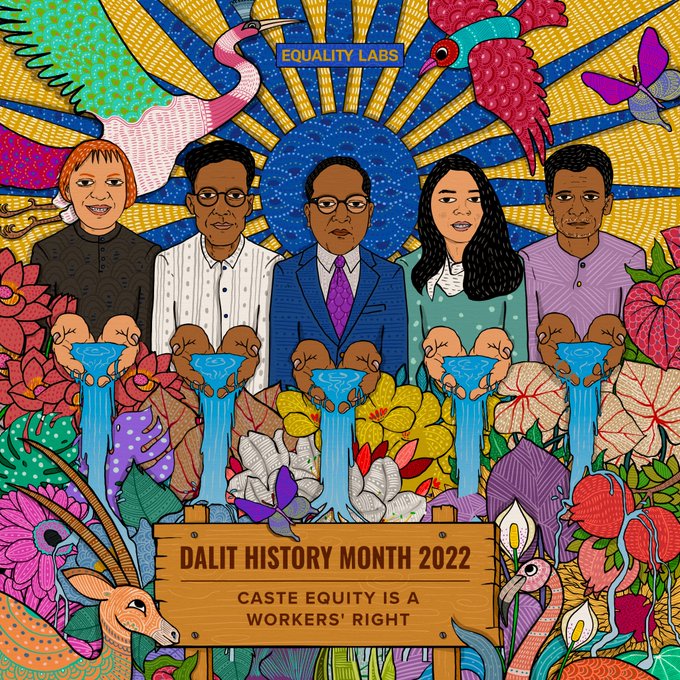
(It is Dalit History Month.  If you are looking for resources on this, click here.)

Wednesday, April 06, 2022

Globalization runs into nationalism

Way, way back on December 12, 2006, The Register-Guard published a commentary of mine on national identities.

As much as I have been a fan of globalization--my life is practically Exhibit A in arguing my case--I have always been concerned and worried about the loss of identity that many people fear.  Eating Mexican food is one thing, for example, for some people, but Mexicans moving to this country is not welcomed because of a "dilution" of national identity.  Marginalized groups want to firmly establish their identity because otherwise they lose political power and, along with that, even an erasure of their identity.

I have been thinking about that commentary in light of the ongoing war that putin has launched against Ukraine.  He falsely believes that there is no Ukrainian identity.  Ukrainians are fierce about how different they are from Russians.

So, here is that commentary from December 12, 2006:
******************************************************

To understand ethnic and religious tensions in faraway places such as Iraq, Lebanon or India, we need look no farther than our own northern neighbor – Canada. 

The Canadian parliament recently acted to formally recognize the Francophone province, Quebec, as a nation within Canada. Prime Minister Stephen Harper introduced the motion, which passed overwhelmingly. 

The move explicitly recognizes the ethnic nationalism that has been the driving force behind two failed referenda that called for a formal separation of Quebec from Canada. 

For years Quebecers have maintained that their language, history and cultural traditions were being systematically ignored, put down and forgotten by Canada's English-speaking majority. It's like Rodney Dangerfield's complaint: "I don't get no respect." Quebecers felt so intensely about this that in 1980 and 1995, they voted on proposals to formally secede from Canada. The prime minister's hope is that this formal recognition of Quebecers as a nation within Canada will preclude further independence efforts. 

Recognition of Francophone Canadians as a nation within the country comes almost 140 years after the country was formed. 

This recent development is a reminder that humans value and cherish their respective identities – in this case as members of a group with its own shared language, history and cultural traditions. Once we grasp this, we can begin to understand why there is a great deal of commotion along ethnic and religious lines in many other parts of the world. 

Take the case of Iraq. During World War I, the Ottoman Empire supported Germany, and after the war the empire essentially was carved into territories, one of which was the territory of Iraq. Iraq was placed under British control, as per the agreement developed by the League of Nations – the forerunner to the United Nations. 

Iraq then went through different forms of government, many of which were externally imposed. The modern-day Iraqi republic was established in 1958 after a military coup. In 1979, Saddam Hussein emerged as the president; as they say, the rest is history. 

During all this time, the many "nations" within Iraq not only were ignored by the government, some were in fact systematically abused because of their culture, language and religious beliefs. 

The Kurds are one of Iraq's ethnic groups; as a people, they also are scattered across Iran and Turkey. They want to be recognized as a "nation" as much as Quebecers did. Saddam's government killed many Kurds simply because they were Kurds. 

Turkey does not want the Kurds in Iraq to gain independence because of the worry that Kurds in Turkey will demand recognition of their status or, worse, join hands with the Kurds in Iraq and form a greater Kurdistan. These "nation" issues are not unique to Iraq or Turkey. 

These are found all across the world. In Quebec, the struggle for recognition is nonviolent. Unfortunately, that is the not the case in a number of other struggles to establish national and state identities. 

And even if a people's nationality is well recognized, achieving formal statehood is not always an orderly or peaceful process. Take the case with Palestine, where violence has been endemic for decades. 

Even in Bhutan, regarded by outsiders as a Shangri-la, there are problems related to ethnicity and nationality. Ethnic Nepalese have left Bhutan in large numbers because the monarch's policies do not appear to recognize differences in the way the Nepalese look, the Hindu religion they practice and, of course, the language they speak. 

We have been so wrapped up with our fascination with globalization that maybe we assumed that ours is a homogeneous world. On the contrary, we have different languages, religions, beliefs, histories. And sometimes, people want explicit recognition of those differences. 

It has taken Canada 140 years to formally recognize that Quebecers are a nation within their country. How long will it take for the Kurds, for instance, to be recognized as a nation within Turkey? 

So, let us use the opportunity that Quebecers have given us and understand not only the thirst for recognition, but the similar feelings that various "nations" have in all corners of the world. This recognition is a fundamental step in achieving peace and stability, particularly in the violent Middle East.

Tuesday, April 05, 2022

At least they built the railways!

“No man ever went to the East Indies with good intentions.” Wrote Horace Walpole.  As in no European man went to the East Indies with good intentions.  They went to plunder and colonize.  And they largely succeeded.

They stole everything that they could, and left their imprints on the lands.  They loved plundering so much that they even adopted "loot" into the English language:

One of the very first Indian words to enter the English language was the Hindustani slang for plunder: “loot”. According to the Oxford English Dictionary, this word was rarely heard outside the plains of north India until the late 18th century, when it suddenly became a common term across Britain.

The colonizers succeeded in so many ways including how their languages spread around the world.  Instead of English, French, and Spanish being provincial languages,  they are now global.  A rich language like Tamil, with its long history, struggles to maintain its life against English.  Here I am, a Tamil by birth, blogging in the English language, while living in what was once a colony of Britain, after having immigrated from a country that was also a British colony!

Back in the old country, we used to say that at least it was the British that colonized us, and not the large-scale killers and torturers like Belgium or even the Netherlands.  France's unwillingness to let go of Algeria reminded us about the hollowness of Liberty, Equality, and Fraternity. 

Further, the British built up the railways and dams and canals and ... of course, we conveniently overlooked the fact that the British did that to make the plundering that much easier for them!

Britain gets off rather easily compared to its continental counterparts who went around colonizing lands and people in the other inhabited continents.  It is not that the British were saintly; recall Jallianwala Bagh?  They had a good public relations system, and they also knew how to cover their tracks, like how they did in Kenya: "Operation Legacy was intended to ensure that “the British way of doing things” would be remembered with “fondness and respect” – that the conduct of its imperial retreat would be seen as exemplary."

"The British Empire was much worse than you realize," writes Sunil Khinani in The New Yorker. 

[The] British Empire’s baneful legacy may well have been deeper and more diffuse than that of any other modern state. Was British liberal imperialism, given the extent of the damage it inflicted over generations, a more malevolent influence on world history than even Nazi Fascism?

The empire retracting back to the cold islands in the northern seas did not clear the slate, so to speak, in the former colonies.  The multi-generational legal system that was in place in the colonies became a part of the legal system in the newly independent countries, and often this had disastrous results for people:

Ghanaian leaders, shortly after their country became independent, in 1957, cribbed from British preventive-detention laws the right to detain citizens for five years without trial. In the nineteen-sixties, Malaysian officials, building on British models, enacted laws permitting suspects to be detained indefinitely. In the seventies, Indian leaders used colonial emergency powers embedded into their constitution to censor the press, jail political opposition, clear urban slums and even sterilize their residents.

I used to think that the "emergency" years in the seventies were India's darkest as an independent democracy.  But, the virulent anti-minority politics and policies of contemporary India make a saint of Indira Gandhi and her power-hungry "emergency" rule.

Why is such a discussion important?  We need to get the inaccuracies out of our past stories, and accurately present the colonizers for what they did; else, going forward will not be easy.  As Pankaj Mishra wrote in a different context: "The old question—what is a country, and what is its basis?—has become menacingly relevant long after it appeared to have been settled."