Monday, April 11, 2022

Where in the world is ...

Take a look at the photograph of the mosque below:


Also look at the photo below of the same mosque, from a different angle, with the overflow crowd of Muslims praying:


It is a huge mosque that can accommodate about 10,000 people.

Now for the question: Where is this mosque located?

If you didn't know, chances are that you would use your critical thinking skills. 

You would immediately notice that the buildings around look modern and are well spaced.  Your mind thinks about the photos of mosques in countries with large Muslim populations, like Indonesia, Nigeria, India, or Pakistan.  In those countries, you would expect to see evidence of the dense and crowded human settlements all around such a mosque.  Here, there is no such evidence of a crowded settlement.

You are now left wondering where this mosque could be located.

You look again at the photo with worshipers all around the structure.  You look beyond them.  The buildings perhaps look like what you would expect in a country that is more affluent than Indonesia, Nigeria, India, or Pakistan.  Could it be Iran, you wonder.  But there is something about the red building in the first photo that makes you ditch Iran as the location.

Because the blogger lives in the US, you entertain the possibility that the huge mosque is somewhere in America.  Like in Detroit or Minneapolis or Houston which have large Muslim populations.  But then you notice that the mosque has no huge parking lots and parking structures nearby.  It then occurs to you that there is no way 10,000 people in America, whatever their religion, walk or take public transit to a place of worship.

You scratch your head.  All that does is remind you to shampoo your hair, and you have no idea where this magnificent mosque is located.

Your jaw drops when you read that this mosque is in Moscow, Russia.

It is a new mosque that was built on the same site as an older mosque that was demolished.  In 2015, Moscow's Cathedral Mosque was opened by, hold your breath, Putin.

Flanked by President Recep Tayyip Erdogan of Turkey and Mahmoud Abbas, the president of the Palestinian Authority, President Vladimir V. Putin used his speech at the inauguration of the mosque, which he called the biggest mosque in Europe, to emphasize that Russia would develop its own system of religious education and training to counter extremism. ...

“Finally, Moscow, which lays claim to the title of the biggest Muslim city in Europe, has a big mosque,” said Aleksei Malashenko, an expert on Islam at the Carnegie Moscow Center. “It shows that the center of Islamic life in the Russian Federation is in Moscow.”

Yes, Putin was there at the inauguration.  And maybe you are shocked about Moscow with "the title of the biggest Muslim city in Europe."

I am with you; as I wrote in this post in 2009, I would never have correctly guessed Russia's Muslim population.

The number of Muslims in Russia is mostly an educated guess because the government's data on this is suspect.  A recent US State Department report suggests that "there were 25 million Muslims in 2018, approximately 18 percent of the population." 

In case you are now wondering whether there are Muslims in Ukraine, the answer is yes, of course.


When we think of the diffusion of Islam, we often forget that Mongols went west too and took Islam with them.  The Ottoman Empire was also an important player in the geopolitics of the region and in spreading Islam.  In fact, Crimea, which is where Putin's Ukrainian invasion began, has a long history with Muslims:

From the mid-1400s it existed as the Crimean Khanate, a protectorate of the Ottoman Empire, during which time it became the center of a roaring slave trade. 
The modern name "Crimea" seems to have come from the language of the Crimean Tatars, a Turkic ethnic group that emerged during the Crimean Khanate. The Tatars called the peninsula "Qırım." While Russia, which annexed the state in 1783, officially tried to change the name back to Taurica, Crimea was still used informally and eventually reappeared officially in 1917.

All I want to do here is remind ourselves that the world is one complicated place, and that it takes a lot of work to understand it.

(A simple question popped up inside me.  "It is Ramadan now.  I wonder how it is being observed in Russia."  That, in turn, led me to wonder about mosques in Moscow.  This post was the result!)

Sunday, April 10, 2022

Ukrainian Honey Cake in Oregon

A month ago, I wrote about being a metaphorical squirrel in helping Ukraine defeat the Russian Ravana, like the squirrel that helped Rama vanquish Ravana in the Hindu mythological epic Ramayana.  While it is easy to imagine that we are insignificant in a geopolitical situation far away from where we live, we can and should find ways in this fight against evil.  If a squirrel could, what prevents us humans, right?

From here in Oregon, I contributed to Doctors Without Borders (MSF,) who have a dedicated unit for their Ukraine operations.  For years, I have been contributing to MSF to assist in the work that they do, and it was MSF that immediately came to mind when I thought about helping Ukraine.

In December 1999, after Doctors Without Borders was awarded the Nobel Peace Prize, its then president, James Orbinski, started his Nobel lecture with a reference to Chechnya:

The people of Chechnya—and the people of Grozny—today, and for more than three months, are enduring indiscriminate bombing by the Russian army. For them, humanitarian assistance is virtually unknown. It is the sick, the old and the infirm who cannot escape Grozny. While the dignity of people in crisis is so central to the honor you give today, what you acknowledge in us is our particular response to it. I appeal here today to his excellency the Ambassador of Russia and through him, to President Yeltsin, to stop the bombing of defenseless civilians in Chechnya. If conflicts and wars are an affair of the state, violations of humanitarian law, war crimes and crimes against humanity apply to us all—as civil society, as citizens, and as human beings.

Note the reference to "indiscriminate bombing by the Russian army."  

Putin became Russia's Prime Minister on Aug. 9, 1999, "and by the end of that month, Russia was waging a renewed bombing campaign against Chechen rebels in an attempt to reverse the earlier humiliation." 

Now, in 2022, more than decades after orchestrating a human tragedy in Grozny, an unchecked Putin is indiscriminately bombing civilian areas in Ukraine.

Organizations like Doctors Without Borders help ease civilians' sufferings.  As noted in that 1999 Nobel lecture:

Bringing medical aid to people in distress is an attempt to defend them against what is aggressive to them as human beings. Humanitarian action is more than simple generosity, simple charity. It aims to build spaces of normalcy in the midst of what is abnormal. More than offering material assistance, we aim to enable individuals to regain their rights and dignity as human beings. As an independent volunteer association, we are committed to bringing direct medical aid to people in need. But we act not in a vacuum, and we speak not into the wind, but with a clear intent to assist, to provoke change, or to reveal injustice. Our action and our voice is an act of indignation, a refusal to accept an active or passive assault on the other.

It is not charity, but with an "aim to enable individuals to regain their rights and dignity as human beings."  Fiercely proud people like Ukrainians detest the very idea that they need charity.  But, the reality is that civilian lives are affected in many ways that are beyond the imaginations of those of us who live in peaceful areas, watching our favorite streaming programs, and eating our favorite foods and snacks.

Food itself becomes an issue for civilians trapped in war zones.  Recognizing the urgent need of food, an Oregon bakery has been selling "Ukrainian Honey Cake" with the proceeds going to World Central Kitchen.  Friends who came over to have meals with us brought us this cake that they picked up at the bakery in Waldport:


There are many ways to contribute to defeat Putin, and to help Ukraine.  Be a squirrel.


Saturday, April 09, 2022

India is a fraternal society?

During the past few days, I have been reading up, watching videos, and thinking about caste and Dalit issues.  I have also been reading some of my own blog posts on this topic.

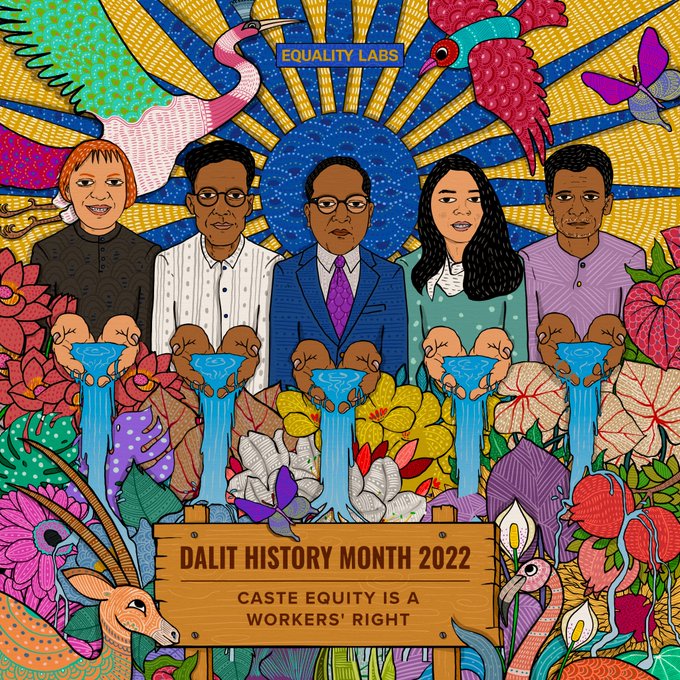
Click here if you want to tap into resources to further your understanding of caste issues during this Dalit History Month.

The following is a verbatim re-post of my blog entry from December 24, 2017:

************************

In this post a couple of days ago, I wrote about the geographic separation of religions and castes and subcastes that has been the condition in India forever.  I added there:
Had the randomness in the cosmos made me a Dalit and not a brahmin by birth, I know for certain that I would have been an angry young man, an angry middle-aged man, and perhaps a bitter old man, unable to forget the atrocities that were committed against my people.
The coexistence in India is a false narrative.  An overwhelming part of India operates within its own.
India is a fraternal society. There is a Brahmin society, a Reddy society and a Dalit society. Within each society, there is a sense of fraternity, but they don’t want to come out of that circle.
This is what I too had noted in my post, when I wrote, that the paths don't seem to cross much.  Unlike me, the one who remarked about the warped sense of fraternity in India is the Magsaysay awardee, Bezwada Wilson.
Bezwada Wilson has been fighting for the eradication of manual scavenging for three decades now. Born in Kolar, Karnataka, to a family of manual scavengers, he founded the Safai Karmachari Andolan in 1994 with retired IAS officer S.R. Sankaran and Dalit activist Paul Diwakar.
What he has been doing is simply invaluable.  According to his group, about 160,000 people continue to work as manual scavenging.  In the 21st century, as 2017 comes to an end!

Bezwada Wilson says:
Sanitation is reserved for Dalits. So there is no development in that field. We have apps to deliver food home without involving human beings but they can’t discover a technology to clear human waste. Caste is the reason behind this discrimination.
Launching rockets is a priority. Serving as the back office for US and European firms is a priority.   But, developing an appropriate technology to remove human shit is not a priority because it is not a priority for the upper castes, whose priorities are elsewhere.
Every field has extensive research, but in sanitation, no research is ever done. We are over 130 crore people, we defecate every day. We have a caste to clean it up. We don’t even think about it.  
When I was young, and a wannabe commie, all I knew was that the societal priorities were messed up.  As I got older, I figured that I did not have the balls to be an activist.  The best I could then do was to at least intellectually begin to understand the issues and engage with a few people about it.

After all these years, I am all the more convinced that there's something seriously wrong with the world, and I can't do a damn thing about it!