Tuesday, September 20, 2022

The best time to travel

Pattamadai was one grandmother's village, and Sengottai was the other's.  They were not even forty miles apart, but boy was it a pain to travel from one place to another!


It took almost five hours from the time we left one doorstep and walked into the other grandma's home.  Five tiring hours for forty miles of travel via public transport buses!

The main road in Sengottai

The bus stop at Sengottai was practically in my grandmother's backyard.  We would be at the stop by the post office a few minutes before the time that the bus was scheduled to arrive there.  And then the long bus ride, with stops that seemed to occur every two minutes.

The bus stop at Pattamadai was a long, long walk from home.  It always which seemed infinitely longer on those sunny and hot summer days.
The road home from the Pattamadai bus stand
Walk we did if we didn't have anything heavy to carry.  If not, via letters--the ancient days before even landlines became common--we would have pre-arranged for a bullock-cart.  Yep, bullock-cart.  We kids then competed for the car equivalent of "riding shotgun."  To sit up front was very exciting, even with the oxen farting and shitting as they walked.

We couldn't complain much about such travel conditions because the elders had even worse stories from their childhood days.  The complicated logistics and travel that took up an entire day were big reasons why they rarely traveled at all.  If it was out of the range of a bullock-cart ride, well, forget about it then.

A few of the extended family getting set for a short trip, about 60 years ago
(From parents' collections)

Travel was so arduous that elders always consulted the almanac to chalk out auspicious days, which seemed to assure them that they would safely return after completing a productive trip.  

It was just us three siblings traveling one summer.  We got bored at Pattamadai and got tired of the heat and the mosquitoes.  We preferred to return to Sengottai, which was always a tad cooler thanks to its location by the hills.  But, we weren't allowed to leave for two days because they were considered inauspicious.  செவ்வாய் புதன் வடக்க சூலம்  Yes, inauspicious for travel over those forty miles.

During another summer holidays, we weren't allowed to leave Pattamadai for a couple of days because there was a death in a house up the street.  The person who died was not related to us, but that didn't matter to the elders who were guided by the tradition that a death in the street meant that we couldn't leave!

Life was not easy, in the old days, and a belief in such auspicious days for travel was one way they thought they could deal with the probabilities of things going wrong.  After all, that we are mortals is not any new wisdom, and those astrological superstitions helped them deal with the uncertainties of life.

Franz Kafka writes about the uncertain life in the story, The Next Village:
My grandfather used to say: "Life is astoundingly short. To me, looking back over it, life seems so foreshortened that I scarcely understand, for instance, how a young man can decide to ride over to the next village without being afraid that -- not to mention accidents -- even the span of a normal happy life may fall far short of the time needed for such a journey."
Yet, we take those chances.  We humans have been taking those chances ever since walked upright and wandered out of Africa.

In mid-July, I left for a two month stay in Chennai.  I did not consult any almanac.  I bought the ticket based on my preferences and the availability of seats on the flight segments.  A distance from one side of the planet to another that is obviously way more than the forty miles that separated Pattamadai and Sengottai, and travel that involved flying for hours over oceans, the crossing of which was forbidden in the old traditions. 

In my almanac, every day that I am alive and well and able to do things is always an auspicious day!

Monday, September 19, 2022

A new academic year begins

I am pleasantly surprised, and relieved, at how much I have embraced by prematurely retired status, instead of constantly thinking about how things were and how life could  have been. 

"I am very disappointed that you are not working as a professor anymore," my father recently said.  "Because you don't have retirement age in American universities, I thought you would be a professor for a long time like GG" he added.  GG is his cousin, who has been a university professor for decades in Texas.

"If you are disappointed, then think about the magnitude of my disappointment," I told my father.  "Retiring this early was never in any of my plans."

But, life is what it is.  The Buddha advised us more than 2,000 years ago that our desire for something other than how things are is the root cause of suffering.  Thankfully, I do not ponder about work and life other than what they currently are, though there was the initial shock of it all that upset my mental equilibrium for a short time.

I was given my layoff notice in a Zoom call on March 30, 2021. 


Well before this layoff, almost six months prior, in manner that is typical of how I engage with the world, I authored a commentary in The Oregonian, which was published on November 4, 2020. In that commentary, I wrote:

Like many regional public universities in the United States, my university too is dealing with financial crisis that had been slowly developing and which the coronavirus accelerated.  “Our goal is to retain as many employees as possible,” noted the president in a three-page, single-spaced memo to the campus about the process of rightsizing the university.

In a couple of weeks, we will find out about the president’s plan to “align faculty resources with enrollment trends to reduce faculty expenses in academic programs.”

The regional public universities have been the ones that mostly served, and continue to serve, the vast numbers of under-privileged students.  You can easily recognize them.  Many of them have geographic identifiers like "western."  One of my first applications for a teaching job was to Southeast Missouri State University,  In California, the "CalState" campuses were designed as regional universities.

As one who has thought a lot about higher education, and has authored quite a few commentaries on it, I clearly understood that there was nothing unique about my layoff and how my former employer was going about the business of it all.  The large universities and private liberal arts colleges with money are in a league of their own.  But, not the regionals.

Today I read in the news of another regional going the same route: Declaring a financial emergency that then allows for tenured faculty to be laid off, so that the university can align its resources with what will sell in these contemporary times.  It is deja vu all over again, this time at Emporia State University in Kansas:

Ken Hush, the university’s president, told the board that for years, the university had enacted traditional budget-cutting measures like hiring freezes, spending restrictions, and voluntary retirements. It’s been “death by a thousand cuts,” Hush said. But “that doesn’t work for us anymore, either programmatically or financially.”

The university has terminated 33 positions, "the bulk coming out of the College of Liberal Arts and Sciences."  Sounds familiar to me.

Even in the years before the financial problems worsened, I repeatedly suggested to the president and anybody who raised the issue that there was a simple solution to untie the Gordian Knot: Cut the spending on athletics.  The millions spent on athletic entertainment can easily be downsized and academic programs can be sustained with that money.  But, of course, American higher education is cursed with spending gazillions on athletics.

In no other country’s university system, after all, does sports play anything like the central role it does in American academic life. Men do not go to Oxford to play cricket; the Sorbonne does not field a nationally celebrated soccer team. Even in the most sports-mad countries, sports is sports and education is education. That’s a better system.

American universities are big time landlords, who earn a lot of income from their developed real estate. Country clubs Dorms, conference rooms, auditoriums, climbing walls, etc.  Some also own huge basketball and football venues for educational purposes entertainment.

These public policy decisions I don't care about anymore.  The people have spoken, and very clearly at that.  Philosophy or Geography or History are not what universities are about.  Universities exist to offer football and basketball and more, and whatever money is left will be used for the liberal arts and sciences.

Sunday, September 18, 2022

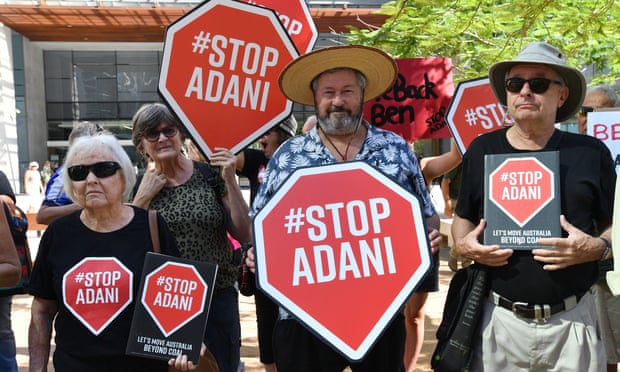
Stop Adani

A post that is about the coming together of capitalism, religion, and divisive nationalistic politics, might suggest to an American that this post is about tRump, whose political power is driven by "faithful" Christians and rabid capitalists alike, who are all united in their "bah, humbug!" attitude towards the natural environment.  But, America is not truly exceptional when it comes to such a formula of religious political economy.

This post is about the old country, where its current Prime Minister has long been a tRump well before tRump even surfaced as a candidate who slithered down the golden escalators.

Observing India from the other side of the planet, which is what I have been doing for 35 years, I wrote in this blog-post in March 2009: "I won't be surprised at all if Modi, or somebody like him, becomes the prime minister really soon."

He was elected Prime Minister in 2014, and was successfully re-elected in 2019.  Prior to his election in 2014, I authored a commentary in The Register Guard, in which I wrote:

Odds are looking highly favorable for the Bharatiya Janata Party (BJP) and its leader, Narendra Modi. Both the BJP and Modi have cultivated a nationalistic spirit, bordering on jingoism.  The party and Modi also have strong associations with Hindu nationalist groups.  Modi is alleged to have had a hand in the anti-Muslim riots in 2002, though subsequent government inquiries have cleared him of those charges. It is for these reasons that the US State Department has also denied Modi a visa to visit this country.  If Modi gets elected Prime Minister, I suppose we here would have an interesting and controversial political question to resolve.

mOdi's pro-business policies that couldn't care about the natural environment was lauded by corporate India, despite his divisive politics of Hindus vs others--especially Muslims.  Through all these years one person in particular has become so prosperous that he is now wealthier than Jeff Bezos, and that man is Gautam Adani.
How did he create those billions? "Many of his businesses are involved in natural gas, coal mining and electricity generation, and are likely to have benefited from the global energy price increase."

From the descriptions thus far, you are perhaps hypothesizing that there is a huge movement in India against this mega-mega-rich Indian and, hence, the "Stop Adani" slogan.

Nope.

It is from way down under.


The "Stop Adani" protests are truly Australian.

What has Adani done to piss off the usually laid back and sun-loving Australians?  "Adani is digging the biggest coal mine in Australian history"

Adani still plans to dig the biggest coal mine in Australia, extracting up to 60 million tonnes of coal a year for 90 years, and creating 4.6 billion tonnes of carbon pollution. Adani’s coal will be shipped through the Great Barrier Reef via Adani’s Abbot Point coal port and burned in Adani’s Indian coal plants. 
Adani’s mine will open the way for at least 8 other mega coal mines in Queensland’s Galilee Basin - one of the largest unexploited coal reserves in the world.

Stopping the world's third wealthiest guy from pursuing his grand ideas will not be easy, as one can imagine.

Adani continues to flex his muscles in order to pay back to the political movement and its leaders who made possible his unimaginable wealth.  A couple of weeks ago, Adani "a 29 percent stake in New Delhi Television (NDTV) and a proposal to buy an additional 26 percent from public shareholders."

Gautam Adani, the richest man in Asia and a close ally of prime minister Narendra Modi, owns some of India’s busiest airports and seaports, coal mines and power plants. This week, Adani made a foray into a new field — television — in a move that could reshape India’s media landscape.
...
It is not clear when Adani, who overtook Warren Buffett this year to become the world’s fourth-richest man, would amass a majority stake in NDTV and take control. But the move by a business mogul who famously lent his private jet to the prime minister-elect after Modi’s 2014 election triumph stunned India’s liberal elite, threw the broadcaster’s staff into upheaval and surprised even NDTV’s founders.

Because, you know, India too needs its own Fox News!

I doubt if either Adani or mOdi can be stopped.  What a tragedy!