Amy Howe: In Plain English: The Affordable Care Act, including its individual mandate that virtually all Americans buy health insurance, is constitutional. There were not five votes to uphold it on the ground that Congress could use its power to regulate commerce between the states to require everyone to buy health insurance. However, five Justices agreed that the penalty that someone must pay if he refuses to buy insurance is a kind of tax that Congress can impose using its taxing power. That is all that matters. Because the mandate survives, the Court did not need to decide what other parts of the statute were constitutional, except for a provision that required states to comply with new eligibility requirements for Medicaid or risk losing their funding. On that question, the Court held that the provision is constitutional as long as states would only lose new funds if they didn't comply with the new requirements, rather than all of their funding.Reports were that at one point, the live "readership" at SCOTUSblog exceeded half a million! Who cares for CNN or MSNBC or Faux Noose or CBS or ABC or ....
Thursday, June 28, 2012
SCOTUSblog on ObamaCare: The way to get news
At about a minute before 7:00 am, Pacific Time, I tuned into SCOTUSblog, which has long been my source for understanding in plain English what the highest court delivers in legalese. The wonderful folks there did it, again. Like with this plain speak at 7:32:

Tuesday, June 26, 2012
Poem of the day: I, a stranger and afraid ... In a world I never made
To re-assure myself of the world in which we have to deal with issues, here is a re-post from an earlier one--a profound poem by A.E. Housman:
The Laws of GodLife and its complexities!
THE laws of God, the laws of man,
He may keep that will and can;
Not I: let God and man decree
Laws for themselves and not for me;
And if my ways are not as theirs
Let them mind their own affairs.
Their deeds I judge and much condemn,
Yet when did I make laws for them?
Please yourselves, say I , and they
Need only look the other way.
But no, they will not; they must still
Wrest their neighbour to their will,
And make me dance as they desire
With jail and gallows and hell-fire.
And how am I to face the odds
Of man's bedevilment and God's?
I, a stranger and afraid
In a world I never made.
They will be master, right or wrong;
Though both are foolish, both are strong.
And since, my soul, we cannot fly
To Saturn nor to Mercury,
Keep we must, if keep we can,
These foreign laws of God and man.
Friday, June 22, 2012
Declining by degrees
We have practically forced more than a generation to go after post-secondary education, only for them to realize later that it might not deliver the pot of gold after all. Perhaps even makes them worse off than otherwise.
First, remember "Declining by Degrees" from a few years ago?
Over the years, we have pushed college so much that we have diluted the quality of education and, certainly, the economic worth of the college degree itself.

I have been commenting for years now that the problem began with linking higher education to nothing but employment benefits, which then made an undergraduate degree nothing more than a credentialing process. If we want to return to the grander ideas of higher education, then, we have to re-think how we measure what we value:

First, remember "Declining by Degrees" from a few years ago?
Over the years, we have pushed college so much that we have diluted the quality of education and, certainly, the economic worth of the college degree itself.
I have been commenting for years now that the problem began with linking higher education to nothing but employment benefits, which then made an undergraduate degree nothing more than a credentialing process. If we want to return to the grander ideas of higher education, then, we have to re-think how we measure what we value:
Here's a simple exercise that will help us appreciate how much we are missing the target right now. Think about how to answer the following questions. Which is the more important outcome?
1. A.) Acquiring knowledge or
B.) Improving critical thinking
2. A.) Getting a job or
B.) Getting a job you love
3) A) A graduate who gets a job or
B.) A graduate who creates jobs for others
4. A.) A good job or
B.) A good life
5. A.) A good life or
B.) A good society
The vast majority of us would answer B's across the board. ...
Aside from a hint of measurement of critical thinking, we are not currently measuring any of the most valued outcomes of an education. ...
The answer won't be found in running faster and harder toward the targets currently in front of us. And it won't be found in a new government standard or ranking system. We have to aim higher, for a wholly different -- and much more meaningful -- set of outcomes. They may be harder to measure than the ones we have now. But that's no excuse. Colleges and universities everywhere can measure these outcomes now, and if we want to defend the value of higher education, we must measure them.
Thursday, June 21, 2012
Cartoon of the day tests whether I have a sense of humor!
First the cartoon:

Hilarious!
But, apparently not everybody loves such humor. Some find, gasp, offensive, writes the New Yorker's cartoon editor:

Hilarious!
But, apparently not everybody loves such humor. Some find, gasp, offensive, writes the New Yorker's cartoon editor:
But offensiveness, like love, is in the eye of the beholder, and there are enough eyes eying The New Yorker that even cartoons that seem innocuous can trigger outrage.

Wednesday, June 20, 2012
Exporting coal is stupid and unethical. But, who listens to me!
I cannot believe that we Oregonians are actually considering
the idea of partnering with Wyoming and Montana in order to export coal toChina and anybody else who might want it.
Without a doubt, coal was an integral component of the
revolution that transformed the world over the last two hundred-plus
years. Coal’s heat melted iron in
furnaces, generated the steam for the “iron horse” locomotive engines, and
accounts for nearly 45 percent of the electricity generated in the US.
However, the days of coal as a resource that fuels the
economic engine are behind us. To quite
a large extent, we need to start thinking about coal the way we think about
wood as a source of fuel. Three centuries
ago, wood was by far the dominant source of energy—but, that does not mean that
we harvest trees in order to export them as firewood, do
we?
Our energy sources are quickly shifting towards better and cheaper alternatives. Even now, it turns out that joule for joule,
natural gas is rapidly becoming a better bargain than coal, similar to how coal
itself displaced wood in our economic history.
While natural gas extraction and use is not without controversies, its
price has been rapidly falling over the last few years, and is expected to
decrease in the immediate future as well.
The price for natural gas, which accounts for about a quarter of the
energy consumption in the US, has halved over the past year. So inexpensive it has become that even
coal-fired power generation plants are now being converted to make use of this
better source.

I
do understand the practical aspects of using coal in the developing countries. I grew up in an industrial township in Indiawhere low-quality coal was mined, which continues even now, in order to
generate electricity. Every visit to
India is a stark reminder of the tremendous energy shortage there. Countries like China and India, which are
experiencing rapid economic growth rates, will need a great deal of energy to
sustain this pace and they simply cannot dig enough coal fast enough from under
their own soils. Hence, they import coal,
typically from Australia and Indonesia.
One can, therefore, easily see why a Wyoming might want to export
coal—domestic demand is dropping fast, and there is an external demand for the
same commodity.
That there is a global market for coal shouldn’t surprise us,
when, after all, even now, there is quite an active market for firewood in
villages in India or Tanzania. But, that does not automatically mean we should hitch
our economic wagons to these coal trains.
This is not expected to generate a great deal of long-term sustained
jobs and incomes, nor will the few dollars have significant local economic multiplier
effects. To cap it all, coal is not a
growth industry, but one whose obsolescence is underway.
And then there are serious ethical problems. We regulate coal—right from the mining
stage—because we understand its potential to severely affect human and other
life forms, and the natural environment itself.
The burning of coal is regulated because of its various byproducts, including
carbon dioxide. When we are so worried
about the use of coal, shouldn’t we pause to carefully consider whether we
would want to export it to countries where regulatory and oversight structures
are considerably below our standards?
Finally, I find it disturbing, to put it mildly, that
affluent countries like the US and Canada, to merely name a few, are vociferous
about the fragile global environment, and yet are eager to sell to poorer
countries the very resources that are confirmed harmful agents. Whether it is coal or asbestos, which Canada gladly exports while banning domestic consumption, these
super-rich countries are only too happy to export to the much poorer cousins
materials whose continued use is not in the best interests of anybody on
this planet.
I would rather that we developed and exported technical knowledge so that the developing countries can afford to bypass the mistakes the richer countries made in their industrial revolutions. But, by exporting coal, we do these countries no favor at all.
I would rather that we developed and exported technical knowledge so that the developing countries can afford to bypass the mistakes the richer countries made in their industrial revolutions. But, by exporting coal, we do these countries no favor at all.
Tuesday, June 19, 2012
Obama's re-election hinges on unemployment and the Euro crisis?
What is the connection?
Kind of crazy, therefore, that Obama's re-election might heavily depend on the strict European mom, Angela Merkel:
All these get way too complicated for Obama because not everything is well on the domestic front. For one, it is only a matter of days before the Supreme Court rules on Obamacare.
And then there is that huge problem that remains awfully stubborn: unemployment.
for all the attention on Syria, Egypt and other areas of conflict, the most important crisis for Mr. Obama remains the European economy because of its impact at home. “Europe’s weakness is likely to blow back on Obama’s efforts this fall — just at the wrong time,” she said. “He’ll have to run harder because of it.”Spending time and energy on the Euro crisis and the rest of the world's problems mean that Obama will have that much lesser to devote to his own re-election campaign.
Kind of crazy, therefore, that Obama's re-election might heavily depend on the strict European mom, Angela Merkel:
The clouds in Europe are casting a shadow over the American economy, which, in turn, is casting a shadow over the president’s re-election effort. And Obama administration aides admit there is little they can do except cajole European leaders not to let a big Spanish bank go under or to let austerity measures drag the continent’s economy down even. German Chancellor Angela Merkel, who has her hand on the German finance spigot, has more far more control over this piece of the president’s re-election puzzle than does the president himself.Meanwhile, the tension over the Euro crisis is building up, which then makes the political theatre that much more unscripted;
[European Commission President José Manuel] Barroso, asked by a Canadian reporter why North Americans should help pay for Europe's crisis, broke from his conciliatory tone and effectively blamed U.S. practices for causing the European troubles.Nice try, Mr. Barroso, to blame the US for the crisis across the Atlantic. His cause would be better served if he had instead said that we are all in it together.
"This crisis was not originated in Europe," Mr. Barroso said. "This crisis was originated in North America. Many in our financial sector were contaminated by unorthodox practices from some sectors of the financial market."
All these get way too complicated for Obama because not everything is well on the domestic front. For one, it is only a matter of days before the Supreme Court rules on Obamacare.
And then there is that huge problem that remains awfully stubborn: unemployment.
The year-over-year increase in part-timers not working at their capacity is troubling in light of the decline in unemployment. The unemployment decline may paint a rosier jobs picture than is warranted and would mask the persistent fact that 18% of U.S. workers are having difficulty finding the level of employment they would like. Anyone who works at least an hour per week for pay is considered "employed," by both the BLS and Gallup.The following cartoon from the Economist captures well how unemployment influences Obama's re-election:
For example, if a worker spends two hours a week mowing lawns and gets paid, that person is counted as employed, even if he or she wants to work full time. So while fewer people are unemployed, many are still not working at their desired capacity, as measured by Gallup's underemployment rate.
Monday, June 18, 2012
I climbed up tamarind trees, too
In this opinion piece, the writer worries about tamarind trees being chopped down in order to construct buildings and roads:
Until I read that essay, I had no idea that the tamarind tree, like us humans, is also from Africa!
All my years till I completed high school and went off to college were in the same house at Neyveli. One of the many charming aspects to it was the number of trees in the compound. I forget the precise count, but, as I recall now, there were six tamarind trees, eight mango trees, one cashewnut tree, and a couple of trees that did not yield any edible fruits. It was a jungle out there, come to think of it.
By the gate was a giant tamarind tree. It was huge. As my sister recently recounted, kids were brought up with ghost stories in which tamarind trees were almost always the favorite "hang out" for the spirits. Even in the best of the lighting, the compound was in semi-darkness at best, and some of the trees were in utter darkness. Most of this old tamarind tree by the gate was in the dark. It is, therefore, easy to imagine that some of the school friends coming over wanted to get past the tree as fast as they could.
But, we kids were never afraid of that tamarind tree. After all, we did not know any better. The tree was always there from the time we remembered the world.
That particular tamarind tree, more than the other ones in the compound, had blossoms and fruits that were phenomenally tasty. Yes, the blossoms. I drool now for that taste. Oh the money I would pay now to grab a few and eat a mouthful of them!
And then came the fruits. The tiny green ones were wonderfully tasty. I would pay even more to climb up a branch right now and taste a few.
The tiny green ones mature and bulk up to become the tamarind fruit that is an important ingredient in every Tamil kitchen. This tree's fruits were a tad sweet, in addition to the usual sourness that made one shut the eyes in response. It was sheer ecstasy for the kid that I was to enjoy this naturally sweet and sour taste.
Had I known that I would live this far away from tamarind trees, I would have eaten a lot more blossoms, tiny young ones, and the big brown fruits.
A few years ago, when we visited the old home after more than twenty years, the jungle had become even more dense and green. It looked fantastic. The few photos that have survived the ten years since, well, there is nothing of that old friend by the front gate. I do have one where I can spot the green of the Tamarind tree in the rear of the compound:

The man in the photo was the gardener taking care of the property. It was a German consultant who lived in the house, and was away when we visited. There is a good probability that the German had no idea about how to enjoy the tamarind trees.
I suppose this is what life is also about: we have no idea about the wonderful stuff we have.
Sometimes we are aware of them and we enjoy them.
Other times, perhaps all too often, we abuse what we have--like cutting down tamarind trees so that we can build roads :(
men come with axes and saws for the slaughter of these trees. They bring heavy bulldozers and earth movers — construction equipment powered for destruction — to gouge the ancient roots out of the earth. Trees that stood for centuries are brusquely despatched in a matter of hours.How terrible!
Until I read that essay, I had no idea that the tamarind tree, like us humans, is also from Africa!
Its name, derived from the Arabic ‘tamar-ul-Hind' or the ‘the date of India', finds mention in written historical accounts of India going back centuries. There is irony in this, for the tamarind is native to Africa and not a species that grows naturally in India's forests. Despite being alien to India, the tamarind has not run wild and become an invasive pest, becoming instead what biologists call a naturalised species. Embraced by a deep tolerance and cultural acceptance into Indian cuisine and culture, the tamarind is today a familiar and inseparable part of Indian life and landscape.I now imagine that the humans wandering out of Africa brought along the tamarind seeds because they were so much in love with the tree and its fruits, and that love is what I experienced as a child.
All my years till I completed high school and went off to college were in the same house at Neyveli. One of the many charming aspects to it was the number of trees in the compound. I forget the precise count, but, as I recall now, there were six tamarind trees, eight mango trees, one cashewnut tree, and a couple of trees that did not yield any edible fruits. It was a jungle out there, come to think of it.
By the gate was a giant tamarind tree. It was huge. As my sister recently recounted, kids were brought up with ghost stories in which tamarind trees were almost always the favorite "hang out" for the spirits. Even in the best of the lighting, the compound was in semi-darkness at best, and some of the trees were in utter darkness. Most of this old tamarind tree by the gate was in the dark. It is, therefore, easy to imagine that some of the school friends coming over wanted to get past the tree as fast as they could.
But, we kids were never afraid of that tamarind tree. After all, we did not know any better. The tree was always there from the time we remembered the world.
That particular tamarind tree, more than the other ones in the compound, had blossoms and fruits that were phenomenally tasty. Yes, the blossoms. I drool now for that taste. Oh the money I would pay now to grab a few and eat a mouthful of them!
And then came the fruits. The tiny green ones were wonderfully tasty. I would pay even more to climb up a branch right now and taste a few.
The tiny green ones mature and bulk up to become the tamarind fruit that is an important ingredient in every Tamil kitchen. This tree's fruits were a tad sweet, in addition to the usual sourness that made one shut the eyes in response. It was sheer ecstasy for the kid that I was to enjoy this naturally sweet and sour taste.
Had I known that I would live this far away from tamarind trees, I would have eaten a lot more blossoms, tiny young ones, and the big brown fruits.
A few years ago, when we visited the old home after more than twenty years, the jungle had become even more dense and green. It looked fantastic. The few photos that have survived the ten years since, well, there is nothing of that old friend by the front gate. I do have one where I can spot the green of the Tamarind tree in the rear of the compound:

The man in the photo was the gardener taking care of the property. It was a German consultant who lived in the house, and was away when we visited. There is a good probability that the German had no idea about how to enjoy the tamarind trees.
I suppose this is what life is also about: we have no idea about the wonderful stuff we have.
Sometimes we are aware of them and we enjoy them.
Other times, perhaps all too often, we abuse what we have--like cutting down tamarind trees so that we can build roads :(
After the Rodney King verdict, when I witnessed rioting in Los Angeles
The news reports and commentaries on the death of Rodney King stir a whole lot of memories.
As a starving graduate student at USC, I lived quite close to campus, which is not any hot piece of real estate. After living in an apartment complex that was only a few blocks of a walk to the campus, I moved to significantly cheaper housing more than a mile away. I didn't understand, until much later, that it was also a drug-crime infested area; oh well, that is a story for another day!
There were many moments when I used to wonder how the neighborhood I lived in could possibly be there at all in the phenomenally rich country that the US is. Of course, a trip to New Orleans and walking through some of the neighborhoods there quickly straightened me out: my LA neighborhood was much better than some of the places I saw in LA's New Orleans.
To cut a long story short, the rioting took on crazy dimensions. People in buildings up and down the street were rushing here and there in their pickups and cars and coming back with shoes, tires, television sets, and anything they could lay their hands on. One guy told me to go to the Pep Boys store that was round the corner and grab whatever I wanted.
The building manager, who was a Japanese-American (his stories will be for yet another day!) advised me, in his halting English, that I should not even peep out of the window. I thought it was good advice, and turned the TV on. Every local channel was covering the riots big time, and then in one I saw my neighborhood. A view from a helicopter above. I could see my own building. That was when the seriousness really hit me.
 Two days or so later, when things had calmed down enough, I biked down the usual path, on Hoover, to the campus. Odd shoes were scattered all along the road--people were rushing that they couldn't be bothered to stop and gather the spills, I suppose. I passed the Pep Boys store, which had some awful black coating from the fires.
I reached the campus, where the perimeter was heavily patrolled by university and city police. I remember trying to talk to one officer, who simply brushed me off.
The entire riot was surreal. But, even more surreal was the original event--the beating of Rodney King, which was captured on camera. It felt to unreal that real cops would really beat the crap out of a guy like that.
As the riots continued, I do remember watching on TV Rodney King uttering those now famous words: "can we all get along?"
It was so profound. Such simple words with such heavy weight in those dramatic moments.
A few months after that, I think, when I was an intern at a public agency in downtown LA, I was one of the few people who rode the Long Beach Blue Line in its trial runs, and when they were filming publicity campaigns. From the train, I could see the Watts Tower and I was reminded of the narratives I had read and heard about the riots in the 1960s. Another reminder that even as things change, they remain the same?
A few years ago, I drove by those old haunts. Every building, including the apartment complex where I lived, looks so much more spruced up and bright than ever. Perhaps no more riots? Wouldn't that be an achievement?

As a starving graduate student at USC, I lived quite close to campus, which is not any hot piece of real estate. After living in an apartment complex that was only a few blocks of a walk to the campus, I moved to significantly cheaper housing more than a mile away. I didn't understand, until much later, that it was also a drug-crime infested area; oh well, that is a story for another day!
There were many moments when I used to wonder how the neighborhood I lived in could possibly be there at all in the phenomenally rich country that the US is. Of course, a trip to New Orleans and walking through some of the neighborhoods there quickly straightened me out: my LA neighborhood was much better than some of the places I saw in LA's New Orleans.
To cut a long story short, the rioting took on crazy dimensions. People in buildings up and down the street were rushing here and there in their pickups and cars and coming back with shoes, tires, television sets, and anything they could lay their hands on. One guy told me to go to the Pep Boys store that was round the corner and grab whatever I wanted.
The building manager, who was a Japanese-American (his stories will be for yet another day!) advised me, in his halting English, that I should not even peep out of the window. I thought it was good advice, and turned the TV on. Every local channel was covering the riots big time, and then in one I saw my neighborhood. A view from a helicopter above. I could see my own building. That was when the seriousness really hit me.

I reached the campus, where the perimeter was heavily patrolled by university and city police. I remember trying to talk to one officer, who simply brushed me off.
The entire riot was surreal. But, even more surreal was the original event--the beating of Rodney King, which was captured on camera. It felt to unreal that real cops would really beat the crap out of a guy like that.
As the riots continued, I do remember watching on TV Rodney King uttering those now famous words: "can we all get along?"
It was so profound. Such simple words with such heavy weight in those dramatic moments.
A few months after that, I think, when I was an intern at a public agency in downtown LA, I was one of the few people who rode the Long Beach Blue Line in its trial runs, and when they were filming publicity campaigns. From the train, I could see the Watts Tower and I was reminded of the narratives I had read and heard about the riots in the 1960s. Another reminder that even as things change, they remain the same?
A few years ago, I drove by those old haunts. Every building, including the apartment complex where I lived, looks so much more spruced up and bright than ever. Perhaps no more riots? Wouldn't that be an achievement?

Saturday, June 16, 2012
You can't always get what you want, even if that is satisfaction?
So, I was listening to Pandora, and all of a sudden I hear a Rolling Stones piece that I hadn't heard for a very long time ...
Timeless!
I then pulled up this version on YouTube:
Naturally, I then had to listen to ...
Timeless!
I then pulled up this version on YouTube:
Naturally, I then had to listen to ...
Friday, June 15, 2012
A big day for two Bengalis, on opposite sides of the planet
Rajat Gupta, who was born in Calcutta, and who went on to head the famed McKinsey, and served on quite a few prestigious corporate and non-profit boards, was found guilty of insider trading:
We people have truly arrived in the US, from technology to Wall Street to politics to prison time!
Meanwhile, on the other side of the planet, another Bengali is looking at an uptick in his fortunes:

Count 1 – Conspiracy to commit securities fraud — GuiltyNot looking good for Gupta:
Count 2 – Securities Fraud – Not Guilty – Goldman Sachs ahead of the investment bank’s March 2007 earnings.
Count 3 – Securities Fraud – Guilty – Goldman Sachs ahead of Warren Buffett investing $5 billion.
Count 4 – Securities Fraud – Guilty – Goldman ahead of Buffett deal.
Count 5 – Securities Fraud – Guilty – Goldman Sachs ahead of its December 2008 earnings.
Count 6 – Securities Fraud – Not Guilty — Procter & Gamble ahead of its January 2009 earnings.
The conspiracy count carries a prison term of up to five years and a fine of at least $250,000. Each securities fraud count carries a maximum of 20 years and a fine of $5 million.
U.S. Atty. Preet Bharara has called trading on nonpublic inside information "rampant" on Wall Street.Bharara, as I noted before, was the attorney in the Raj Rajaratnam case, and all the people being of South Asian origin. Not to forget the "Indian mafia!"
"Having fallen from respected insider to convicted inside trader, Mr. Gupta has now exchanged the lofty boardroom for the prospect of a lowly jail cell," Bharara said.
We people have truly arrived in the US, from technology to Wall Street to politics to prison time!
Meanwhile, on the other side of the planet, another Bengali is looking at an uptick in his fortunes:
India's ruling Congress party on Friday nominated Finance Minister Pranab Mukherjee for the largely ceremonial post of president, capping several days of dramatic negotiations that exposed a frail government coalition. Congress President Sonia Gandhi announced the party's decision, praising Mr. Mukherjee for a "long and distinguished career of public service" over more than four decades and urging all parties to back him.It used to be said that Bengal was so ahead of everybody else that whatever happened in Bengal today happened elsewhere a few days after. If that is true, then ... oh, maybe that is the end of the world that the Mayans predicted :)
Thursday, June 14, 2012
Dance of the day: Scherezade Grand Pas De Deux
For an arts-challenged guy that I am, well, I actually like to watch and listen to music and dance. And, no, I am not talking about a Britney Spears jumping about letting out some constipated sounds, as a cousin recently put it :) I am talking about real music and real dance. It is like how I intentionally check C-Span and C-Span2--intentionally!
Anyway, there I was, yet again, checking to see what might be out there on the wonderful Classic Arts Showcase channel. An aria from Lakmé was ending, and I stayed on to see what would be next.
Boy, was I in for a treat!
It was a wonderful dance, choreographed to the music from Scheherazade. Months ago, I bought an old Scheherazade LP, and have played that only once. The music did sound lovely to my caveman ears. But, listening to music was very different an experience compared to having my eyes and ears follow the music.
I waited for the piece to end--I wanted to know the dancers names, which, I didn't pay attention to when it began and I was confident, would lead me to the YouTube clip.
"Ilze Liepa and Victor Yeremenko" were listed as the soloists.
A simple search for the dancers names and Scheherazade was all it took:
I blogged once earlier about such a serendipitous experience. The craziest thing is this: that post was about Lakmé itself! What a coincidence! The Indian in me and Lakmé; well, luck me :)
Anyway, there I was, yet again, checking to see what might be out there on the wonderful Classic Arts Showcase channel. An aria from Lakmé was ending, and I stayed on to see what would be next.
Boy, was I in for a treat!
It was a wonderful dance, choreographed to the music from Scheherazade. Months ago, I bought an old Scheherazade LP, and have played that only once. The music did sound lovely to my caveman ears. But, listening to music was very different an experience compared to having my eyes and ears follow the music.
I waited for the piece to end--I wanted to know the dancers names, which, I didn't pay attention to when it began and I was confident, would lead me to the YouTube clip.
"Ilze Liepa and Victor Yeremenko" were listed as the soloists.
A simple search for the dancers names and Scheherazade was all it took:
I blogged once earlier about such a serendipitous experience. The craziest thing is this: that post was about Lakmé itself! What a coincidence! The Indian in me and Lakmé; well, luck me :)
Going after Obama's Kill List leakers makes case for WikiLeaks
Finally, Jon Stewart has something to say about the emperor's President's Kill List.
Now, before you click play and laugh away, here is more for you about those darned drones; let us see if you will laugh now!
Senator Rand Paul is introducing a bill to protect us--yes, you and me living in America--from those darned drones:
Meanwhile, Obama's don't-take-prisoners-to-Guantanamo-but-kill-them approach via drones is, as one can easily predict, triggering (yes, awful pun!) the growth of anti-American sentiments in those countries where drones are extensively used:
You see why the likes of Julian Assange are important for democracy? If in a supposedly democratic US there can be so much of a secrecy about government programs, and when there is bipartisanship against leaks, one can imagine how incredibly opaque things might be in many other countries around the world.
Speaking of Assange, he lost his legal battle against extradition.
Ok, here is the Daily Show segment; watch and weep!
Now, before you click play and laugh away, here is more for you about those darned drones; let us see if you will laugh now!
Senator Rand Paul is introducing a bill to protect us--yes, you and me living in America--from those darned drones:
Like other tools used to collect information in law enforcement, in order to use drones a warrant needs to be issued. Americans going about their everyday lives should not be treated like criminals or terrorists and have their rights infringed upon by military tacticsWTF, right? We have reached a situation where the Constitution and the Bill of Rights apparently aren't enough, and we need additional legislation to protect us and our rights from our own government.
Meanwhile, Obama's don't-take-prisoners-to-Guantanamo-but-kill-them approach via drones is, as one can easily predict, triggering (yes, awful pun!) the growth of anti-American sentiments in those countries where drones are extensively used:
The New York Times has an extraordinary Op-Ed this morning by Ibrahim Mothana, a 23-year-old democracy activist and Al Qaeda opponent in Yemen. The headline is “How Drones Help Al Qaeda,” and it explains in compelling detail how the principal U.S. tactic ostensibly devoted to fighting Al Qaeda in his country — repeated drone attacks — is having exactly the opposite effect.At the end of his post, Greenwald also refers to the Jon Stewart clip on the Kill List. But, wait, there is more for you. As Stewart point out, those pompous Congressional folks are upset--not at the fact that the President has his finger on a Kill List, but about the fact this was leaked. How dare they leak it!
You see why the likes of Julian Assange are important for democracy? If in a supposedly democratic US there can be so much of a secrecy about government programs, and when there is bipartisanship against leaks, one can imagine how incredibly opaque things might be in many other countries around the world.
Speaking of Assange, he lost his legal battle against extradition.
Ok, here is the Daily Show segment; watch and weep!
Philosophical hassles with income inequality. Can Rawls or Bain help you out?
Before graduate school, I found it extremely easy to figure out answers to pressing public policy issues. Graduate school messed me up--it was challenging to sort out the competing interpretations on any given issue. It was like I ate the forbidden fruit from the tree of knowledge and I was, therefore, condemned to a life of constant weighing of the multiple narratives.
In one of the courses, two readings were paired together--an essay by John Rawls (one of the earlier essays prior to the publication of his magnum opus) and Robert Nozick's counterargument. Years of doing math and science hadn't prepared me for this. Math and science seemed way easier compared to figuring out my own public policy prescriptions post-Rawls and post-Nozick. And then there was another essay--by Isiah Berlin on thinking about liberty in two ways.
Over the years, I have found that the ideas from these three, more than anything else, complicate my personal take on any of the pressing public policy issues of the day.
Income inequality is one of the most contemporary urgent issues. In the old days, before wandering around in graduate school, I would have flatly stated that income inequality is awful. Now, I have to wear Rawls' "veil of ignorance" and think about Berlin's "postive and negative freedom" while dealing with Nozick's libertarianism. The result: nothing is ever easy anymore. Nor am I stupid enough to echo the words and sentiments of a former president who proudly claimed that he did not do nuance!
Even while sorting these out through those philosophical filters, there is Warren Buffett with his "ovarian lottery," which is what Michael Lewis also seems to point out:

In one of the courses, two readings were paired together--an essay by John Rawls (one of the earlier essays prior to the publication of his magnum opus) and Robert Nozick's counterargument. Years of doing math and science hadn't prepared me for this. Math and science seemed way easier compared to figuring out my own public policy prescriptions post-Rawls and post-Nozick. And then there was another essay--by Isiah Berlin on thinking about liberty in two ways.
Over the years, I have found that the ideas from these three, more than anything else, complicate my personal take on any of the pressing public policy issues of the day.
Income inequality is one of the most contemporary urgent issues. In the old days, before wandering around in graduate school, I would have flatly stated that income inequality is awful. Now, I have to wear Rawls' "veil of ignorance" and think about Berlin's "postive and negative freedom" while dealing with Nozick's libertarianism. The result: nothing is ever easy anymore. Nor am I stupid enough to echo the words and sentiments of a former president who proudly claimed that he did not do nuance!
Even while sorting these out through those philosophical filters, there is Warren Buffett with his "ovarian lottery," which is what Michael Lewis also seems to point out:
Don't be deceived by life's outcomes. Life's outcomes, while not entirely random, have a huge amount of luck baked into them. Above all, recognize that you have had success, you have also had luck. And with luck comes obligation. You owe a debt, and not just to your gods. You owe a debt to the unlucky.Keep all those in mind as you watch Jon Stewart talk with Edward Conard, a former managing director of Bain Capital before he retired when he was about fifty years old.
Tuesday, June 12, 2012

How are college campuses like the USSR?
No, it is not any cheap shot at faculty who walk around calling each other "comrade."
(Wait a sec, that was a cheap shot, right? But, it is true--they proudly and loudly use the words "comrade" and "solidarity" ...)
Tim Groseclose, a political economist at UCLA, writes in the context of the faculty there rejecting a general education requirement:
The various "studies" are often--not always--much lighter intellectual endeavors. While they are always presented as serious activities, in practice, many of the "studies" are what most students would recognize as easy A. Further, they tend to be ideological in nature.
One disagreement with Groseclose: he writes that no one will dare to say publicly how faulty the system is. Ahem, not me; I have been saying and writing about this for years! Which is also why the "comrades" excommunicated me :)
(Wait a sec, that was a cheap shot, right? But, it is true--they proudly and loudly use the words "comrade" and "solidarity" ...)
Tim Groseclose, a political economist at UCLA, writes in the context of the faculty there rejecting a general education requirement:
While few people will say it, nearly everyone on college campuses understands that the “studies” classes are not very rigorous; nor do they have high intellectual standards.Groseclose brings up a number of issues that those outside the academic walls, and many even inside, do not understand. The first is that left-of-center faculty (which, by and large, includes me too, which is all the more why the "comrades" get pissed off at me, I think) can also be academic conservatives. Conservatives in the sense of holding on to ideas and ideals that have are often considered old-fashioned anymore: such as, we are about education and knowledge and not about credentialing or inflating grades; we expect students to be self-driven and engaged; faculty will have the highest sense of integrity and will welcome differing opinions; .... you see what I mean?
If, however, you say something like that on a university campus, within seconds you’ll usually hear a reply such as, “No, no academic discipline is any more rigorous than any other. It’s just that different disciplines require different talents.”
Notwithstanding how often you hear such statements, no one in the history of mankind has ever said, “Darn, I made a D in Chicano studies. I guess now I’ll have to major in chemistry.” In contrast, lots of people have said the opposite. Academic conservatives—even those who are leftwing politically—understand that fact.
My liberal friend made another claim: The same academic conservatives, although they do not think very highly of the “studies” departments, do not want to admit that fact publicly. They understand the mob-like responses they will have to face, including being called a racist, if they do that. ...
Thus, the current situation on college campuses is similar to the last several years of the Soviet Union. Nearly everyone can see that the system is faulty. But no one will dare to say that publicly.
The various "studies" are often--not always--much lighter intellectual endeavors. While they are always presented as serious activities, in practice, many of the "studies" are what most students would recognize as easy A. Further, they tend to be ideological in nature.
One disagreement with Groseclose: he writes that no one will dare to say publicly how faulty the system is. Ahem, not me; I have been saying and writing about this for years! Which is also why the "comrades" excommunicated me :)
Monday, June 11, 2012
China and India in the global economy? Spot them if you can!
Do you see the two countries of India and China in the graphic below?

Your eyes aren't deceiving you!
Even after we adjust for purchasing power parity, China's per capita income barely cracks into the top 100, at #92.
Ecuador, which was a wonderful experience at tourist prices that even I could afford, is ahead of China!
So, why are we then so obsessed with economic growth rates in India and China? Perhaps because we are always looking for some boogeyman?
Meanwhile, reports about India's economy are getting gloomier by the day. The Times of India says that "India may become first 'fallen angel' among BRIC countries."
Somebody better inform the politicians about these!
Your eyes aren't deceiving you!
Even after we adjust for purchasing power parity, China's per capita income barely cracks into the top 100, at #92.
Ecuador, which was a wonderful experience at tourist prices that even I could afford, is ahead of China!
So, why are we then so obsessed with economic growth rates in India and China? Perhaps because we are always looking for some boogeyman?
Meanwhile, reports about India's economy are getting gloomier by the day. The Times of India says that "India may become first 'fallen angel' among BRIC countries."
Somebody better inform the politicians about these!
The poetry of a term coming to an end ...
After I collect the tests and papers that students in the freshman class turn in, the first thing I do is to flip over to the final pages of each of those submitted works hoping that there would be interesting comments for me. For, it was not that much out of the ordinary for students to include comments like, "thanks for a great class," or, well, you get the drift.
One term, a student made a flip-book kind of thanks, which was innovative. A few years ago, one student in my intro class upped the ante to levels I had never experienced before. It was an in-class exam, and she had written a rhyming set of lines at the end of her responses.
Since then, ironically, there have been only occasional comments from intro class students anymore.
And, nothing at all over the last couple of years.
I am hoping that it is not because I have changed and that my work doesn't spark in students anything substantive for them to write such comments.
Perhaps I come across as way too intense now, compared to years past, especially now that the age gap has widened between a typical intro class student and me.
But, hey, to that student, whose name--and I am sheepish to admit it--I hadn't jotted down, well, a big thanks to you wherever you are. I did save your verse:

One term, a student made a flip-book kind of thanks, which was innovative. A few years ago, one student in my intro class upped the ante to levels I had never experienced before. It was an in-class exam, and she had written a rhyming set of lines at the end of her responses.
Since then, ironically, there have been only occasional comments from intro class students anymore.
And, nothing at all over the last couple of years.
I am hoping that it is not because I have changed and that my work doesn't spark in students anything substantive for them to write such comments.
Perhaps I come across as way too intense now, compared to years past, especially now that the age gap has widened between a typical intro class student and me.
But, hey, to that student, whose name--and I am sheepish to admit it--I hadn't jotted down, well, a big thanks to you wherever you are. I did save your verse:

When it rains nude in Spain ... does it stay in the plains?
The Guardian has a collection of photos of people cycling in the nude. Odd that the countries (and state) where the nude bicyclists were photographed are also the ones with some serious economic problems now ...
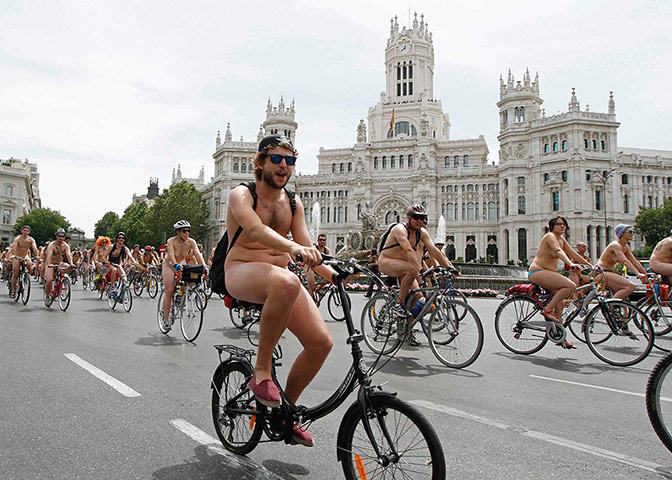
I would imagine that the bicycle seat, which is highly uncomfortable even when appropriately attired, gets even more uncomfortable when unclothed. Different strokes for different folks, eh!
Meanwhile, Spain, where the nude bicyclists featured here were photographed, is being bailed out with gazillion dollars. Not that the nude bicyclists are the world's problems ... but, ...
I would imagine that the bicycle seat, which is highly uncomfortable even when appropriately attired, gets even more uncomfortable when unclothed. Different strokes for different folks, eh!
Meanwhile, Spain, where the nude bicyclists featured here were photographed, is being bailed out with gazillion dollars. Not that the nude bicyclists are the world's problems ... but, ...
Sunday, June 10, 2012
The imperial presidencies of Obama and Bush! Father knows worst!
As if the thought of going to the dentist office the first thing on a Monday morning isn't enough for me to get into a fetal position under the sheets, I have to figure out how to calm myself down after reading the following three commentaries on the Nobel Peace Prize recipient, President Obama, and his zealous use of drones to kill.
Slate has a detailed interactive map:

Slate has a detailed interactive map:
From the other side of the planet, this op-ed in The Hindu comments on the "imperial presidency":Since Obama took office, media outlets have reported more than 300 drone strikes in Pakistan targeting al-Qaeda or the Taliban, outnumbering the Bush administration’s drone strikes five to one. Supporters say the strikes are an efficient way to kill militants, while critics say the strikes kill too many civilians, spur terrorist recruitment, shirk judicial oversight, and represent an abuse of presidential power. This map, which is based on data from the New America Foundation, displays the location and kill count of reported drone strikes since 2004 and shows that Obama has greatly extended the drone program.

Having criticised the Bush administration for the secret practices of surveillance, interrogation and detention, Mr. Obama has dramatically expanded the practice of secretly putting people on kill lists. Drone warfare greatly stretches the boundaries of the imperial presidency. It has expanded presidential power enormously relative to Congressional checks and judicial oversight.It also raises the question: is the extrajudicial of killing foreigners (and Americans living abroad) following a bureaucratic determination, as Obama is doing, more or less frightening and morally condemnable than capturing them and sending them to detention and torture in Guantánamo Bay, as Mr. Bush did and Mr. Obama condemned? As with other administrations in most countries around the world, the government forgets or chooses to ignore that the expanded, unchecked power will be available to subsequent administrations.
Finally, from Glenn Greenwald:
the American media has been repeatedly and willingly coopted in the Obama administration’s propagandistic abuse of its secrecy powers, with a focus on the recent high-profile, Obama-flattering national security scoops from The New York Times.Oh well; if only I had paid attention to how ignorance is bliss!

American students avoid science and math because of ... postmodernism?
When I was a kid, adults encouraged us kids to eat vegetables that might not typically appeal to us by saying things like, "eat this so that you will do better in science." Or sometimes, it was "eat this so that you will get better at maths." I am sure quite a few kids held their noses and gobbled up vegetables they hated only to make sure that they did better in science and math. (Not me: I loved them all--vegetables and science and math!)
I wonder if parents and grandmas say that anymore to India's children. Perhaps not. If so, that will be awful, because the kids don't know what they are missing--vegetables and education!
Here in the US, the veggie food route to science and math will never work, given the typical aversion that most children have for vegetables, science, math. Well, I take it back; it appears that the young might even hold their noses and swallow the veggies if they can entirely avoid science and math. Again, they don't know what they are missing--vegetables and education! (Except this veggie, of course!)
My initial experiences of Americana were as a graduate student. Walking or biking across campus from the social sciences area towards math, science, and engineering, well, was often punctuated by an observation about the rapidly decreasing female population. The few female students in those areas were almost always graduate students from India or China or Europe. American-born undergraduate science or math majors, male or female, were a minority on campus.
American students avoiding math and science seems to have only gotten worse. American-born science and math students are practically an endangered species in higher education. And that is terribly unfortunate.
The higher education system, meanwhile, makes it all the more attractive for students to almost bypass science and math. While by now I ought to be used to this, I continue to be shocked every single time when I realize how easy it is for students to complete "higher education" and even graduate with a perfect 4.0 GPA, but with barely a couple of classes in science. And even those science classes tend to be "Mickey Mouse" classes, as one student put it.
The hyper-inflated sense of self that students gain throughout their K-12 system does not help either. The school system appears to be hell-bent on telling students how special they all are, and that they can do anything they wanted to do in life. Of course, we need to convey the idea that the world is their oyster, but shouldn't we also make sure they understand that hard work is a prime ingredient in a successful formula? But, it seems that educators systematically dismiss that often one needs to go after difficult tasks, and that life is not simply about plucking those non-existent metaphorical low hanging fruits.
Science and math are by no means any low hanging fruit. Well, accomplishment in anything, in the arts or languages or whatever, is not as easy to pluck those fruits.
I am convinced that this awful state of education is a result of the postmodernist conditions in education--though I love the postmodernist environment within which I operate. Modernism and reason have been replaced with arguments of multiple truths. While philosophically I have no problems with this, and have come to enjoy it over the years, the translation of these ideas into how we educate students means that we are in the mess that we are in now.
The multiplicity of truths, as opposed to the truth, has led us to legitimize any crazy approach to education as equally valid. Along the way, we have even empowered students to stand up and loudly proclaim their aversions towards science and math. We have then provided plenty of routes for them to "succeed" without ever having to deal with science and math. (They do geography, for instance!)
Students educated in this manner in colleges and universities across these United States then go on to become teachers in elementary, middle, and high schools, where they amplify the message that children can do whatever they want to do without ever paying homage to science and math. Science and math be damned, eh!
I still shudder recalling how an English professor told the freshman Honors students, in a course that I had put together, that it was completely ok if they were not good in science and math. Because, she was like that and she made it as an English professor. What a message to give impressionable college freshman, right?
Thus, even a small university like mine has quite an extraordinary amount of fluffy courses (like geography?) where students can excel. The number of students graduating with the various levels of "laude" honors seems to increase year after year. A casual scan of the list here indicates the highly skewed ratio of non-science to science majors when it comes to summa and magna cum laude. Seriously, how many of us will openly admit that for a typical student, earning a B in organic chemistry is way more difficult than earning an A in economic geography? I will.
What have we gained then as a society after thousands of students thus graduate magna cum laude?

I wonder if parents and grandmas say that anymore to India's children. Perhaps not. If so, that will be awful, because the kids don't know what they are missing--vegetables and education!
Here in the US, the veggie food route to science and math will never work, given the typical aversion that most children have for vegetables, science, math. Well, I take it back; it appears that the young might even hold their noses and swallow the veggies if they can entirely avoid science and math. Again, they don't know what they are missing--vegetables and education! (Except this veggie, of course!)
My initial experiences of Americana were as a graduate student. Walking or biking across campus from the social sciences area towards math, science, and engineering, well, was often punctuated by an observation about the rapidly decreasing female population. The few female students in those areas were almost always graduate students from India or China or Europe. American-born undergraduate science or math majors, male or female, were a minority on campus.
American students avoiding math and science seems to have only gotten worse. American-born science and math students are practically an endangered species in higher education. And that is terribly unfortunate.
The higher education system, meanwhile, makes it all the more attractive for students to almost bypass science and math. While by now I ought to be used to this, I continue to be shocked every single time when I realize how easy it is for students to complete "higher education" and even graduate with a perfect 4.0 GPA, but with barely a couple of classes in science. And even those science classes tend to be "Mickey Mouse" classes, as one student put it.
The hyper-inflated sense of self that students gain throughout their K-12 system does not help either. The school system appears to be hell-bent on telling students how special they all are, and that they can do anything they wanted to do in life. Of course, we need to convey the idea that the world is their oyster, but shouldn't we also make sure they understand that hard work is a prime ingredient in a successful formula? But, it seems that educators systematically dismiss that often one needs to go after difficult tasks, and that life is not simply about plucking those non-existent metaphorical low hanging fruits.
Science and math are by no means any low hanging fruit. Well, accomplishment in anything, in the arts or languages or whatever, is not as easy to pluck those fruits.
I am convinced that this awful state of education is a result of the postmodernist conditions in education--though I love the postmodernist environment within which I operate. Modernism and reason have been replaced with arguments of multiple truths. While philosophically I have no problems with this, and have come to enjoy it over the years, the translation of these ideas into how we educate students means that we are in the mess that we are in now.
The multiplicity of truths, as opposed to the truth, has led us to legitimize any crazy approach to education as equally valid. Along the way, we have even empowered students to stand up and loudly proclaim their aversions towards science and math. We have then provided plenty of routes for them to "succeed" without ever having to deal with science and math. (They do geography, for instance!)
Students educated in this manner in colleges and universities across these United States then go on to become teachers in elementary, middle, and high schools, where they amplify the message that children can do whatever they want to do without ever paying homage to science and math. Science and math be damned, eh!
I still shudder recalling how an English professor told the freshman Honors students, in a course that I had put together, that it was completely ok if they were not good in science and math. Because, she was like that and she made it as an English professor. What a message to give impressionable college freshman, right?
Thus, even a small university like mine has quite an extraordinary amount of fluffy courses (like geography?) where students can excel. The number of students graduating with the various levels of "laude" honors seems to increase year after year. A casual scan of the list here indicates the highly skewed ratio of non-science to science majors when it comes to summa and magna cum laude. Seriously, how many of us will openly admit that for a typical student, earning a B in organic chemistry is way more difficult than earning an A in economic geography? I will.
What have we gained then as a society after thousands of students thus graduate magna cum laude?
Saturday, June 09, 2012
Wah! Wah! Girls
Don't hold your breath, grandpa, this post ain't about girls, girls, girls :)
It is about a musical that is playing in London, which the Guardian doesn't care for much:
And the review ends with this line:
The music that the above video begins with is one of my favorite fun-songs-videos--the colors, the tune, the beat, ... I haven't watched this movie. Early on during my graduate schooling days, one of the visits back to India, this song was the rage then and seemed like I could never go five minutes before somebody somewhere cranked it all over again... here is that movie original:
Anyway, hey, grandpa, that Elvis movie that you had in mind, featured this awesome piece:
It is crazy to think that "Return to Sender" was in 1962, and the Beatles appeared in the Ed Sullivan Show only slightly more than a year later. Yet, the two come across as from two different generations!
With the girls theme, here is one of my favorite Beatles number:
Well, I might as well wrap up this post by looping back to India, with the Beatles; happy listening!
It is about a musical that is playing in London, which the Guardian doesn't care for much:
You could translate "wah! wah!" – how some Indian audiences express their pleasure at a performance – as "bravo!". Sadly, there's far more woe than wah in this feeble attempt to create a British Bollywood musical, which seems to owe more to a dull episode of EastEnders than it does to rich traditions elsewhere. The costumes often have a bright, jewelled swagger, but the rest of Keith Khan's designs, including what appears to be a papier-mache red London bus, look cheap and tacky, as if the budget had unexpectedly run out.Ouch!
And the review ends with this line:
there is not a single song you'd come out singing.Must have sucked big time, eh!
The music that the above video begins with is one of my favorite fun-songs-videos--the colors, the tune, the beat, ... I haven't watched this movie. Early on during my graduate schooling days, one of the visits back to India, this song was the rage then and seemed like I could never go five minutes before somebody somewhere cranked it all over again... here is that movie original:
Anyway, hey, grandpa, that Elvis movie that you had in mind, featured this awesome piece:
It is crazy to think that "Return to Sender" was in 1962, and the Beatles appeared in the Ed Sullivan Show only slightly more than a year later. Yet, the two come across as from two different generations!
With the girls theme, here is one of my favorite Beatles number:
Well, I might as well wrap up this post by looping back to India, with the Beatles; happy listening!
Friday, June 08, 2012
Gosling and me. It happened, again!
When I blogged this a month ago, I noted how it didn't occur to me then to take a photo.
Well, sometimes, I learn from experience.
So, hey, I shot the birds :)

You happy now? :)
Well, sometimes, I learn from experience.
So, hey, I shot the birds :)

You happy now? :)
No money. Will travel. Donations accepted!
It has been a while since "B" swung by my office. It is always a delight to chat with this student, who is rapidly transitioning to serious adulthood. As we talked, she asked, "this summer, are you going to Ecuador or any other crazy place like that?"
I wish!
I so wish :(
What a wonderful experience that was! A week in an "elevated" mood, taking in sights, sounds, and smells that were so far away from my regular life. And, yet, so many seemed so familiar too. A sense of "strangely familiar" that echoed yet again, in a different way, when I later spent a hundred days in India.
Thanks to "B" here I am reminiscing about Ecuador, and thinking that bizcochos will go well with a cappuccino :(
Sadder is the realization that with so many other places in the world that I want to visit, I might never return to Ecuador. As I warn students, being infected with the travel bug simultaneously leads to pain and pleasure.

I wish!
I so wish :(
What a wonderful experience that was! A week in an "elevated" mood, taking in sights, sounds, and smells that were so far away from my regular life. And, yet, so many seemed so familiar too. A sense of "strangely familiar" that echoed yet again, in a different way, when I later spent a hundred days in India.
Thanks to "B" here I am reminiscing about Ecuador, and thinking that bizcochos will go well with a cappuccino :(
Sadder is the realization that with so many other places in the world that I want to visit, I might never return to Ecuador. As I warn students, being infected with the travel bug simultaneously leads to pain and pleasure.
Thursday, June 07, 2012
Talking trash. No, it is not about university faculty :)
This map from the Economist is three days late as far as I am concerned; I could have made wonderful use of it in my intro class on Monday!

In the US, we are one heck of a consuming population that generates so much trash!
Meanwhile, this report (ht) argues that we are getting ever so close to an ecological tipping point:
In the US, we are one heck of a consuming population that generates so much trash!
Meanwhile, this report (ht) argues that we are getting ever so close to an ecological tipping point:
In a paper published in today's edition of the journal Nature, 22 researchers from a variety of fields liken the human impact to global events eons ago that caused mass extinctions, permanently altering Earth's biosphere.Party like it is 2025!
"Humans are now forcing another such transition, with the potential to transform Earth rapidly and irreversibly into a state unknown in human experience," wrote the authors, who are from the U.S., Europe, Canada and South America.
If current trends continue — exploding global population, rapidly rising temperatures and the clearance of more than 40% of Earth's surface for urban development or agriculture — the planet could reach a tipping point, they say.
"The net effects of what we're causing could actually be equivalent to an asteroid striking the Earth in a worst-case scenario," the paper's lead author, Anthony Barnosky, a professor of integrative biology at UC Berkeley, said in an interview. "I don't want to sound like Armageddon. I think the point to be made is that if we just ignore all the warning signs of how we're changing the Earth, the scenario of losses of biodiversity — 75% or more — is not an outlandish scenario at all."
Global population just passed 7 billion and is expected to reach 9.3 billion or more by 2050. "By the year 2070, we'll live in a hotter world than it's been since humans evolved as a species," Barnosky said.
Wednesday, June 06, 2012
A "sweet" cupcake ending to the term :)
Every term turns out to be unique it is own way. The neatest aspect to this term, which is nearing the end? Students brought munchies to class. ("J" brought me, not to the class, home-baked banana-nut bread.)
"R" brought donuts for us. Not once, but twice!
"A" brought a box of chocolate chip cookies.
But, the grandest of all was home-baked cupcakes that "K" treated us to, and they were awesome.
Cupcakes with fruit preserve filling, and decorative icing on the top. At the end of the class, when "K" was gathering her stuff, she noticed that there was one left--because one student didn't show up today. His ill-luck that he missed out on this experience.
"K" asked me if I wanted it. I told her that if she didn't want it, I would gladly enjoy a second one. And that became mine!
I remembered to take a photo of the cupcake after I reached my office. I wish I had patiently set up the background and taken a good photograph; but, I am glad I have at least this much. Eat your heart out :)

A wonderful term, at least for this reason, and a contrast to the bitter experience from a few years ago, when an ill-tempered student took the advice of a moronic faculty colleague.
Thanks to "J," "K," "R," and "A."
Oh, yeah, I took a bunch of orange-cranberry scones to one class. No, I didn't bake them--I bought them at my favorite store.
Maybe next year I will get back to baking cookies and brownies for my classes?
"R" brought donuts for us. Not once, but twice!
"A" brought a box of chocolate chip cookies.
But, the grandest of all was home-baked cupcakes that "K" treated us to, and they were awesome.
Cupcakes with fruit preserve filling, and decorative icing on the top. At the end of the class, when "K" was gathering her stuff, she noticed that there was one left--because one student didn't show up today. His ill-luck that he missed out on this experience.
"K" asked me if I wanted it. I told her that if she didn't want it, I would gladly enjoy a second one. And that became mine!
I remembered to take a photo of the cupcake after I reached my office. I wish I had patiently set up the background and taken a good photograph; but, I am glad I have at least this much. Eat your heart out :)

A wonderful term, at least for this reason, and a contrast to the bitter experience from a few years ago, when an ill-tempered student took the advice of a moronic faculty colleague.
Thanks to "J," "K," "R," and "A."
Oh, yeah, I took a bunch of orange-cranberry scones to one class. No, I didn't bake them--I bought them at my favorite store.
Maybe next year I will get back to baking cookies and brownies for my classes?
Ray Bradbury dies at 91. His writings will live on--unless we burn 'em!
Heard on NPR that Ray Bradbury died.
In his memory, and as thanks to him, am re-posting the following old one from my own blog:
 ht
ht
Based on Ray Bradbury's warning , I imagine that books engage in self-immolation when Jersey Shore is on!
In his memory, and as thanks to him, am re-posting the following old one from my own blog:
Based on Ray Bradbury's warning
, I imagine that books engage in self-immolation when Jersey Shore is on!Hey graduating high school seniors: You sure you want college, now?
"S," who is working on her thesis on whether it will be to the students' advantage if they are counseled about a gap-year between high school and college, or even when in college, might be happy to read this advice from across the continent (if she does read my blog, eh!):
[Don't] rush into college right after high school if, like me, you would benefit from an extra year of growing up. People are starting their careers later than ever, and in the long run it’s better to be a 25-year-old with a degree in something you’re passionate about than a 22-year-old with an aching feeling you just wasted four years. And don’t pick a school for name recognition or because you like the way it will look on your resume. Why anyone would choose a prohibitively expensive school like Harvard or Penn or Dartmouth (minus a scholarship of course) for their undergraduate degree when there are plenty of quality universities offering a solid education at a reasonable price is beyond me. (At $180 a credit, Community College of Philadelphia has a first-year honors program that rivals those at many four-year colleges.) Save the big names for graduate school when they’ll pack more punch.Yep!
Finally, consider spending your first year in a comprehensive liberal arts program.
Tuesday, June 05, 2012
If only the jobs news was enjoyable as news about Facebook shares!
If only the news was always as good as this one: Facebook shares are trading at $25.79 as I type this! Couldn't make my schadenfreude better :) I am enjoying this because, well, why the heck not! Even if commentaries like this point out that the schadenfreude is bizarre!
In contrast to the fun with news about FB, I am not thrilled with the latest jobs report that has shocked the markets into a tumble as investors worried about the economic outlook. Oil is down to $82, which was hard to imagine three months ago.
This is not good news for any incumbent President. On the other hand, it appears that the incumbent chief executive of the state of Wisconsin might survive the recall effort, which will add to the President's political woes as the summer campaign begins to heat up.
Take it away, Jon Stewart, and let us watch that wonderful game-show called "Polish that turd" :)
In contrast to the fun with news about FB, I am not thrilled with the latest jobs report that has shocked the markets into a tumble as investors worried about the economic outlook. Oil is down to $82, which was hard to imagine three months ago.
This is not good news for any incumbent President. On the other hand, it appears that the incumbent chief executive of the state of Wisconsin might survive the recall effort, which will add to the President's political woes as the summer campaign begins to heat up.
Take it away, Jon Stewart, and let us watch that wonderful game-show called "Polish that turd" :)
On the death of a 19-year old :(
"I have a sad news for you" my mother said.
I knew it had to be about somebody's unfortunate and premature death. I prepared myself for the awful news that was coming.
"You remember "M"'s grandson--the son of "S"?" she asked, not as a question but more as a preface. By then I knew what was coming.
"He died a few days ago."
He was a kid, who was in the final year of his teenage phase of life. A freshman at Stanford. The cancer that he had battled against, the battle that I thought he had won a couple of years ago, had come back in a nasty manner.
After the phone call, I remembered "S" telling me a couple of years ago how this kid had taken on a couple of initiatives to spread cancer awareness and to raise funds to wipe out the dreaded "C" word. I was confident that the newspaper I grew up with would have something about him.
The paper does have a lengthy piece on the kid's demise.
Akash initiated and organized the Terry Fox runs in Chennai, and raised money for cancer research and treatment.
I knew it had to be about somebody's unfortunate and premature death. I prepared myself for the awful news that was coming.
"You remember "M"'s grandson--the son of "S"?" she asked, not as a question but more as a preface. By then I knew what was coming.
"He died a few days ago."
He was a kid, who was in the final year of his teenage phase of life. A freshman at Stanford. The cancer that he had battled against, the battle that I thought he had won a couple of years ago, had come back in a nasty manner.
After the phone call, I remembered "S" telling me a couple of years ago how this kid had taken on a couple of initiatives to spread cancer awareness and to raise funds to wipe out the dreaded "C" word. I was confident that the newspaper I grew up with would have something about him.
The paper does have a lengthy piece on the kid's demise.
Akash Dube, a symbol of courage and resolve for so many cancer patients across the country, succumbed to the very disease earlier this month. A freshman at Stanford, this 19-year-old spent the last few months in the hospital, battling against the disease and undergoing multiple rounds of intensive chemotherapy19! I mean, nineteen!
Akash initiated and organized the Terry Fox runs in Chennai, and raised money for cancer research and treatment.
What do you tell a mother whose son died at 19? What do you tell a 83-year old whose grandson passed away? Life is simply cruel, sometimes.Akash Dube wanted to wipe out cancer. He wanted a world where no one would know of this six-letter fiend, a disease whose grip seems to only be tightening around us with each passing day. Akash envisioned a world where cancer is spoken of in the same breath as the bubonic plague and tuberculosis; as epidemics that ruined thousands of lives in the past but also as diseases that man no longer needs to be afraid of....Akash Dube was a teenager, just like you and me. Yet, he fought for what he truly believed in and worked towards the greater good. He had a vision, a mission and a road map. Akash Dube taught us that no hurdle is too much to cross, no goal is too big to aspire towards and there is no such thing as overambitious.
Monday, June 04, 2012
If arugula was the measure of elitism, how about "salade niçoise"
Remember all that brouhaha after the then candidate, Senator Obama, remarked at a campaign event in Iowa:
Even though I logically understand this, emotionally I cannot but think that country club Republicans will lead a very different life from mine, but that I will be able to relate to liberal luminaries ... Of course, my logic tells me that affluent liberals might not differ all that much from affluent Republicans. Thus, a tension between the logical and emotional understanding of the world, right?
A recent column in the Financial Times further illustrates the point. Martin Wolf, of the FT, writes about his conversation with Paul "the conscience of a liberal" Krugman, in which he notes:
Ahem, that lunch was not up the gourmet lunch standards? Wow!
BTW, I had to look up "salade niçoise" and "foie gras terrine" ... now I know, but they don't appeal to me :)

“Anybody gone into Whole Foods lately and see what they charge for arugula?” the senator said. “I mean, they’re charging a lot of money for this stuff.”Of course, during the campaign season, candidates have to go figure out a way to exorcise the Coriolanus curse; it is a tradition in democracies. Especially here in the US.
Even though I logically understand this, emotionally I cannot but think that country club Republicans will lead a very different life from mine, but that I will be able to relate to liberal luminaries ... Of course, my logic tells me that affluent liberals might not differ all that much from affluent Republicans. Thus, a tension between the logical and emotional understanding of the world, right?
A recent column in the Financial Times further illustrates the point. Martin Wolf, of the FT, writes about his conversation with Paul "the conscience of a liberal" Krugman, in which he notes:
At this point we order: salade niçoise for Krugman; foie gras terrine for me; and a bottle of sparkling water. This is definitely not going to be up to the gourmet standards of some lunches with the FT.I have always enjoyed reading Paul Krugman and Martin Wolf. (Turns out that for whatever reason this old post on Krugman was quite popular last week!) But, to realize through this simple comment that the world in which they live is so far removed from mine is quite startling, I suppose.
Ahem, that lunch was not up the gourmet lunch standards? Wow!
BTW, I had to look up "salade niçoise" and "foie gras terrine" ... now I know, but they don't appeal to me :)
Sunday, June 03, 2012
An Indian Tocqueville comments on democracy in America
Alexis de Tocqueville paved a grand path for any "outsider" wishing to talk about American issues. Every once in a while, I am reminded of Tocqueville, and I even authored a newspaper column referencing him.
With the US increasingly influencing global happenings over the nearly two centuries since Tocqueville's visit, we come across plenty of commentaries about democracy in America, which makes my intellectual and personal life that much more exciting.
One of those observers of the American scene is Ramesh, who was two years my senior back in the wonderful township in India, where I had some fabulous formative experiences. Ramesh, who blogs on business-related issues, after a rich management career, has the following observations, looking at America from his vantage point in India.
I am guessing Ramesh is a closeted libertarian-Democrat, unlike me who is out in the open about it :)
With the US increasingly influencing global happenings over the nearly two centuries since Tocqueville's visit, we come across plenty of commentaries about democracy in America, which makes my intellectual and personal life that much more exciting.
One of those observers of the American scene is Ramesh, who was two years my senior back in the wonderful township in India, where I had some fabulous formative experiences. Ramesh, who blogs on business-related issues, after a rich management career, has the following observations, looking at America from his vantage point in India.
I am not an American. I don’t even live in America. Naturally, I don’t get to vote in the elections there. However, I have a lot of admiration for the country and have a passing knowledge of the issues that seem to be important to the electorate, so I wondered how I would vote, if I indeed had that right.
Can somebody tell me how to vote please !
- I am a staunch believer in the virtues of capitalism and that free markets are the only road to prosperity. That makes me deep red.
- I am completely pro choice (on abortion – a clarification unnecessary to Americans who seem to believe that is the only choice available to mankind !). That makes me deep blue.
- I have nothing against contraceptive pills, but fail to see why somebody else (read insurance companies) should pay for it. You want to have a ball; sure go ahead, but please pay for it. Rush Limbaugh (or was it Glenn Beck) hugs me.
- I believe Americans are nuts to be running the sort of deficit they are running and doing precious little about it except bickering. That makes me a card carrying member of the Tea Party.
- Tax breaks for long term capital gains, for America, is not justified either in economics or in politics. It is purely the rich lobby that is blocking this from changing. So, that makes me a socialist.
- Spending on Medicare, Medicaid and Social Security has gone way overboard and is simply unsustainable. This has got to be cut. I must be welcomed to Fox News.
- The US spends more on defense than the next 10 countries on the top spenders list combined. That is downright crazy. I will be given a free pass to MSNBC.
- I can never understand the fascination with guns. Does any civilised society accept people carrying machine guns around? The Second Amendment was passed in 1791, for God’s Sake when the place was lawless. Are Americans dumb enough to continue to want it in this day and age? Michael Moore makes a film on me.
- Doesn’t America realise that its legal system has gone completely overboard? Tort reform is a must and only somebody with the brain size of a pea will be against it. Nancy Pelosi borrows a gun from Paul Ryan and shoots me.
- To any human not breathing American air, it’s obvious that the health care system is completely broken and that the Patient Protection and Affordable Care Act is not ideal, but the best possible deal under the circumstances. Mitt Romney picks a handgun from his collection and obliterates me, although he hugged me in 2006.
- Corporations are not evil, you pompous Senators. They do far more good than you do – even oil companies. Without them you lot will be driving horse drawn buggies like the Amish. Harry Reid knocks me out.
- Corporations are not people, you silly old men in funny dress. Only a nitwit will allow Super PACs to be going on like this. Clarence Thomas sends me to Guantanamo.
I am guessing Ramesh is a closeted libertarian-Democrat, unlike me who is out in the open about it :)
Saturday, June 02, 2012
Remembrance of things past
Back in graduate school, when I was lot more of a bumbling idiot than what I am now, a couple of graduate students from India pitched an idea: why not perform a film song at the university's international students day (or whatever that was called.)
I had nothing to hold me back, and I said I will gladly sing along, while making sure they knew that my knowledge of Hindi was pretty basic at best.
It was a long time ago, and I have forgotten the names of people. The leader was nearing the end of her PhD days--in the sciences, was it? The name of one guy suddenly came back to me, and easily did I track him down on the web. Another girl, whatever her name--we even worked together at the university's computing services--was the sister of this guy, as I recall.
Anyway, it was a group of about eight or ten of us. And the song that our leader had us practicing quite a bit was this one:
A lovely tune, yes. I had no idea what the lyrics meant.
Later on, this friend joked that I was pronouncing a few words like how somebody with a Bengali accent might. (Interesting side note: through the years that I was there, he was working on his PhD in economics, and then I find out years later that he switched to film studies. Only in America, eh!)
Those were the days, my friend :)
Oh, the performance itself? You had to ask? We sucked. Big time!
I had nothing to hold me back, and I said I will gladly sing along, while making sure they knew that my knowledge of Hindi was pretty basic at best.
It was a long time ago, and I have forgotten the names of people. The leader was nearing the end of her PhD days--in the sciences, was it? The name of one guy suddenly came back to me, and easily did I track him down on the web. Another girl, whatever her name--we even worked together at the university's computing services--was the sister of this guy, as I recall.
Anyway, it was a group of about eight or ten of us. And the song that our leader had us practicing quite a bit was this one:
A lovely tune, yes. I had no idea what the lyrics meant.
Later on, this friend joked that I was pronouncing a few words like how somebody with a Bengali accent might. (Interesting side note: through the years that I was there, he was working on his PhD in economics, and then I find out years later that he switched to film studies. Only in America, eh!)
Those were the days, my friend :)
Oh, the performance itself? You had to ask? We sucked. Big time!
Subscribe to:
Posts (Atom)